Skip to content

Teach Electric Charges and Fields in eight steps.

For each idea: show it, ask before you tell, then say one line.

Gather paper and a pencil.

Common misconceptions & worked visual for this chapter · 15 practice questions with answers

How to teach it

Charges, forces and fields

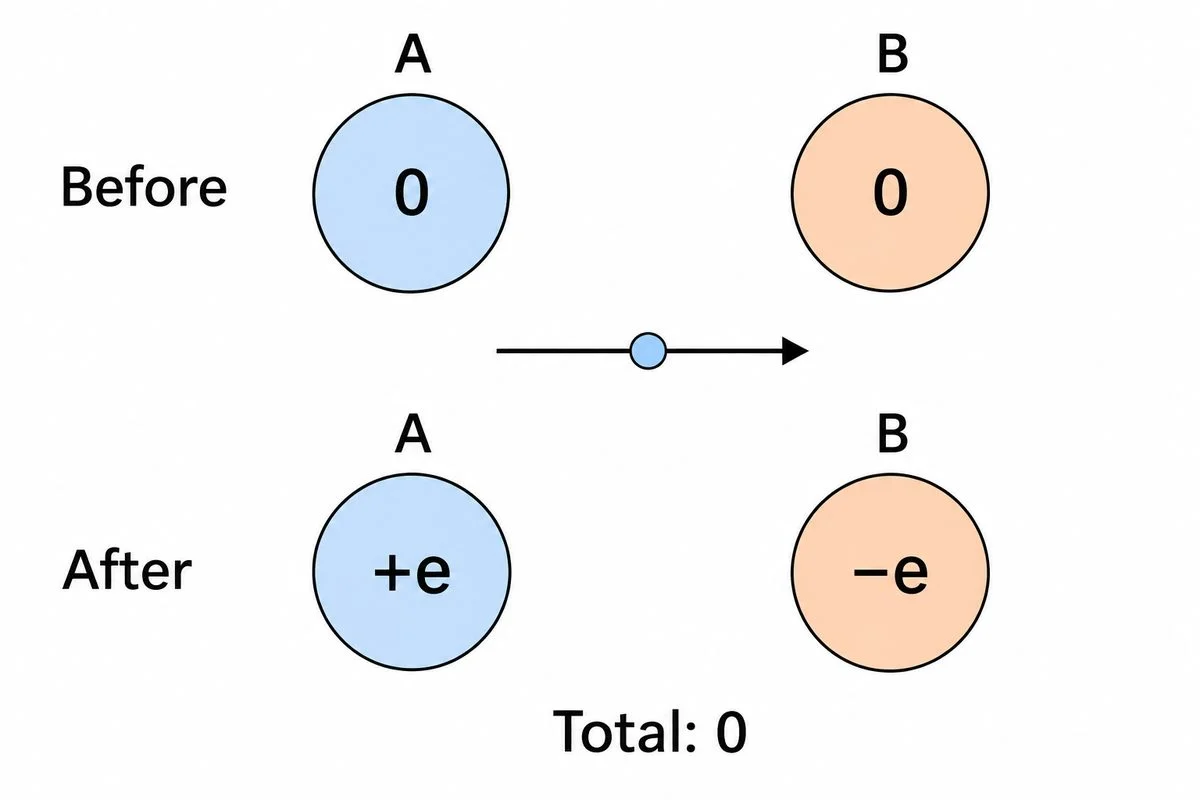
Neutral objects exchange one electron, leaving equal opposite charges and unchanged total charge.

1. Basic properties of electric charge

Electrons transfer whole charges; the combined charge stays unchanged.

Show
Follow the diagram’s electron transfer from A to B.
Ask
What charge will each object gain?
Say
A becomes positive; B becomes negative. Their total stays zero. Each electron transfers one elementary charge.
Used in
Earthing provides a conducting path for excess charge, reducing unwanted static sparks.
If your child says…“Positive charge means extra electrons.”
Ask
Which object lost negative charge?
What’s true
Gaining electrons makes an initially neutral object negative.

FL=0.90 NF_L=0.90\,\mathrm N

FR=0.225 NF_R=0.225\,\mathrm N

2. Coulomb’s law and superposition

Combine electric forces with their directions.

Show
Write these lines for three +1.0 μC charges in vacuum. Sources sit 0.10 m left and 0.20 m right of the target.
Ask
What net force acts?
Say
The opposing forces subtract, leaving 0.675 N rightward.
Used in
Electrostatic paint spraying attracts charged droplets towards a surface, reducing wasted paint.
If your child says…“I just add both force sizes.”
Ask
Does the right-hand charge help or oppose the left-hand charge’s push?
What’s true
Opposite forces subtract because they push in opposite directions.
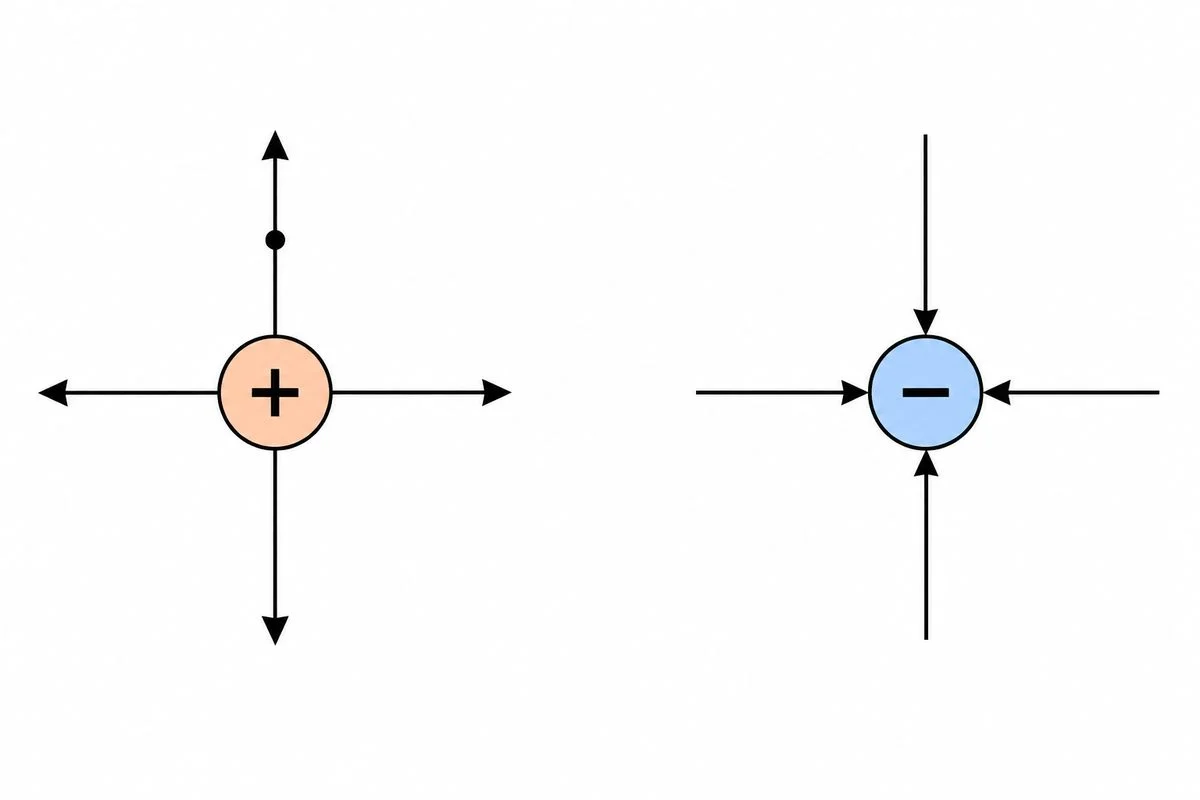
Separate positive and negative charges with outward and inward field arrows.

3. Electric field and field lines

Fields determine electric forces; field lines show the field’s direction.

Show
Look at the diagram’s outward arrows around the positive charge. Find the inward arrows around the negative charge. Locate the marked point and follow its field arrow.
Ask
Which way would a positive test charge be pushed at this point?
Say
A positive test charge feels force along the arrow.
Used in
Electric fields drive charged exhaust particles towards collection plates, helping control industrial pollution.
If your child says…“Field lines cross where two fields meet.”
Ask
If lines crossed here, which single direction would the positive charge’s force take?
What’s true
A nonzero resultant field has one direction at each point.
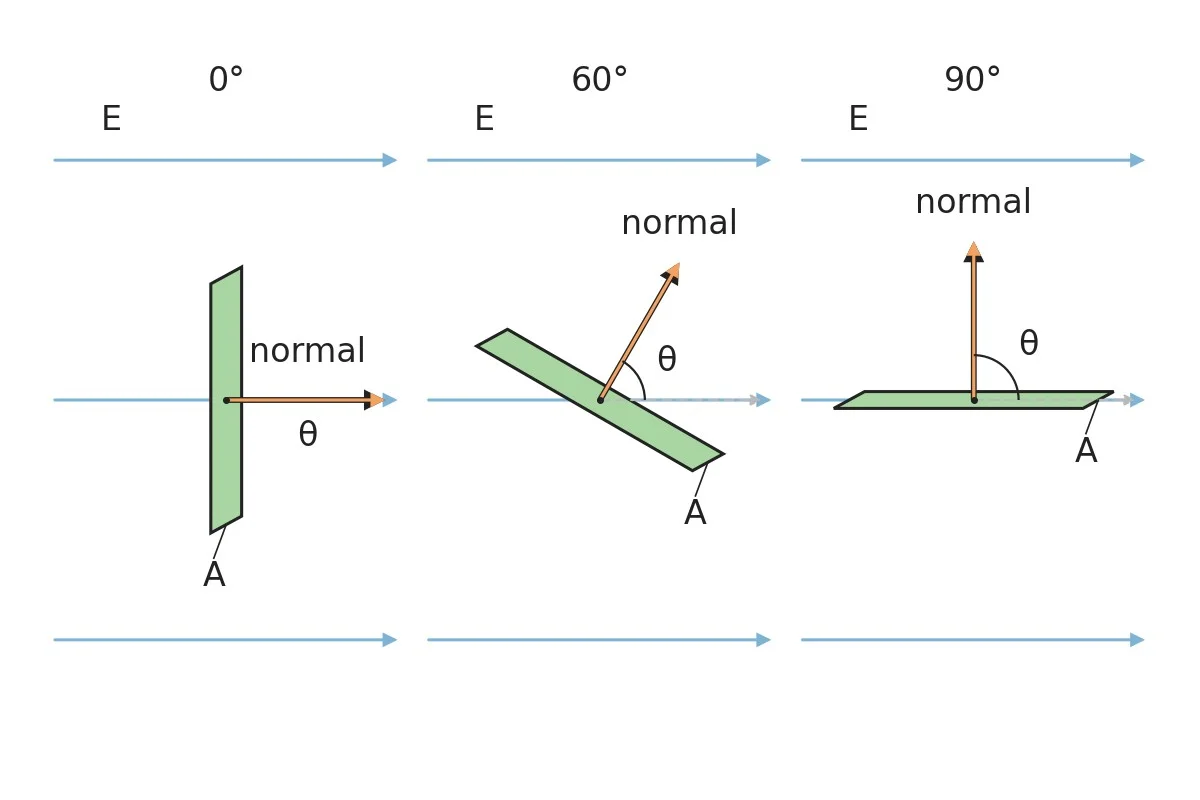
Equal surfaces turn within a uniform field, with angles measured from their normals.

4. Electric flux

Flux measures how much electric field crosses a surface.

Show
Find the diagram’s normals, perpendicular to each surface.
Ask
Which orientation gives greatest flux?
Say
Flux is greatest along the normal.
Used in
Electric flux calculations help engineers choose insulation that reduces unwanted electrical sparks.
If your child says…“I measure the angle from the surface.”
Ask
When the field runs along the surface, how much points through it?
What’s true
The flux angle is measured from the surface normal.

Electric dipoles

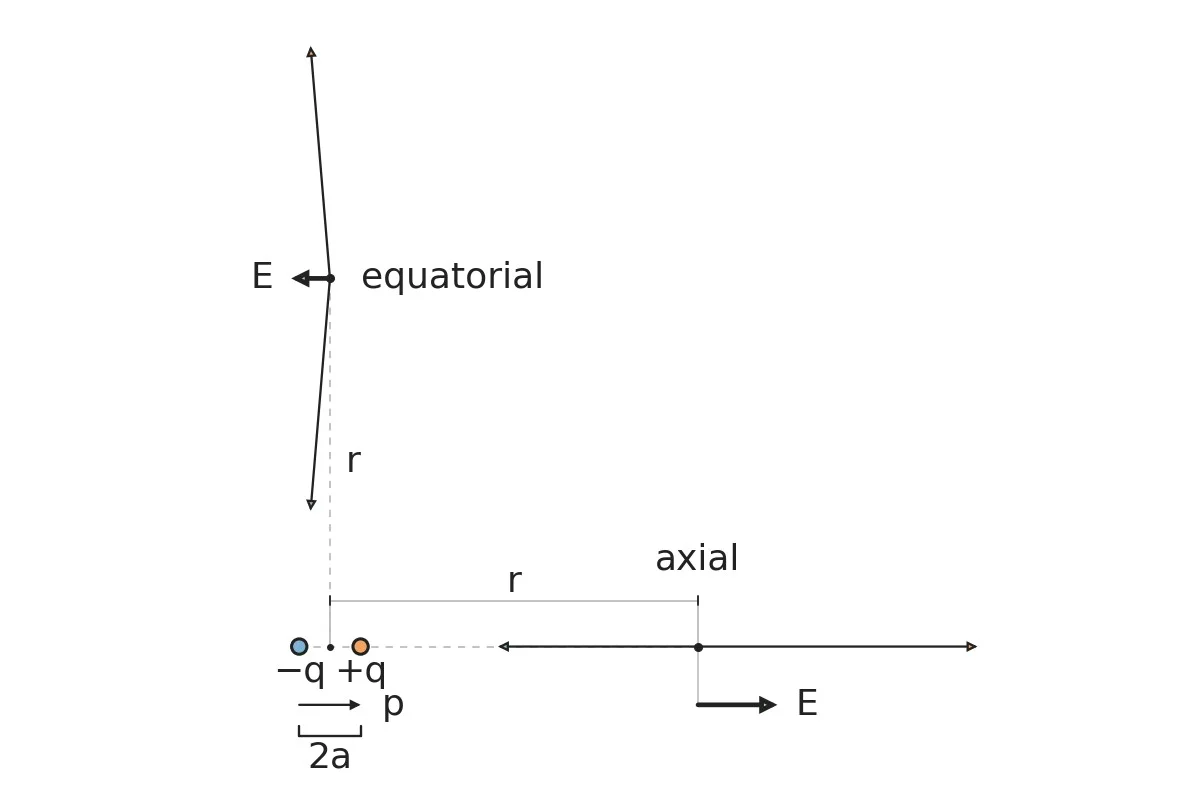
Separated opposite charges produce rightward axial and leftward equatorial resultant fields.

5. Electric dipole moment and field

Separated opposite charges produce a direction-dependent field.

Show
Compare the diagram’s axial and equatorial field arrows.
Ask
Do these fields cancel?
Say
No: separated charges contribute differently.
Used in
Water’s separated charge centres help it dissolve salts, making salty deposits easier to wash away.
If your child says…“I use half the gap for the separation.”
Ask
Where does the distance between the charges begin and end?
What’s true
Dipole moment uses the full distance between the charges.
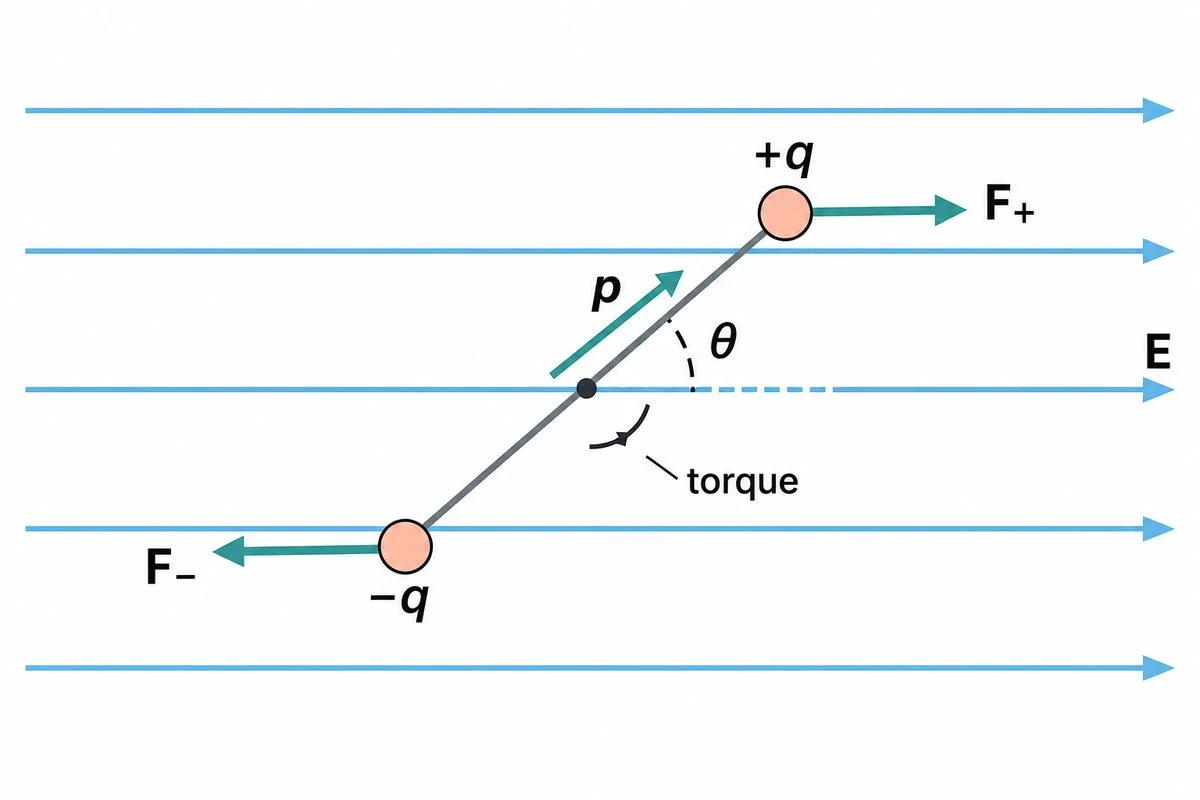
A tilted dipole has equal opposite forces producing a clockwise turning effect.

6. Dipole in a uniform electric field

Opposite forces can turn a dipole without accelerating its centre.

Show
Follow the diagram’s opposite force arrows.
Ask
Will these forces turn the dipole?
Say
Yes: equal opposite forces act at separate points. Their net force is zero.
Used in
Microwave ovens use changing electric fields to turn polar molecules, transferring energy that heats food.
If your child says…“Both forces add and push the dipole along.”
Ask
Do the opposite pushes act at the same place?
What’s true
The forces cancel overall but can produce rotation.

Charge distributions and Gauss’s law

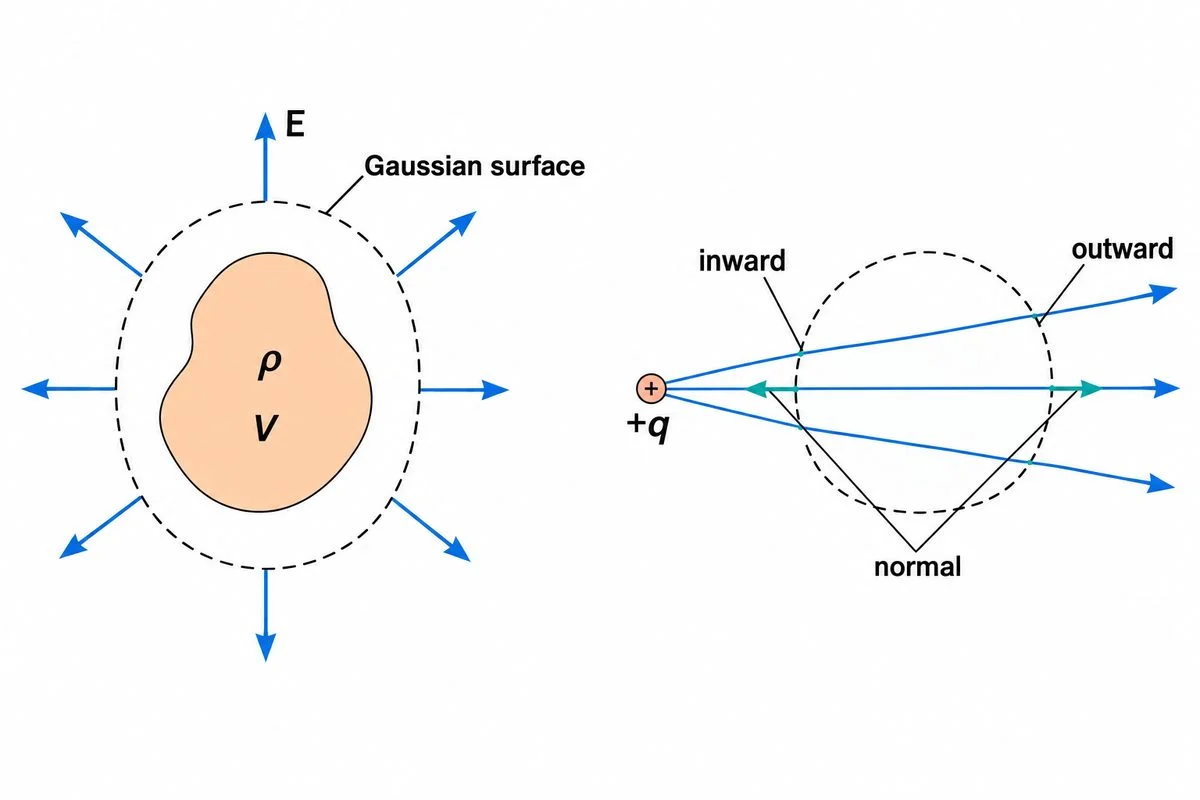
A charged solid lies inside one boundary; an external charge’s field crosses another.

7. Continuous charge distribution and Gauss’s law

Enclosed charge sets net outward flux.

Show
Trace the diagram’s field crossings around each boundary.
Ask
Which boundary has positive net flux?
Say
The left boundary has positive net flux: net flux equals enclosed charge divided by epsilon zero.
Used in
Photocopiers control surface charge to attract toner where the printed image needs it.
If your child says…“The outside charge adds to net flux.”
Ask
Where does the outside charge’s entering flux leave?
What’s true
Only enclosed net charge sets the total outward flux through a closed surface.
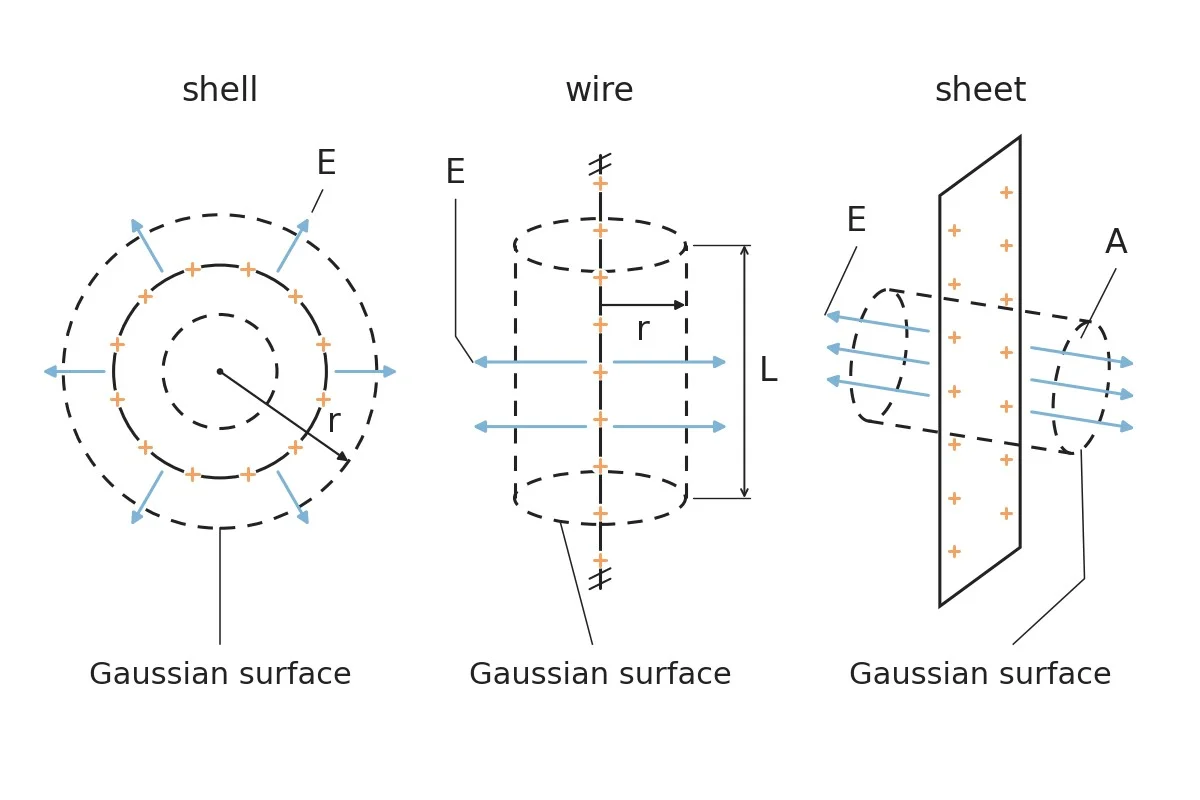
Shell, wire and sheet with Gaussian surfaces showing where electric flux crosses.

8. Applications of Gauss’s law

Charge arrangement determines how fields vary.

Show
Compare the diagram’s Gaussian surfaces around the shell, infinite wire and infinite sheet.
Ask
What happens when distance doubles?
Say
The shell’s outside field quarters, the wire’s halves, and the sheet’s stays unchanged. Their different flux-crossing areas explain this.
Used in
Oppositely charged capacitor plates strengthen the field between them, helping store electrical energy.
If your child says…“Inside the shell, I use the point-charge field.”
Ask
What charge lies inside the smaller centred sphere?
What’s true
Spherical symmetry makes the shell’s field cancel everywhere inside.

A real problem

Electric forces collect particles from industrial exhaust.

Cottrell sought to control pollution from industrial smokestacks.

He applied for an electrostatic precipitator patent in 1907.

Charged exhaust particles are attracted to collection plates carrying the opposite charge.

National Inventors Hall of FameUS EPA

A factory chimney releasing smoky exhaust into the sky.

Concept Lab · Common misconception

The tempting mistake in Electric Charges and Fields

Open standalone misconception page →

Does zero enclosed charge mean zero field everywhere on a surface?

Wrong

If the net electric flux is zero, the electric field must vanish at every point of the surface.

Why it feels right. Gauss's law gives zero for the total, so I assign zero to every contribution.

Right

Flux sums signed contributions over the surface. Fields may cross it even when the sum is zero.

Worked example

Uniform field crosses both faces. Opposite outward normals make the flux contributions cancel.
  1. Place a closed box in a uniform electric field.
  2. Field enters one face and leaves the opposite face.
  3. The contributions cancel although the field is present at both faces.

Ask your child eight quick questions.

One per step. The answer and the reason are given.

  1. A neutral object loses electrons. What sign does its charge have?

    Positive. Removing negative charge leaves an excess of positive charge.

  2. What net force acts on a charge pushed equally in opposite directions?

    Zero. Equal sizes cancel only because the force directions oppose each other.

  3. At one point, two proposed field lines cross. What makes this drawing impossible?

    Two directions at one point. A nonzero field has one direction, so its lines cannot cross.

  4. A nonzero field runs parallel to a flat surface. What is its flux?

    Zero. Only the perpendicular field component contributes.

  5. Charges ±4 nC are 2 cm apart. What is their dipole moment’s magnitude?

    8×10−118\times10^{-11} C m. Multiply one charge’s magnitude by the full separation.

  6. What motion begins when a free dipole rests perpendicular to a uniform electric field?

    Rotation. Opposite forces cancel overall but act at different ends.

  7. If only the outside charge increases, what happens to net outward flux?

    It stays unchanged. Only enclosed charge determines net outward flux, and that charge has not changed.

  8. What field exists halfway between a uniformly charged spherical shell’s centre and its surface?

    Zero. Spherical symmetry ensures cancellation throughout the empty interior.

15 more questions with answers, 2 with pictures