Skip to content

Teach Magnetism and Matter in eight steps.

For each idea: show it, ask before you tell, then say one line.

Gather paper and a pencil.

Common misconceptions & worked visual for this chapter · 15 practice questions with answers

How to teach it

Magnets and their fields

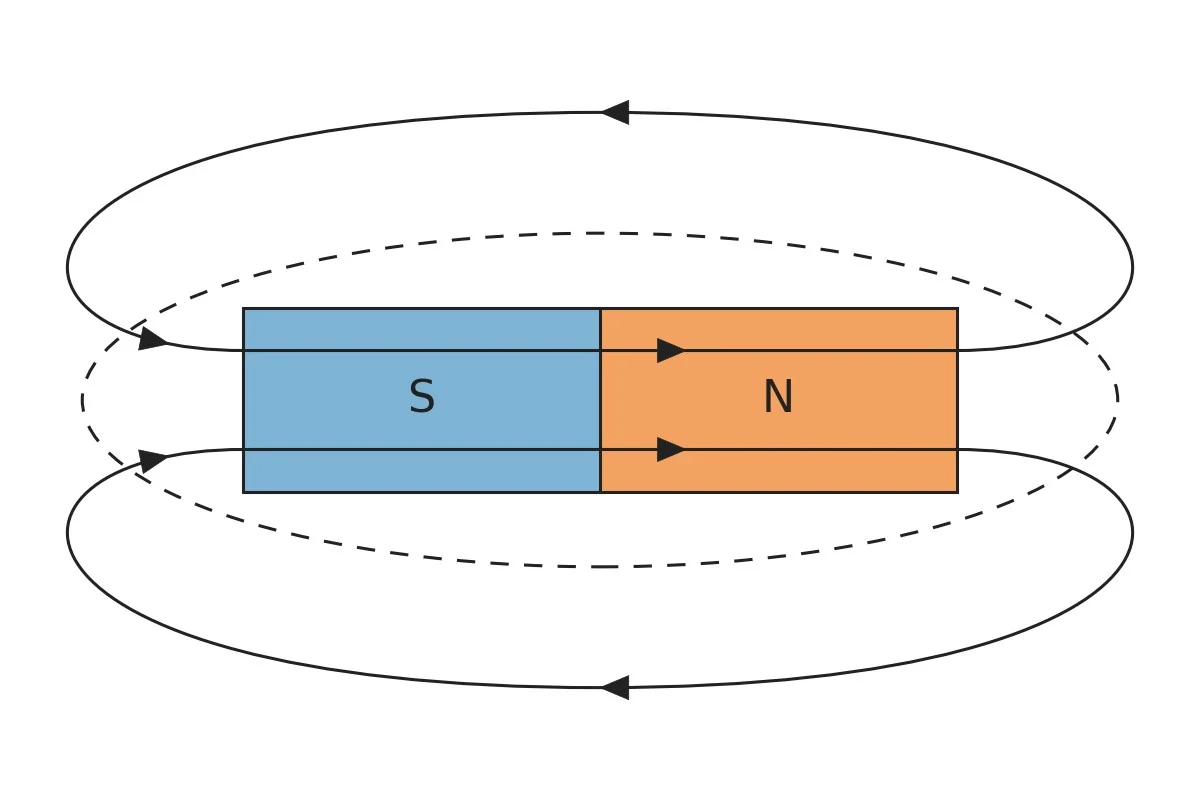
Magnetic field loops cross a dashed boundary around a bar magnet.

1. Magnetic poles and Gauss’s law

Entering and leaving magnetic flux balance.

Show
Find the diagram’s magnet and trace both field loops through it. Find where each loop enters and leaves the dashed boundary. The boundary represents a closed surface.
Ask
If we move this closed boundary, will entering and leaving magnetic flux still balance?
Say
Entering and leaving flux balance; the field remains.
Used in
A compass makes the local field’s direction visible.
If your child says…“Zero total flux means there’s no field.”
Ask
Does balancing the crossings erase either loop?
What’s true
Equal entering and leaving flux can cancel even where the field is strong.
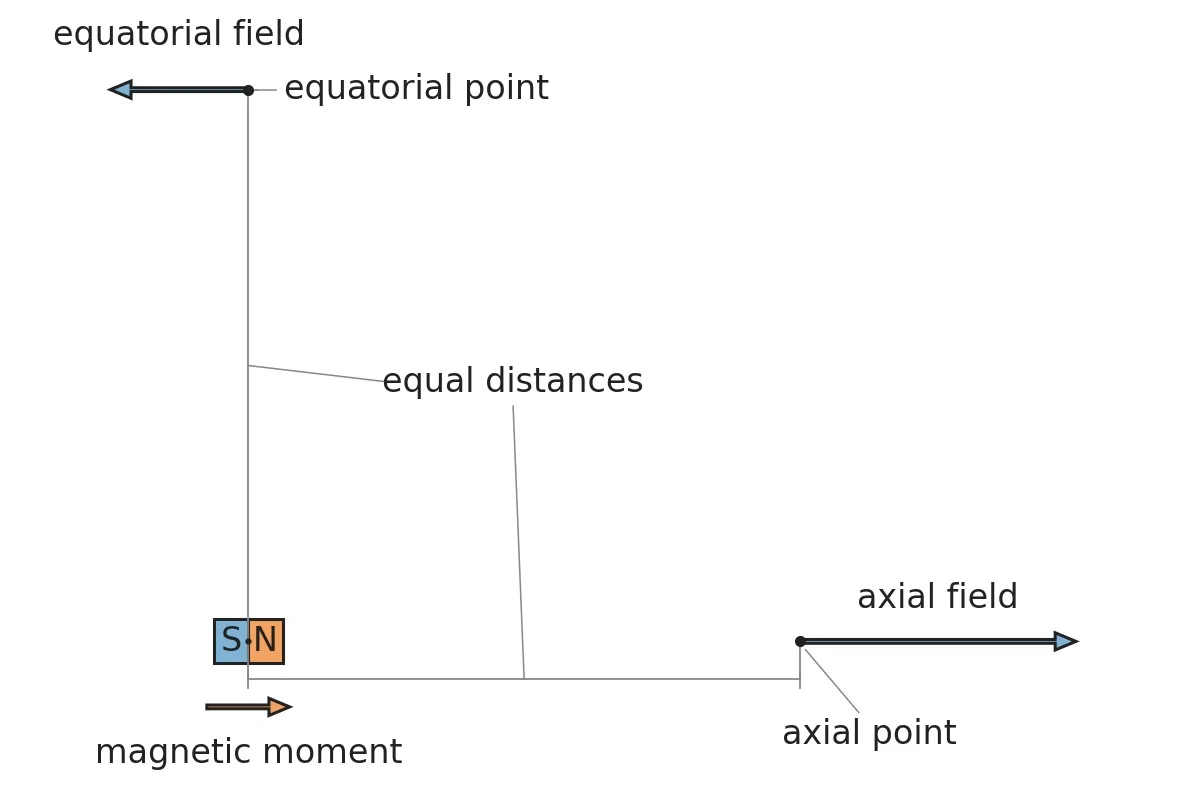
Equal-distance axial and equatorial points show opposite field directions and different strengths.

2. Axial and equatorial dipole fields

Far away, a magnet’s field weakens with distance cubed.

Show
Find the axial point beyond the magnet’s end in the diagram. Find the equally distant equatorial point above its centre.
Ask
How would the field change moving from this end position to this side position?
Say
Far away, the axial field follows the magnetic moment, from south towards north. The equally distant equatorial field points oppositely and is half as strong.
Used in
Magnetic door alarms detect the weakening field as doors open.
If your child says…“Twice as far means one-quarter of the field.”
Ask
What fraction remains when the distance factor is multiplied three times?
What’s true
A short magnet’s distant field decreases with the cube of distance.
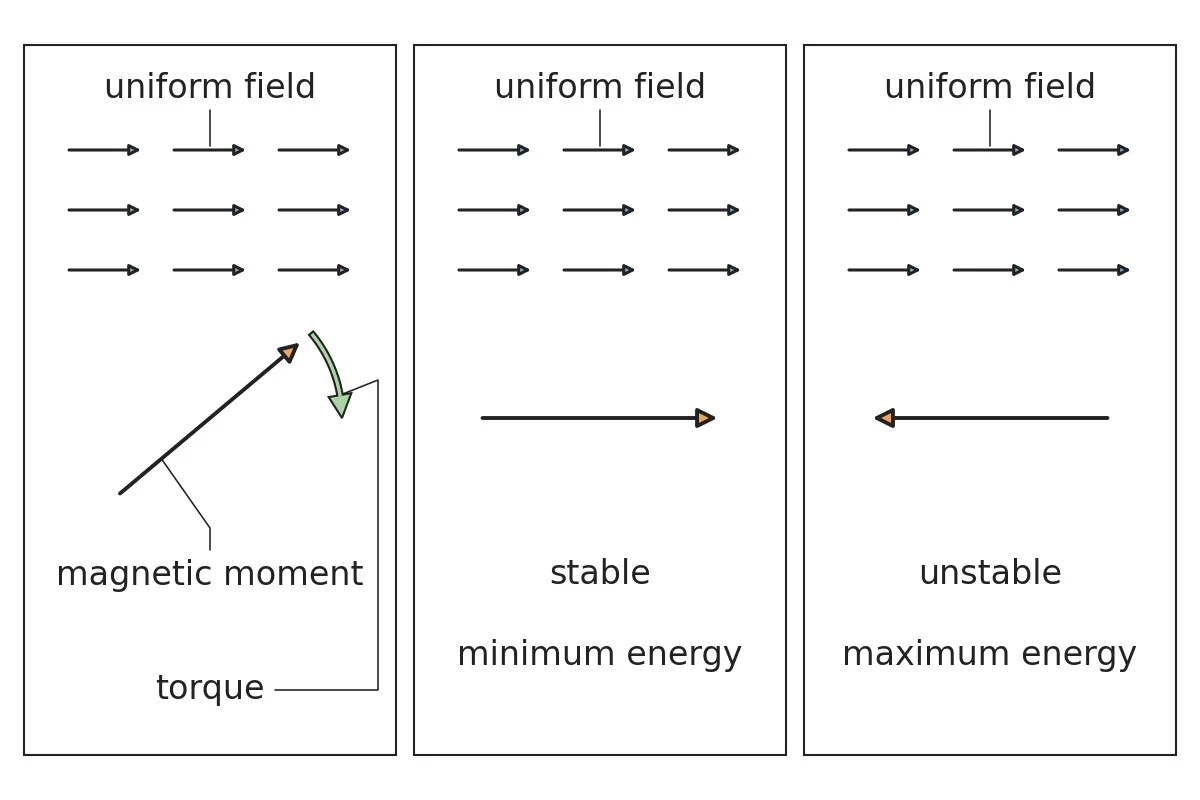
Tilted, aligned and opposed magnetic moments in the same uniform field.

3. Torque and magnetic potential energy

Fields turn magnets towards a stable, lower-energy alignment.

Show
Find the diagram’s tilted magnetic moment arrow, then the aligned and opposed arrows. Follow the curved torque arrow towards alignment.
Ask
Which position would the magnet return towards after a small turn?
Say
Alignment has minimum energy and is stable. Opposition also has zero torque, but a small turn carries it farther away.
Used in
A permanent magnet helped orient a satellite using Earth’s magnetic field.
If your child says…“Zero torque means it must be stable.”
Ask
After a nudge from opposition, does turning towards alignment lower its energy?
What’s true
Both aligned and opposed positions have zero torque, but only alignment gives stable equilibrium.

Describing a material’s response

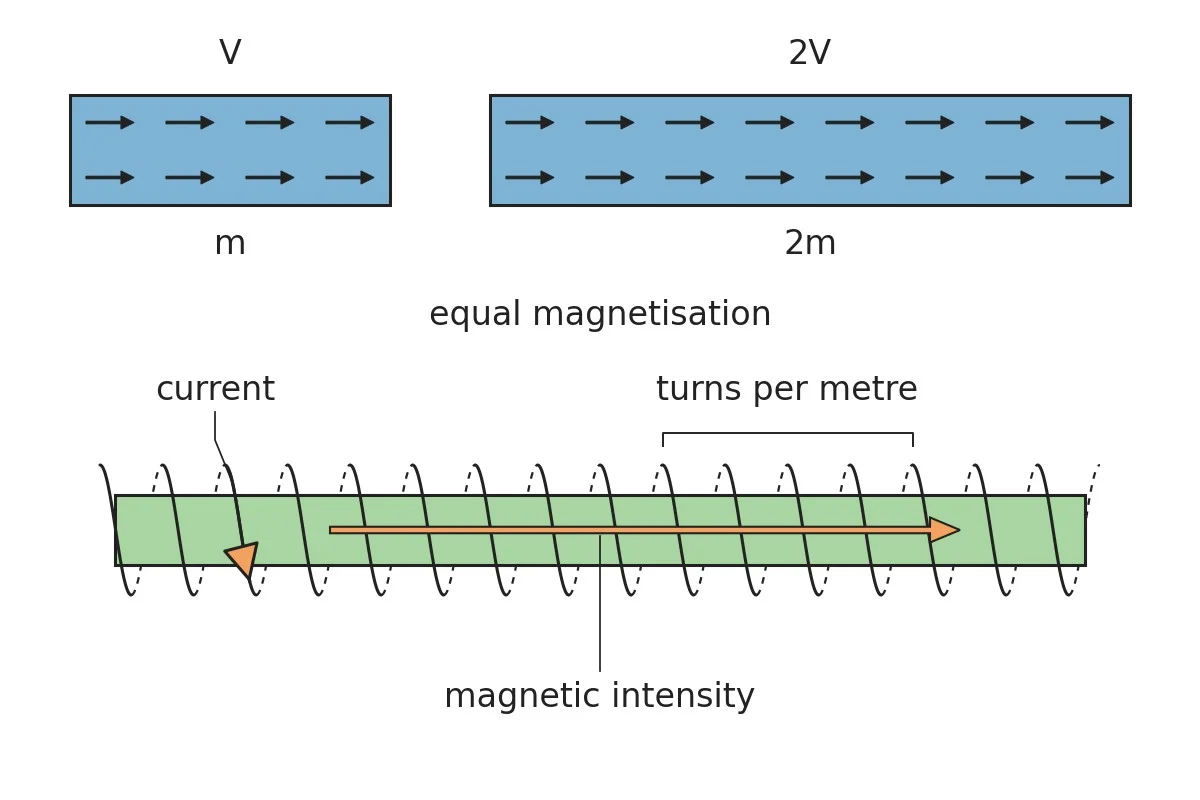
Two samples have equal magnetisation above a material-filled ideal long solenoid.

4. Magnetisation and magnetic intensity

Magnetisation is magnetic moment per volume.

Show
Compare each sample’s volume, V, and magnetic moment, m, in the diagram. Below, find the material inside the ideal long solenoid.
Ask
Would doubling this sample’s volume and moment increase its magnetisation?
Say
Magnetisation stays equal because moment and volume increase together.
Used in
An electromagnet’s iron core strengthens its field, helping cranes lift iron.
If your child says…“I multiply moment by volume to get magnetisation.”
Ask
Does doubling both moment and volume change the moment in each unit of volume?
What’s true
Magnetisation measures the net moment in each unit of volume.

μr=1+χm\mu_r=1+\chi_m

μr=1+0.02\mu_r=1+0.02

5. Susceptibility and permeability

Relative permeability compares material and vacuum fields at equal magnetic intensity.

Show
Use a linear material with susceptibility 0.02. Name μᵣ relative permeability and χₘ susceptibility. Say, “Relative permeability includes the vacuum contribution plus the material’s response.” Write the relationship after your child predicts.
Ask
What relative permeability includes both the vacuum field and this material’s extra response?
Say
Relative permeability compares the total field with the vacuum field. The vacuum contributes one, and the material adds its susceptibility, giving 1.02.
Used in
A transformer’s permeable core helps transfer energy between coils.
If your child says…“Relative permeability is just susceptibility.”
Ask
If the material adds nothing, does the vacuum field disappear?
What’s true
Relative permeability includes the vacuum contribution as well as the material’s response.

How materials respond

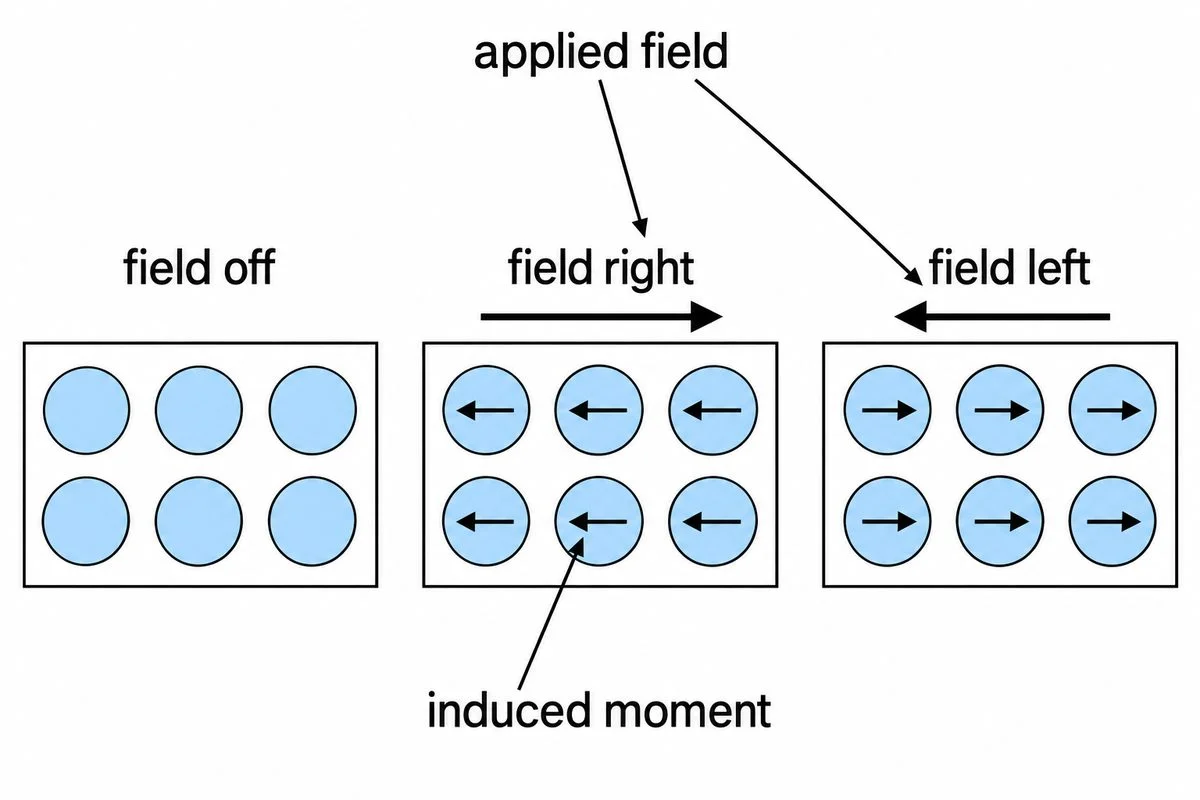
Diamagnetic moments appear only with an applied field and oppose either field direction.

6. Diamagnetism

An applied field induces an opposing magnetic moment.

Show
Find the field-off sample in the diagram. Compare the induced moments under the rightward and leftward fields.
Ask
Will this sample respond when the field switches on, despite having no permanent atomic moments?
Say
The field induces opposing moments even without permanent atomic moments. They reverse with the field and disappear when it is removed.
Used in
Superconducting shields exclude magnetic fields, protecting sensitive instruments.
If your child says…“One pole repels it, so the other attracts it.”
Ask
When the field reverses, what happens to the moment it induces?
What’s true
The induced moment changes direction with the applied field, preserving the opposing response.
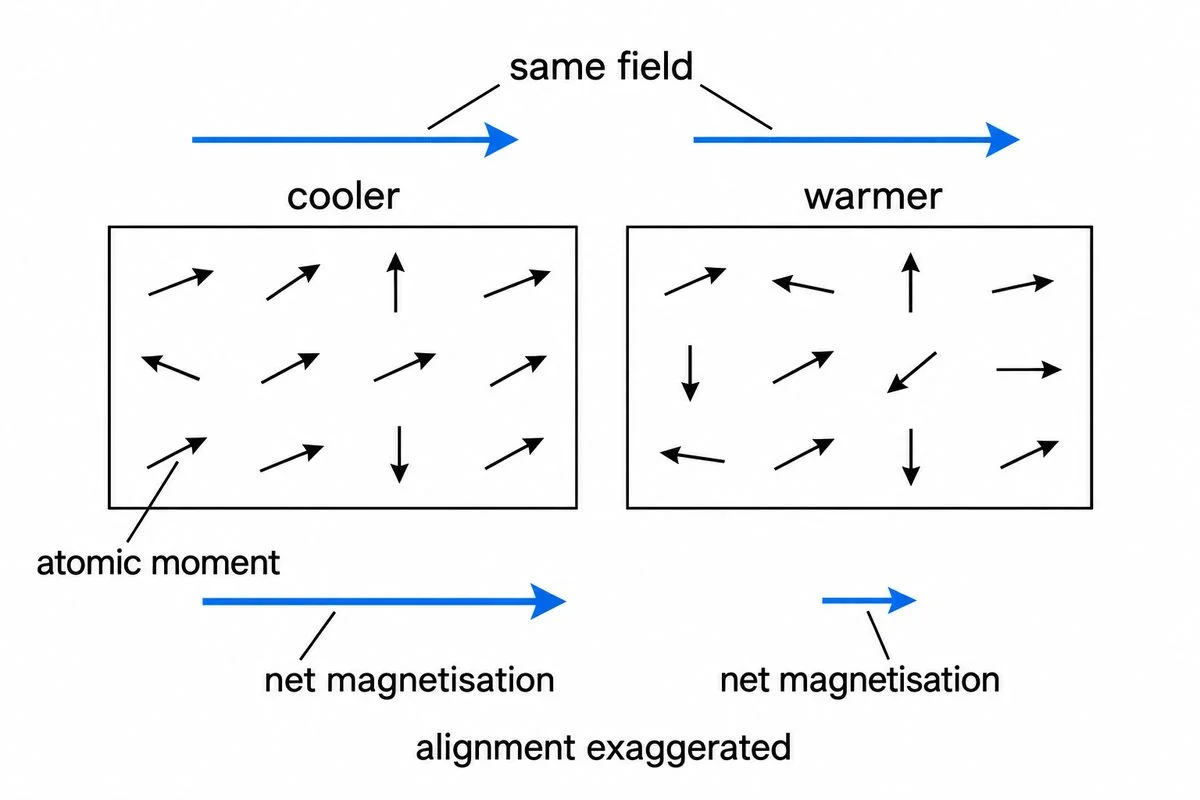
Equal atomic moments show less overall alignment in the warmer paramagnetic sample.

7. Paramagnetism and thermal disorder

Heat disrupts the partial alignment of permanent atomic moments.

Show
Compare the cooler and warmer samples in the diagram. Check their equal applied fields and equal-length atomic moment arrows.
Ask
How would warming change this sample’s magnetisation in the same field?
Say
Warming weakens magnetisation because thermal motion disrupts alignment. The atoms keep their permanent moments.
Used in
Oxygen analysers use oxygen’s weak magnetic attraction to measure its proportion in a gas.
If your child says…“Heating helps the tiny magnets line up.”
Ask
Would more random motion help the moments keep a shared direction?
What’s true
Heating weakens magnetisation while the material remains paramagnetic and unsaturated in a fixed weak field.
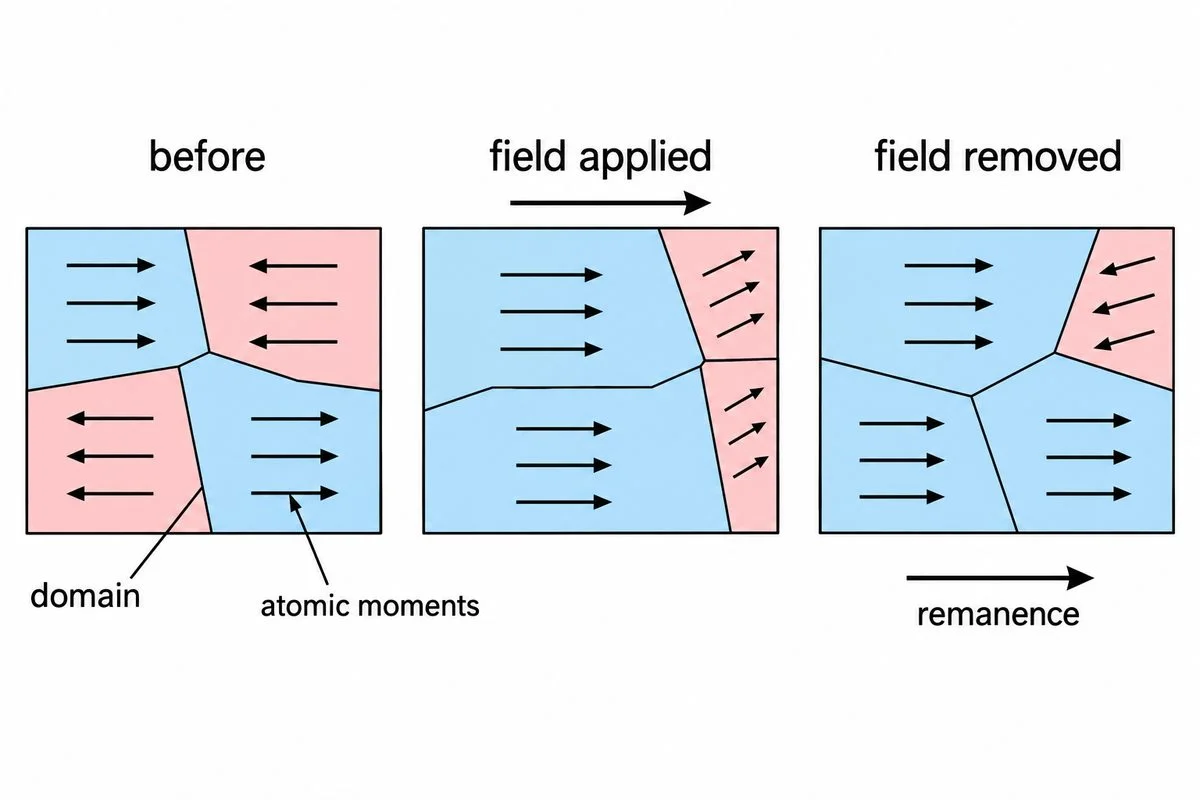
Domains change during magnetisation and retain some overall alignment after the field is removed.

8. Ferromagnetic domains and remanence

Magnetised domains can cancel; some materials retain their overall alignment.

Show
Find the domains before magnetisation in the diagram. Follow their changes during the applied field and after its removal.
Ask
After removing the field shown here, must this sample lose all its magnetisation?
Say
Domains already contain aligned atomic moments, but their contributions can cancel. The field favours domains pointing along it. Here, some magnetisation remains after removal.
Used in
Hard magnetic materials retain magnetisation, making them useful as permanent magnets.
If your child says…“An unmagnetised nail has no magnetised regions.”
Ask
Could magnetised regions point differently and cancel when taken together?
What’s true
An applied field can favour existing domains without creating their magnetisation from nothing.

A real problem

A permanent magnet helped stabilise a satellite.

Swayam was developed by the College of Engineering, Pune.

Its stabilisation design used a permanent magnet aligned with Earth’s magnetic field.

Satellite data indicated that stabilisation occurred on 30 June 2016.

ISRO’s U R Rao Satellite CentreMaharashtra Directorate of Technical Education

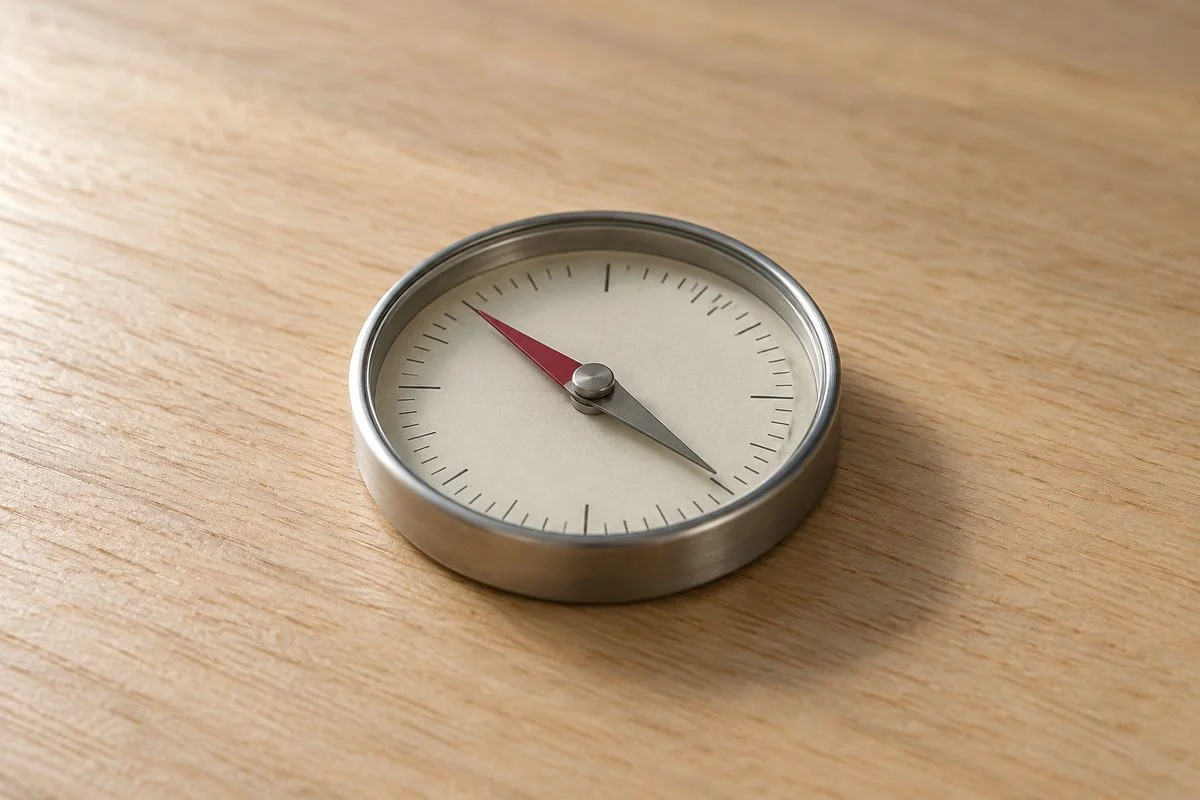
A magnetic compass resting on a wooden classroom desk.

Concept Lab · Common misconception

The tempting mistake in Magnetism and Matter

Open standalone misconception page →

Can you separate the north pole by cutting a magnet?

Wrong

Cutting a bar magnet in half gives one north pole and one south pole.

Why it feels right. The original poles are at opposite ends.

Right

Each ordinary fragment remains a dipole with its own north and south poles.

Worked example

Before
NOne barS
After
NPiece 1S
NPiece 2S
Cutting creates new faces with opposite poles. Each piece remains a dipole.
  1. Cut across a bar magnet.
  2. Each shorter bar has an original end and a new cut end.
  3. A compass can distinguish the opposite poles on each bar.

Ask your child eight quick questions.

One per step. The answer and the reason are given.

  1. Five box faces have combined outward flux +f. What is the remaining face’s outward flux?

    −f. The fluxes must sum to zero across the complete closed surface.

  2. The distant axial field is B. What is it at twice that distance?

    B8\frac{B}{8}. The distance factor is cubed: doubling gives a factor of eight.

  3. A freely turning magnet points opposite a uniform field. What follows a small turn from opposition?

    It turns farther from opposition. Turning towards alignment lowers its potential energy.

  4. The same magnetic moment occupies half the volume. What happens to magnetisation?

    It doubles. Dividing the same moment by half the volume doubles magnetisation.

  5. A linear material has zero susceptibility. What is its relative permeability?

    One. Zero material response still leaves the vacuum contribution.

  6. Which nearby pole weakly repels a diamagnetic sample?

    Either pole. Reversing the field also reverses the sample’s induced moment.

  7. An unsaturated paramagnet warms in a fixed weak field. What happens to its magnetisation?

    It decreases. Greater thermal disorder weakens the field’s partial alignment of atomic moments.

  8. Before the field was applied, were the individual domains already magnetised?

    Yes. Each domain already contains aligned atomic moments.

15 more questions with answers, 1 with pictures