Skip to content

Teach Electrostatic Potential and Capacitance in eight steps.

For each idea: show it, ask before you tell, then say one line.

Gather paper and a pencil.

Common misconceptions & worked visual for this chapter · 15 practice questions with answers

How to teach it

Potential, work and energy

V(0.10 m)=(9×10⁹)(10−9)0.10V(0.10\,\mathrm m)=\dfrac{(9\times10^9)(10^{-9})}{0.10}

V(0.10 m)=90 VV(0.10\,\mathrm m)=90\,\mathrm V

1. Electrostatic potential

Potential describes electric potential energy per unit charge.

Show
Write these lines for a +1 nC source. Take infinity as zero; V means potential.
Ask
What is the potential at twice this distance?
Say
It becomes 45 V because potential halves when distance doubles.
Used in
A torch battery supplies energy to flowing charge.
If your child says…“Doubling distance makes potential one quarter as large.”
Ask
What happens to the first calculation when its denominator doubles?
What’s true
Point-charge potential varies inversely with distance, unlike field strength.
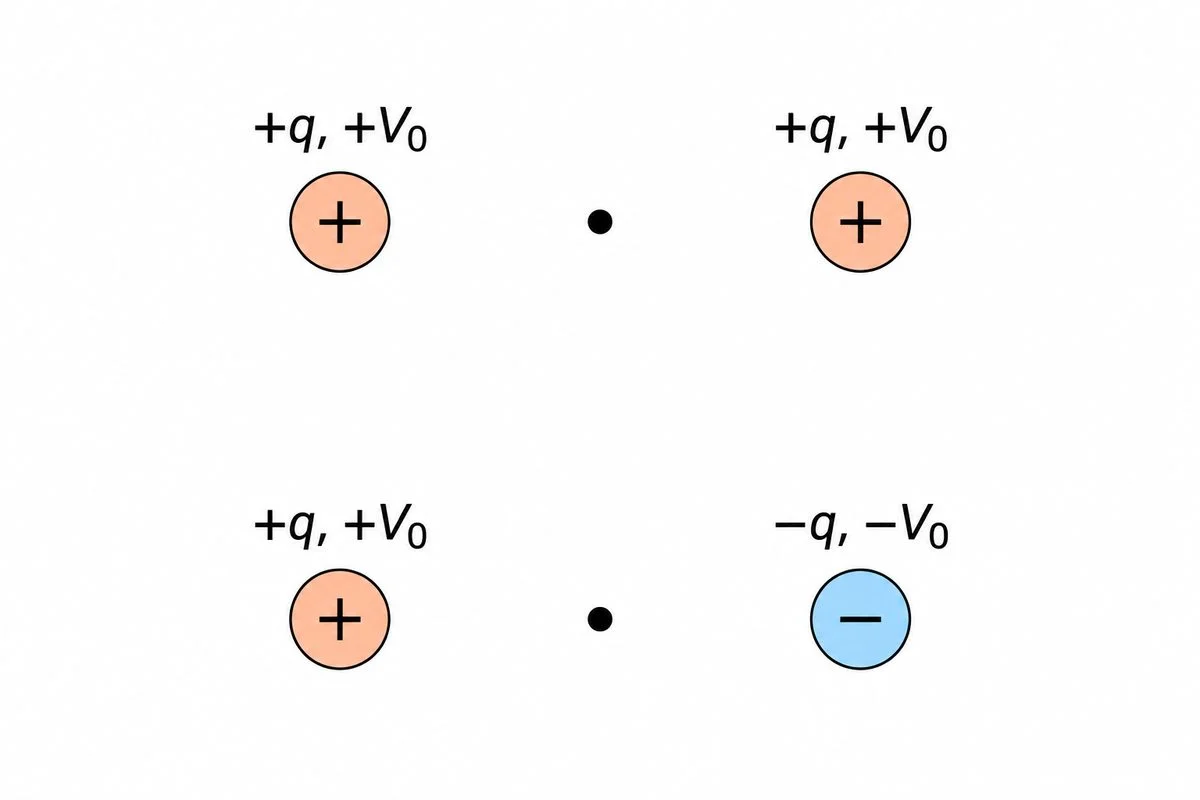
Two rows show charge pairs and their signed potentials at central dots.

2. Superposition of potential

Add each charge's potential with its sign.

Show
Compare the diagram’s two rows. Find each charge’s signed potential at the central dot.
Ask
Taking infinity as zero, which row gives zero potential at the dot?
Say
Positive potentials add. Equal opposite charges cancel midpoint potential.
Used in
Photocopiers use combined potentials from charged parts to guide toner onto paper.
If your child says…“Charges on opposite sides cancel the potential.”
Ask
Which potential is negative when both charges are positive?
What’s true
Potential has a sign, but no direction.
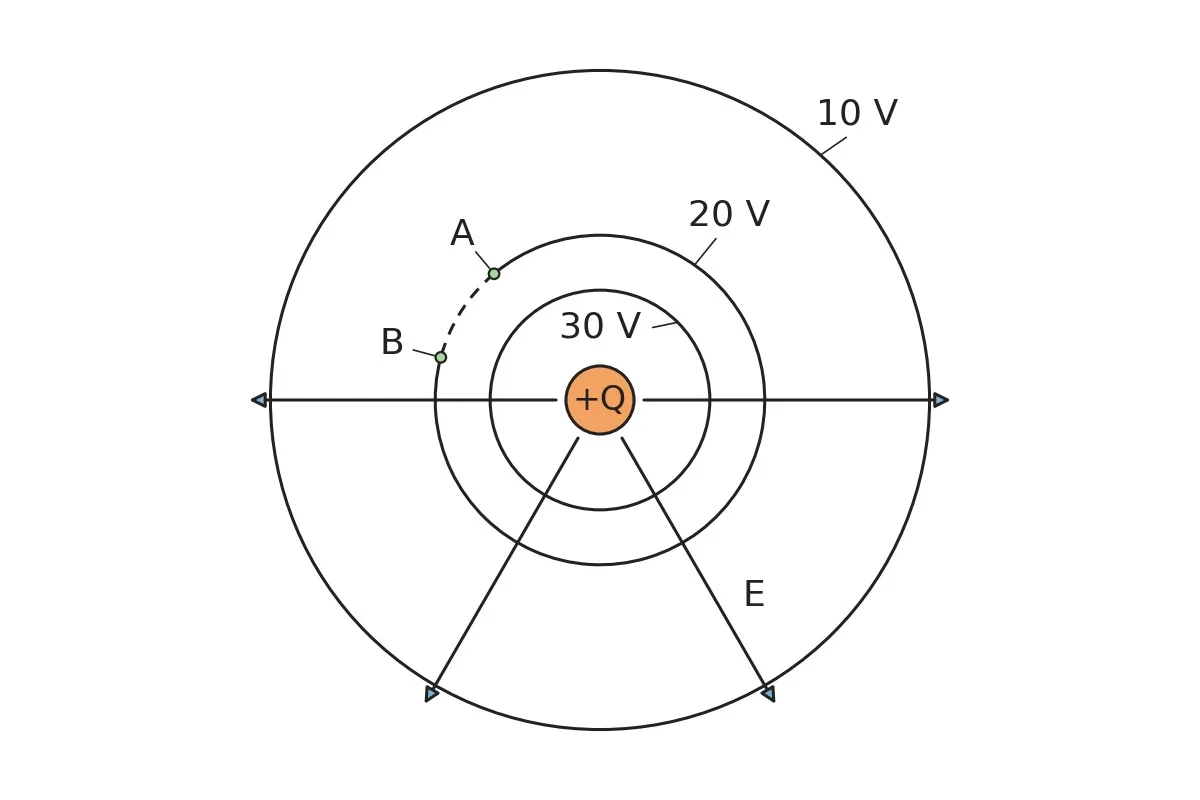
Concentric equipotential circles surround a positive charge, with outward field arrows.

3. Equipotential surfaces

An equipotential surface has the same potential everywhere.

Show
Look at the diagram. Find A and B on the same circle. Follow the outward arrows across the circles and compare their spacing.
Ask
Would moving a charge from A to B change its potential energy?
Say
No energy change occurs because A and B have equal potential. The field crosses these surfaces perpendicularly towards lower potential. Closer surfaces for equal voltage changes mean a stronger field.
Used in
Rounded high-voltage terminals reduce strong local electric fields, lowering the chance of sparks.
If your child says…“The field points towards higher potential.”
Ask
Do the potentials rise or fall along the outward arrows?
What’s true
The electric field points towards falling potential, not rising potential.
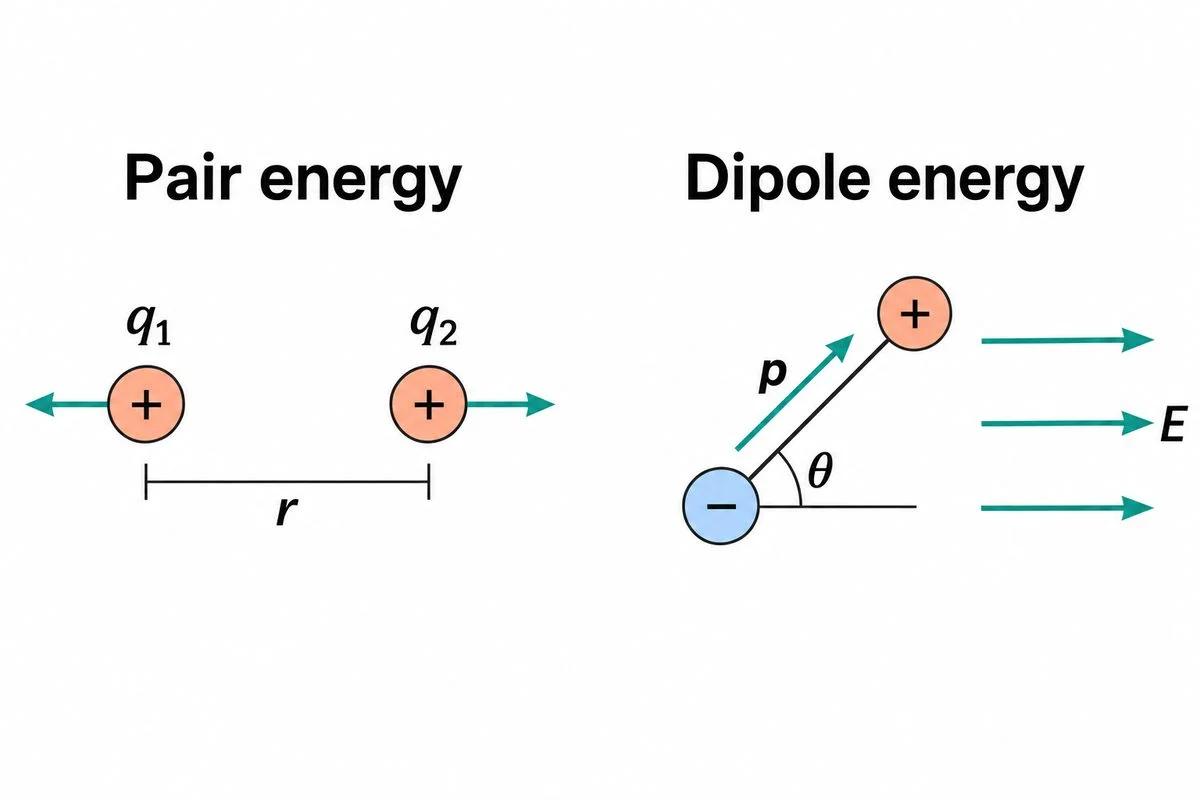
A repelling positive charge pair and a tilted dipole in a rightward field.

4. Potential energy of charges

Energy depends on charge pairs and a dipole's orientation.

Show
Find the diagram’s positive pair, then its tilted dipole.
Ask
Will aligning this dipole release energy?
Say
Yes, electric forces do work as it aligns. Assembling the positive pair slowly requires work.
Used in
Microwave ovens turn polar water molecules, helping heat food.
If your child says…“A dipole has most energy when it points along the field.”
Ask
If turning an aligned dipole requires work, does its stored energy rise or fall?
What’s true
An aligned dipole has minimum potential energy in a uniform electric field.

Materials and capacitors

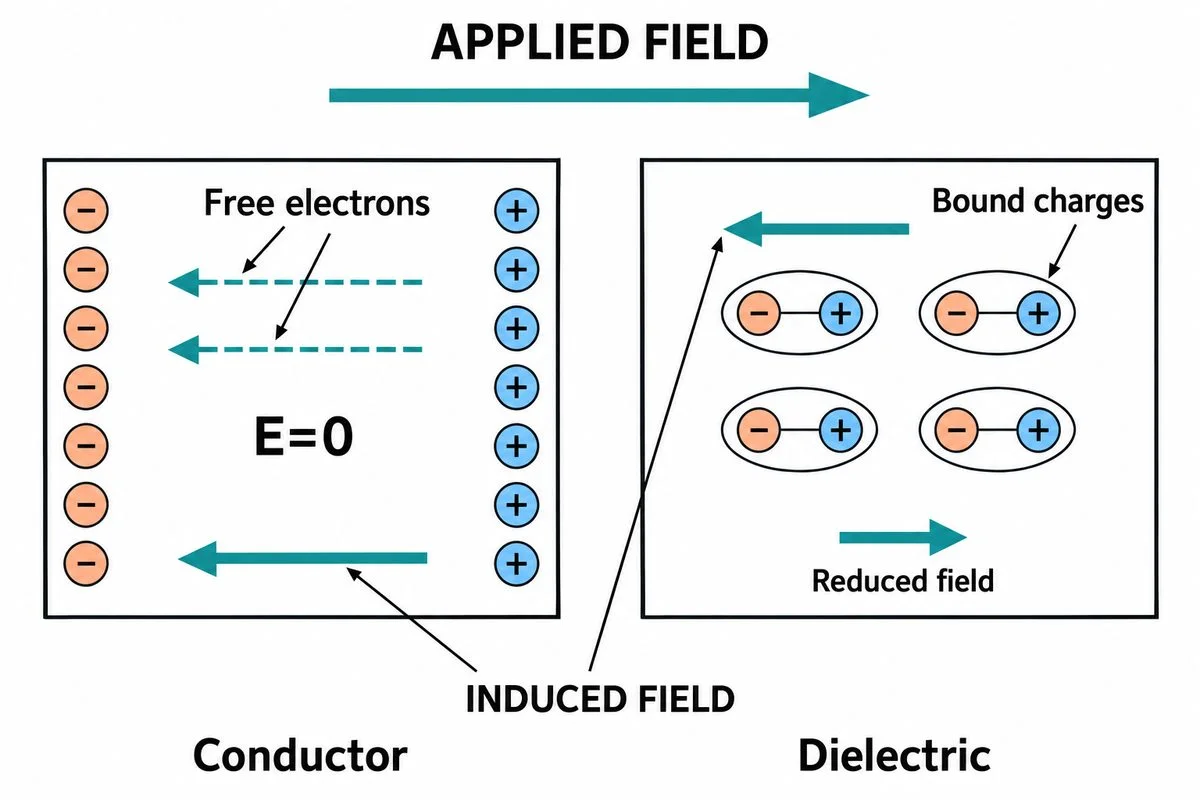
Metal surface charges and dielectric molecular charges oppose a rightward applied field.

5. Conductors and dielectrics

Materials respond differently to an applied electric field.

Show
Look at the diagram’s rightward applied fields. Compare the metal’s surface charges with the dielectric’s separated charges inside molecules.
Ask
Will the dielectric’s separated charges strengthen or weaken the applied field?
Say
Its bound charges separate locally, producing an opposing field. This reduces the field without cancelling it. Metal electrons move through the material until its internal field vanishes at equilibrium.
Used in
A metal enclosure shields sensitive equipment from stray external electric fields.
If your child says…“Insulators cancel the field like metals.”
Ask
Can the dielectric’s charges cross the whole slab like the metal’s electrons?
What’s true
Unlike metal, an ordinary dielectric only reduces its internal field for fixed source charge.
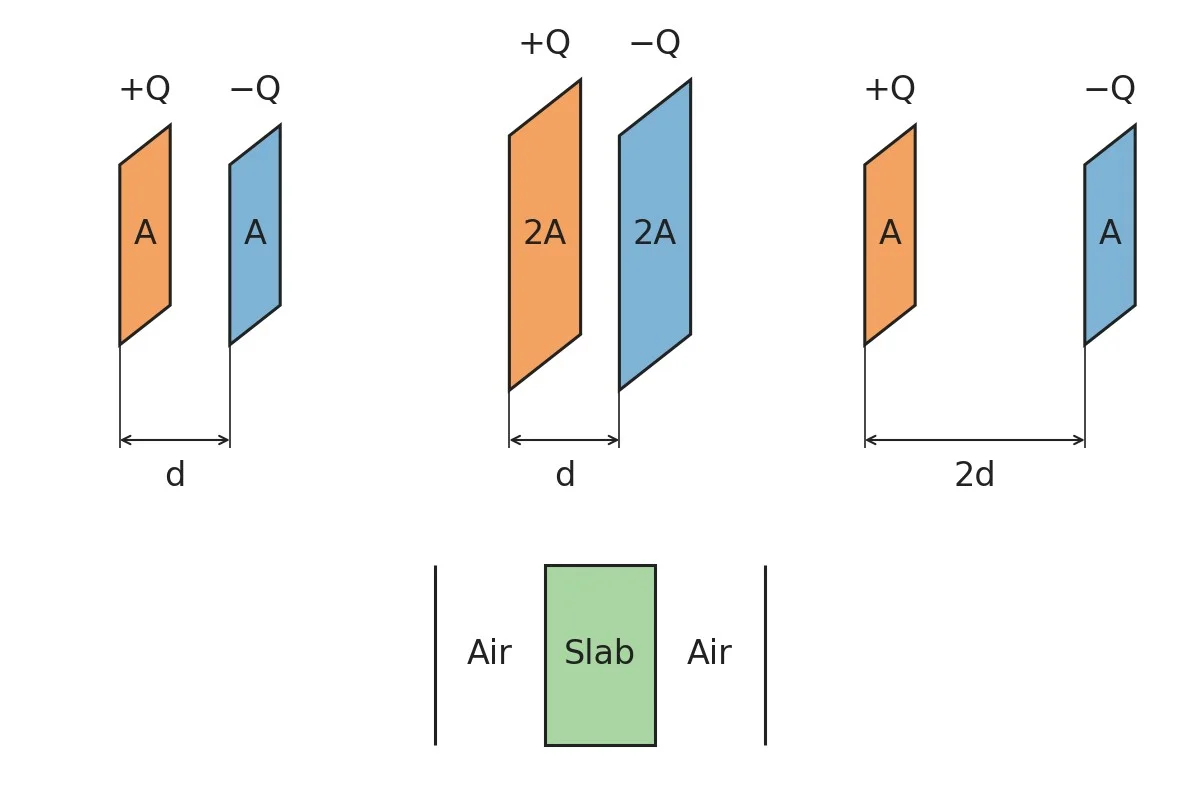
Three capacitor geometries and an inset showing air remaining beside a partial slab.

6. Capacitance

Capacitance measures how much charge is separated per volt.

Show
Compare the diagram’s plate areas and gaps. Find air beside the inset’s slab.
Ask
Which top capacitor has greatest capacitance?
Say
The larger plates do; widening the gap reduces capacitance. Remaining air contributes voltage.
Used in
Touchscreens detect capacitance changes to locate touch.
If your child says…“An insulating slab works like filling the whole gap.”
Ask
If a slab fills only part of the gap, what fills the rest?
What’s true
Any remaining air contributes to the voltage between plates.
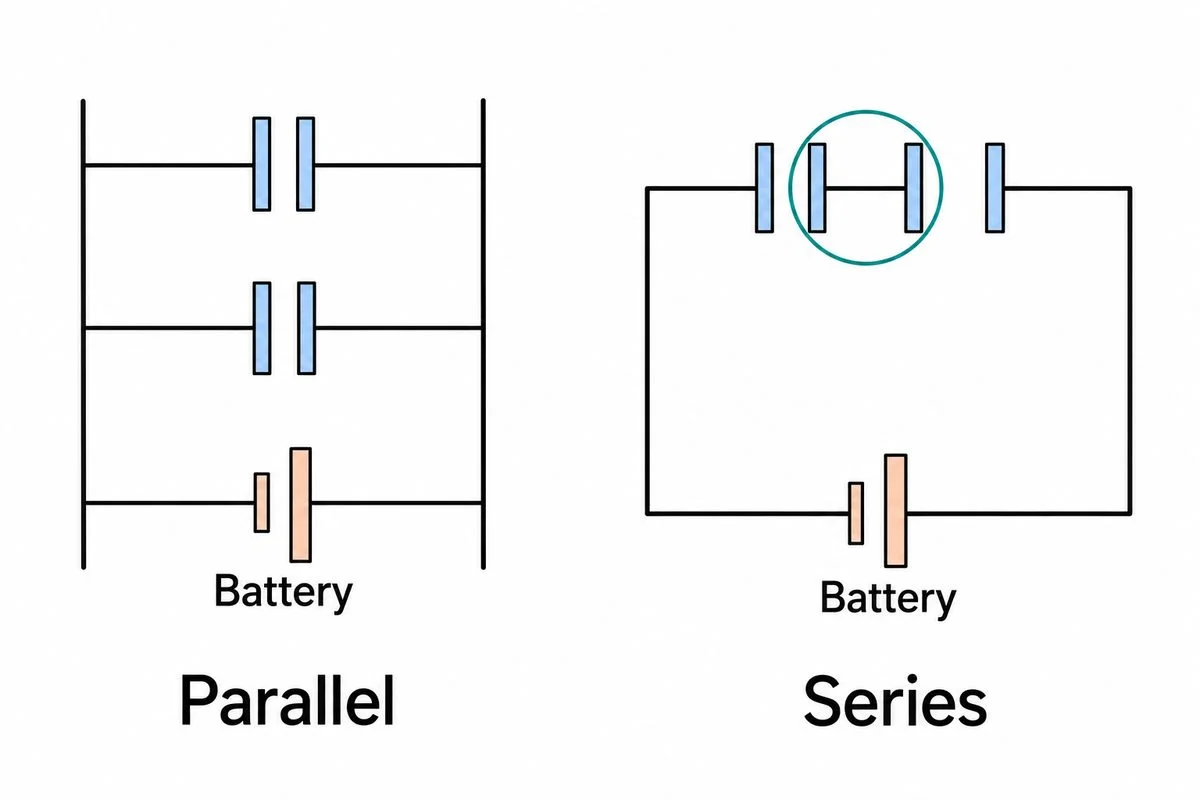
Parallel and series capacitor diagrams, with the series middle conductor circled.

7. Capacitor connections

Connections determine which voltages and charges stay equal or fixed.

Show
Trace each branch’s endpoints in the diagram. Find the circled wire and attached plates between the series capacitors.
Ask
Which pair shares the battery's voltage?
Say
Parallel capacitors share voltage.
Used in
Power supplies connect capacitors in parallel to increase capacitance and reduce unwanted voltage changes.
If your child says…“The old battery voltage stays after disconnection.”
Ask
With charge fixed, what happens to voltage when capacitance increases?
What’s true
An isolated capacitor keeps its plate charges, but its voltage changes if capacitance changes.
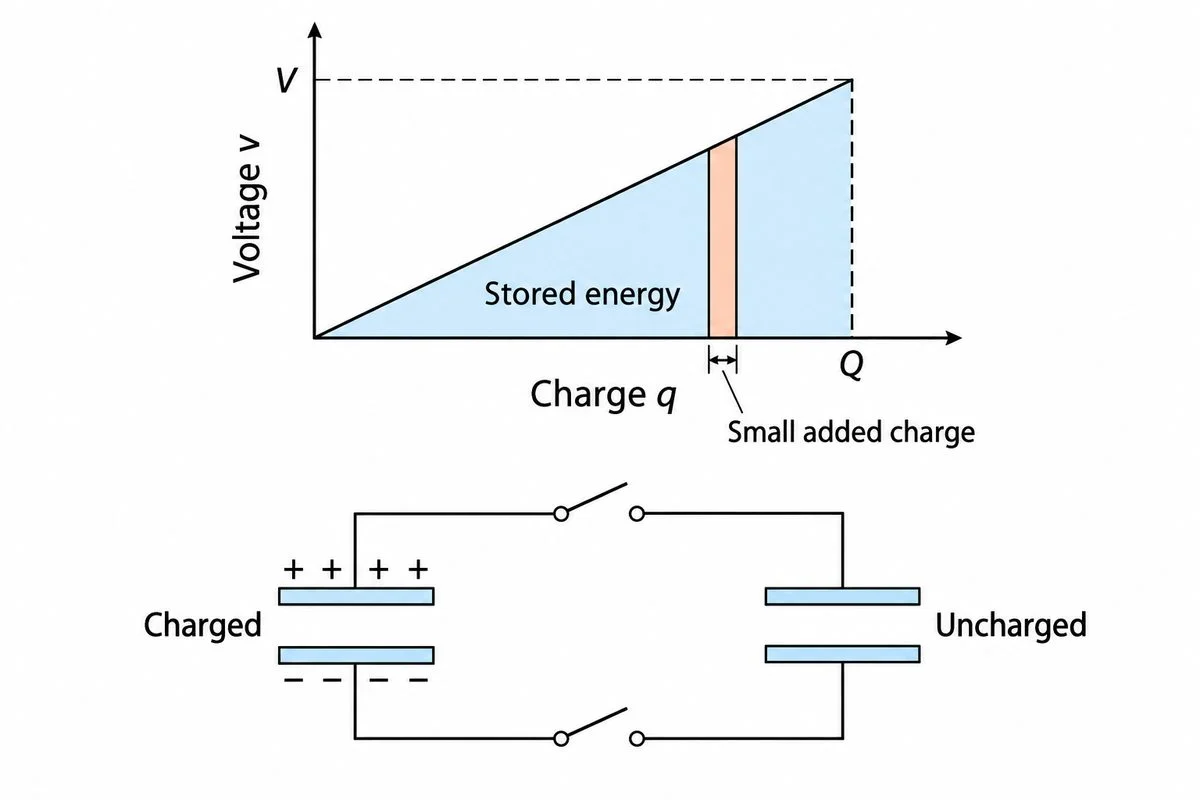
Voltage–charge graph above identical charged and uncharged capacitors awaiting connection.

8. Energy stored in a capacitor

Charging stores field energy; sharing charge can reduce that stored energy.

Show
Find the diagram’s triangle, then the identical capacitors below.
Ask
Does charging store the rectangle’s full energy?
Say
It stores half: the triangle’s area.
Used in
A capacitor powers a camera’s brief flash.
If your child says…“Keeping all the charge keeps all the stored energy.”
Ask
If moving charge heats the connections, where did that energy come from?
What’s true
When isolated capacitors at different voltages share charge, some energy becomes heat, radiation, or both.

A real problem

Faraday’s cage shields electrical equipment

Faraday invented his shielding cage in 1836.

Electrons moved along the metal surface.

A metal enclosure protects sensitive electrical equipment from stray external electric fields.

Royal InstitutionNational MagLabUniversity of Texas at Austin

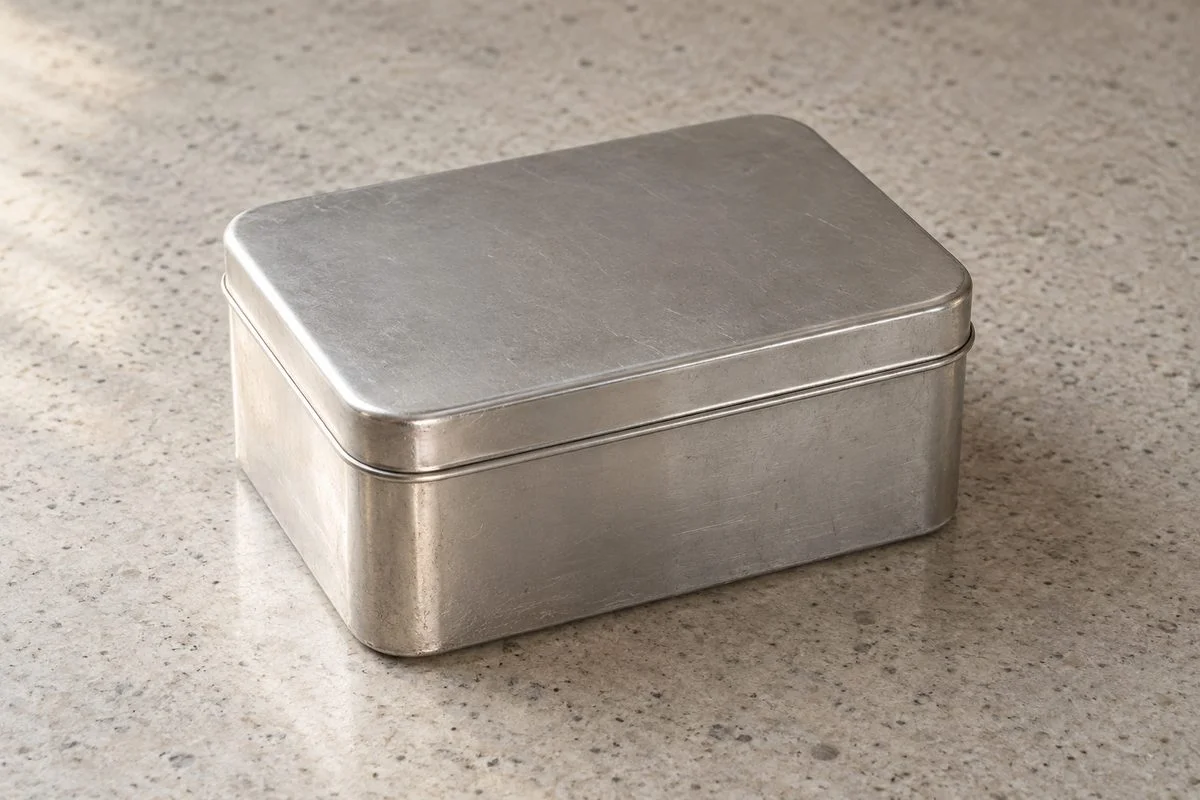
Plain metal biscuit tin with its lid fitted.

Concept Lab · Common misconception

The tempting mistake in Electrostatic Potential and Capacitance

Open standalone misconception page →

Can the electric potential be zero while the field is nonzero?

Wrong

If electric potential is zero at a point, the electric field there must also be zero.

Why it feels right. Both quantities describe the same charges, so I expect them to cancel together.

Right

Potential adds as a scalar. Electric field adds as a vector.

Worked example

At the midpoint, opposite potentials cancel. Both electric fields point to the right.
  1. At the midpoint between +q and −q, the potentials cancel when zero is set at infinity.
  2. Both field contributions point from +q towards −q, so they add.

Ask your child eight quick questions.

One per step. The answer and the reason are given.

  1. What potential occurs twice as far from this source?

    45 V. Doubling distance halves this potential.

  2. Taking infinity as zero, what sign is the potential midway between equal positive charges?

    Positive. Both potentials are positive, even though their fields cancel.

  3. Potential varies only horizontally and falls towards the right. Which way does the electric field point?

    To the right. The field points towards decreasing potential.

  4. Which dipole orientation has least energy?

    Its moment along the field. Turning it away requires work.

  5. An ordinary dielectric fills a charged, isolated capacitor's unchanged gap. What happens to the field?

    It decreases but remains nonzero. With plate charge fixed, bound charges oppose only part of the original field.

  6. Would a noncontacting metal slab make capacitance infinite?

    No. Remaining air still contributes voltage.

  7. An isolated capacitor's capacitance increases while its plate charges stay fixed. What happens to its voltage?

    It decreases. Dividing the same charge by a larger capacitance gives a smaller voltage.

  8. Where does the lost field energy go?

    Heat, radiation, or both. Moving charge transfers field energy.

15 more questions with answers, 2 with pictures