Skip to content

Teach Ray Optics and Optical Instruments in eight steps.

For each idea: show it, ask before you tell, then say one line.

Gather a coin, a clear drinking glass, water, paper and a pencil.

Common misconceptions & worked visual for this chapter · 15 practice questions with answers

How to teach it

Reflection and refraction

Concave and convex mirrors reflect rays around local normals towards real or virtual foci.

1. Reflection and spherical mirrors

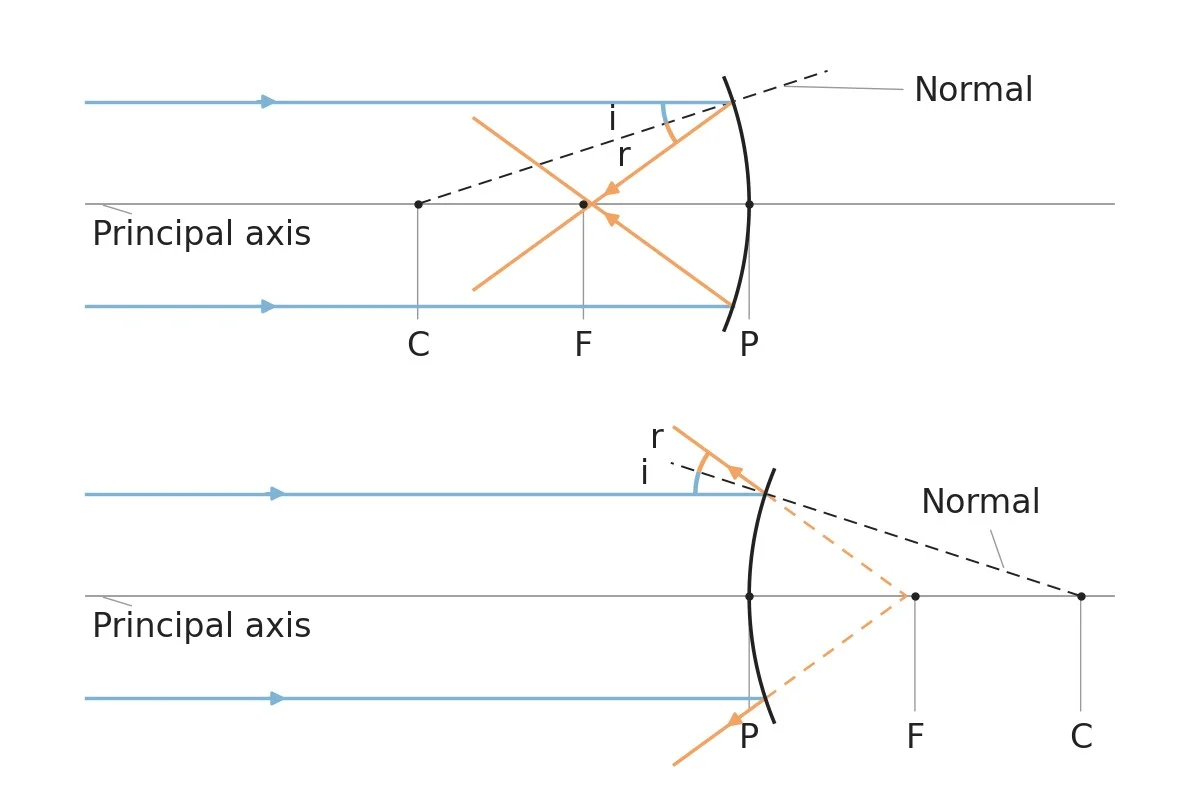
Angles use the mirror’s perpendicular normal. Axial distances start at its pole.

Show
Look at the diagram. Follow the rays beside each normal. Find the pole, focus and centre of curvature.
Ask
If these parallel rays strike each mirror, will the reflected rays gather or spread?
Say
The normals differ, but incoming and reflected angles remain equal around each normal. Measure distances from the pole. For rays near the axis, the focus lies halfway between pole and centre.
Used in
Concave telescope mirrors gather light to form distant objects’ images.
If your child says…“We measure reflection angles from the surface.”
Ask
Which line is perpendicular to the surface here?
What’s true
On a spherical mirror, the normal passes through the centre of curvature.
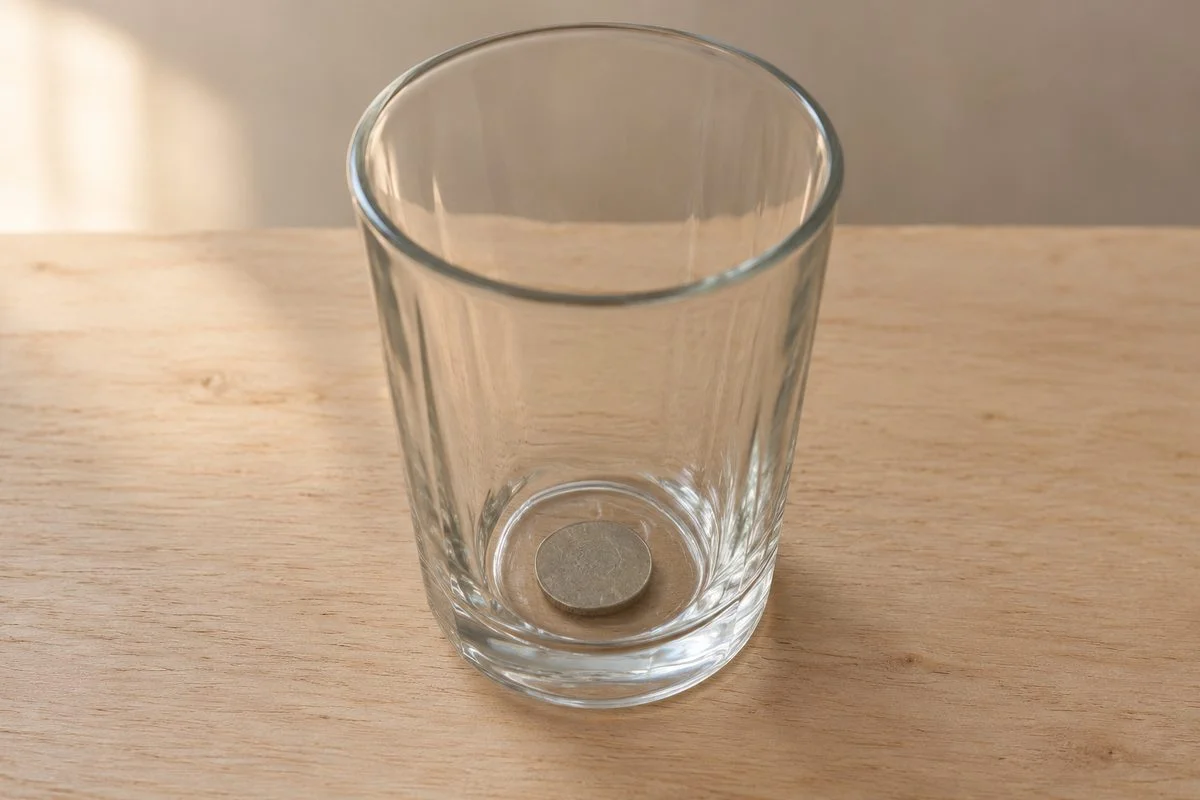
A coin rests inside an empty clear glass.

2. Refractive index and apparent depth

Higher refractive index means slower light; bending can change apparent positions.

Show
Place a coin in an empty glass before adding water.
Ask
After adding water, will the coin look nearer or farther when viewed almost straight down?
Say
The coin looks shallower because light bends as it leaves water.
Used in
Magnifiers use refraction to give a larger view of nearby details.
If your child says…“Water makes the coin look deeper.”
Ask
After pouring, does the coin look closer even though it has stayed still?
What’s true
Rays leaving water appear to come from a shallower position.
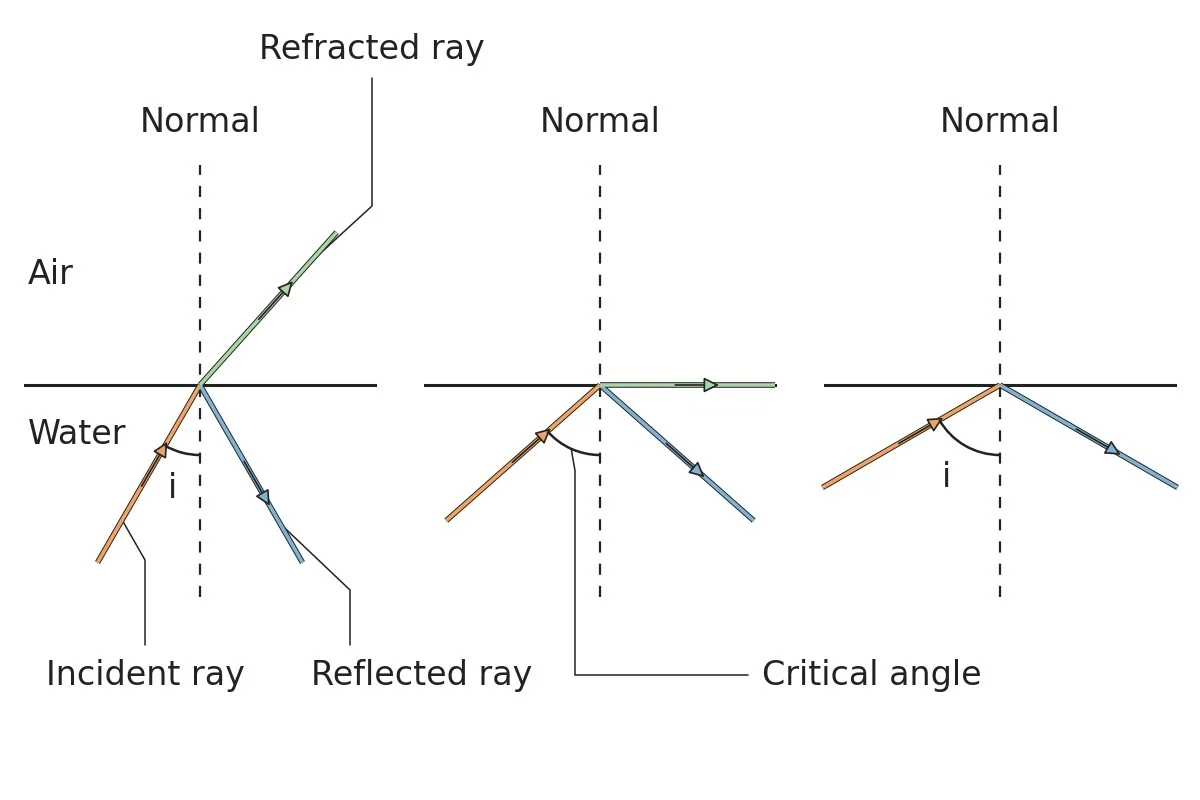
Water-to-air rays below, at and above the critical angle show the reflection threshold.

3. Critical angle and total internal reflection

Beyond the critical angle, light reflects completely inside the higher-index material.

Show
Follow the diagram’s water-to-air rays from left to right.
Ask
When will this boundary turn light back completely?
Say
At the critical angle, the refracted ray follows the surface. Above it, light reflects completely because air has a lower index.
Used in
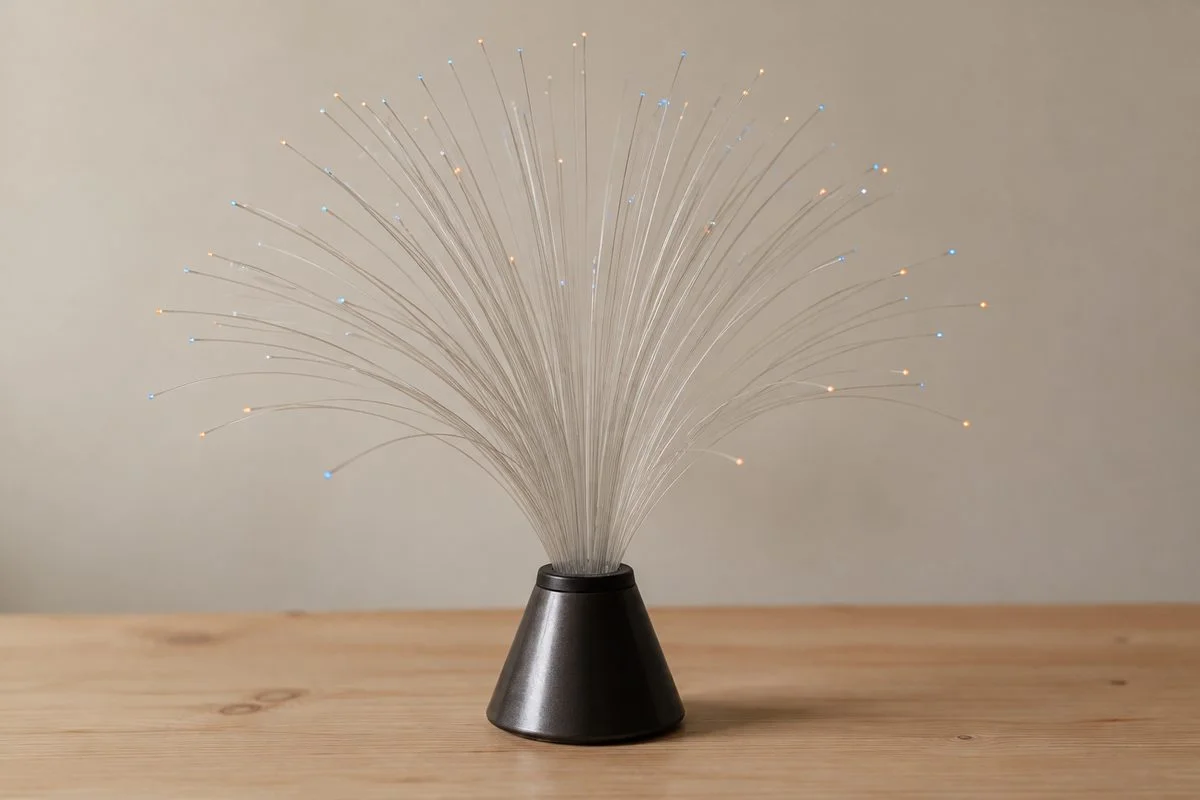
Optical fibres guide light around bends, allowing flexible instruments to carry images inside the body.
If your child says…“The critical angle already gives total internal reflection.”
Ask
Which panel still has a refracted ray along the surface?
What’s true
At the critical angle, the refracted direction runs along the surface.

Lenses and prisms

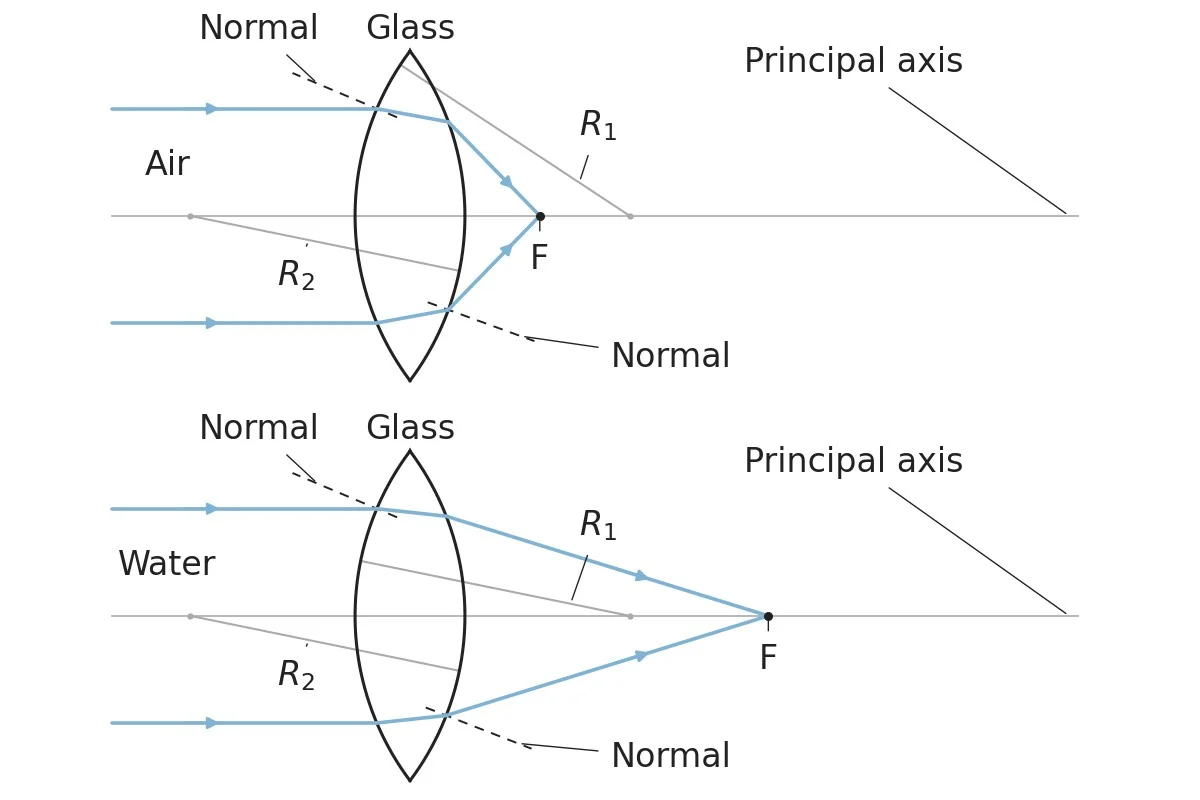
Identical glass lenses focus parallel rays nearer in air and farther away in water.

4. Curved surfaces and thin lenses

Curvature and surroundings determine a lens’s effect.

Show
Look at the diagram’s identical glass lenses in air and water. Follow the rays through both curved faces. Compare the focus positions.
Ask
Will the same glass lens bring light together equally strongly in air and water?
Say
The lens focuses farther away in water because water’s refractive index is closer to glass’s. Each curved surface bends light according to the materials on both sides.
Used in
Camera lenses bend light to form sharp images on a sensor.
If your child says…“Convex glass always brings light together equally strongly.”
Ask
What changed between these panels while the lens stayed the same?
What’s true
A lens’s focusing strength depends on its surroundings as well as its shape.

P1=10.20 m=5 DP_1=\frac{1}{0.20\,\mathrm{m}}=5\,\mathrm{D}

P2=10.30 m=103 DP_2=\frac{1}{0.30\,\mathrm{m}}=\frac{10}{3}\,\mathrm{D}

P=P1+P2=253 DP=P_1+P_2=\frac{25}{3}\,\mathrm{D}

5. Lens power and successive images

Touching lenses add powers; separated lenses need distances measured afresh.

Show
Write these lines. Say, “Power is reciprocal focal length in metres. P₁ and P₂ add to P; D means dioptres.”
Ask
What focal length gives this combined power?
Say
The reciprocal gives 12 cm.
Used in
Camera lens combinations control where a sharp image forms.
If your child says…“I add the focal lengths when lenses touch.”
Ask
Would adding the focal lengths give the combined power written here?
What’s true
Touching thin lenses add their powers, which are reciprocals of focal lengths in metres.
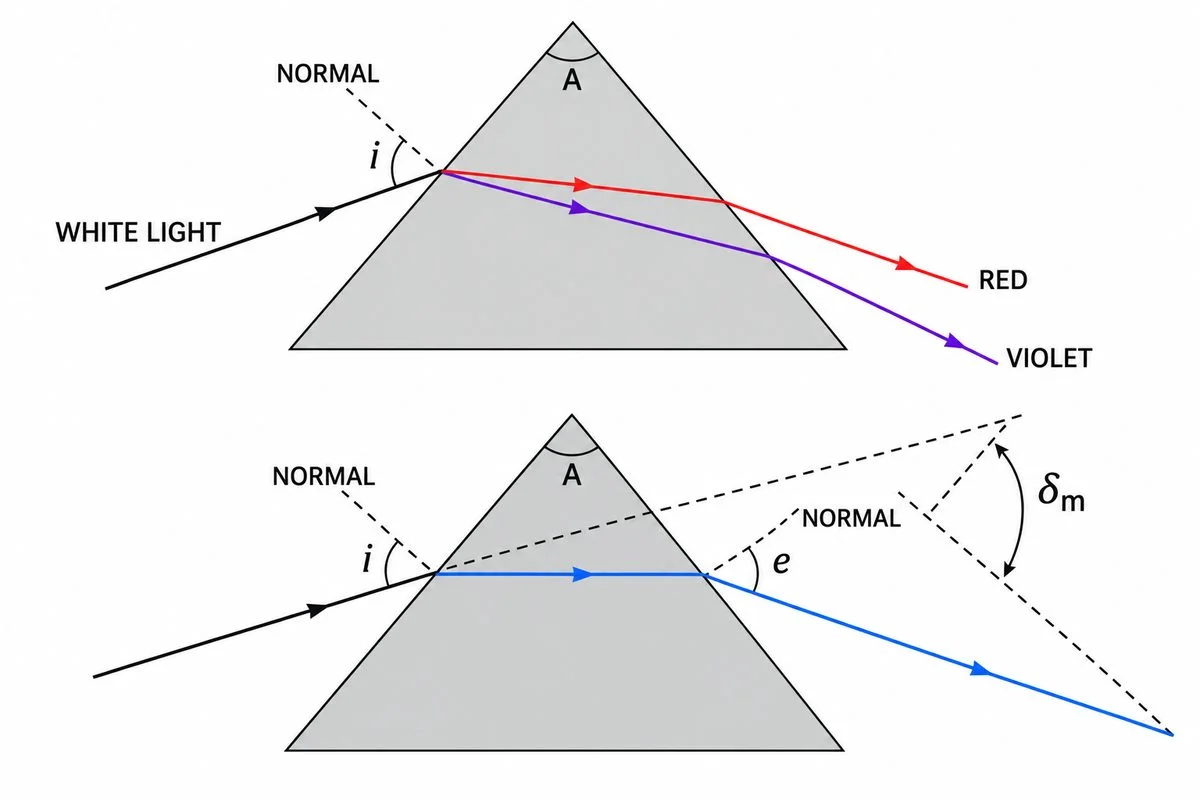
Prism diagrams show colour separation and a symmetric path giving minimum deviation.

6. Prism deviation and dispersion

A prism changes ray direction and separates colours by unequal refraction.

Show
Follow red and violet through the upper diagram. Below, compare entry and exit angles.
Ask
Which path bends one colour least?
Say
Ordinary glass bends violet more because its index is higher for violet. Each colour turns least when entry and exit angles match.
Used in
Prisms in spectroscopes separate colours so materials can be identified from their light.
If your child says…“No bending at entry means the least bending overall.”
Ask
If entry causes no bending, must exit also cause none?
What’s true
Minimum deviation depends on the complete path through both faces.

Optical instruments

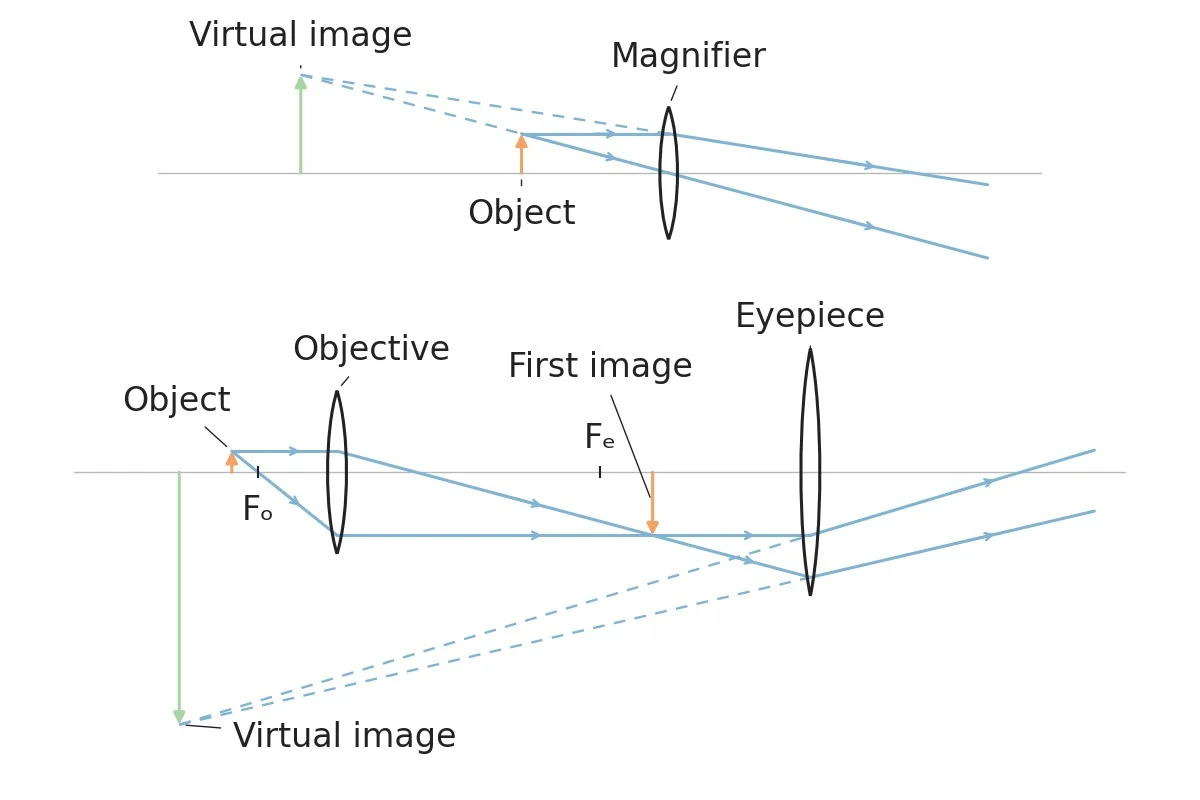
A magnifier enlarges an object’s view; a microscope eyepiece enlarges the objective’s real image.

7. Simple magnifier and compound microscope

A microscope magnifies an enlarged image.

Show
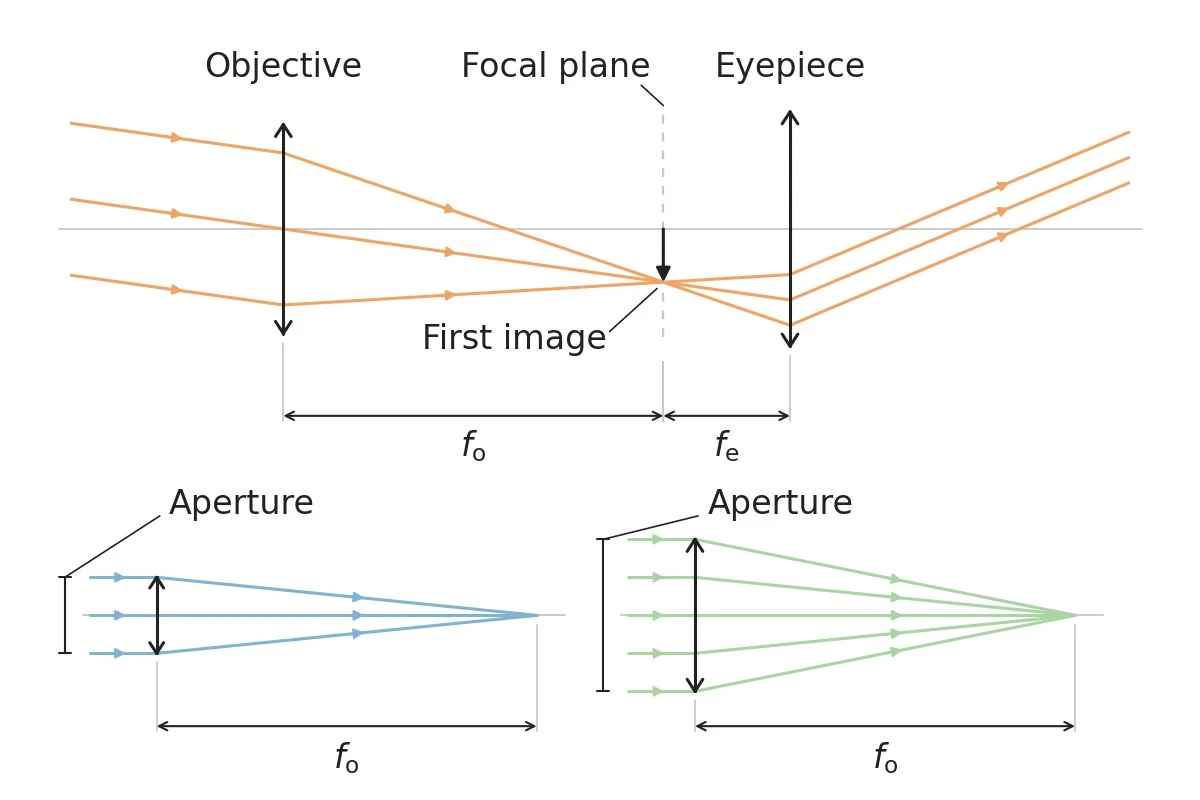
Look at the diagram’s single magnifier and its virtual image. Follow the microscope rays through the objective to the first image, then through the eyepiece.
Ask
With this first image already enlarged, will the two magnification factors add or multiply?
Say
The objective makes an enlarged, inverted real image. The eyepiece acts like the single magnifier, enlarging that image’s apparent angle. Multiply the objective’s image enlargement by the eyepiece’s angular magnification.
Used in
Magnifiers allow clear viewing from closer distances.
If your child says…“The two enlargements add.”
Ask
Does the eyepiece enlarge the original object or the objective’s enlarged image?
What’s true
The second lens acts on an image the first lens has already enlarged.
Telescope focal lengths set magnification, while wider objectives collect broader light bundles.

8. Telescopes and aperture

Telescopes enlarge distant views; wider objectives gather more light.

Show
Follow the diagram’s rays through both lenses. Below, compare the entering bundles.
Ask
Would widening this objective increase magnification?
Say
A wider objective gathers more light without changing magnification. Rays form the inverted first image without a screen.
Used in
Reflecting telescopes use a concave mirror, avoiding colour blur caused by a lens.
If your child says…“A wider objective magnifies more.”
Ask
Which focal length changed when the objective became wider?
What’s true
With both focal lengths fixed, increasing objective aperture changes light collection, not angular magnification.

A real problem

A flexible fibrescope for transmitting images

Hopkins and Kapany published their fibre research in 1954.

Kapany guided light around bends through bundles of optical fibres.

Advanced fibrescopes now support medical examinations such as colonoscopy.

OpticaImperial College LondonTelecommunication Engineering Centre

A decorative fibre-optic lamp has curved strands with illuminated tips.

Concept Lab · Common misconception

The tempting mistake in Ray Optics and Optical Instruments

Open standalone misconception page →

Do mirrors always form images you can catch on a screen?

Wrong

A screen behind a plane mirror can catch the image I see there.

Why it feels right. The reflected image appears to occupy a position behind the mirror.

Right

A screen can capture an image where light rays actually converge. A plane mirror produces a virtual image.

Worked example

The solid rays travel in front of the mirror. Their dashed backward extensions meet behind it at the apparent image.
  1. Draw two rays reflecting from the mirror into your eye.
  2. Extend their paths backwards to the apparent image position.
  3. The extensions meet there, while the light itself remains in front of the mirror.

Ask your child eight quick questions.

One per step. The answer and the reason are given.

  1. A ray arrives at 30° to the mirror surface. What is its reflection angle?

    60°. Measure from the normal, which is perpendicular to the surface.

  2. A coin is 12 cm underwater, with index 4/3. What depth appears from almost directly above?

    9 cm. Divide the actual depth by the water’s index.

  3. Light travels from water towards air at exactly the critical angle. Has total internal reflection begun?

    No. Incidence must increase beyond the critical angle for total internal reflection.

  4. Which surrounding medium gives this glass lens the farther focus: air or water?

    Water. Water’s index is closer to glass’s, so the lens bends rays less.

  5. Compared with either lens alone, where does this touching pair focus parallel incoming rays?

    Closer to the lenses. Adding positive powers gives a shorter focal length.

  6. At minimum deviation, how do the entry and exit angles compare?

    They are equal. The least-deviating path is symmetric through the prism.

  7. The objective enlarges 20 times. The eyepiece magnifies 10 times. What is their combined magnification?

    200 times. The second lens enlarges the first lens’s image, so the factors multiply.

  8. A telescope’s objective becomes wider, with both focal lengths unchanged. What happens to angular magnification?

    It stays the same. The focal-length ratio stays unchanged; the wider objective collects more light.

15 more questions with answers, 2 with pictures