Skip to content

Teach Wave Optics in eight steps.

For each idea: show it, ask before you tell, then say one line.

Gather paper, a pencil and a ruler.

Common misconceptions & worked visual for this chapter · 15 practice questions with answers

How to teach it

How waves travel

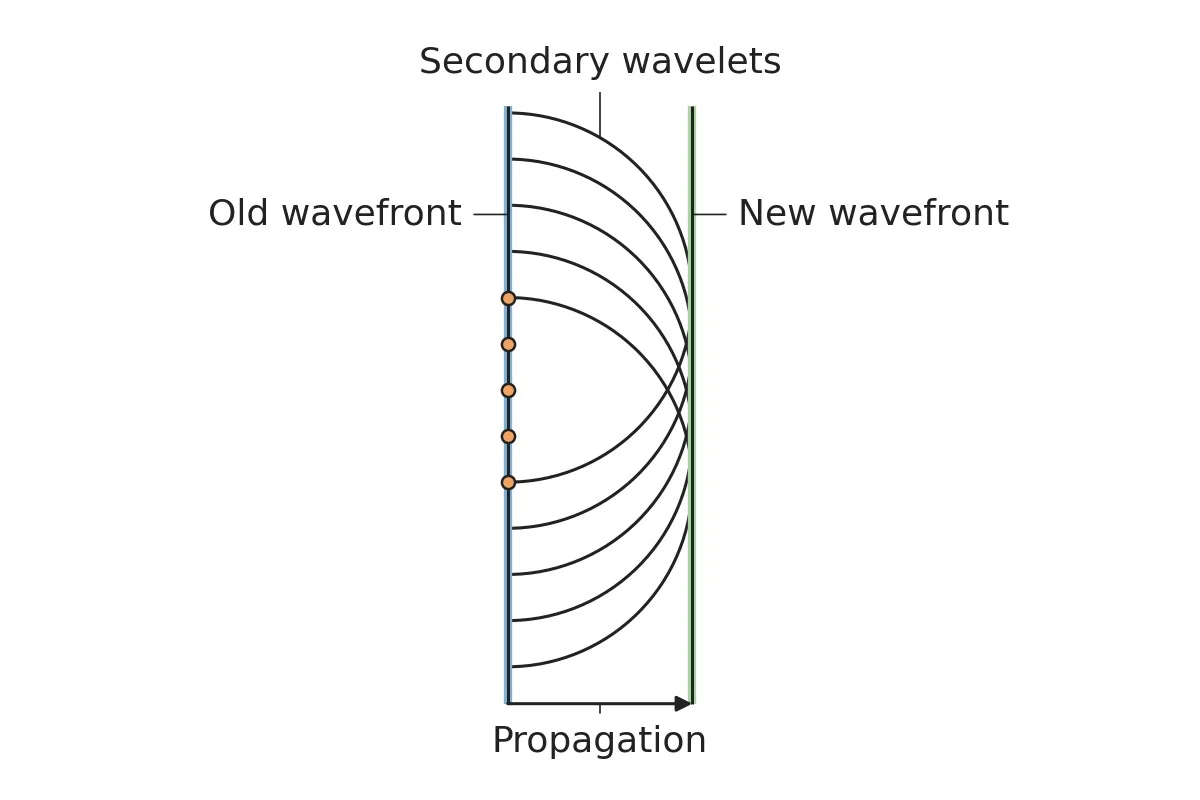
Equal wavelets advance from an old wavefront to a perpendicular propagation direction.

1. Wavefronts and Huygens’ principle

A wavefront joins points at the same stage of vibration.

Show
Look at the diagram’s old wavefront. Follow the equal wavelets towards their forward edges.
Ask
Where will the next wavefront lie after these wavelets spread?
Say
Each point sends out a wavelet. The next wavefront touches their forward edges and advances perpendicular to the old front.
Used in
A converging lens makes a parallel beam when its light source sits at the focus.
If your child says…“Light travels along the wavefront.”
Ask
Does the propagation arrow run along the old wavefront or across it?
What’s true
In a medium identical in every direction, light travels perpendicular to its wavefront.
fair=3.0×108600×10−9=5.0×10¹⁴ Hzf_{\mathrm{air}}=\frac{3.0\times10^8}{600\times10^{-9}}=5.0\times10^{14}\,\mathrm{Hz}

vglass=3.0×1081.5=2.0×10⁸ m s−1v_{\mathrm{glass}}=\frac{3.0\times10^8}{1.5}=2.0\times10^8\,\mathrm{m\,s^{-1}}

fglass=fair=5.0×10¹⁴ Hzf_{\mathrm{glass}}=f_{\mathrm{air}}=5.0\times10^{14}\,\mathrm{Hz}

λglass=2.0×1085.0×1014 m\lambda_{\mathrm{glass}}=\frac{2.0\times10^8}{5.0\times10^{14}}\,\mathrm{m}

2. Wave refraction

Light can change speed and wavelength while keeping the same frequency.

Show
Write these lines for 600 nm light entering stationary glass with refractive index 1.5. Say that f means frequency, v means speed, and λ means wavelength. Take air’s refractive index as 1.
Ask
With frequency unchanged, what wavelength does the slower light have inside this glass?
Say
The wavelength becomes 400 nm. Divide the speed in glass by the unchanged frequency.
Used in
Spectacle lenses refract light to help eyes focus clearly.
If your child says…“Slower light must vibrate less often.”
Ask
Which sets the vibration rate: the incoming light or its speed inside glass?
What’s true
The incoming light sets the frequency, so slower travel means a shorter wavelength.

How waves combine

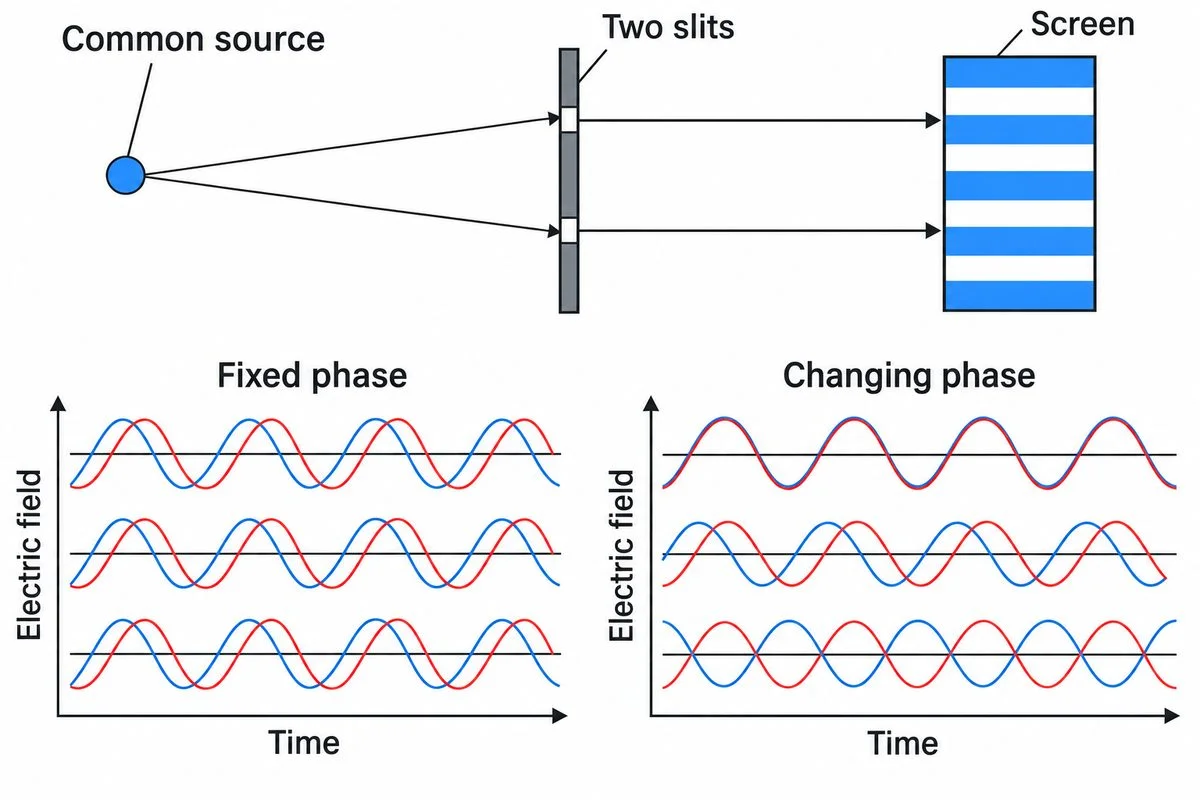
Common-source slits above wave pairs with fixed or changing relative phase.

3. Coherence

Matching frequencies and a steady phase difference allow lasting interference bands.

Show
Follow the diagram from the common source through both slits to the screen. Compare the wave pairs below: fixed phase on the left, changing phase on the right.
Ask
Which wave pair shown will keep its bright and dark bands in fixed positions?
Say
Both waves need the same frequency and a fixed offset between their cycles. A changing offset moves the bands. Rapid, random changes make them average out.
Used in
Holograms use coherent light to record interference patterns that preserve depth information.
If your child says…“Same colour means steady bands.”
Ask
Which wave pair keeps the same gap between corresponding crests?
What’s true
Random changes in relative phase make interference bands average out.
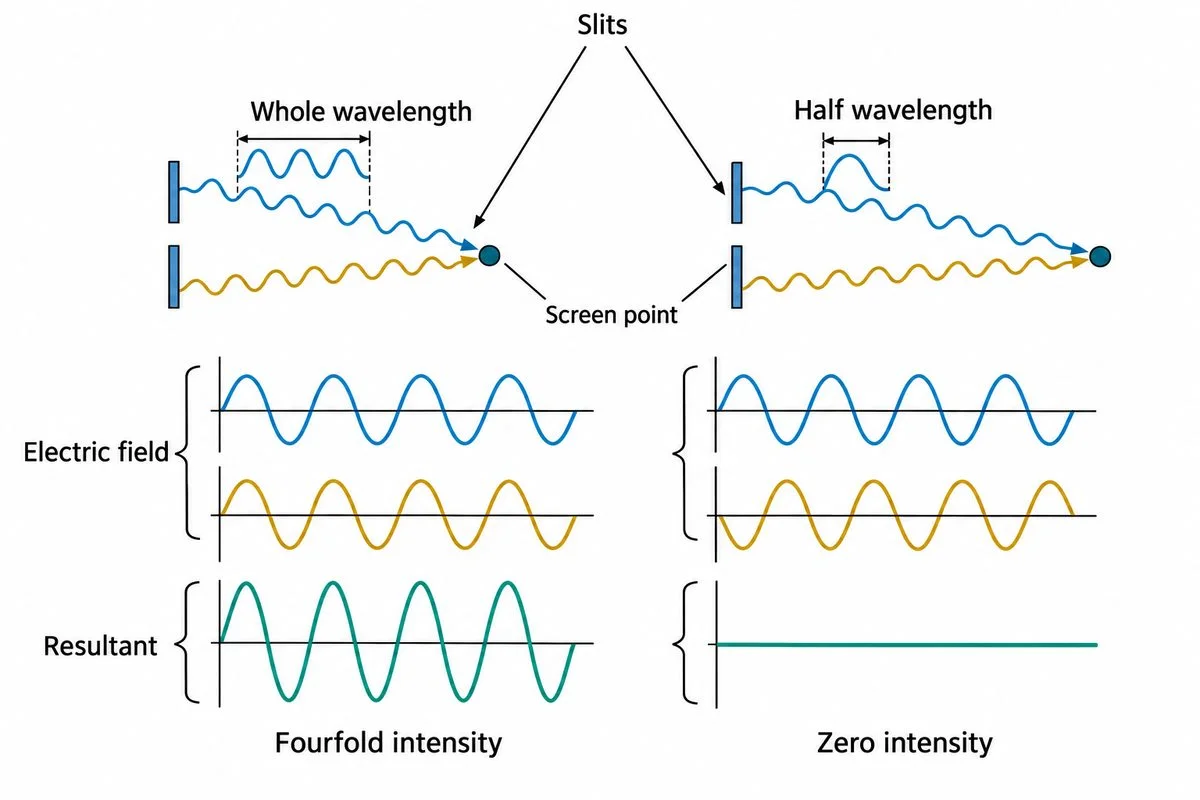
Whole-wavelength and half-wavelength path differences produce reinforcement and cancellation of equal fields.

4. Path difference and interference intensity

Waves add their amplitudes.

Show
Look at the diagram’s equal waves, which start in phase and share polarisation. Compare the extra whole-wavelength path with the extra half-wavelength path.
Ask
Which shown path difference makes the point bright, and which makes it dark?
Say
A whole-wavelength delay doubles the combined field amplitude. Intensity follows amplitude squared, giving four times either beam’s intensity. A half-wavelength delay gives opposite fields and zero intensity.
Used in
Interfering laser beams revealed detector-arm length differences, helping detect gravitational waves.
If your child says…“Half a wavelength gives half the maximum brightness.”
Ask
What remains when equal opposite amplitudes add?
What’s true
Equal beams starting in phase cancel at a half-wavelength path difference when their polarisations match.
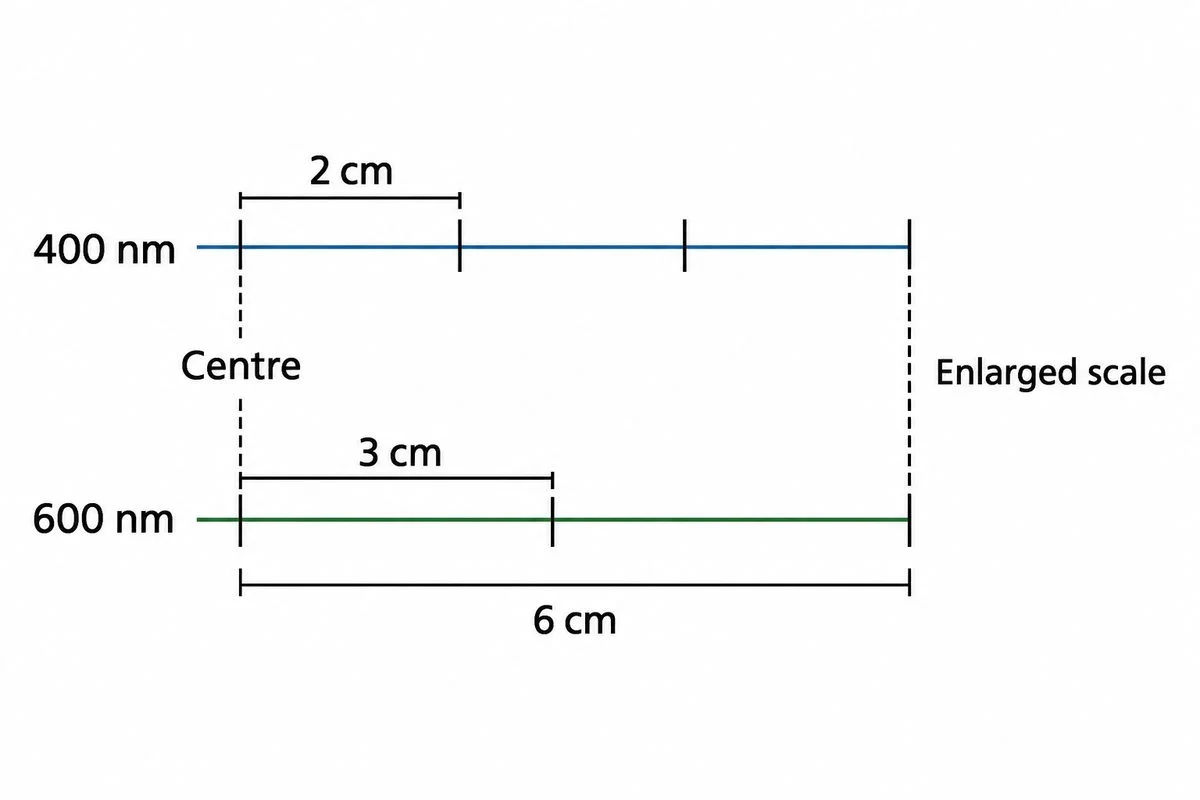
Two rows of fringe marks with different gaps and aligned first shared positions.

5. Young’s fringes

Different colours can share bright-fringe positions.

Show
Compare the diagram’s 400 nm and 600 nm rows, starting at their aligned centres. Find their first shared mark beyond the centre.
Ask
Will equal fringe numbers align beyond the centre?
Say
Longer wavelengths give wider gaps. At the first shared mark, the 400 nm row crosses three gaps. The 600 nm row crosses two, so different orders meet.
Used in
Fringe spacing measures wavelength, helping compare colours.
If your child says…“Different colours meet at the same fringe number.”
Ask
How many gaps does each row cross before its marks first line up again?
What’s true
Different wavelengths need different nonzero orders to reach a shared bright position.
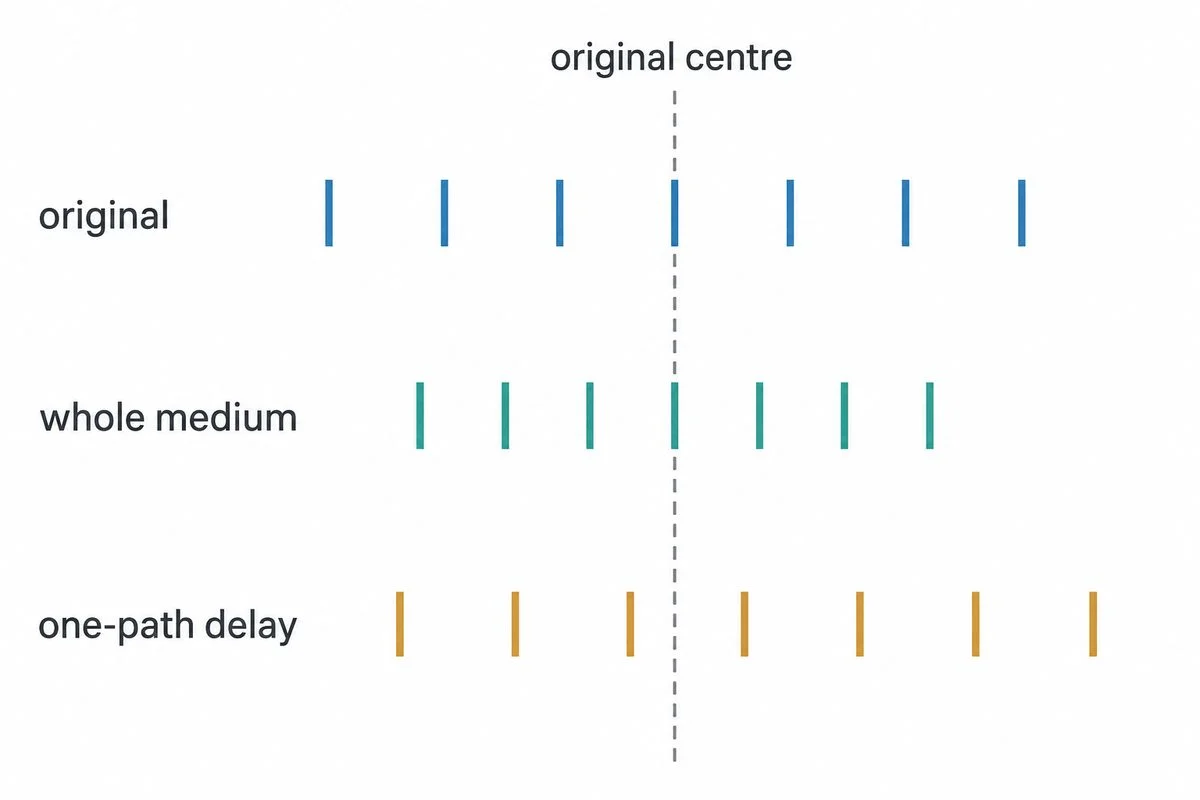
Three fringe rows showing original gaps, closer gaps and an equally shifted pattern.

6. Changing Young’s pattern

Immersion changes spacing; delaying one beam shifts fringes.

Show
Compare the diagram’s three rows. Find which row changes the gaps and which shifts the marks from the original centre.
Ask
Will another uniform delay change the gaps?
Say
A constant delay shifts fringes without changing gaps.
Used in
Fringe shifts reveal glass thickness differences, helping check uniformity.
If your child says…“Delaying one beam changes the gaps.”
Ask
In the shifted row, which gaps changed?
What’s true
A constant added phase shifts every fringe equally.

Spreading and vibration direction

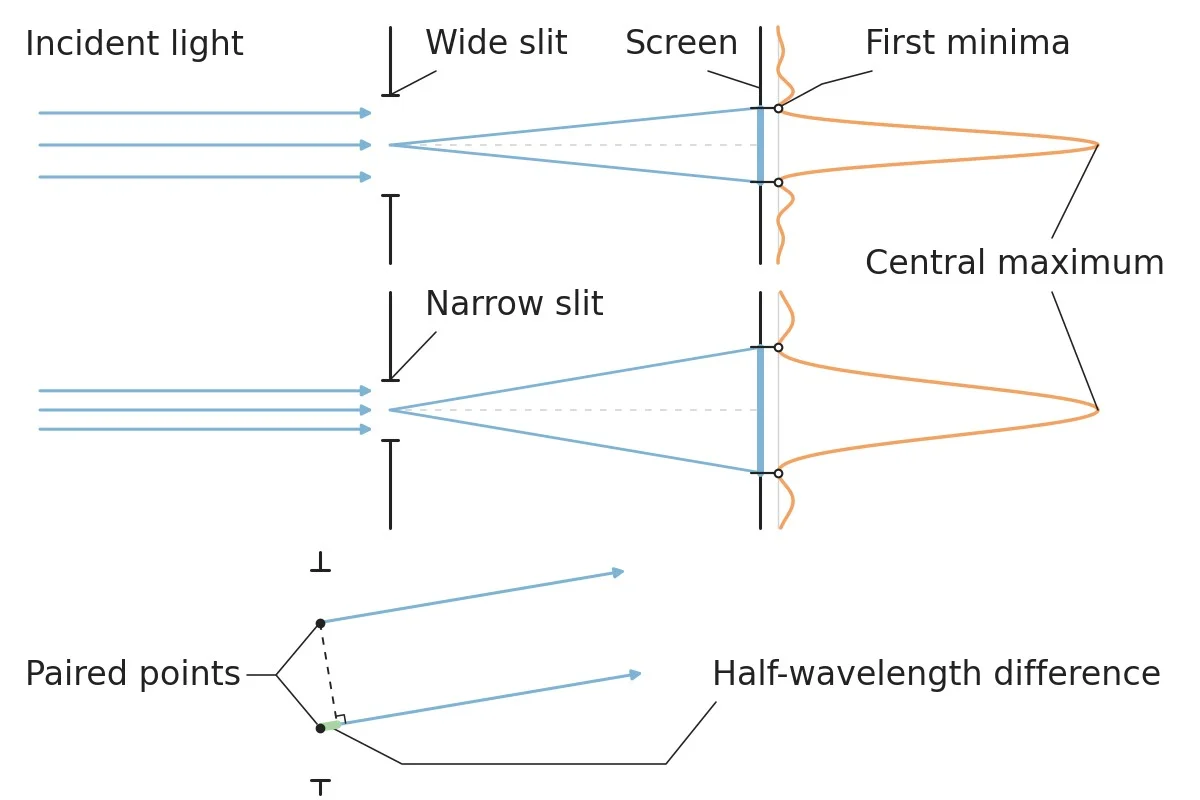
Two slit widths produce different central maxima; paired contributions explain the first dark boundary.

7. Single-slit diffraction

A narrow slit spreads light.

Show
Find the diagram’s paired points and first minimum. Compare both central bands at unchanged wavelength and screen distance.
Ask
Will light from all parts of this slit reinforce at every screen position?
Say
Paired contributions cancel at the first minimum because they arrive half a wavelength apart. Narrowing the slit widens the central bright band.
Used in
Larger telescope apertures reduce diffraction spreading, helping distinguish closely spaced stars.
If your child says…“A wider slit spreads light more.”
Ask
Would bringing the first dark boundaries closer make the central bright region wider or narrower?
What’s true
Narrowing the slit moves its first dark boundaries farther from the bright centre.
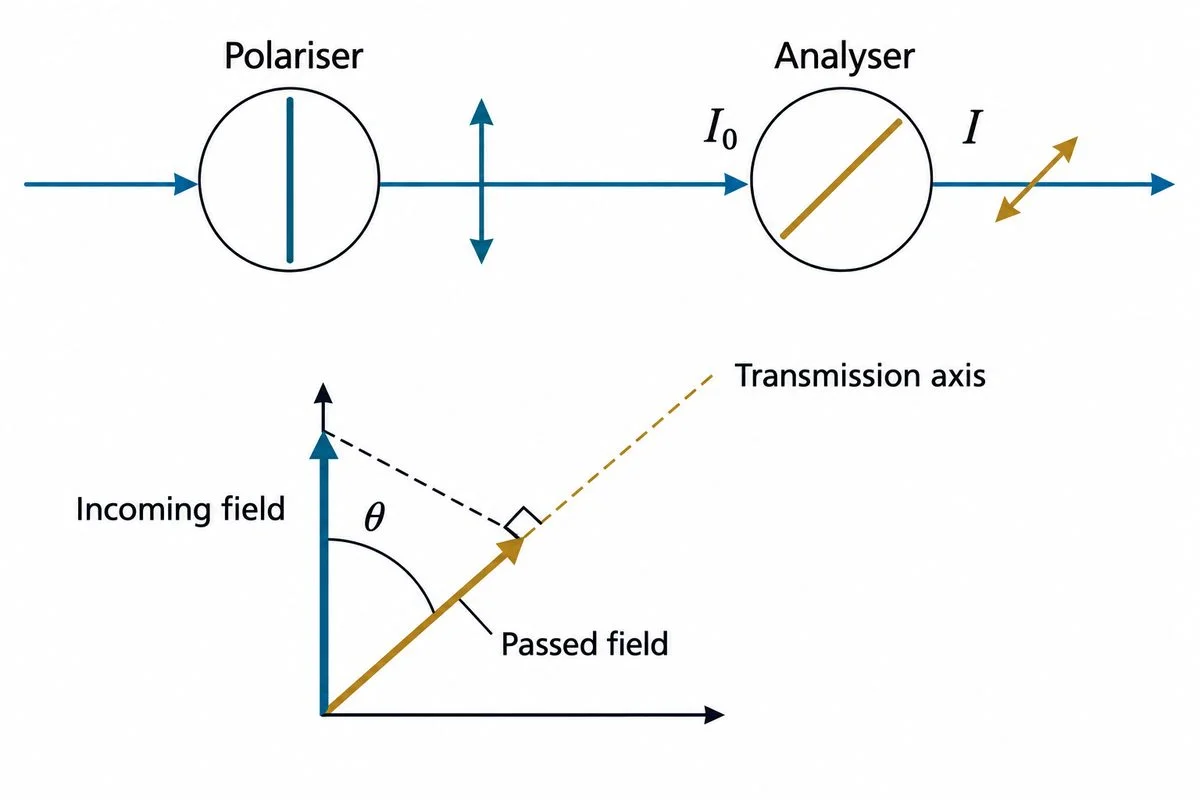
An analyser passes the incoming electric field’s component along its tilted transmission axis.

8. Polarisation and Malus law

A polariser selects a vibration direction.

Show
Follow the diagram’s beam through the polariser and analyser. Find the incoming field and its component along the analyser’s transmission axis.
Ask
As the diagram’s analyser turns towards crossed axes, what will happen to the emerging intensity?
Say
The analyser passes the field component along its axis, and intensity follows its square. Intensity entering the analyser is I₀, and intensity leaving it is I. With θ the angle between the transmission axes, I=I0cos⁡2θI=I_0\cos^2\theta.
Used in
Polarising sunglasses reduce reflected glare, making objects easier to see.
If your child says…“Half the field means half the intensity.”
Ask
What happens to a half when you square it?
What’s true
Halving the electric-field amplitude leaves one quarter of the intensity.

A real problem

Light interference helped detect gravitational waves.

LIGO first detected gravitational waves directly in 2015.

Interference between returning laser beams revealed differences between the detector arms’ lengths.

The detected disturbance came from merging black holes.

ESALIGO Scientific CollaborationNASA

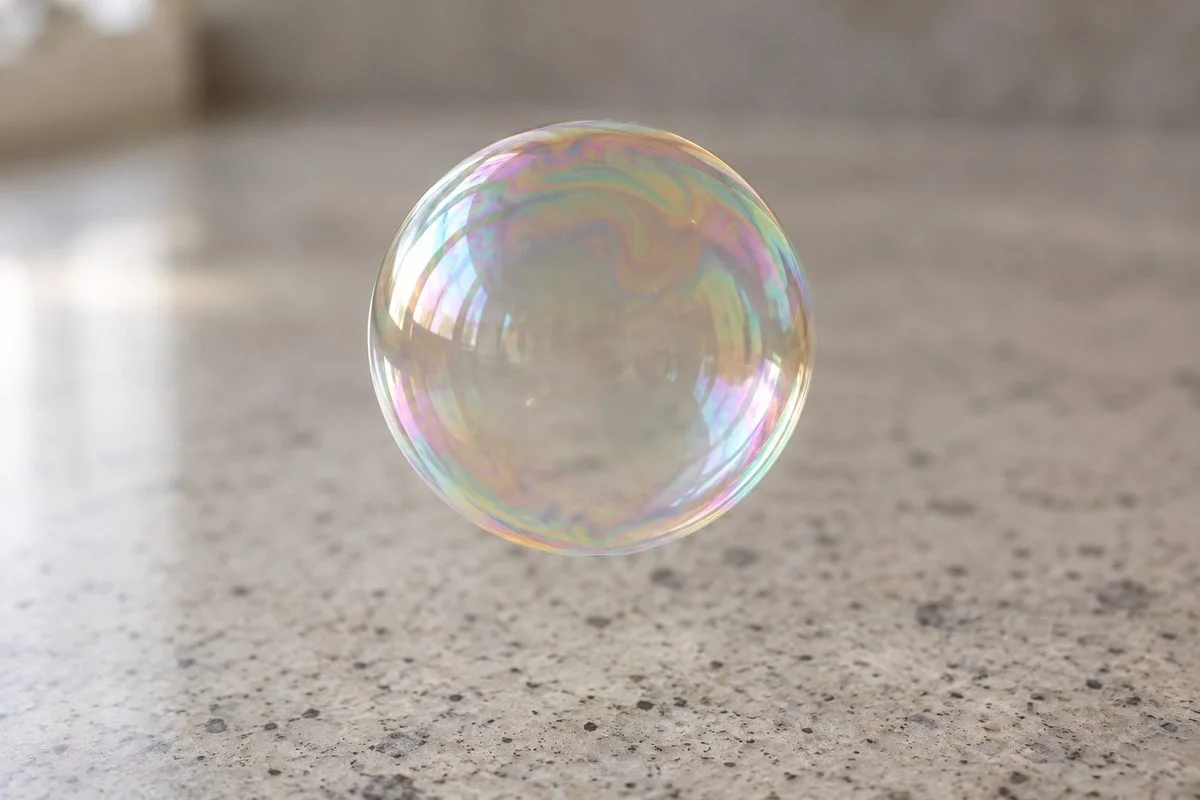
Soap bubble showing colourful interference bands in daylight.

Concept Lab · Common misconception

The tempting mistake in Wave Optics

Open standalone misconception page →

Does a dark fringe mean the light's energy disappeared?

Wrong

Two waves destroy their energy when they make a dark fringe.

Why it feels right. The intensity at that position drops to zero.

Right

Interference redistributes intensity across the pattern.

Worked example

Double-slit intensity has bright peaks and dark troughs. Interference shifts where the light reaches the screen.
  1. In a double-slit pattern, at a dark fringe equal waves arrive half a cycle apart.
  2. At neighbouring bright fringes they reinforce, so energy is concentrated in other regions.

Ask your child eight quick questions.

One per step. The answer and the reason are given.

  1. A light wavefront lies horizontally in uniform air. Which direction do its rays take?

    Perpendicular to that surface. Rays follow the advancing front, rather than running along it.

  2. Light slows when entering stationary glass. What happens to its frequency?

    It stays unchanged. The incoming light sets the vibration rate; slower travel shortens the wavelength.

  3. Two same-colour lamps have randomly changing relative phase. What happens to their interference bands?

    They average out. Equal frequencies alone cannot keep bright and dark positions steady.

  4. Equal, equally polarised beams start in phase. What intensity results from a half-wavelength path difference?

    Zero. Their electric-field amplitudes cancel.

  5. Which 400 nm and 600 nm bright orders first meet beyond the centre?

    Third and second. Three times 400 equals two times 600.

  6. A uniform plate delays one beam. What happens to adjacent bright-fringe spacing?

    It stays unchanged. The same added delay shifts every fringe equally.

  7. At fixed wavelength, what happens to the central bright region when the slit widens?

    It narrows. A wider slit brings the first dark boundaries closer to the centre.

  8. At 60° to the incoming field, what fraction of intensity passes through an ideal analyser?

    One quarter. The field halves, and intensity depends on the field amplitude squared.

15 more questions with answers, 1 with pictures