Skip to content

Teach Atoms in eight steps.

For each idea: show it, ask before you tell, then say one line.

Gather paper and a pencil.

Common misconceptions & worked visual for this chapter · 15 practice questions with answers

How to teach it

Finding the nucleus

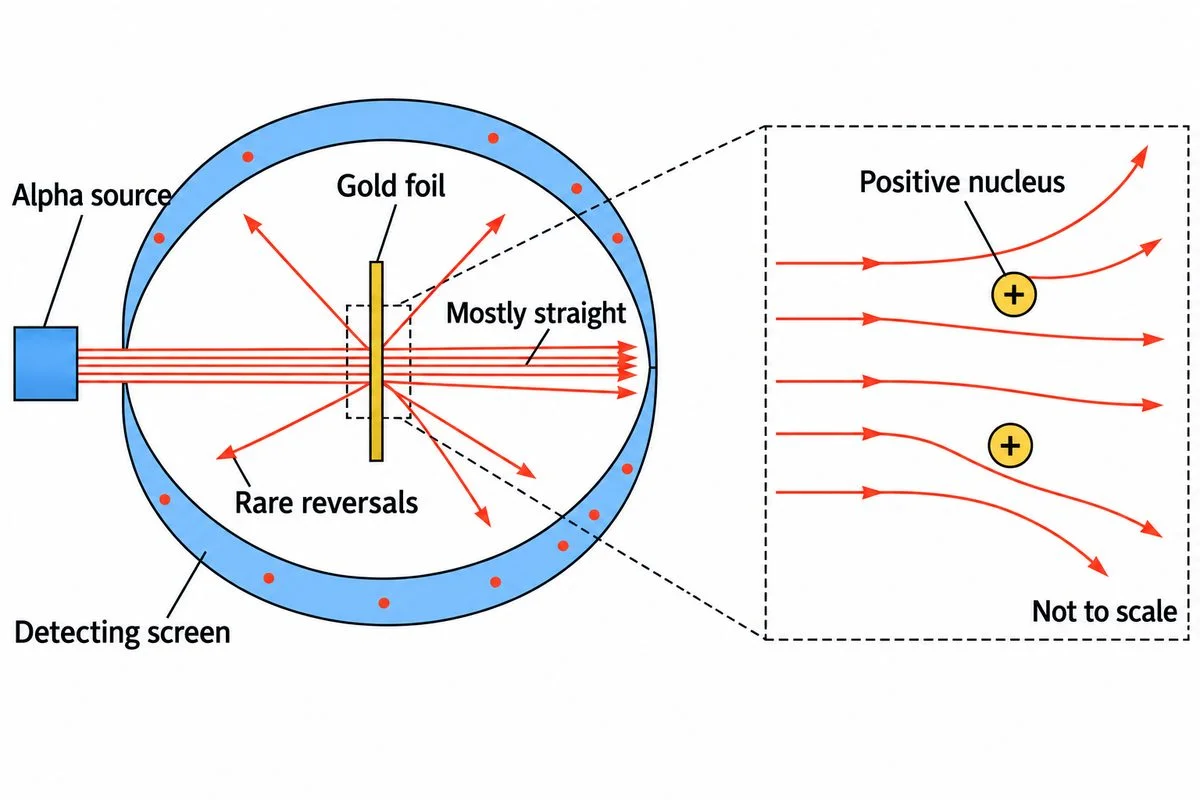
Gold-foil experiment beside enlarged paths curving away from tiny positive nuclei.

1. Nuclear model

A tiny positive nucleus holds nearly all the atom’s mass.

Show
Look at the diagram. Follow the beam through the foil, then find the rare backward paths. Find their turning points beside the positive nuclei.
Ask
Would these heavy particles reverse near a light electron or a massive positive nucleus?
Say
Most paths stay nearly straight because most atomic volume is empty. Rare reversals reveal a tiny positive nucleus holding nearly all the mass.
Used in
A zinc sulphide screen reveals scattered particles through flashes, letting researchers locate them.
If your child says…“The electrons turn alpha particles back.”
Ask
Which could reverse a heavy alpha particle: a light electron or the massive positive nucleus?
What’s true
Electrons lack enough mass to reverse a heavy alpha particle; the positive nucleus repels it.
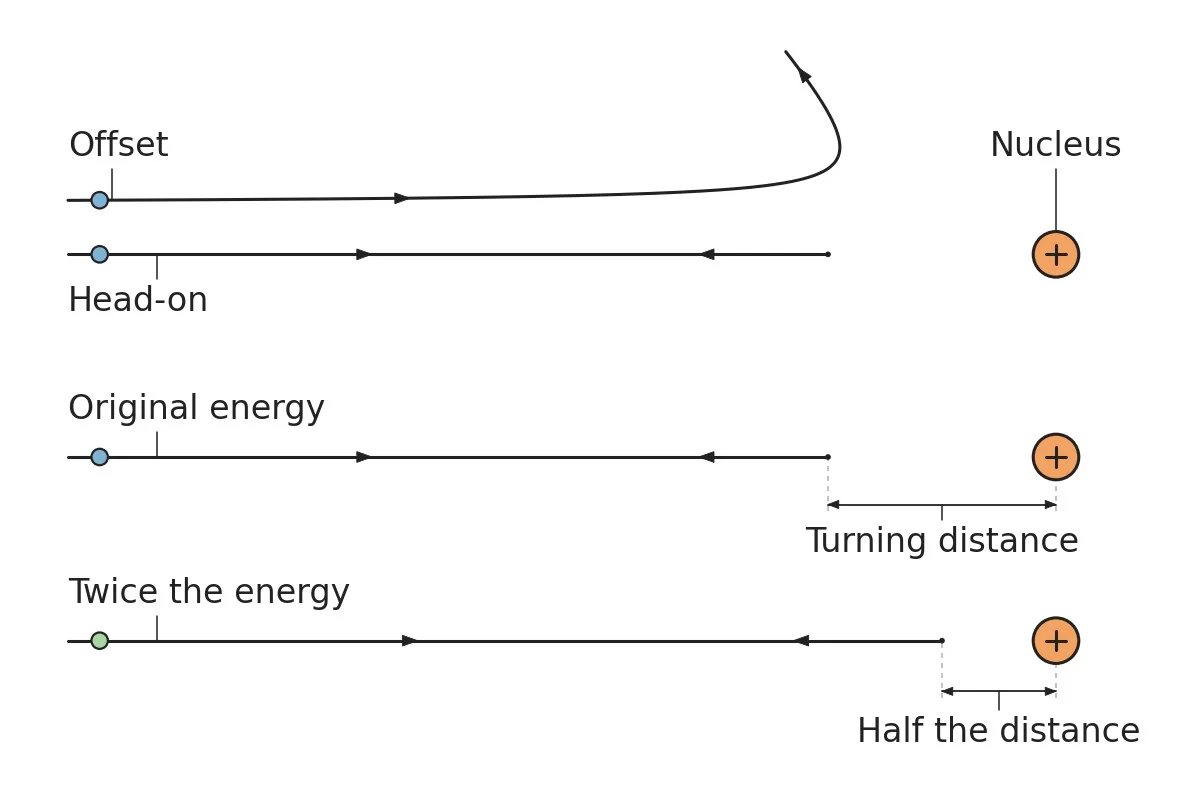
Scattering paths and head-on turning distances at the original energy and twice that energy.

2. Alpha-particle scattering

Initial offset affects deflection; energy affects the head-on turning distance.

Show
Follow the head-on and offset paths in the diagram. Compare the turning distances for the two head-on energies.
Ask
Which head-on particle reaches nearer: the higher-energy or lower-energy one?
Say
For a fixed heavy nucleus, closer aim increases deflection at equal energy. Doubling head-on energy halves turning distance.
Used in
Head-on turning distances give an upper bound on nuclear size.
If your child says…“A faster alpha particle turns back farther away.”
Ask
Which turning point is closer in the diagram?
What’s true
With charges unchanged, more kinetic energy carries the particle closer before it reverses.

Bohr’s orbits and energy levels

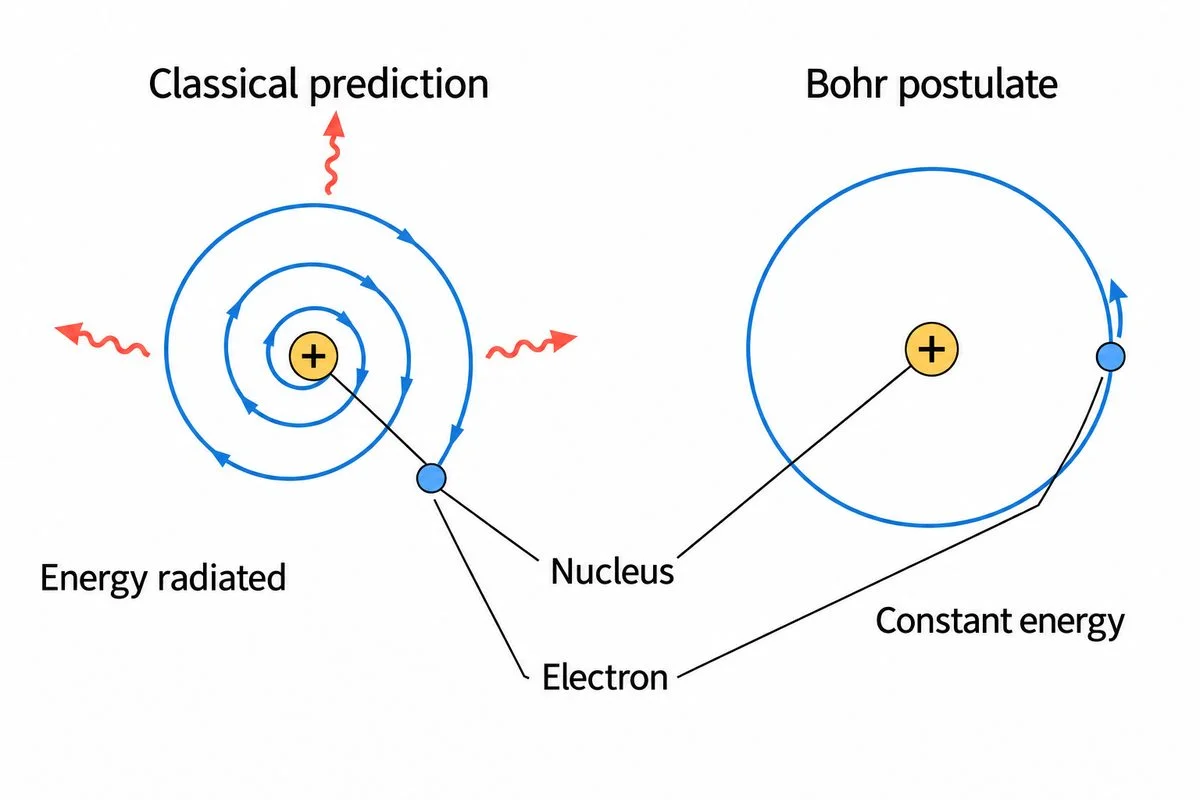
Classical inward spiral beside Bohr’s circular orbit with constant energy.

3. Stationary states

Bohr’s electron keeps its energy while remaining in an allowed orbit.

Show
Look at the diagram’s inward spiral and outgoing radiation arrows. Compare the circular orbit on the right and its motion arrow.
Ask
Would the circular orbit shown remain stable if its electron radiated energy?
Say
The circular orbit would not remain stable. The electron still moves. Classically, changing direction means acceleration, so the electron radiates and spirals inward.
Used in
Atomic clocks use transitions between stable energy levels to keep precise time.
If your child says…“The electron gives off light every time it goes around.”
Ask
If the electron emitted light every turn, where would that energy come from?
What’s true
In Bohr’s model, radiation accompanies a downward transition, not motion within a stationary orbit.

L2=2ℏL_2=2\hbar

r2=22r1=4r1r_2=2^2r_1=4r_1

v2=v1/2v_2=v_1/2

4. Quantised angular momentum and Bohr orbits

Bohr’s rule fixes allowed radii, speeds and revolution times.

Show
Write these lines. Say: “L means angular momentum, r radius, v speed; subscripts identify orbits. H-bar is Planck’s constant divided by twice pi.”
Ask
How much longer does the second revolution take?
Say
Eight times longer: four times the distance at half the speed.
Used in
Calculated hydrogen orbits predict its spectral lines, helping astronomers identify hydrogen in stars.
If your child says…“The orbits are equally spaced.”
Ask
If radii follow squared orbit numbers, would successive differences stay equal?
What’s true
Doubling hydrogen’s orbit number quadruples its radius, halves its speed and multiplies revolution time by eight.
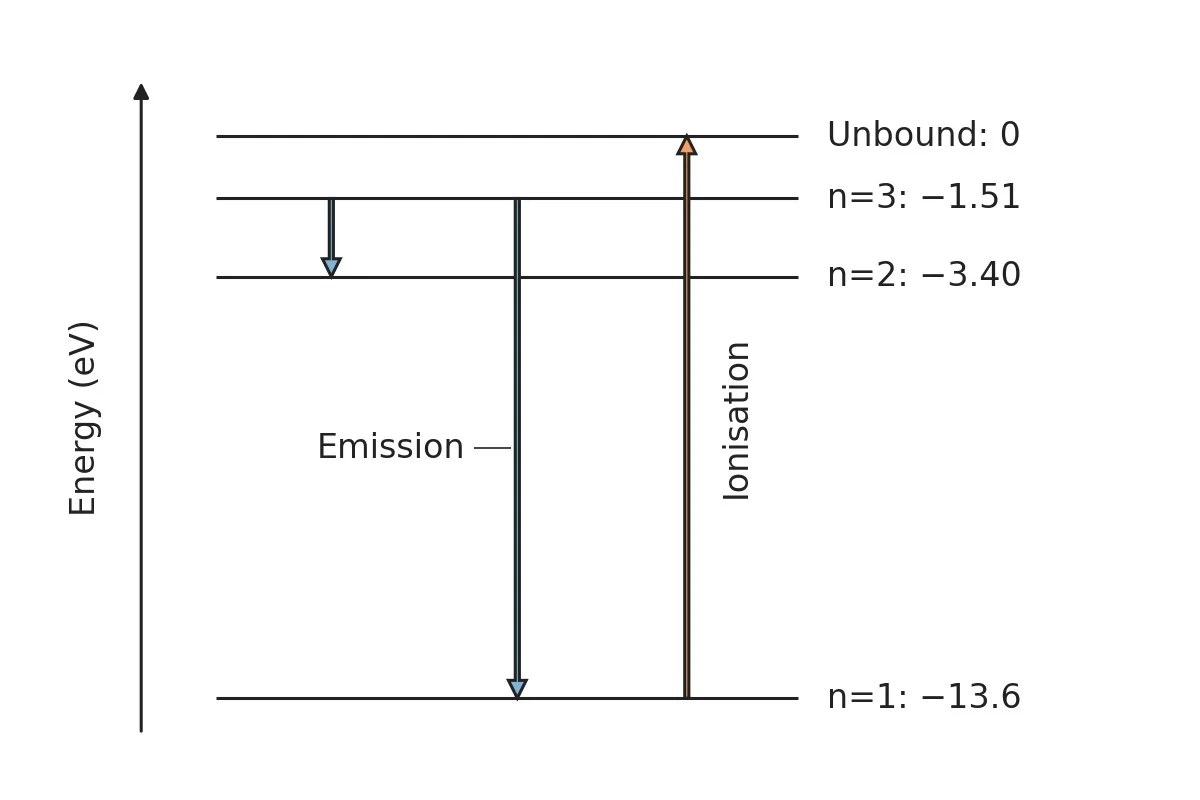
Hydrogen energy levels below zero, with emission arrows and an upward ionisation arrow.

5. Atomic energies and photon transitions

Negative total energy indicates binding, while transitions exchange photons.

Show
Find the diagram’s zero: rest infinitely far away, with potential energy also zero. Follow both downward arrows.
Ask
Which arrow gives the shorter wavelength?
Say
Negative total energy means binding. The larger drop gives the shorter wavelength.
Used in
Discharge lamps emit light when excited atoms lose energy, lighting signs.
If your child says…“A bigger energy jump gives a longer wavelength.”
Ask
If photon energy times wavelength stays constant, can both increase together?
What’s true
More photon energy means a shorter wavelength.

Spectra and the model’s limits

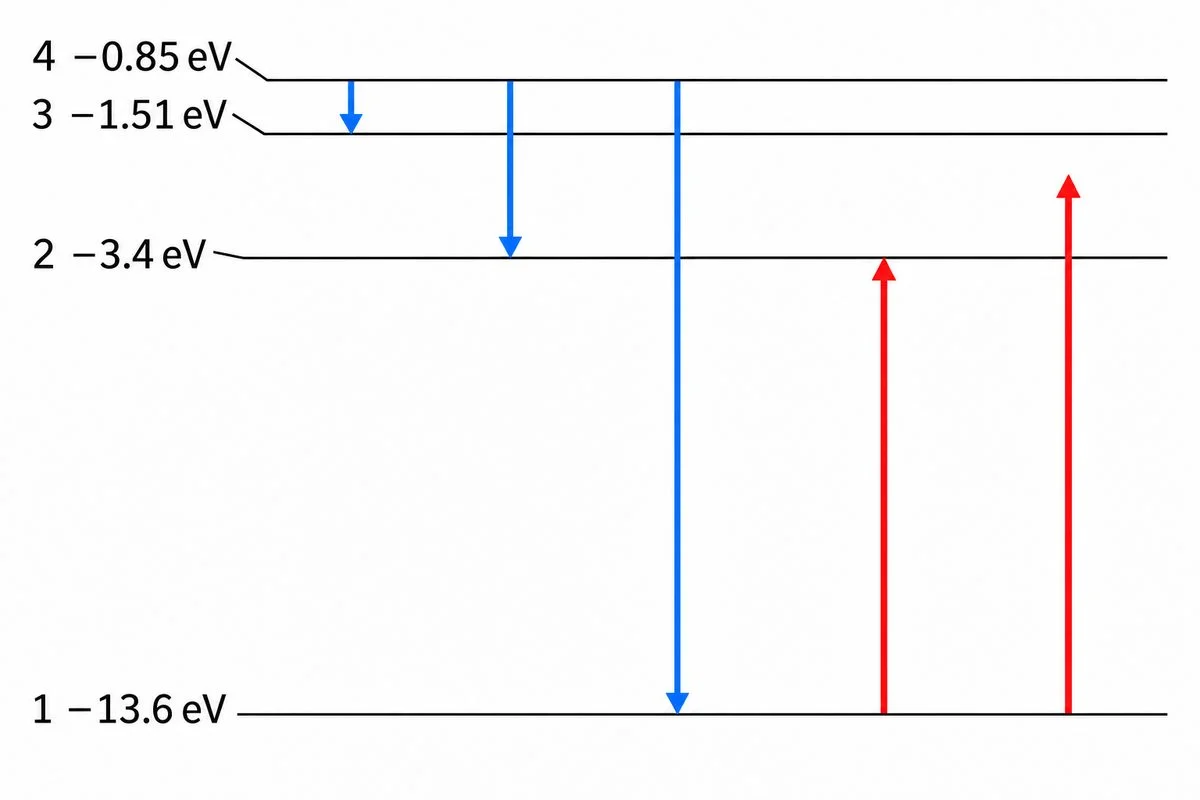
Four hydrogen energy levels with downward transitions and matching and unmatched upward arrows.

6. Hydrogen spectra and selective absorption

Level gaps set spectral lines and which photons can excite atoms.

Show
Find the four levels and three downward arrows in the diagram. Compare where the two upward arrows end.
Ask
Which upward arrow shows a photon the atom could absorb?
Say
The upward arrow ending at a level shows a photon the atom could absorb. Absorption needs matching photons.
Used in
Spectral lines identify elements in sunlight, revealing the Sun’s composition.
If your child says…“Any photon above the first excitation energy gets absorbed.”
Ask
Where would the unmatched photon’s extra energy go if the atom absorbed it whole?
What’s true
Level 4 has three downward jumps, level 3 has two, and level 2 has one. Across many atoms, these give six possible spectral lines. Photon absorption below ionisation needs an exact match.
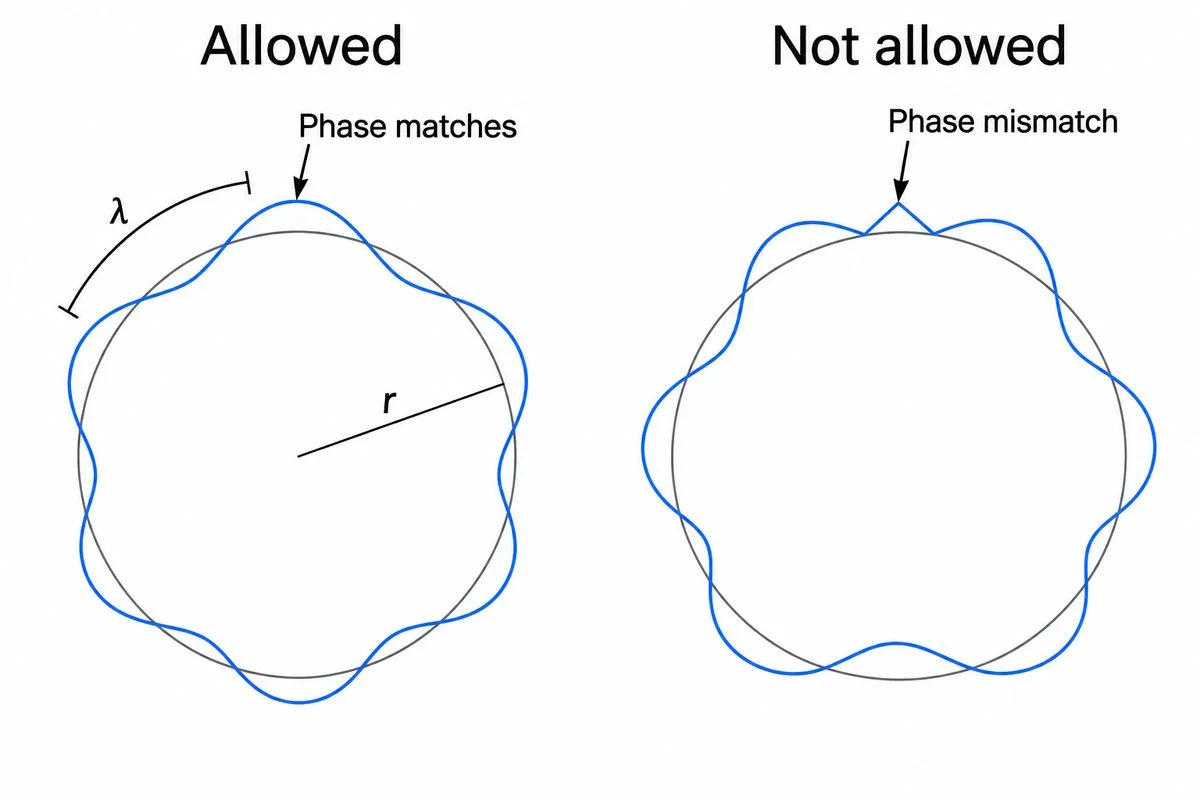
Circular waves with matching and mismatching seams, beside radius and wavelength markers.

7. de Broglie standing-wave condition

Whole electron wavelengths fit around an allowed orbit’s circumference.

Show
Compare where each wave rejoins itself at the top of the diagram. Find the radius and one wavelength. Say: “r means radius, n counts wavelengths, and lambda means wavelength.”
Ask
Which wave could repeat around the orbit without a mismatch?
Say
Only whole wavelengths join smoothly around the circumference: 2πr=nλ2\pi r=n\lambda. The wavy line shows phase matching, not the electron’s path.
Used in
Electron microscopes use electrons’ short wavelengths to reveal details too small for ordinary microscopes.
If your child says…“The wavelengths fit along the radius.”
Ask
Would following the radius bring the wave back to its starting point?
What’s true
The electron wave must match itself after following the whole circumference.
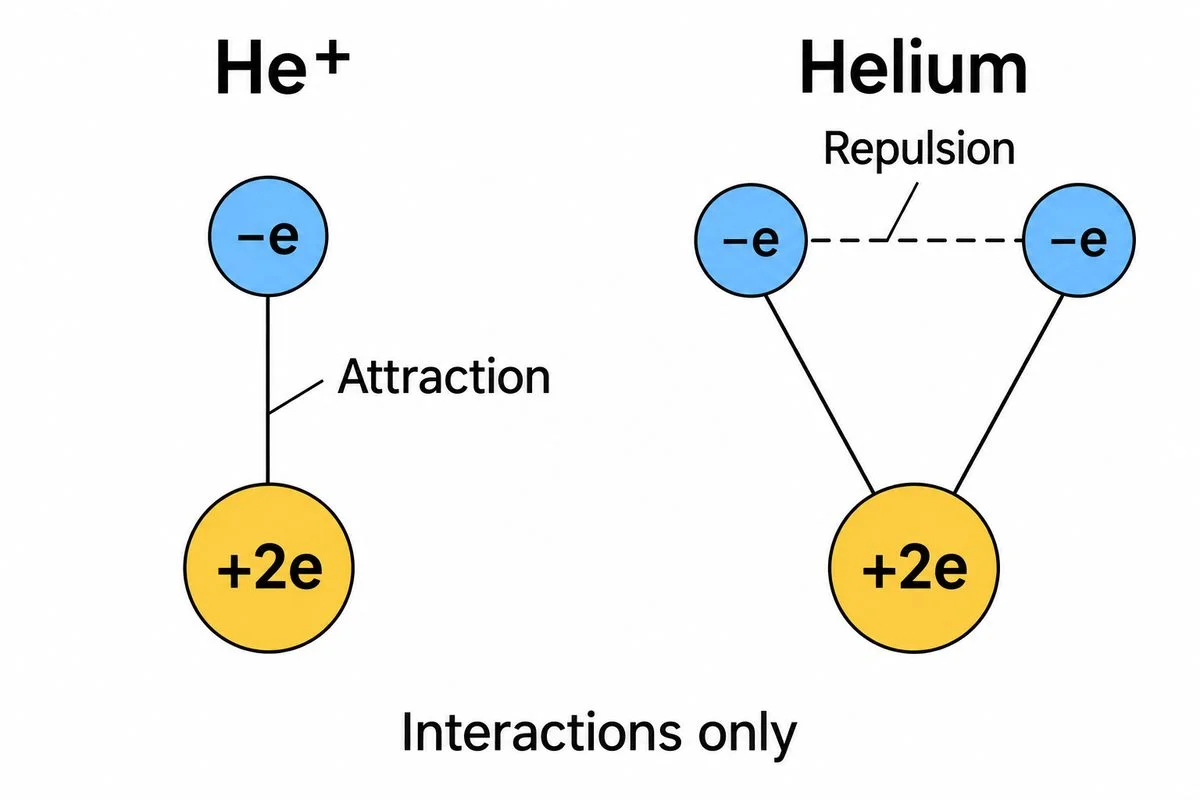
One-electron helium ion beside neutral helium, showing the additional repulsion between electrons.

8. Limits of the Bohr model

Bohr’s simple calculation applies to atoms or ions containing one electron.

Show
Look at the diagram’s identical nuclei. Count the electrons on each side. Find the extra interaction joining the two electrons on the right.
Ask
With two electrons shown, would their mutual repulsion change the one-electron calculation?
Say
The two electrons repel each other while both are attracted to the nucleus. Bohr’s simple calculation handles one electron and leaves out this extra interaction.
Used in
Modern atomic models help predict chemical bonds, supporting the design of useful materials.
If your child says…“Bohr’s model works for every atom.”
Ask
Where does the second electron’s repulsion appear in the one-electron calculation?
What’s true
Neutral helium has two electrons that repel each other.

A real problem

A solar spectral line led to helium’s discovery.

In 1868, Janssen visited Guntur, India, to observe a solar eclipse.

A newly observed yellow spectral line pointed to an unknown element.

Lockyer named the element helium.

Such lines carry energy released when electrons move between atomic levels.

American Physical SocietyRoyal Society of ChemistryNASA

A prism’s colour band illustrates dispersion, without showing helium’s identifying spectral line.

Concept Lab · Common misconception

The tempting mistake in Atoms

Open standalone misconception page →

Is an emitted photon set by the upper energy level alone?

Wrong

The photon energy equals the atom's energy at the upper level.

Why it feels right. The light comes from an atom leaving that level.

Right

The photon carries the difference between the two levels.

Worked example

Both transitions begin at −2 eV. The lower destination gives the larger energy gap.
  1. In a model atom, a transition from −2 eV to −5 eV emits a 3 eV photon.
  2. A transition from the same upper level to −8 eV emits a 6 eV photon.

Ask your child eight quick questions.

One per step. The answer and the reason are given.

  1. What causes some alpha particles to reverse at the foil?

    Repulsion by the positive nucleus. Its concentrated positive charge and large mass account for the reversals.

  2. For unchanged charges and a fixed heavy nucleus, how does doubling energy change head-on turning distance?

    It halves. With charges unchanged, turning distance varies inversely with the starting kinetic energy.

  3. What happens to an electron’s energy while it stays in one allowed Bohr orbit?

    It stays constant. Bohr postulates that an allowed orbit does not radiate.

  4. How do the radial gaps from orbit 1→2 and orbit 2→3 compare?

    The 2→3 gap is larger. The radii follow the squares of orbit numbers, so successive gaps increase.

  5. Hydrogen allows both 3→1 and 3→2 transitions. Which emits the shorter wavelength?

    3→1. The larger energy drop produces the higher-energy photon and therefore the shorter wavelength.

  6. Below ionisation, what must a photon’s energy match to excite an atom?

    An allowed energy gap. The whole photon is absorbed, so its energy must match the transition.

  7. In Bohr orbit number 3, where must three electron wavelengths fit?

    Around the orbit’s circumference. The wave closes around the entire orbit.

  8. Which can Bohr’s simple calculation handle: neutral helium or helium with one electron removed?

    Helium with one electron removed. It has one electron; neutral helium has two interacting electrons.

15 more questions with answers, 1 with pictures