Skip to content

Teach Electromagnetic Induction in eight steps.

For each idea: show it, ask before you tell, then say one line.

Gather paper and a pencil.

Common misconceptions & worked visual for this chapter · 15 practice questions with answers

How to teach it

Flux, voltage and current

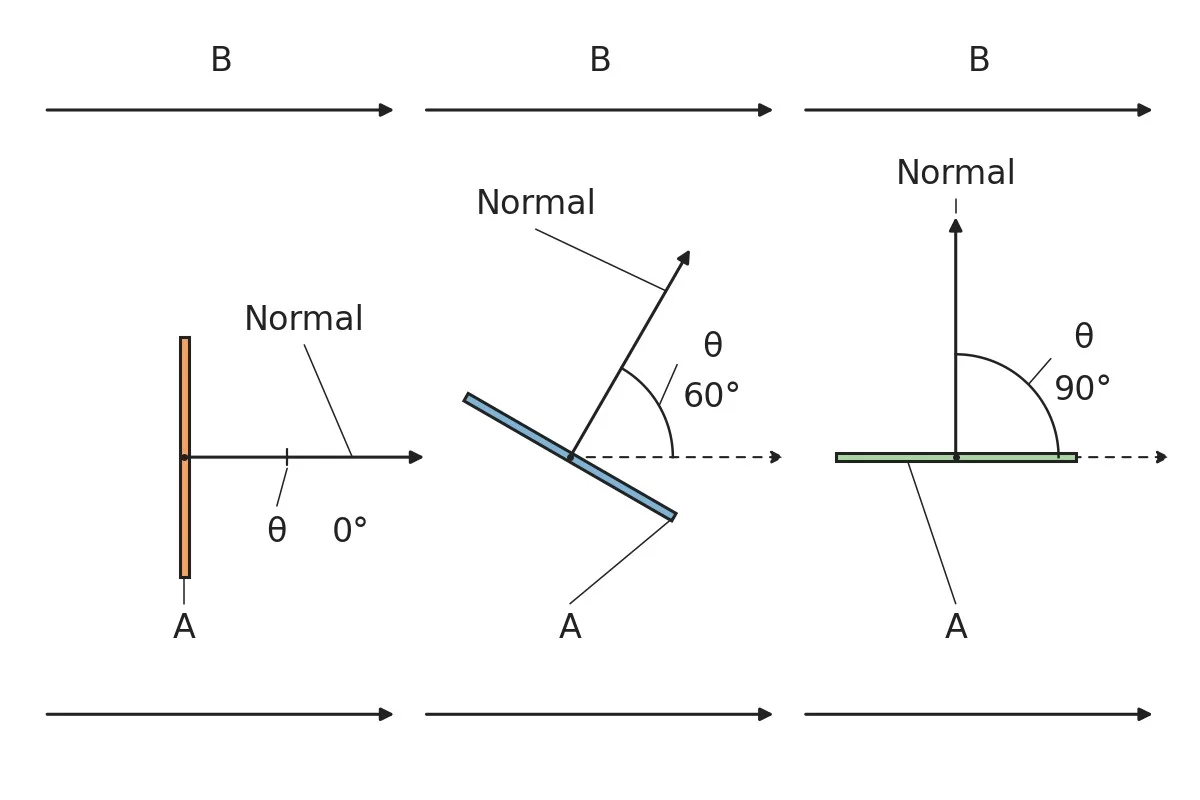
Three surfaces turn relative to a uniform field, with normals and angles marked.

1. Magnetic flux

Flux measures how much magnetic field crosses a surface.

Show
Look at the diagram’s three surfaces. Find each perpendicular normal, then its angle with the field.
Ask
How will turning this surface edge-on change its flux without changing the field?
Say
Turning the surface edge-on reduces its flux to zero.
Used in
Aligned charging coils share more magnetic flux, helping wireless chargers transfer energy efficiently.
If your child says…“The field along the paper counts too.”
Ask
In the edge-on panel, do the field arrows cross the surface or run along it?
What’s true
A field running entirely along a flat surface contributes no flux through it.
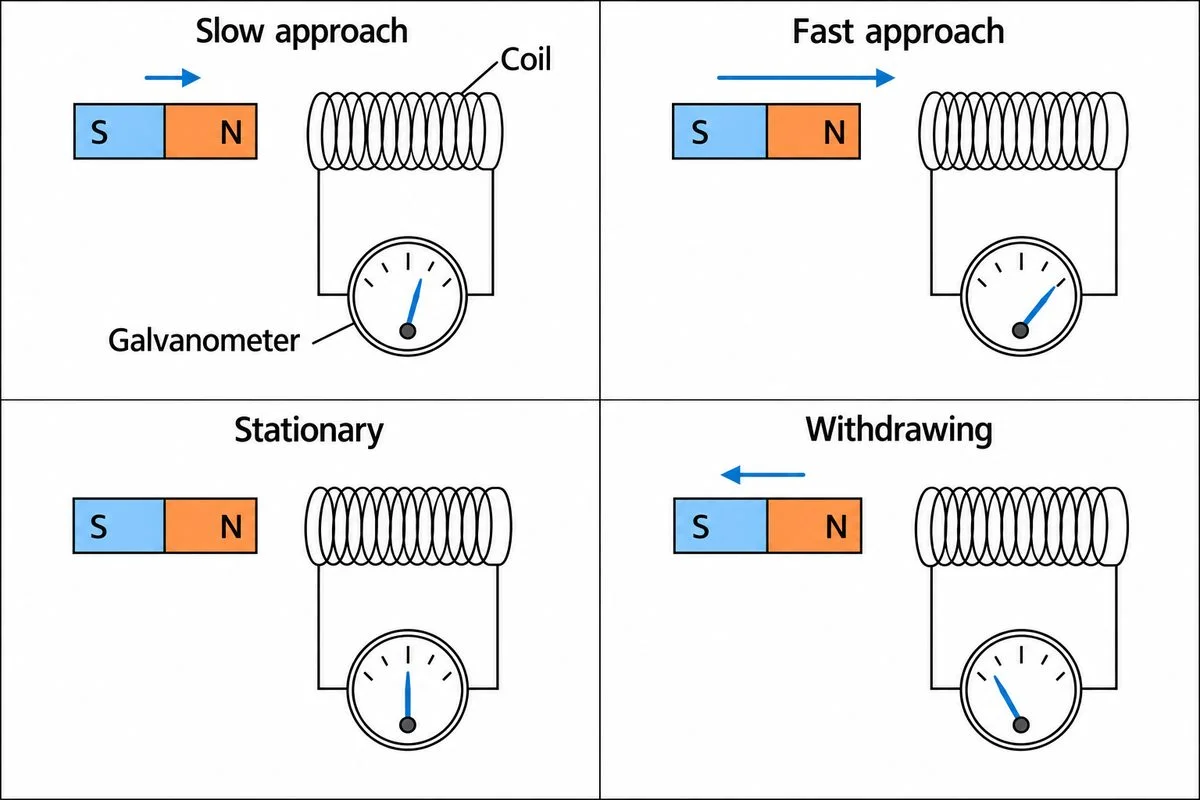
Four magnet motions beside identical coils produce different galvanometer readings.

2. Faraday’s law

Induced voltage depends on how quickly linked magnetic flux changes.

Show
Look at the diagram’s magnets and connected coils. Compare their motion arrows before reading the meters.
Ask
What will happen to the induced voltage when the approaching magnet stops?
Say
The galvanometer shows current. The stationary magnet gives zero voltage, while withdrawal reverses it.
Used in
Induction cooktops use changing magnetic flux to drive currents that heat cooking vessels.
If your child says…“A stronger steady field gives more voltage.”
Ask
Once the magnet stops, what is changing through the fixed coil?
What’s true
Unchanging flux produces no induced voltage, however large the flux.
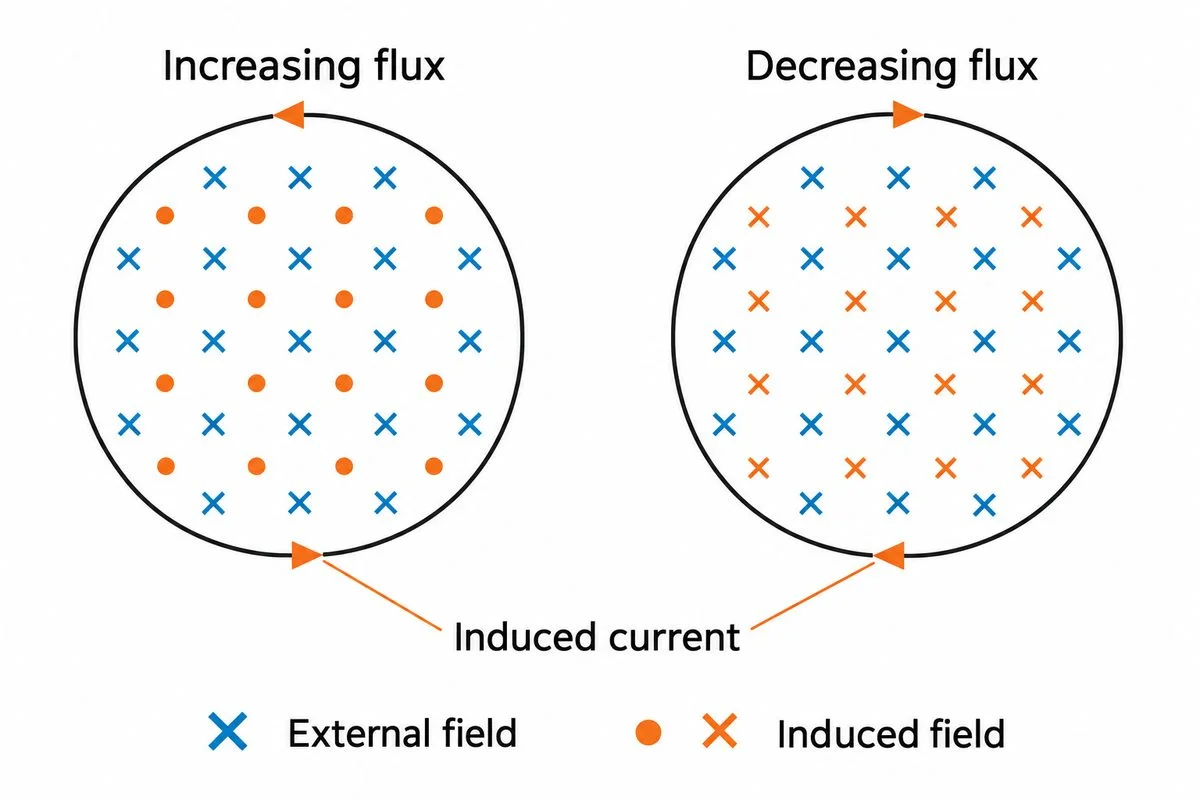
Induced currents oppose increasing and decreasing inward flux in two closed loops.

3. Lenz’s law

Induced current opposes the flux change that produces it.

Show
Look at the diagram’s increasing and decreasing inward fields. Match each current arrow to its induced field using the right-hand grip rule.
Ask
As the inward field weakens, which current direction will resist that change?
Say
Clockwise current produces an inward field, resisting the decrease. Anticlockwise current produces an outward field, resisting the increase.
Used in
Magnetic brakes use induced currents to resist motion, slowing moving parts without rubbing surfaces together.
If your child says…“The induced field always opposes the existing field.”
Ask
Would an outward induced field preserve the weakening inward flux or reduce it further?
What’s true
The induced field reinforces a weakening external field to resist its decrease.
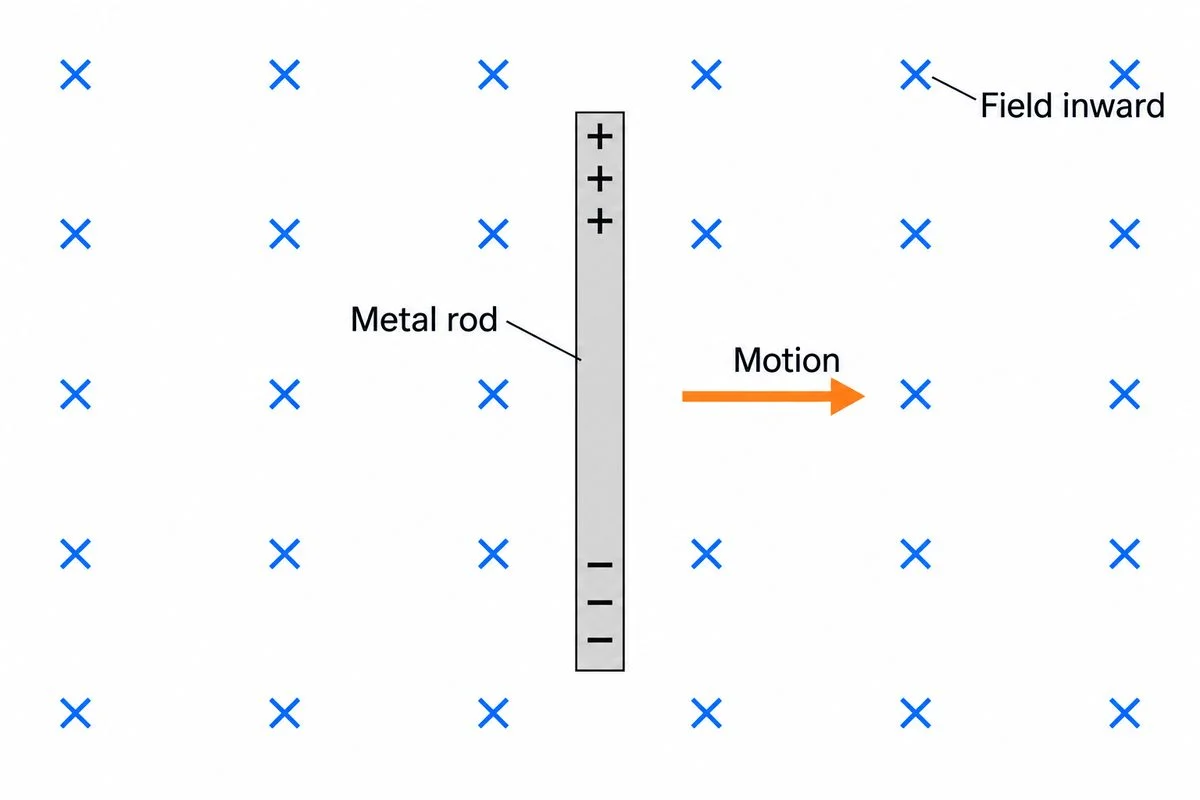
Diagram of an unconnected moving rod, positive above and negative below.

4. Motional emf

Motion across a magnetic field can produce voltage without circulating current.

Show
Look at the rod diagram. Find its open ends and rightward motion arrow. Find the inward field crosses and the separated charges.
Ask
Can charges keep circulating with both ends unconnected?
Say
The magnetic force shifts electrons downward, leaving a voltage between the ends. The open path prevents continuous current.
Used in
Moving-coil microphones turn sound into voltage for recording.
If your child says…“Open ends mean there cannot be any voltage.”
Ask
Must these separated charges circulate for the ends to have different voltages?
What’s true
Separated charges can produce voltage even when there is no complete conducting path.

Induction in coils

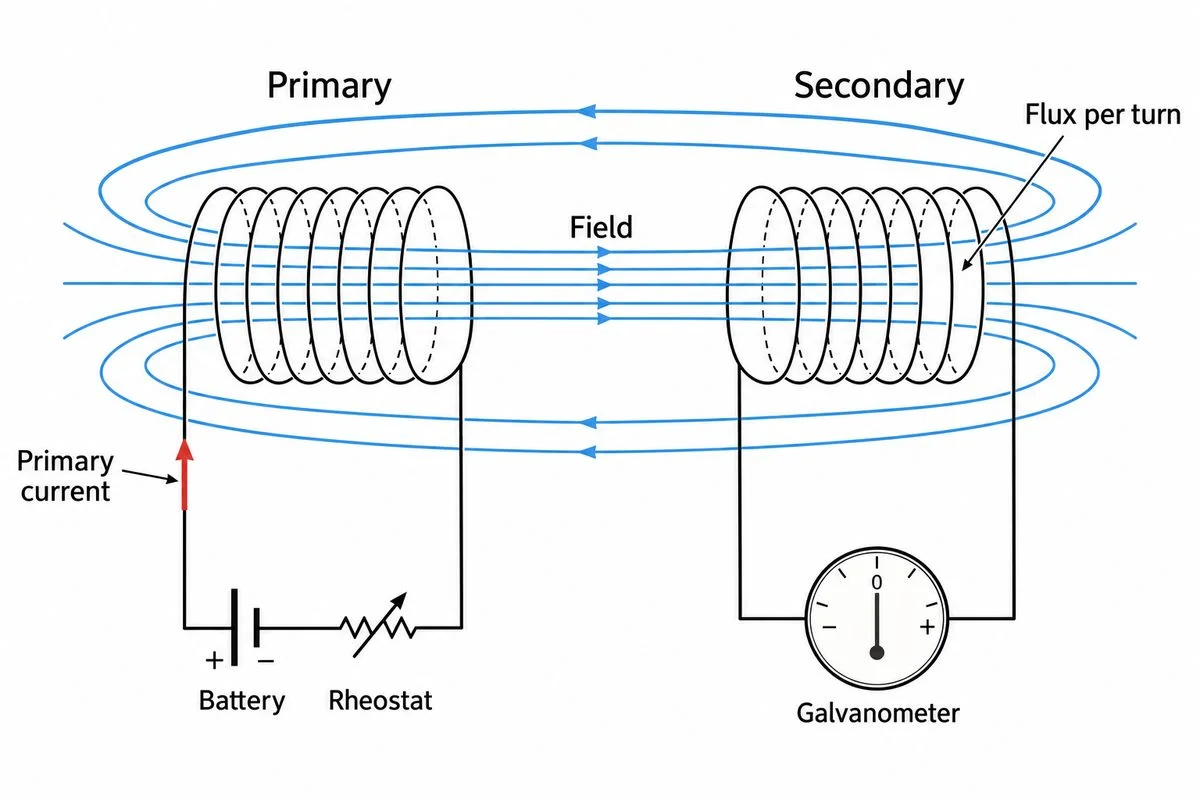
Separate primary and secondary circuits share magnetic flux through their coils.

5. Mutual inductance

Mutual inductance measures secondary flux linkage per ampere in the primary.

Show
Look at the diagram. Follow the primary’s field through the secondary.
Ask
How can changing primary current produce voltage in this separate secondary?
Say
Its changing field induces voltage in the secondary.
Used in
Transformers transfer energy between coils to lower supply voltage for homes.
If your child says…“Taking longer means less total flux change reaches the other coil.”
Ask
With unchanged coils, would taking longer change the final field if the final current stayed unchanged?
What’s true
With fixed mutual inductance, current change sets the total flux linkage change in the secondary.
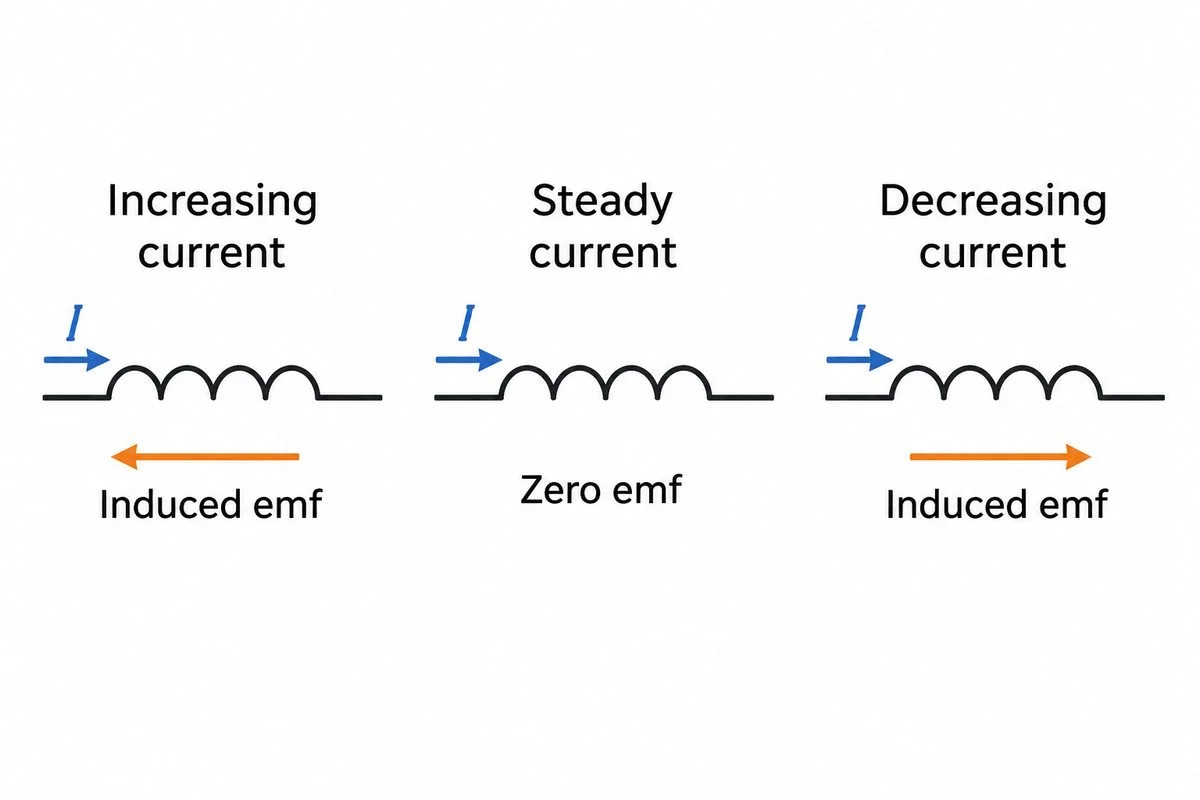
The same current direction accompanies opposing, zero and supporting self-induced emf.

6. Self-induction

A coil’s changing current induces voltage in that same coil.

Show
Look at the diagram’s matching current directions. Compare the induced emf arrows during rising and falling current.
Ask
As this coil’s current falls, which way will its own induced voltage drive current?
Say
It drives current forwards, resisting the fall in the coil’s own magnetic flux. During a rise, it drives backwards.
Used in
Choke coils limit alternating current in fluorescent lamps, protecting the lamps from excessive current.
If your child says…“The coil always pushes against the current.”
Ask
To resist a decrease, must the coil support the current or reduce it further?
What’s true
Induced voltage supports falling current, opposes rising current, and disappears when current stays steady.

U=12LI2U=\frac{1}{2}LI^2

U=12(2 H)(3 A)2U=\frac{1}{2}(2\,\mathrm{H})(3\,\mathrm{A})^2

7. Magnetic energy

A coil stores energy in its magnetic field.

Show
Write these lines. Name energy U, constant inductance L (2 H), and current I (3 A).
Ask
How much energy does this coil’s magnetic field store?
Say
The field stores 9 J.
Used in
Vehicle ignition coils store magnetic energy and release it to make sparks that ignite fuel.
If your child says…“Reversing current makes stored energy negative.”
Ask
Does squaring a negative current give a negative energy?
What’s true
Reversing current without changing its magnitude leaves the final stored energy unchanged.

Generating electricity

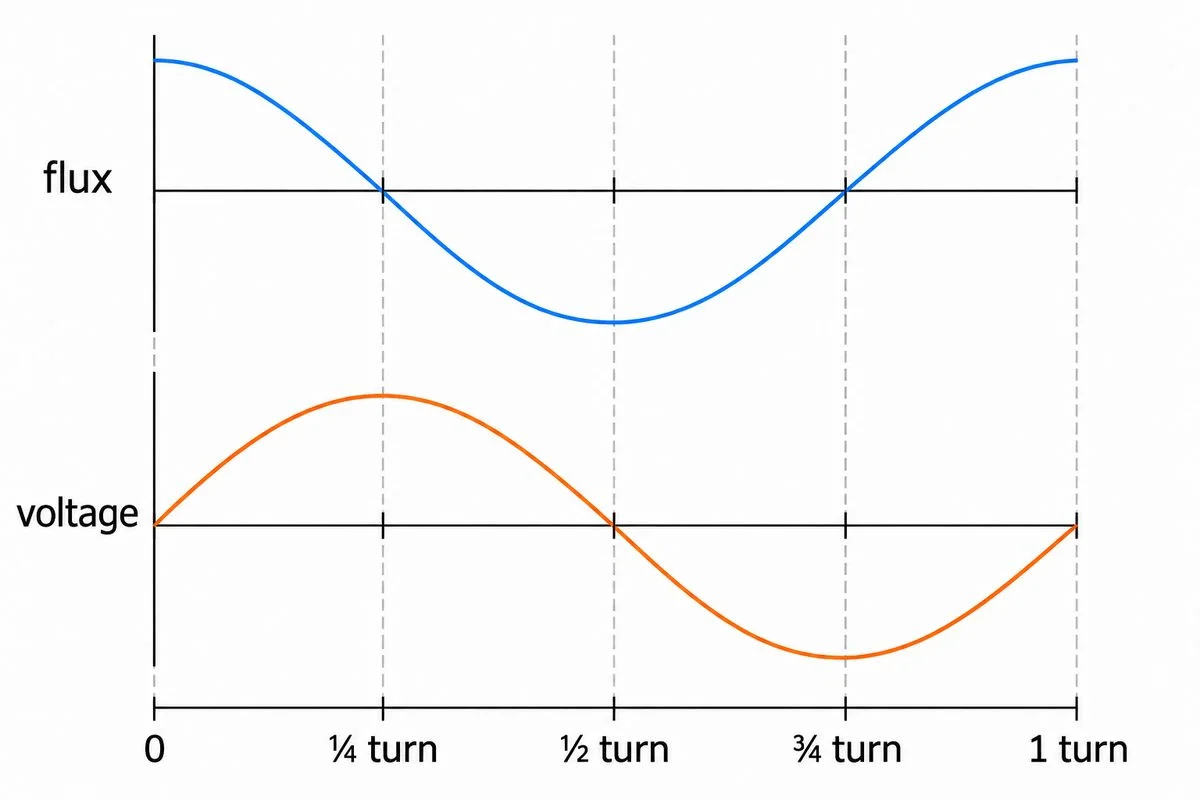
Aligned graphs show flux peaks matching voltage zeros.

8. AC generator

A rotating coil can produce alternating voltage.

Show
Look at the diagram’s aligned flux and voltage graphs. Find the flux peaks and troughs, then locate the corresponding voltage values.
Ask
At the next flux peak, where will the voltage curve be?
Say
Voltage is zero at flux extremes and greatest in magnitude when flux crosses zero.
Used in
Hydroelectric generators produce electricity that can supply public lighting.
If your child says…“The most flux means the most voltage.”
Ask
At a flux peak, is the flux curve steep or briefly level?
What’s true
Generator voltage follows the rate of flux change, rather than the amount of flux.

A real problem

Sidrapong brought electricity for better public lighting.

Sidrapong Hydroelectric Power Station opened on 10 November 1897.

Its electricity improved public lighting in Darjeeling.

Many hydroelectric generators produce electricity by rotating electromagnets past stationary conductors.

IEEE Milestones proposalU.S. Geological Survey

Glowing streetlamp beside a hillside road in Darjeeling at dusk.

Concept Lab · Common misconception

The tempting mistake in Electromagnetic Induction

Open standalone misconception page →

Will a stationary magnet keep inducing current?

Wrong

A strong magnet held inside a coil keeps inducing a current.

Why it feels right. The magnet keeps producing a field through the coil.

Right

An emf is induced while the magnetic flux through the coil changes.

Worked example

The meter deflects while flux changes. Reversing the motion reverses the deflection.
  1. Move the magnet into a closed coil with a meter.
  2. The meter deflects during movement, returns to zero when the magnet stops, and deflects oppositely when it is withdrawn.

Ask your child eight quick questions.

One per step. The answer and the reason are given.

  1. Which part of the magnetic field contributes to flux through the surface?

    Only the perpendicular component. Field running along the surface does not cross it.

  2. Two identical coils have constant fluxes of different sizes. What voltage does induction produce?

    Zero in both. Voltage depends on flux changing, rather than its size.

  3. An inward magnetic field through a closed loop weakens. Which way does induced current flow?

    Clockwise. Its inward field resists the decrease in inward flux.

  4. What prevents continuous current despite the voltage between this moving rod’s ends?

    The open conducting path. Charges separate, but they have no complete path around which to circulate.

  5. The same current change takes longer with fixed mutual inductance. What happens to flux linkage change?

    It stays the same. Duration affects induced voltage, not the total linked-flux change.

  6. An ideal coil carries steady nonzero current. What is its self-induced voltage?

    Zero. Its current and its own magnetic flux are no longer changing.

  7. Current reverses but keeps the same magnitude. What happens to the coil’s final stored energy?

    It stays the same. Magnetic energy depends on current squared, so reversing current leaves it unchanged.

  8. A generator coil rotates uniformly through maximum flux. What is its induced voltage at that instant?

    Zero. At maximum flux, the instantaneous rate of flux change is zero.

15 more questions with answers, 1 with pictures