Skip to content

Teach Nuclei in eight steps.

For each idea: show it, ask before you tell, then say one line.

Gather paper and a pencil.

Common misconceptions & worked visual for this chapter · 15 practice questions with answers

How to teach it

What nuclei contain

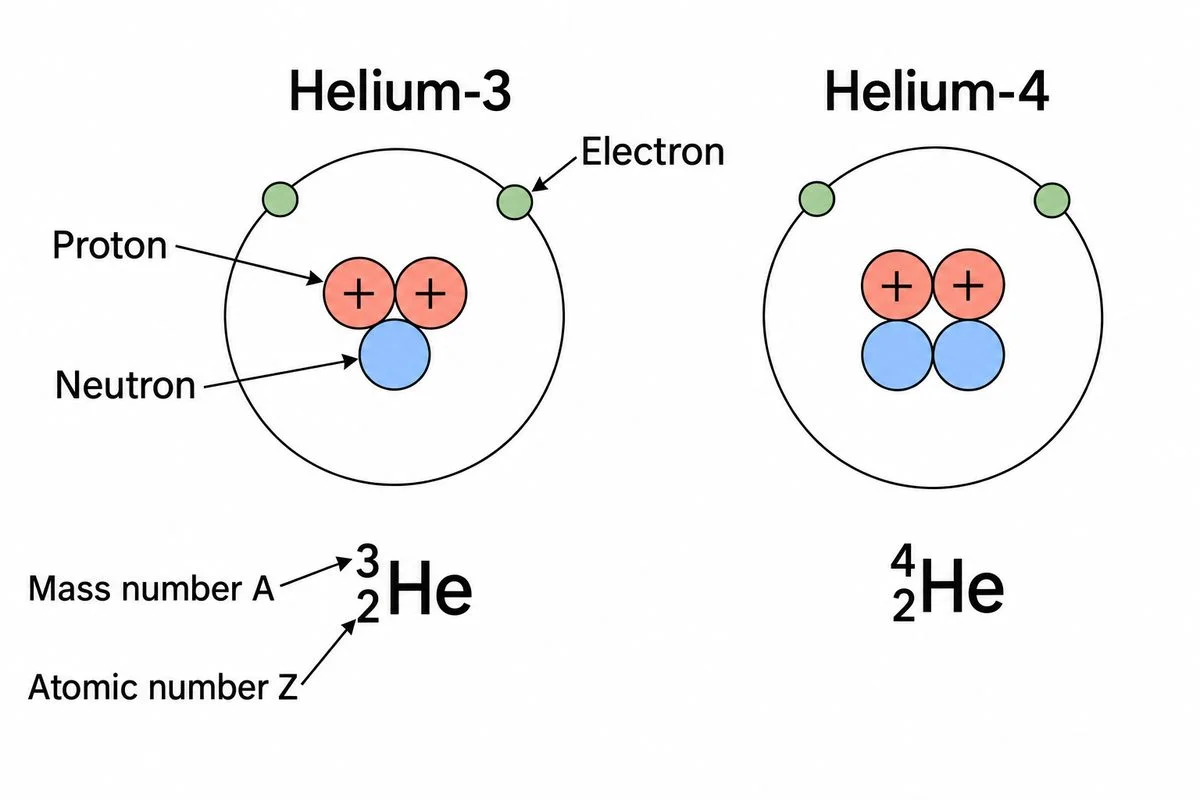
Helium isotopes have matching proton counts, different neutron counts, and electrons outside their nuclei.

1. Nuclear composition and atomic masses

Mass number A counts nucleons. Atomic number Z counts protons.

Show
Look at the diagram. Compare the nuclei, then find the electrons outside.
Ask
For these helium atoms, would changing only their neutron count change the element or its mass?
Say
These helium isotopes share a proton count but have different neutron counts. Mass number counts nucleons. Atomic mass includes the surrounding electrons.
Used in
Radioactive isotopes serve as medical tracers, helping doctors examine how organs work.
If your child says…“Atoms and nuclei weigh the same.”
Ask
What mass does an atom have outside its nucleus?
What’s true
Ignoring electron binding, subtract the electrons' combined mass from atomic mass to find nuclear mass.
R128R16=(12816)1/3=2\dfrac{R_{128}}{R_{16}}=\left(\dfrac{128}{16}\right)^{1/3}=2

V128V16=23=8\dfrac{V_{128}}{V_{16}}=2^3=8

M128M16≈12816=8\dfrac{M_{128}}{M_{16}}\approx\dfrac{128}{16}=8

2. Nuclear radius and density

Larger nuclei contain more particles at nearly unchanged density.

Show
Write these lines using the cube-root radius rule. Say R means radius.
Ask
With eight times the mass and volume, what will the density ratio be?
Say
The density ratio is approximately one. Mass and volume grow together, so the larger nucleus is not more densely packed.
Used in
Nuclear size estimates help scientists interpret scattering experiments that reveal the structure of matter.
If your child says…“Heavier nuclei must be denser.”
Ask
What happens to mass divided by volume when both increase eightfold?
What’s true
Nuclear density stays approximately constant because mass and volume grow proportionally.

What holds nuclei together

Free nucleons sit above a bound nucleus on a rest-energy diagram.

3. Mass defect, binding energy and Q

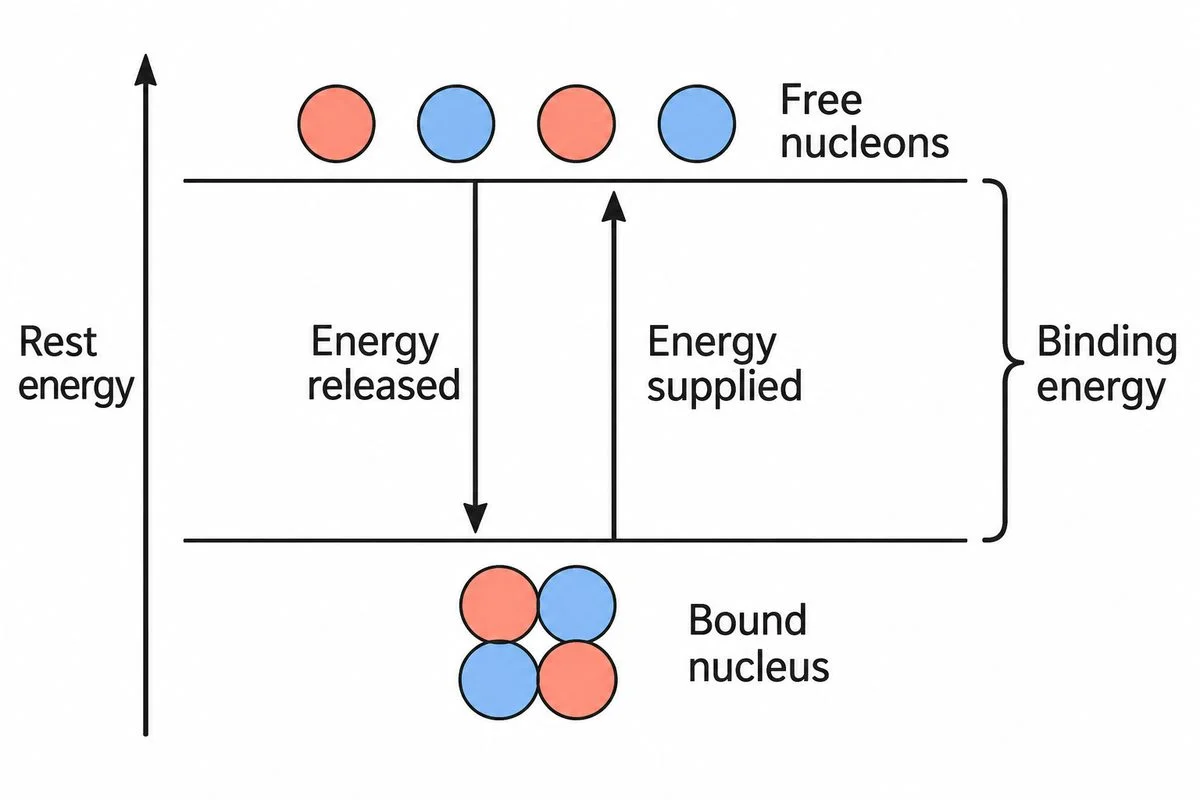
Released energy comes from a decrease in total rest mass.

Show
Look at the diagram. Compare the energy levels, then follow the downward and upward arrows.
Ask
When these nucleons bind and release energy, will their total rest mass increase or decrease?
Say
Binding releases energy and lowers rest mass; separation needs that energy back.
Used in
Nuclear energy calculations help engineers estimate the heat a reactor must remove.
If your child says…“Binding adds mass.”
Ask
If binding releases energy, does the nucleus keep that energy as extra rest mass?
What’s true
A bound nucleus has less rest mass because binding releases energy.
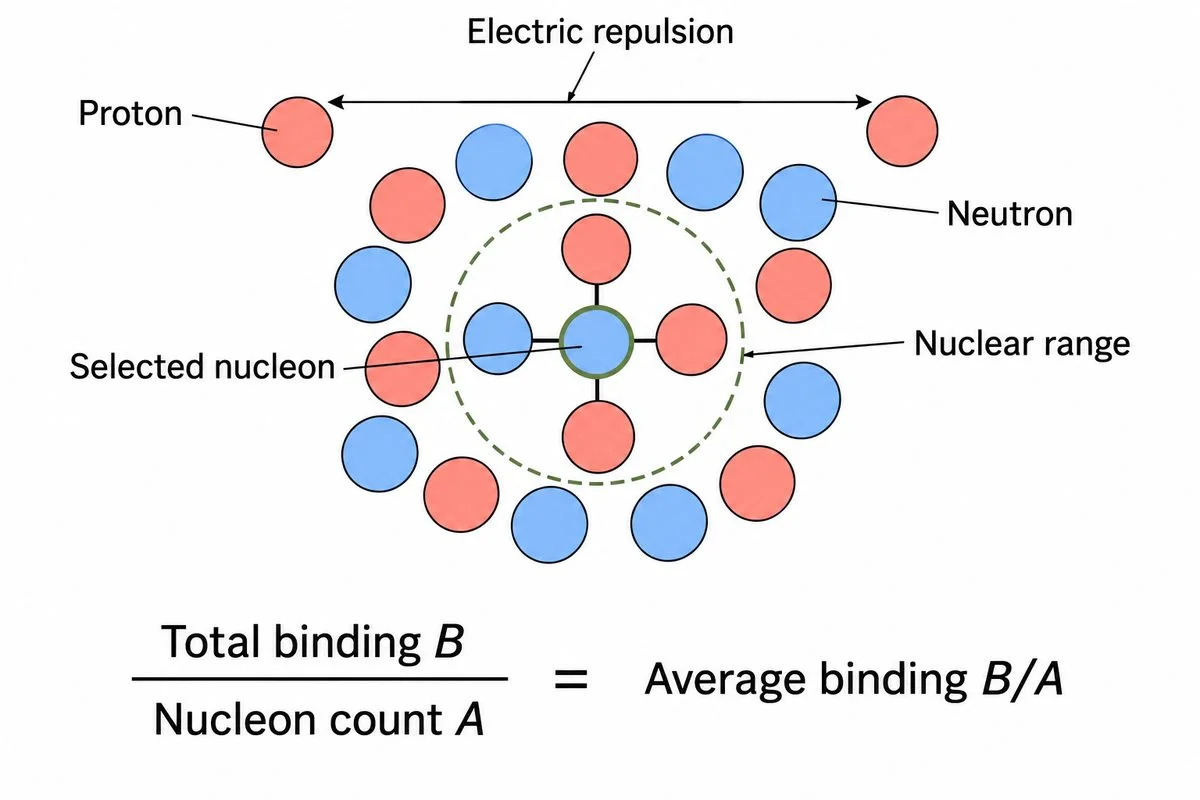
Nuclear attraction links neighbours; total binding divided by nucleon count gives average binding.

4. Nuclear force and binding energy per nucleon

B is total binding energy. B/AB/A gives average binding per nucleon.

Show
Look at the diagram. Find the circled neighbours, then the division underneath.
Ask
Does greater total binding mean stronger binding for each nucleon?
Say
Not necessarily; compare nuclei by dividing total binding energy by their nucleon counts. Nuclear attraction mainly links neighbours.
Used in
Binding comparisons help researchers identify nuclear reactions that can supply useful energy.
If your child says…“Every nucleon strongly attracts every other nucleon.”
Ask
Would being in the same nucleus make a distant nucleon a close neighbour?
What’s true
Strong nuclear attraction mainly links nearby nucleons because its range is very short.

How nuclei change and release energy

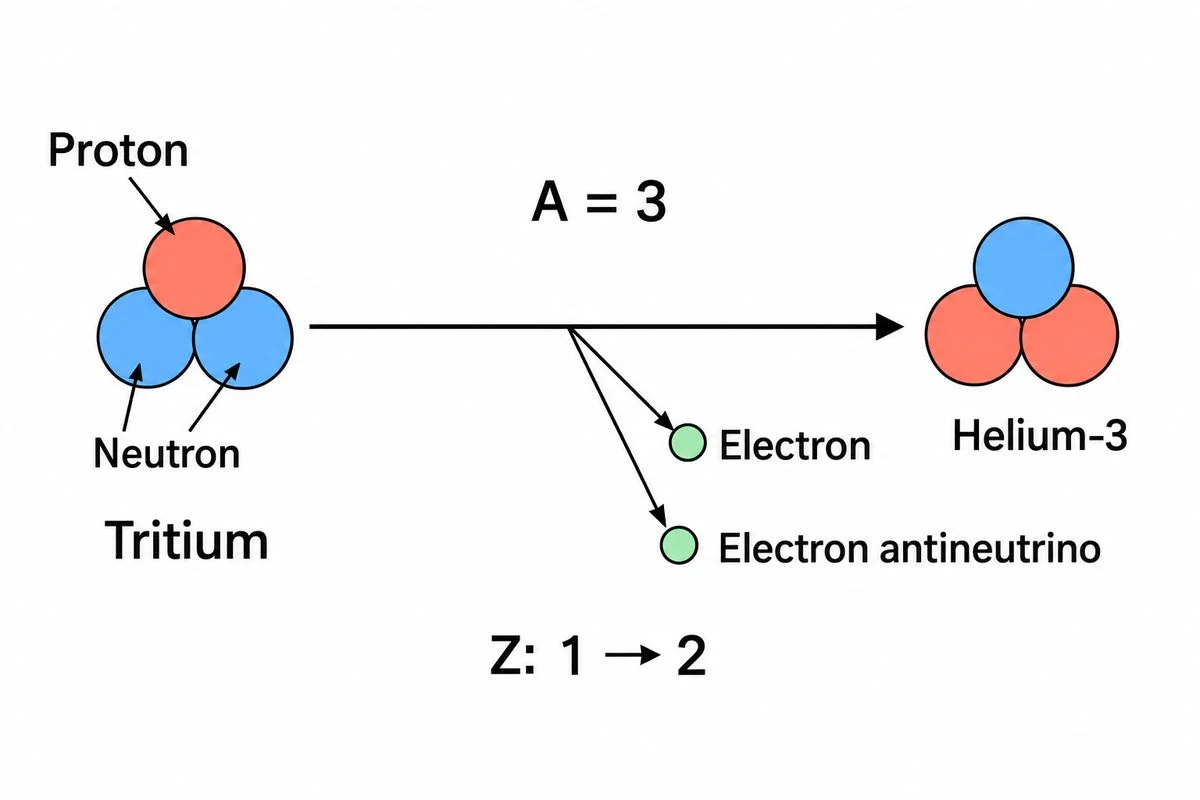
Tritium becomes helium-3, emitting an electron and an antineutrino while keeping three nucleons.

5. Nuclear decay

A nucleus can emit particles or release radiation.

Show
Look at the diagram. Compare the nuclei, then follow the electron and antineutrino arrows.
Ask
When a neutron becomes a proton here, what will happen to the proton count?
Say
A neutron becomes a proton, creating an electron and an antineutrino. Three nucleons remain, but the proton count rises from one to two.
Used in
Radiation from nuclear decay sterilises medical equipment by killing microbes.
If your child says…“Proton and neutron counts both stay unchanged.”
Ask
Which particle count increases when a neutron becomes a proton?
What’s true
In beta-minus decay, A stays unchanged while Z increases by one.
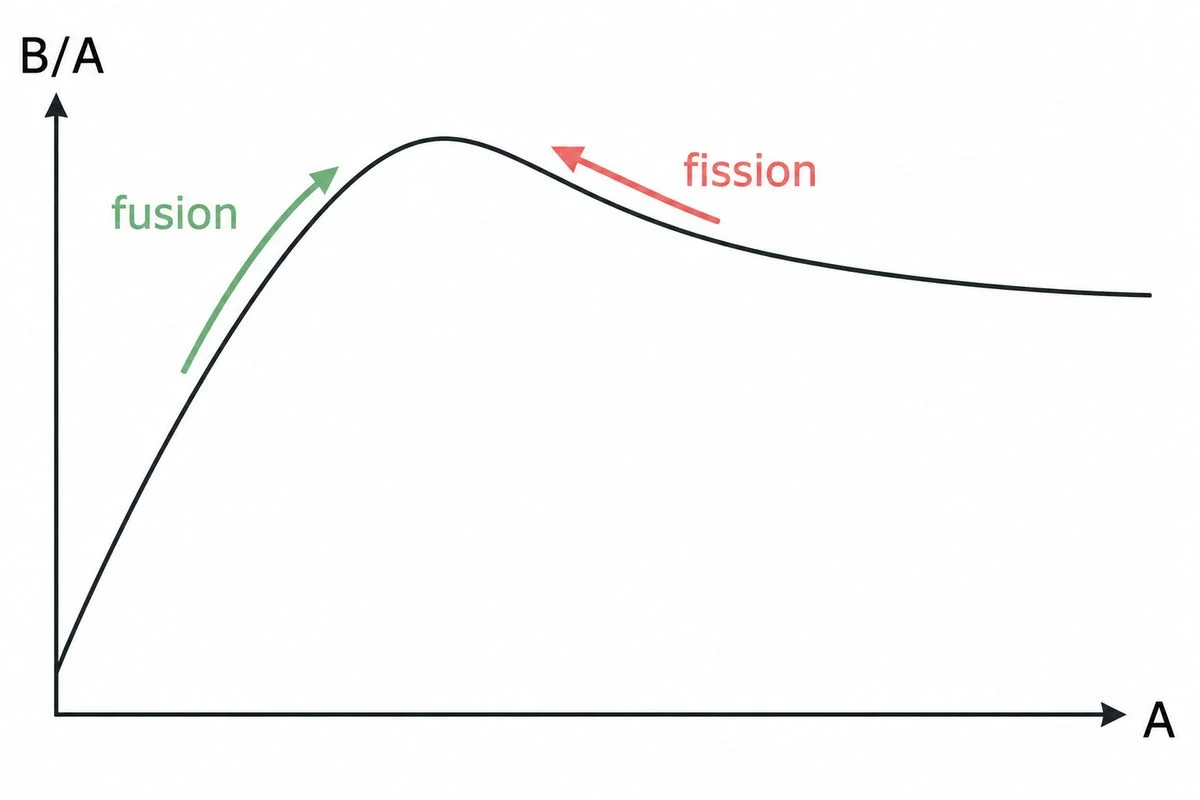
Binding-energy diagram with fusion and fission arrows pointing uphill from opposite sides.

6. Fission and fusion

Energy release depends on the increase in total binding.

Show
Look at the diagram. Find mass number A horizontally and average binding per nucleon B/A vertically. Follow both reaction arrows towards the peak.
Ask
With unchanged proton and neutron totals, will these uphill changes release energy?
Say
Fusion joins light nuclei; fission splits heavy nuclei. Here, increased total binding releases energy.
Used in
Nuclear power stations use fission heat to generate electricity.
If your child says…“The average gain is the total.”
Ask
Does the graph show binding for one nucleon or the whole nucleus?
What’s true
With unchanged proton and neutron totals, multiply average binding gain by nucleon count.
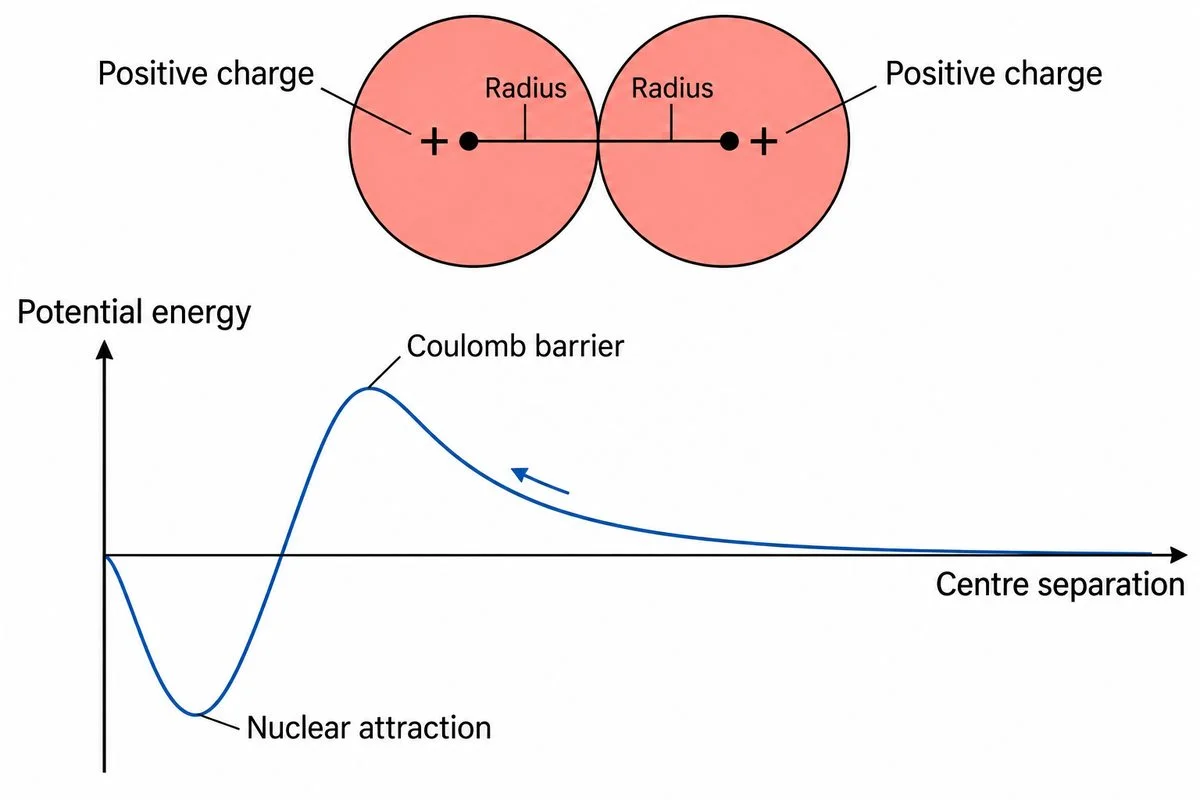
An energy barrier resists approach; touching nuclei have two radii between their centres.

7. Coulomb barrier

Electric repulsion resists the close approach needed for fusion.

Show
Look at the diagram. Follow the curve from right to left, then trace both inset radii.
Ask
How would heating help these repelling nuclei approach closely enough to join?
Say
Heating helps nuclei approach against electric repulsion until nuclear attraction becomes effective. Touching nuclei have both radii between their centres.
Used in
Fusion experiments heat fuel so nuclei approach closely enough to have a chance of joining.
If your child says…“Touching nuclei have their centres one radius apart.”
Ask
How many radii lie between the touching spheres' centres?
What’s true
Touching spherical nuclei have centre spacing equal to the sum of their radii.

12H+12H→13H+11H{}^{2}_{1}\mathrm{H}+{}^{2}_{1}\mathrm{H}\rightarrow{}^{3}_{1}\mathrm{H}+{}^{1}_{1}\mathrm{H}

Each reaction releases 4.03 MeV.

Nreactions=6/2=3N_{\mathrm{reactions}}=6/2=3

8. Nuclear events and total energy

Total energy depends on complete reactions, not just available nuclei.

Show
Write these lines for six deuterons, all consumed through this channel without later reactions.
Ask
How much energy do these six deuterons release altogether?
Say
Three reactions release 12.09 MeV, because each reaction uses two deuterons.
Used in
Counting nuclear reactions helps engineers estimate how much electricity a fuel supply can produce.
If your child says…“Each deuteron gives one reaction.”
Ask
Can the same deuteron be used up in two different reactions?
What’s true
If all deuterons react in pairs, there are half as many events as deuterons.

A real problem

Tarapur began India's nuclear electricity production.

Electricity production began there in October 1969.

Tarapur aimed to show that nuclear electricity could be economically viable in India.

Nuclear reactors use fission heat to boil water into steam.

Press Information BureauIAEAU.S. Energy Information Administration

An illuminated table lamp beside a closed schoolbook.

Concept Lab · Common misconception

The tempting mistake in Nuclei

Open standalone misconception page →

Does half-life remove the same number of nuclei each time?

Wrong

If the first half-life removes an expected 800,000 of 1,600,000 nuclei, the next removes another 800,000.

Why it feels right. The time intervals are equal, so I subtract the same number.

Right

Each half-life halves the expected number remaining.

Worked example

The same fraction remains after each half-life. The amount lost gets smaller.
  1. In a large sample, the expected count goes from 1,600,000 to 800,000 to 400,000 over two half-lives.
  2. The expected losses are 800,000 and then 400,000.

Ask your child eight quick questions.

One per step. The answer and the reason are given.

  1. Ignore electron binding energy. What must you subtract from a neutral atom's mass to find its nuclear mass?

    The combined electron masses. An atom includes electrons whose mass is absent from its bare nucleus.

  2. How do nuclear densities compare when their mass numbers are 16 and 128?

    They are approximately equal. Both nuclear mass and nuclear volume grow in proportion to A.

  3. For positive Q, which total rest mass is greater, including every particle?

    The initial total rest mass. The decrease in rest mass supplies the energy released.

  4. Which attracts a nucleon more: another nucleon 2 fm away or 100 fm away?

    The nucleon 2 fm away. Nuclear attraction acts over a few femtometres and becomes negligible at much larger separations.

  5. After beta-minus decay, how many protons does a nucleus initially containing six protons have?

    Seven protons. A neutron becomes a proton, increasing Z while preserving A.

  6. For 240 nucleons gaining 0.9 MeV of binding each, how much energy is released?

    216 MeV. The gain per nucleon must be multiplied by the total nucleon count.

  7. Two spherical nuclei each have radius 2 fm. What is their centre spacing at contact?

    4 fm. The distance includes one radius from each nucleus.

  8. Six deuterons react once, two per event. How many events occur?

    Three events. Each complete reaction consumes a pair, so counting individual deuterons doubles the events.

15 more questions with answers, 1 with pictures