Skip to content

Teach Exploring Magnets in eight steps.

For each idea: show it, ask before you tell, then say one line.

Gather two large marked bar magnets, a ring magnet, thread, steel paper clips, aluminium foil and thin cardboard.

Use large classroom magnets. Keep magnets and clips away from mouths and noses.

Common misconceptions & worked visual for this chapter · 15 practice questions with answers

How to teach it

Shapes, materials and poles

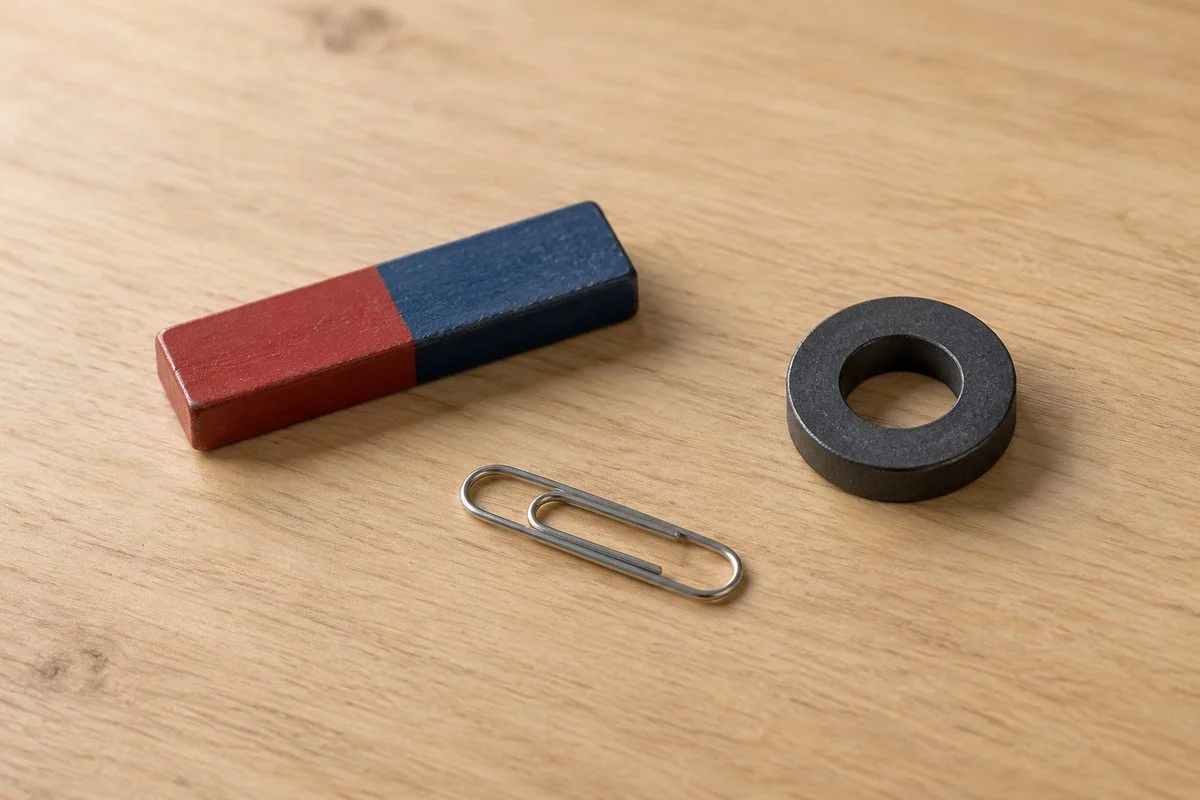
Bar magnet and ring magnet beside a steel paper clip.

1. Magnets in Use and Different Shapes

Magnets can be bars, rings or horseshoes.

Show
Set a bar magnet and a differently shaped toy magnet beside a steel paper clip.
Ask
Which magnet do you expect to attract the clip?
Say
Try each. A magnet does not need a bar shape.
Used in
Flat fridge magnets hold shopping lists where people can see them.
If your child says…“Only bars are real magnets.”
Ask
What happened when the differently shaped magnet approached the clip?
What’s true
Magnets can work without having a bar shape.
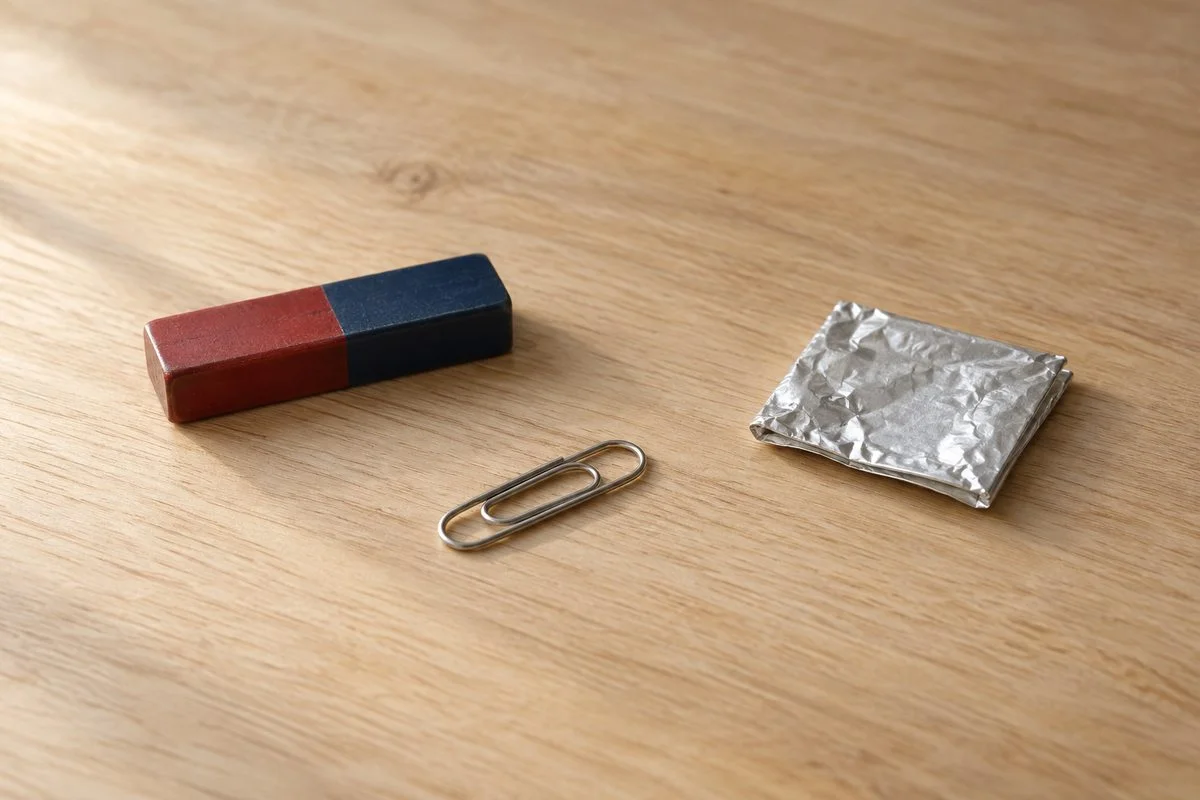
Magnet beside a separated paper clip and folded aluminium foil.

2. Magnetic and Non-magnetic Materials

A magnet attracts some materials, but not others in these classroom tests.

Show
Place a steel paper clip and aluminium foil apart, with a magnet nearby.
Ask
Will the magnet attract both metal objects?
Say
Test both. Being metal does not guarantee attraction.
Used in
Recycling workers use magnets to separate iron from aluminium, making scrap easier to sort.
If your child says…“Every metal sticks to magnets.”
Ask
What did the foil do when the magnet came close?
What’s true
Aluminium is not attracted in this test, although it is a metal.
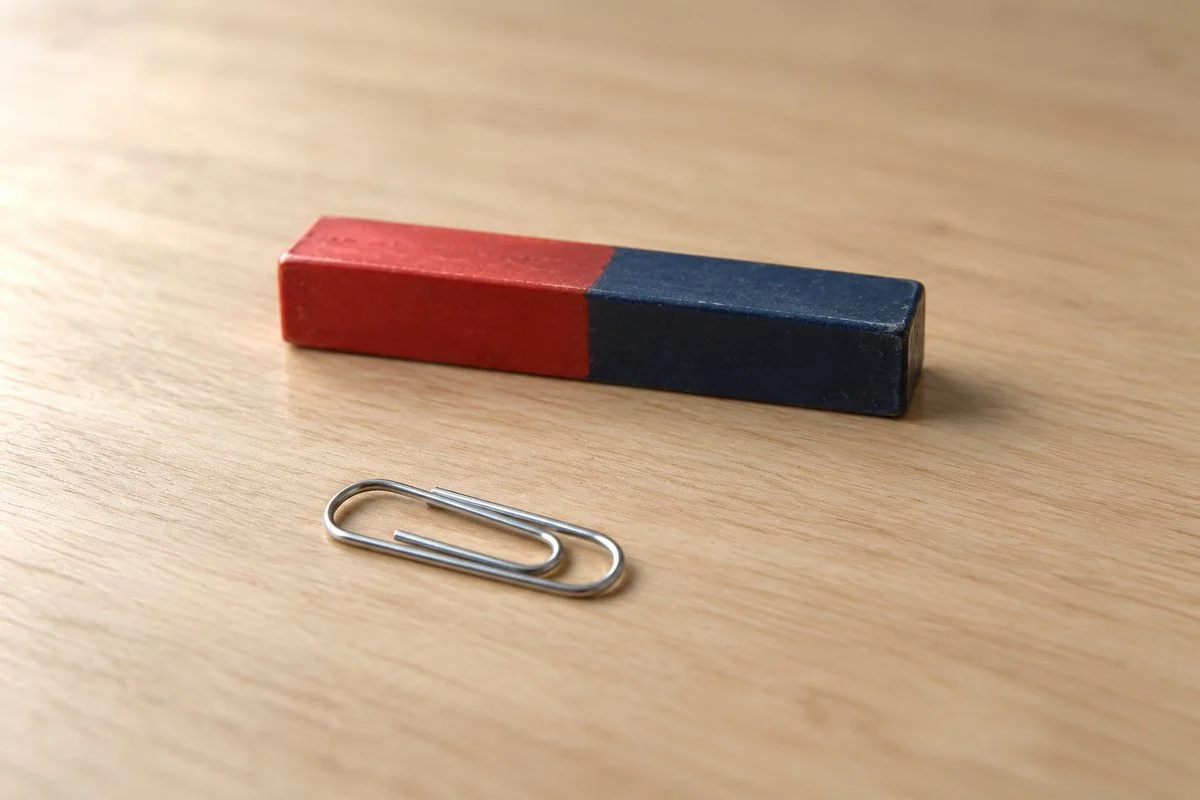
A horizontal bar magnet beside a steel paper clip.

3. Poles of a Magnet

A bar magnet pulls most strongly near its two ends.

Show
Lay a bar magnet flat beside a steel paper clip.
Ask
Where will the pull be strongest: near the middle or near the ends?
Say
Try pulling the clip off the middle, then each end. The strongest regions near the ends are its north and south poles.
Used in
A magnetic pickup tool lifts fallen iron screws with its pole, reaching awkward spaces.
If your child says…“The middle pulls hardest.”
Ask
Where was the clip harder to pull away?
What’s true
A bar magnet's strongest pull is near its poles.

Direction, attraction and repulsion

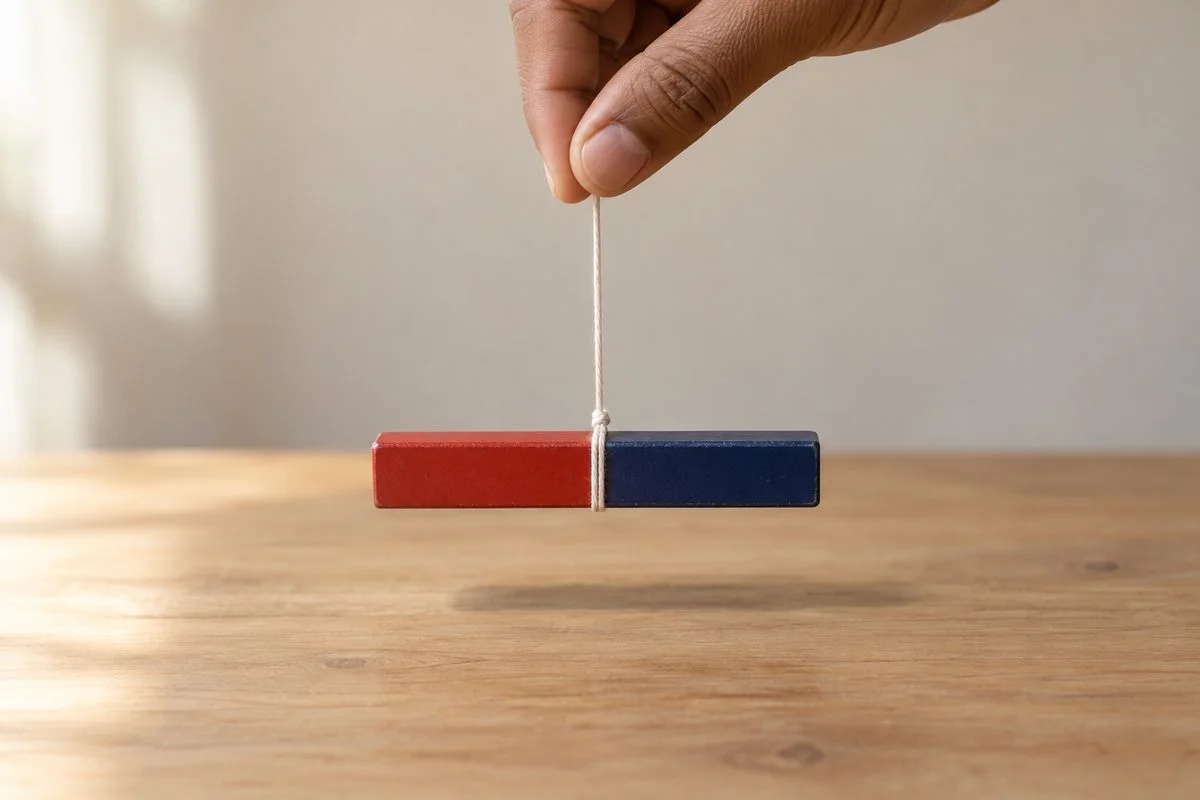
One hand holds a thread suspending a balanced bar magnet.

4. Finding Directions with a Magnet and Compass

A freely turning magnet settles roughly north–south.

Show
Tie thread around a bar magnet's middle so it hangs level and can turn freely. Keep other magnets and metal objects well away.
Ask
If you turn the settled magnet gently, will it return to roughly the same direction?
Say
It settles roughly north–south because Earth acts like a magnet.
Used in
Travellers use magnetic compasses to find their way.
If your child says…“Any hanging metal points north.”
Ask
What matters here: being metal, or being a magnet?
What’s true
An unmagnetised metal bar does not reliably settle north–south.
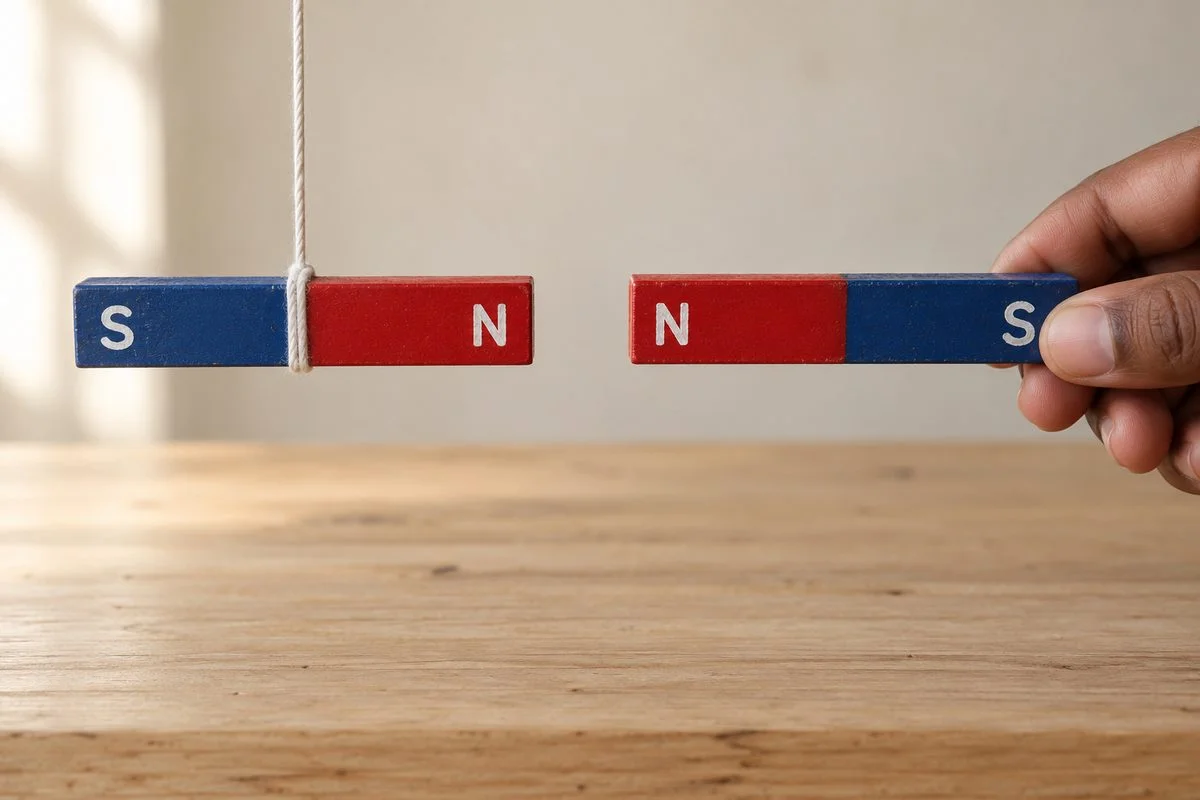
A handheld bar magnet faces a suspended magnet across a gap.

5. Attraction and Repulsion

Opposite poles pull together; matching poles push apart.

Show
Suspend one bar magnet. Hold another nearby, with their north poles facing across a gap.
Ask
Will these facing ends pull together or push apart?
Say
Bring them closer gently. Matching poles repel.
Used in
Magnetic building toys join at opposite poles, holding pieces together for building.
If your child says…“Two magnets always pull together.”
Ask
What changes when you turn the handheld magnet around?
What’s true
The facing poles decide whether magnets attract or repel.
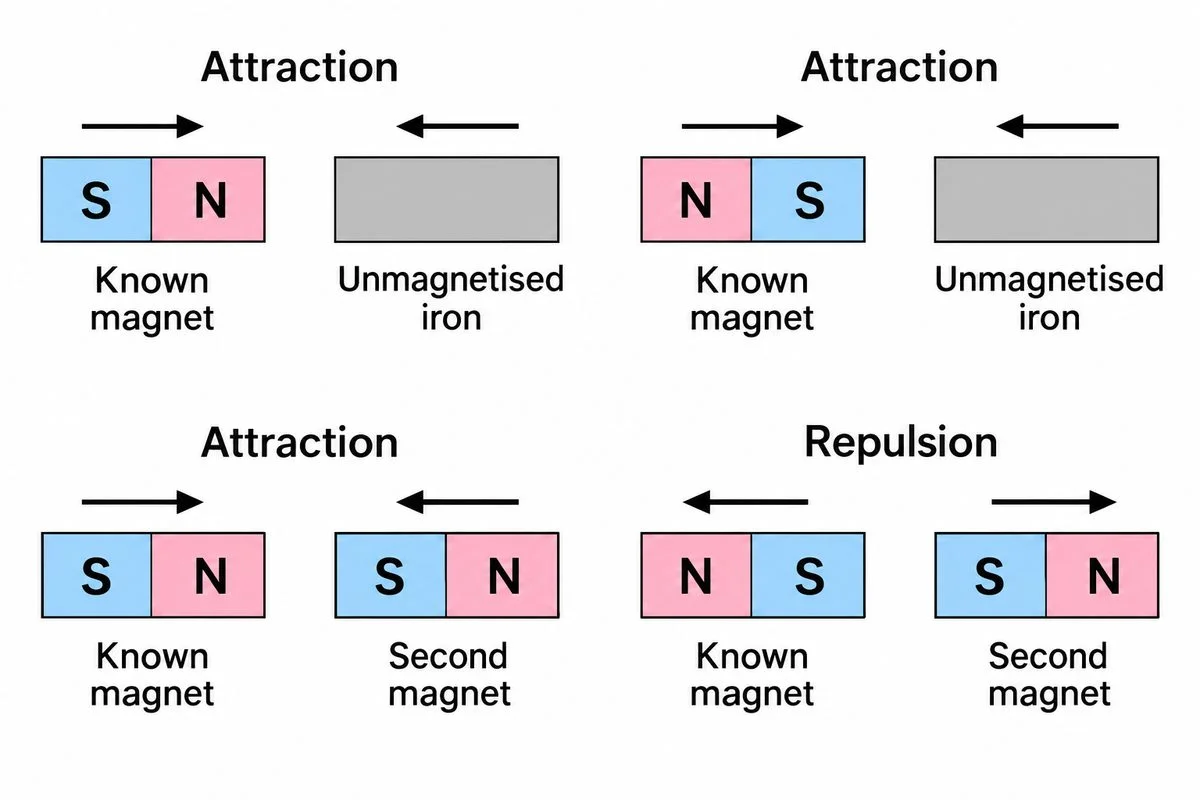
Iron attracts either pole; a second magnet attracts or repels depending on facing poles.

6. Identifying Magnets

Repulsion identifies a magnet; attraction alone cannot.

Show
Look at the diagram's top row, where either pole attracts the iron bar. Follow the bottom row from attraction to repulsion.
Ask
Will reversing the known magnet make the unmagnetised iron bar repel it?
Say
The iron bar is attracted either way, so attraction alone cannot identify another magnet. Repulsion by a known magnet can.
Used in
Testing for repulsion helps sort unmarked magnets from ordinary iron bars in school kits.
If your child says…“Anything attracted must be another magnet.”
Ask
Which result appears only with the second magnet?
What’s true
An unmagnetised iron bar can be attracted by either pole but does not repel either.

Working through materials and storing magnets

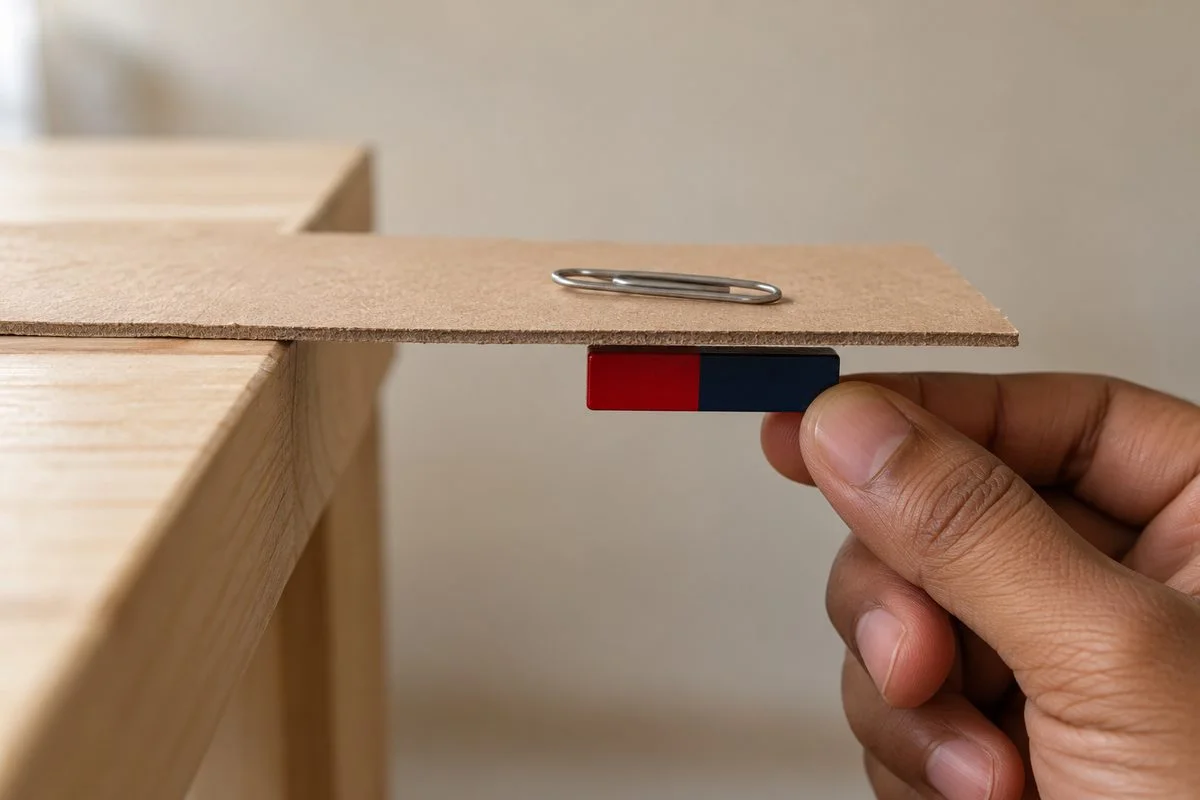
Paper clip on cardboard with a hand holding a magnet underneath.

7. Magnetic Effect Through Non-magnetic Materials

A nearby magnet can pull through thin non-magnetic materials.

Show
Place a steel paper clip on thin cardboard. Hold a magnet just below it.
Ask
Will the clip follow if you move the magnet underneath?
Say
Move the magnet slowly. Its pull can act through this thin cardboard.
Used in
Magnetic aquarium cleaners pull through glass, letting people clean inside without emptying the tank.
If your child says…“Cardboard blocks the magnet's pull.”
Ask
What moved the clip without touching it?
What’s true
Thin cardboard allows the effect through, but greater distance can weaken it.
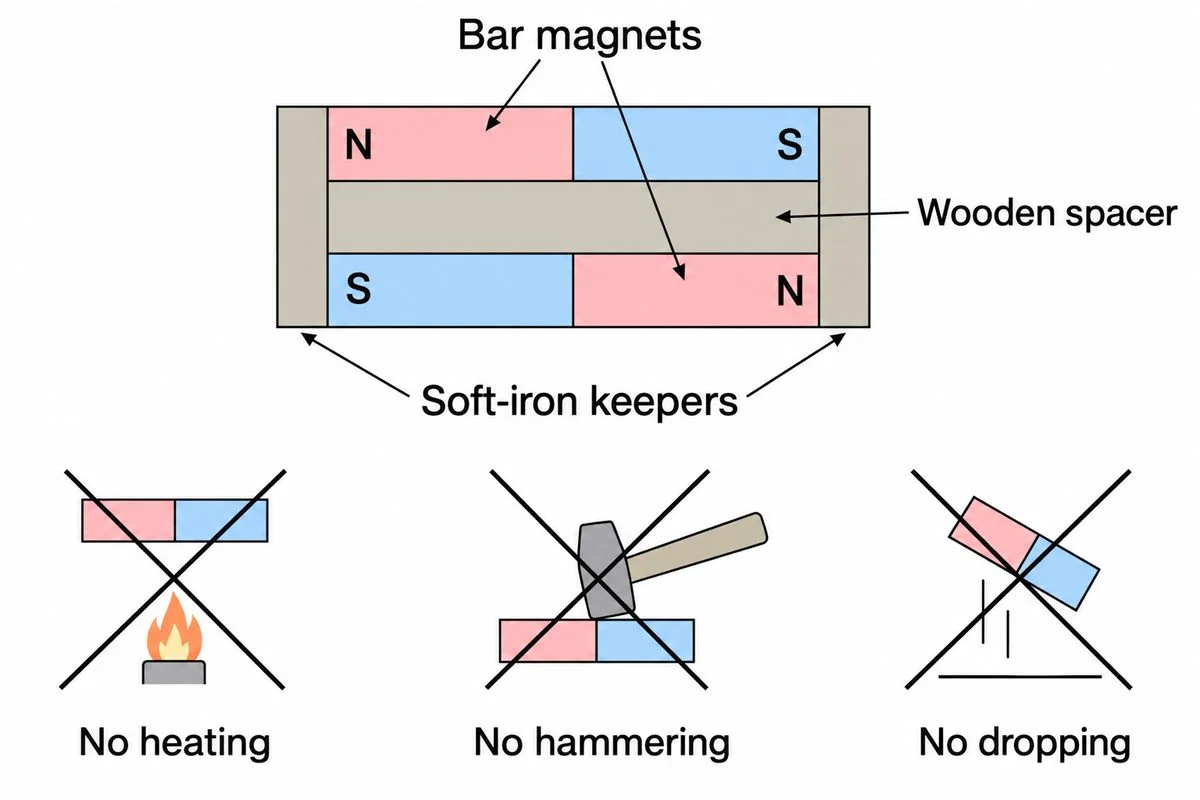
Paired magnets with wood and iron keepers, above crossed-out heating, hammering and dropping.

8. Care and Storage of Magnets

Careful handling and suitable storage help magnets keep their pull.

Show
Look at the diagram's paired magnets, then the wood separating them. Find the iron pieces joining their ends. Look below at the crossed-out actions.
Ask
Will these end pieces help the stored magnets keep their pull?
Say
The soft-iron keepers help the magnets keep their pull. Store the bars with opposite poles alongside, wood between them and keepers across both ends. Heating, hammering or dropping magnets can weaken them.
Used in
Suitable storage helps school magnets keep their magnetism for later activities.
If your child says…“Dropping a magnet cannot weaken it.”
Ask
Why does the diagram warn against dropping and hammering magnets?
What’s true
Rough handling can weaken a magnet's pull.

A real problem

Kelvin's improved compass made travel at sea safer.

Iron near ships' compasses made their readings unreliable.

William Thomson patented his improved compass and its housing in 1876.

Correcting magnets and iron spheres counteracted the effects of the ship's iron.

The improved compass increased safety at sea, and navies worldwide adopted it.

Royal Museums GreenwichSouth Georgia MuseumUniversity of Glasgow

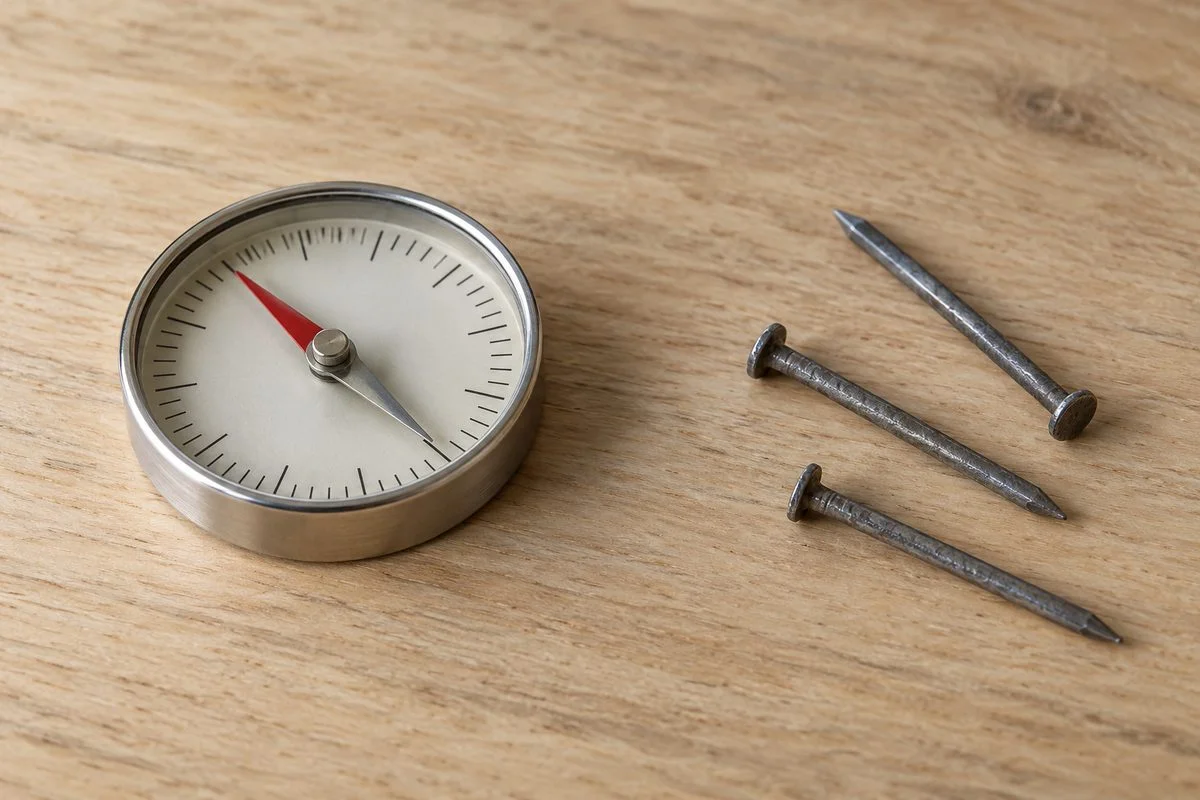
A pocket compass beside iron nails on a wooden table.

Concept Lab · Common misconception

The tempting mistake in Exploring Magnets

Open standalone misconception page →

Do all metals stick to magnets?

Wrong

An aluminium can sticks because it is metal.

Why it feels right. A magnet picks up steel, so I expect it to pick up any metal.

Right

Strong attraction to an ordinary magnet depends on the material.

Worked example

Steel clip
Bring magnet near→Clip sticks
Aluminium can
Bring same magnet near→No noticeable pull
Keep the magnet the same and change the material.
  1. Bring the same magnet near a steel paper clip and an aluminium can.
  2. The steel clip sticks.
  3. The can shows no noticeable attraction.

Ask your child eight quick questions.

One per step. The answer and the reason are given.

  1. A ring attracts the clip. Does its shape rule out it being a magnet?

    No. A ring shape does not rule out a magnet.

  2. Which tested metal object was not attracted when you brought the magnet close?

    The aluminium foil. Some metals are not attracted by a magnet.

  3. Where should you bring a clip to find this bar magnet's strongest pull?

    Near either end. The strongest pull is near the poles, away from the middle.

  4. A magnet and an unmagnetised iron bar hang freely. Which reliably settles roughly north–south?

    Only the magnet. Earth acts on the magnet; being metal alone does not ensure alignment.

  5. What happens with north facing north, then north facing south?

    They repel, then attract. Matching poles push apart, while opposite poles pull together.

  6. What result proves another bar is a magnet when testing it against a known magnet?

    Repulsion. Attraction also happens with an unmagnetised iron bar.

  7. A magnet already pulls across an air gap. Would inserting thin cardboard block that pull?

    No. Thin cardboard allows the magnetic effect through when the magnet is close enough.

  8. What can happen to a magnet's pull after repeated hard knocks?

    It can weaken. Rough handling can reduce a magnet's strength.

15 more questions with answers, 15 with pictures