Skip to content

Teach Arithmetic Expressions in eight steps.

For each idea: show it, ask before you tell, then say one line.

Gather six spoons, twelve chickpeas, eight raisins, ten buttons, a plate, paper and pencil.

Common misconceptions & worked visual for this chapter · 15 practice questions with answers

How to teach it

Expressions and their values

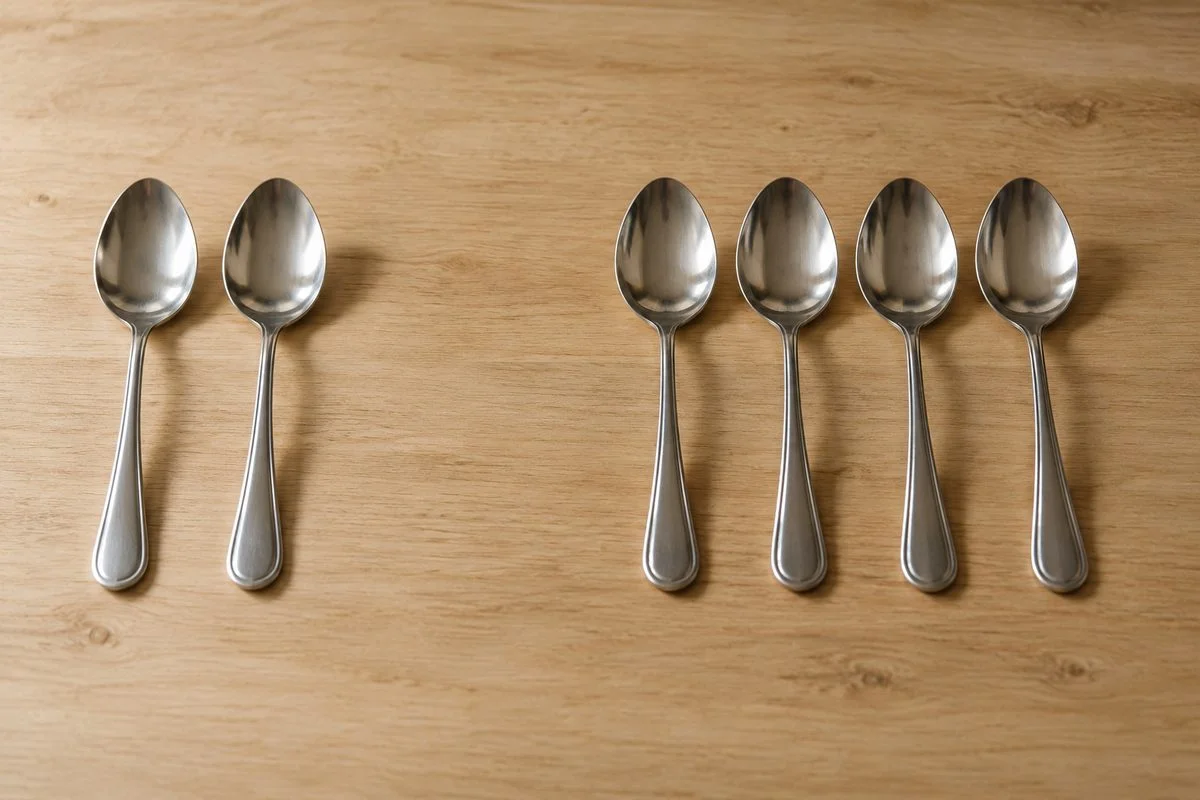
Six steel spoons arranged in groups of two and four.

1. Simple Expressions

A written calculation whose result is its value.

Show
Arrange six spoons in groups of two and four. Write their addition. After the prediction, regroup into threes. Write that addition and join both expressions with equals.
Ask
Will regrouping these spoons change their total?
Say
Both expressions have value six, so equals can join them.
Used in
Different combinations of coins can pay the same amount.
If your child says…“Equals means the answer comes next.”
Ask
Could either spoon grouping go on the left of equals?
What’s true
Equals connects complete sides with matching values.
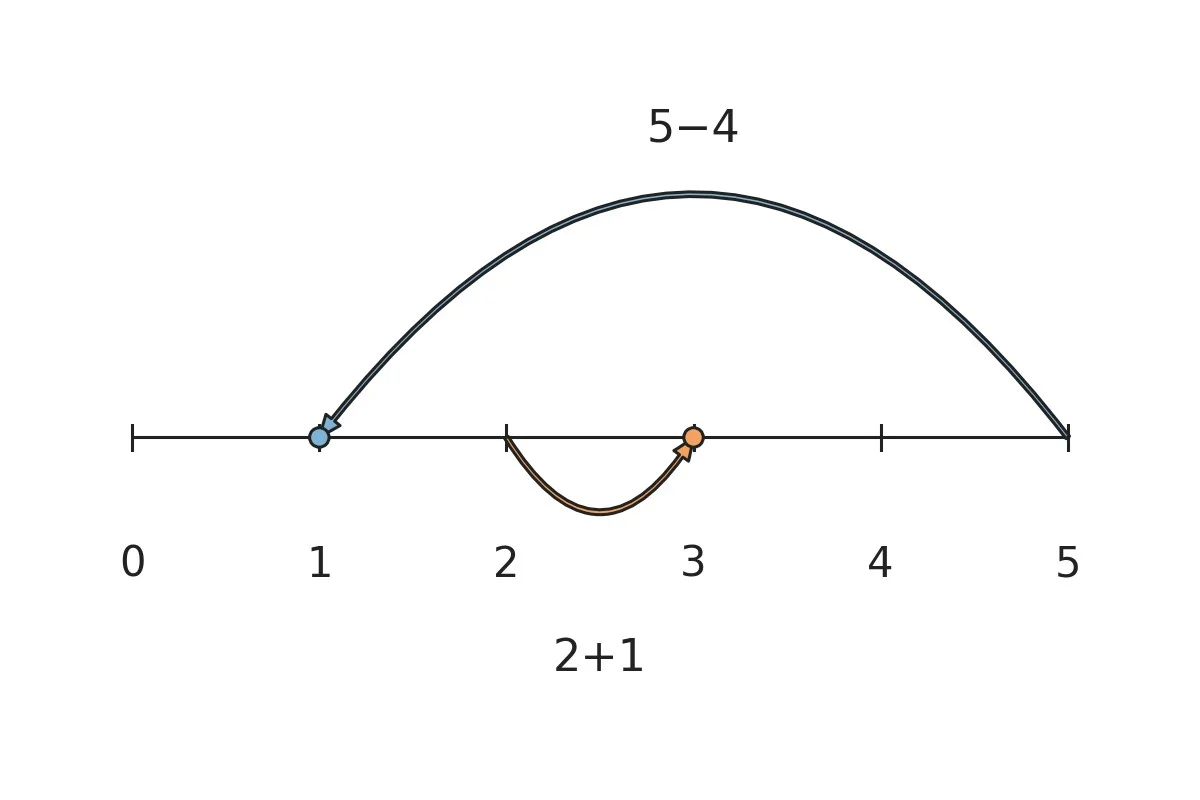
Number line showing five minus four ending at one, two plus one at three.

2. Comparing Expressions

Compare the results of calculations.

Show
Find five minus four in the diagram. Follow its arrow, then follow the arrow for two plus one.
Ask
Does starting at five make five minus four greater than two plus one?
Say
Two plus one is greater. It ends at three, farther right than one on the number line.
Used in
Comparing final prices helps shoppers find the cheaper purchase.
If your child says…“The expression with the biggest number must win.”
Ask
Which arrow lands farther right on the number line?
What’s true
The numbers and operations together determine each expression’s value.
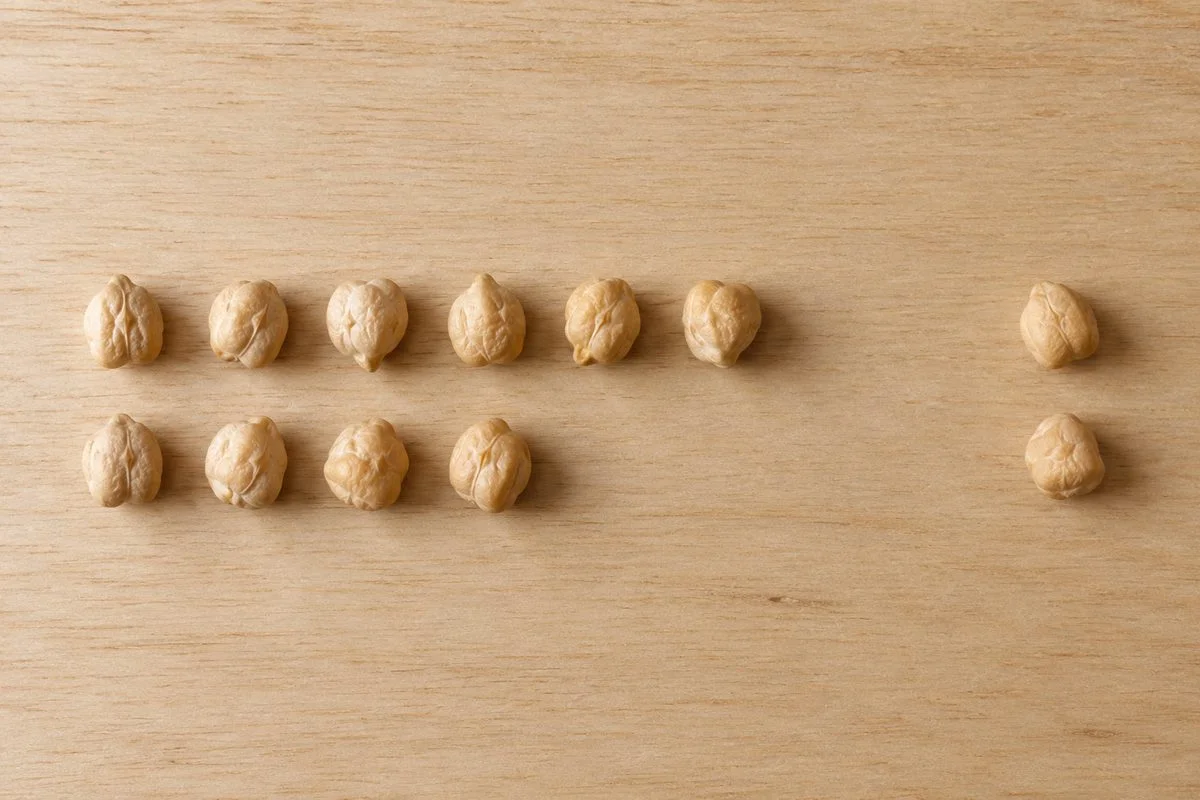
Rows of six and four chickpeas, with two spare chickpeas beside them.

3. Comparing Expressions

Track changes to compare results without calculating both.

Show
Arrange six chickpeas above four, matching vertical pairs. Write “six minus four”. After the prediction, add one to each row and write “seven minus five”.
Ask
Will adding one chickpea to each row change the difference?
Say
The new pair leaves the unmatched chickpeas unchanged, so the differences are equal.
Used in
Comparing price changes can show which shopping total rises more without recalculating everything.
If your child says…“Both rows gain one, so the difference grows by two.”
Ask
Does the added pair leave any extra chickpeas unmatched?
What’s true
Equal increases in both amounts leave their difference unchanged.

Reading and rearranging expressions

(2+3)×2=(2+3)+(2+3)(2+3)\times2=(2+3)+(2+3)

(2+3)+(2+3)=5+5(2+3)+(2+3)=5+5

4. Brackets in Expressions

Finish the enclosed calculation before using its result.

Show
Write this line. Say, “Add two and three, then double their sum.”
Ask
What result comes next when we double the whole sum?
Say
The result is ten. The brackets make us add two and three before doubling.
Used in
Brackets keep all spending together when calculating change.
If your child says…“I can leave the brackets until last.”
Ask
Are we doubling just three, or the sum of two and three?
What’s true
The bracketed group must be ready before its value is used outside.

7−2×3=7+(−2×3)7-2\times3=7+(-2\times3)

7+(−2×3)=7+(−6)7+(-2\times3)=7+(-6)

5. Terms in Expressions

The complete signed parts added to form an expression.

Show
Say, “Subtracting means adding the opposite.” Write this line. Underline seven and the negative product separately.
Ask
After finishing each term, what value goes on the next line?
Say
Negative two times three gives negative six; adding seven gives one.
Used in
Bills keep each quantity-times-price calculation together, making item totals easier to check.
If your child says…“Two and three are separate terms.”
Ask
Are we adding two and three separately, or using their product?
What’s true
A multiplication supplies one value, so its factors stay together.

3+(−2)+2=3+2+(−2)3+(-2)+2=3+2+(-2)

3+2+(−2)=3+(2+(−2))3+2+(-2)=3+(2+(-2))

3+(2+(−2))=3+03+(2+(-2))=3+0

6. Swapping and Grouping

Signed terms can change places or groups without changing the sum.

Show
Say, “Move each term with its sign, then group the opposite terms.” Write this line.
Ask
What remains on the next line?
Say
Group two with negative two: they add to zero, leaving three.
Used in
A forgotten expense can be added to an existing total without restarting the addition.
If your child says…“I can move the number and leave its minus behind.”
Ask
If negative two became positive two, would the pair still cancel?
What’s true
A term keeps its sign when you move it.

Removing brackets

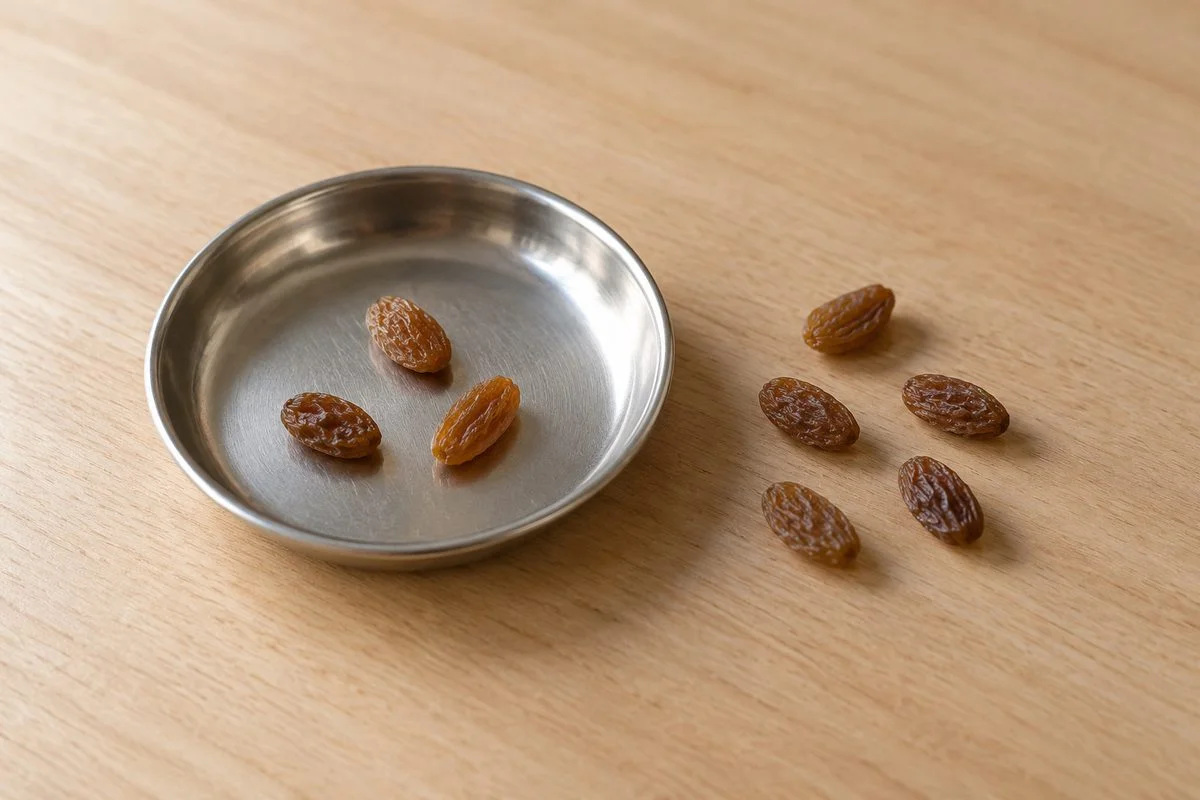
Three raisins on a steel plate and five beside it.

7. Removing Brackets—I

Subtracting a bracketed group changes every term’s sign, including the first.

Show
Place eight raisins on a plate. Write “eight minus the difference of five and two”. Remove five. After the prediction, return two and write 8−(5−2)=8−5+28-(5-2)=8-5+2.
Ask
Should we return or remove two to take away two fewer than five?
Say
Taking five removes two too many, so return two.
Used in
Subtracting the full price leaves too little savings. Adding back the discount gives the correct amount.
If your child says…“I change only the first sign after the minus.”
Ask
If you removed two more, would you have taken away less than five?
What’s true
Subtracting a bracketed group reverses every internal sign when the brackets are removed.
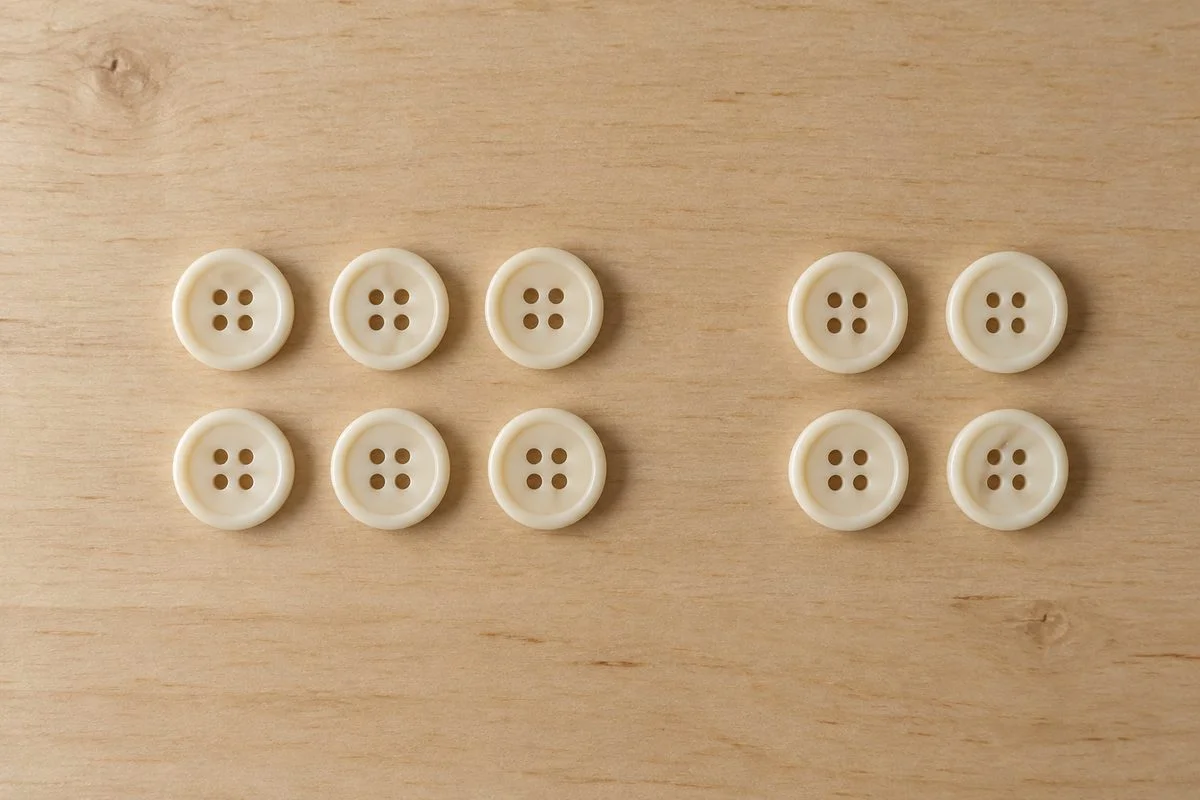
Two rows of buttons, each split into groups of three and two.

8. Removing Brackets—II

Multiply each part of the bracketed group.

Show
Arrange ten buttons in two rows of five. Slide the last two in each row rightwards. After the prediction, write 2×(3+2)=2×3+2×22\times(3+2)=2\times3+2\times2.
Ask
Which parts must be doubled to count both rows?
Say
Each row contains both parts, so double both parts.
Used in
Repeated meal orders multiply every item’s cost, preventing an item from being counted only once.
If your child says…“I multiply only the first number inside.”
Ask
Do both rows contain the group of two?
What’s true
Every part belongs to each copy of the group.

A real problem

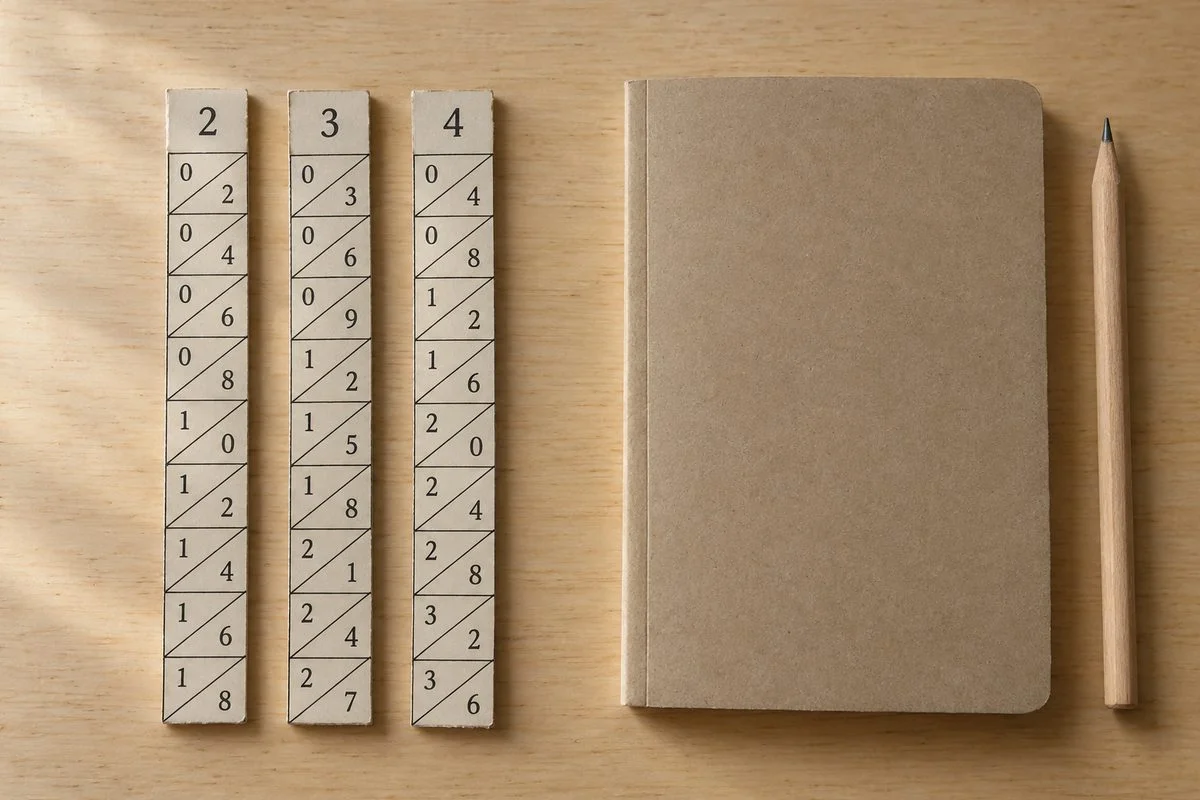
Calculating rods made multiplication easier.

Napier published his calculating-rod method in 1617.

The rods turned multiplication into a series of additions.

Users could multiply without recalling multiplication tables.

National Museums ScotlandHBCSE–TIFR

Cardboard calculating strips face up beside a pencil and closed notebook.

Concept Lab · Common misconception

The tempting mistake in Arithmetic Expressions

Open standalone misconception page →

Must every operation be done left to right?

Wrong

8 + 2 × 3 = 30

Why it feels right. I started with the first operation I saw.

Right

Multiplication takes precedence over addition here.

Worked example

8 + 2 × 3
8
33
(8 + 2) × 3
82
82
82
The brackets change what gets repeated three times.
  1. Two groups of 3 give 6.
  2. Add 8 to get 14.
  3. The expression (8 + 2) × 3 represents 30.

Ask your child eight quick questions.

One per step. The answer and the reason are given.

  1. What fills the blank in 13+4=□+613+4=\square+6?

    11. Both complete sides must equal 17.

  2. Which is greater: 120÷3120\div3 or 35+2535+25?

    35+2535+25. Its value is 60, while the other gives 40.

  3. How does 113−25113-25 compare with 112−24112-24?

    They are equal. The extra starting amount matches the extra amount taken away.

  4. Subtract the bracketed sum of fifteen and fifty-six from one hundred. What comes first?

    15 plus 56. The amount subtracted includes both costs.

  5. In two minus ten plus four times six, which complete term contains multiplication?

    4×64\times6. The product contributes one value to the sum.

  6. When rearranging eighty-three minus fourteen as a sum, what must move with fourteen?

    The minus sign. The term is negative, and moving it must preserve its value.

  7. Start with two hundred minus the bracketed sum of forty and three. After removing brackets, is three added or subtracted?

    Subtract it too. The whole sum is subtracted, including the 3.

  8. Two people each buy items costing forty-three and twenty-four rupees. Which two products, left uncalculated, add to their total?

    2×43+2×242\times43+2\times24. Both costs occur twice.

15 more questions with answers