Skip to content

Teach Large Numbers Around Us in eight steps.

For each idea: show it, ask before you tell, then say one line.

Gather scrap paper, two paper strips, a pencil and a ruler.

Common misconceptions & worked visual for this chapter · 15 practice questions with answers

How to teach it

Understanding large quantities

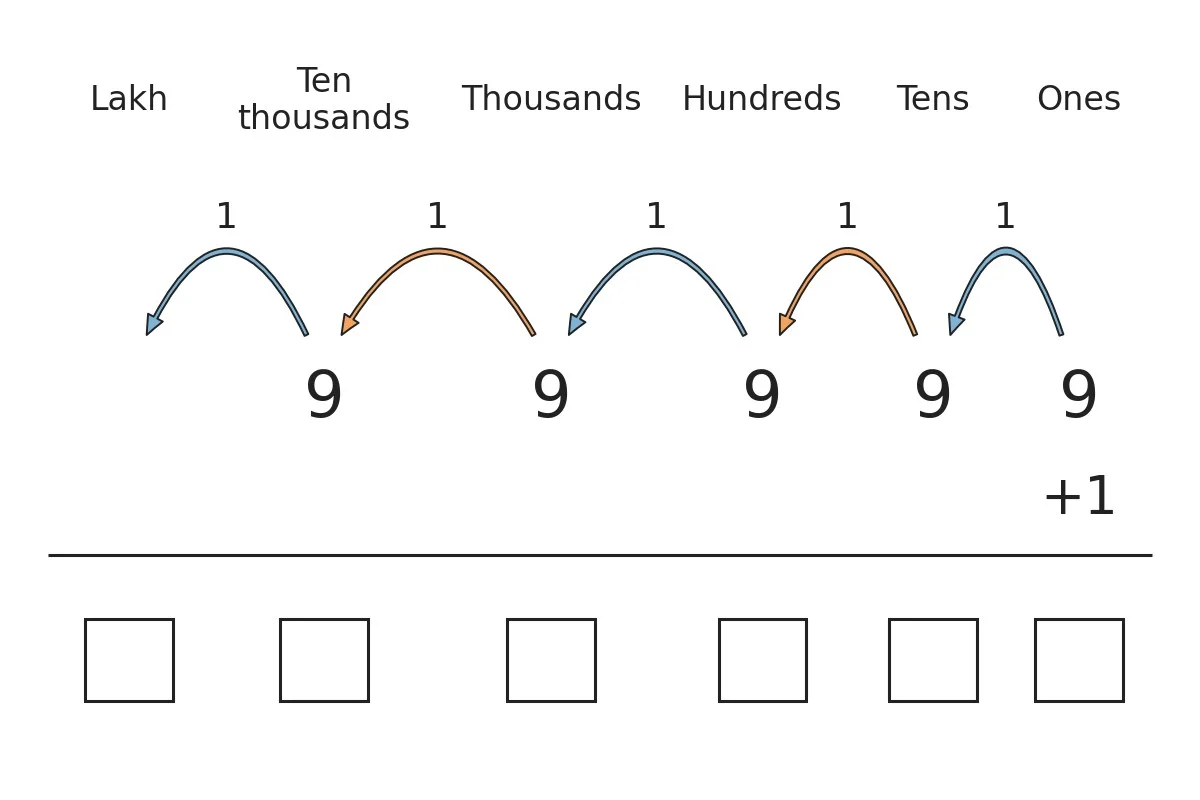
Place-value columns show five nines, adding one, and carries moving left.

1. A Lakh Varieties!

Adding one can create another digit place.

Show
Look at the diagram. Follow the carries from Ones on the right towards Lakh.
Ask
Looking at the five nines, what number will adding one give?
Say
Ten in each place become one in the next. This gives 1,00,000: one lakh, with six digits.
Used in
Understanding digit boundaries helps keep running totals correct when a new place appears.
If your child says…“One lakh needs six zeroes.”
Ask
After counting the 1, how many places remain?
What’s true
The six digits include the leading 1.
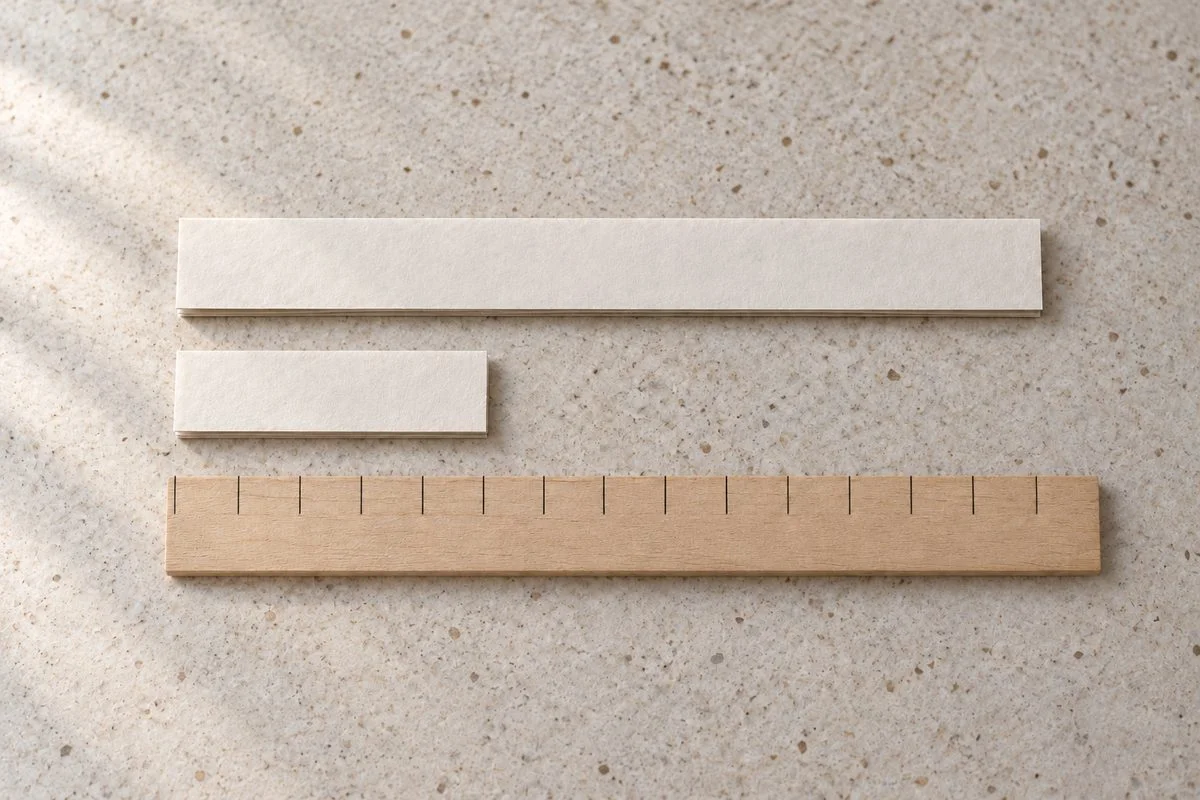
Two paper strips of different lengths aligned beside a ruler.

2. Getting a Feel of Large Numbers

Times as long and how much longer describe different comparisons.

Show
Fold paper strips to 5 cm and 15 cm using a ruler. Align their left ends. After the prediction, slide the shorter strip along, marking each endpoint.
Ask
How will these compare in times as long and centimetres longer?
Say
Division counts three repeats, so the longer strip is three times as long. Subtraction gives ten centimetres extra.
Used in
Comparing building heights shows both their relative size and their height difference.
If your child says…“Ten centimetres longer means ten times as long.”
Ask
How many shorter strips fit along the longer strip?
What’s true
A difference measures the extra length; division counts repeats.

Writing and naming numbers

102003=100000+2000+3102003=100000+2000+3

102003=1 lakh+2 thousand+3102003=1\text{ lakh}+2\text{ thousand}+3

3. Reading and Writing Numbers

Commas separate places into groups for reading.

Show
Say, “One lakh, two thousand, three.” Write this line. Point out the zeroes holding unnamed places.
Ask
How will you write the next line with Indian commas?
Say
Write 1,02,003: count three digits from the right, then pairs.
Used in
Commas help readers recognise large amounts in property prices.
If your child says…“Every comma separates three digits.”
Ask
After the last three digits, how many places make the thousands group?
What’s true
Indian grouping uses three digits at the right, then two per group.

p×100=1,100p\times100=1,100

p=1,100÷100p=1,100\div100

4. Land of Tens

Repeated equal additions build a total.

Show
Say, “Start at zero. Each press adds one hundred, and p counts presses.” Write this line. Say, “Divide the total by one hundred to find the number of presses.”
Ask
What value of p belongs on the next line?
Say
Eleven presses make 1,100 because it contains eleven hundreds. Divide by the amount added each time.
Used in
Counting equal packs by division helps a shopkeeper order the required stock.
If your child says…“I can read the press count from the hundreds digit.”
Ask
How many hundreds are inside the thousand?
What’s true
The thousands also contain hundreds.
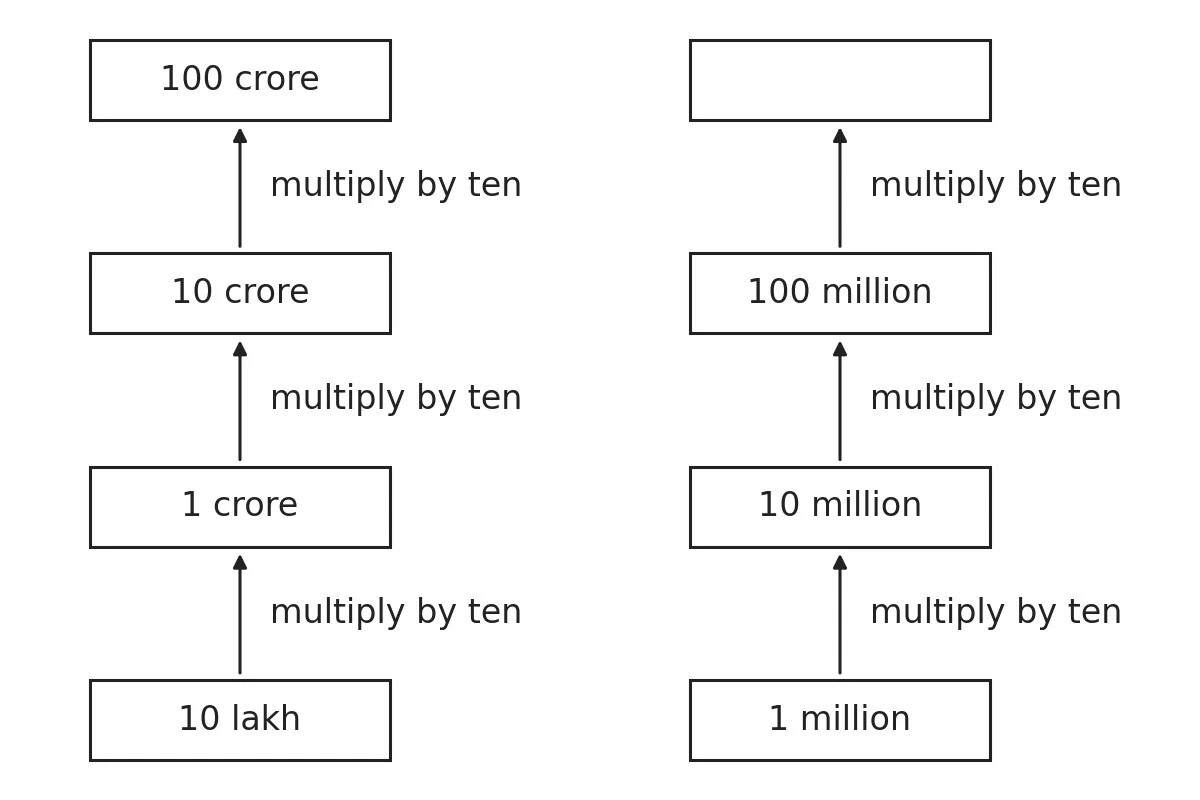
Paired ladders match lakh and crore amounts with millions, increasing upwards.

5. Of Crores and Crores!

Different names describe equal amounts.

Show
Look at the diagram’s ladders. Find 10 lakh beside 1 million, then follow each “multiply by ten” arrow upwards. Say, “A billion means a thousand million.”
Ask
What belongs beside 100 crore?
Say
One billion equals 100 crore.
Used in
Matching number names helps compare population reports.
If your child says…“A crore equals a million.”
Ask
Which name sits beside one crore on the ladder?
What’s true
One crore equals ten million.

Estimating and multiplying

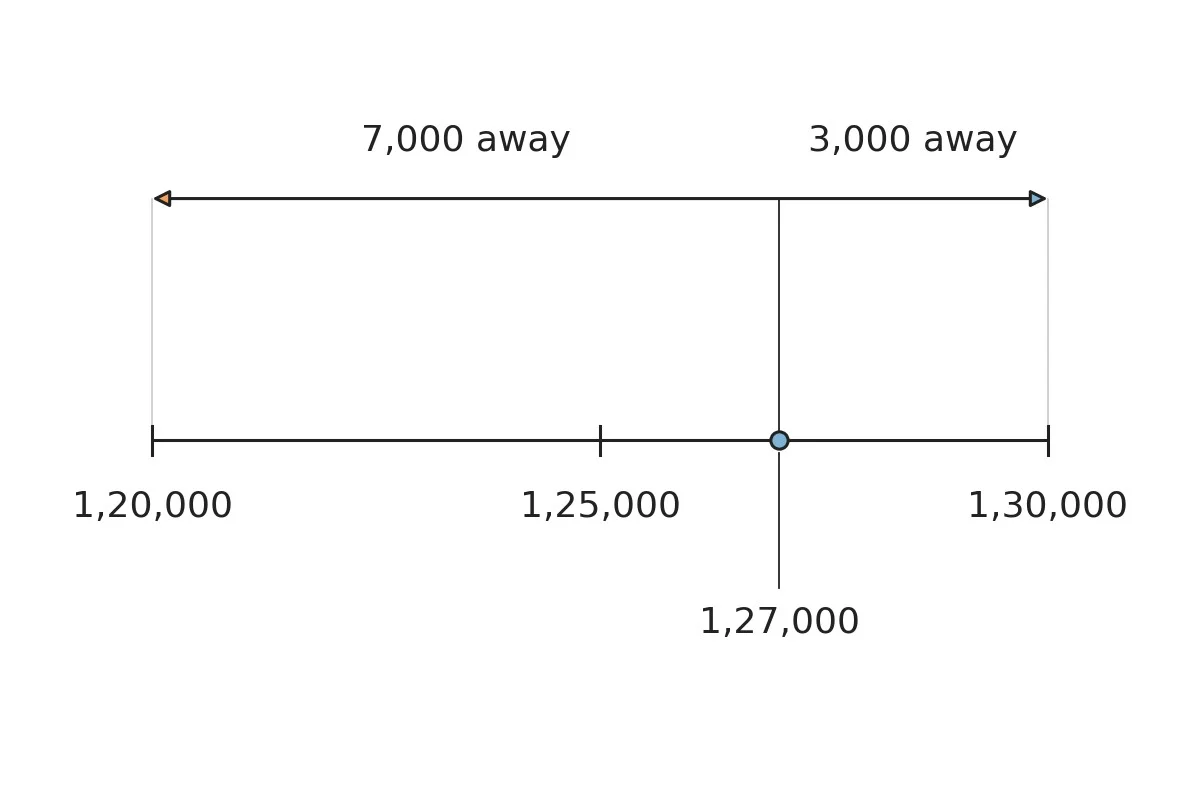
Number line shows 1,27,000 closer to 1,30,000 than to 1,20,000.

6. Exact and Approximate Values — Nearest Neighbours

Rounding replaces an exact count with a nearby convenient number.

Show
Look at the diagram. Find 1,27,000, then the neighbouring ten-thousands. Compare the two marked gaps.
Ask
Which neighbour best describes 1,27,000 visitors when rounding to the nearest ten thousand?
Say
Use about 1,30,000 visitors because the gap is only 3,000. The exact count stays 1,27,000.
Used in
Rounded shopping totals help estimate spending before reaching the counter.
If your child says…“Rounding means changing the last digits to zeroes.”
Ask
Which gap is smaller: 7,000 or 3,000?
What’s true
Compare the gaps to neighbouring multiples of the requested size.

12×5=12×10212\times5=12\times\frac{10}{2}

12×5=(12÷2)×1012\times5=(12\div2)\times10

12×5=6×10¹²\times5=6\times10

7. A Multiplication Shortcut

Rewrite a factor to make multiplication easier.

Show
Say, “Five is half of ten.” Write this line for twelve items costing five rupees each. Say, “Half of twelve is six.” Leave the final multiplication for your child.
Ask
What total will the next line give from six tens?
Say
The total is sixty rupees: halving twelve balances doubling five.
Used in
Mental multiplication helps check the cost of several equally priced items.
If your child says…“I halve twelve and stop at six.”
Ask
What operation is still waiting beside the six?
What’s true
The six still needs multiplying by ten.
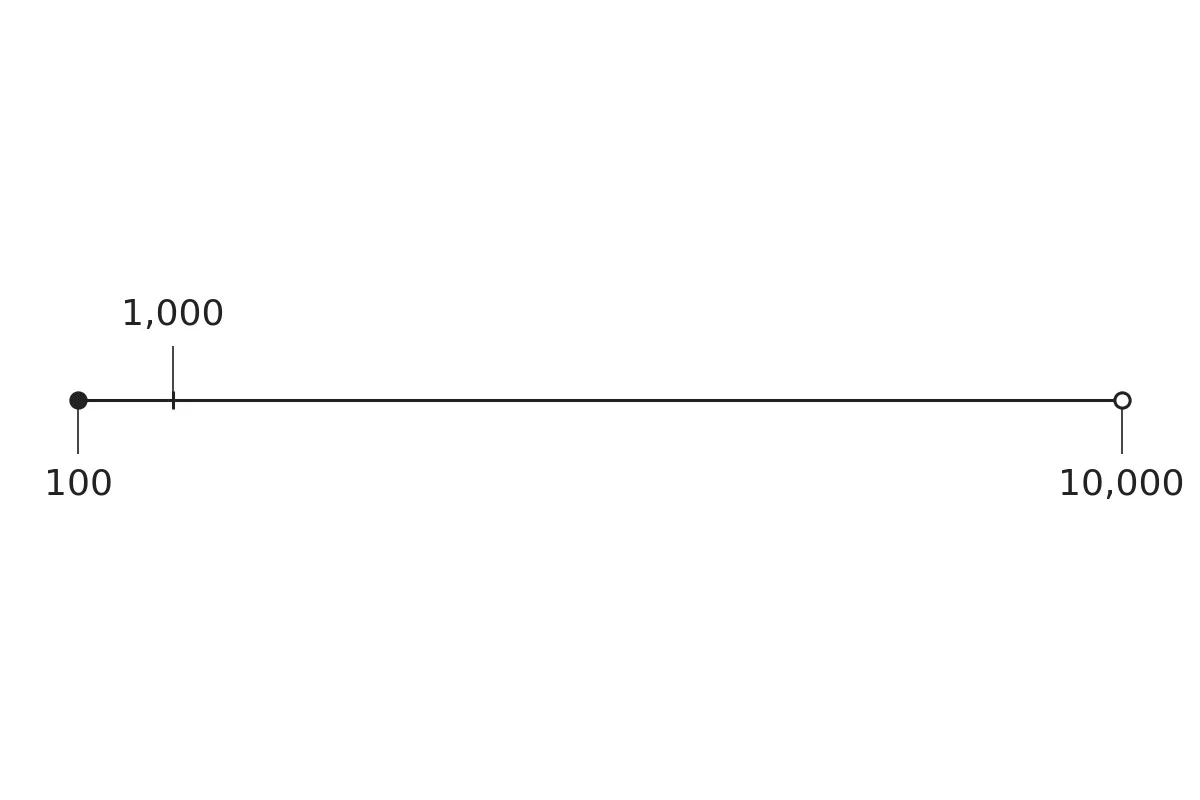
Number line includes 100, marks 1,000 and excludes 10,000.

8. Patterns in Products

Factor sizes limit the product's digit count.

Show
Look at the diagram’s number line. Find 100, 1,000 and 10,000. The filled dot includes 100; the open dot excludes 10,000. Say, “Two-digit factors are at least ten and less than a hundred. Their products are at least 100 and less than 10,000.”
Ask
Which digit lengths can the product have?
Say
Three or four digits fit this range.
Used in
Digit counts help detect misplaced zeroes in bills.
If your child says…“Two two-digit numbers always give four digits.”
Ask
How many digits does the included left endpoint have?
What’s true
The permitted range also includes three-digit answers.

A real problem

Falling paper helped estimate an explosion’s strength.

Fermi made his estimate at the Trinity test on 16 July 1945.

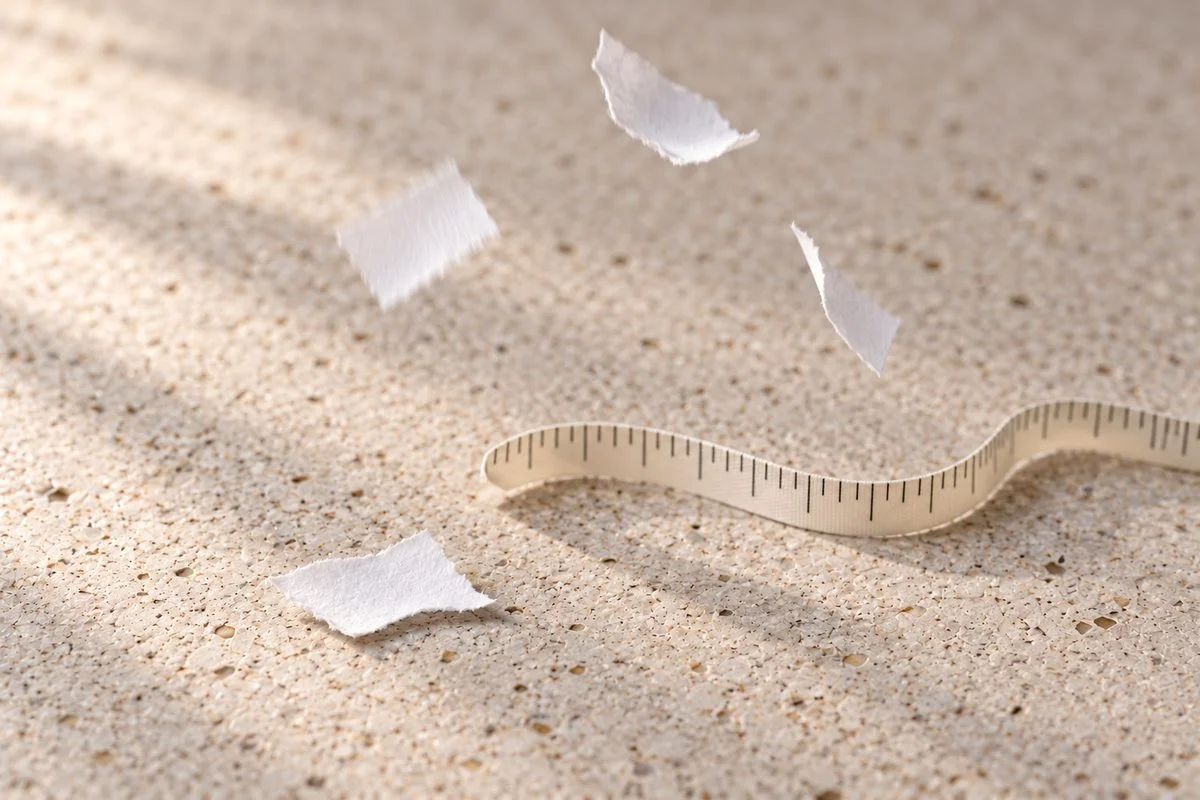
He used falling paper scraps to estimate the explosion’s strength.

He measured how far the blast moved the falling scraps.

American Nuclear SocietyAtomic Archive — Fermi’s original accountWikipedia

Small paper scraps falling beside a measuring tape on the ground.

Concept Lab · Common misconception

The tempting mistake in Large Numbers Around Us

Open standalone misconception page →

Can the same digit have different values?

Wrong

The two 7s in 707,000 are worth the same.

Why it feels right. They have the same symbol.

Right

Place value depends on position.

Worked example

707,000
7Hundred thousands
0Ten thousands
7Thousands
0Hundreds
0Tens
0Ones
The two 7s are separated by two place-value columns. Their contributions differ by a factor of 100.
  1. The first 7 represents 700,000.
  2. The second 7 represents 7,000.
  3. Together they make 707,000.

Ask your child eight quick questions.

One per step. The answer and the reason are given.

  1. What is the smallest six-digit number?

    1,00,000. The leading 1 and five zeroes fill six places.

  2. How many times as long is the 15 cm strip as the 5 cm strip?

    Three times. Three repeats of the shorter strip fit along the longer one.

  3. How do you write 1278830 with Indian commas?

    12,78,830. Count three digits from the right, then two at a time.

  4. Starting at zero, how many additions of 100 make 3,700?

    37. The whole total contains thirty-seven hundreds.

  5. How many millions equal one crore?

    Ten million. Multiplying both starting amounts by ten keeps the pair equal.

  6. What is 1,27,000 rounded to the nearest ten thousand?

    1,30,000. The gap to 1,30,000 is smaller.

  7. After halving twelve, what must you do to finish multiplying by five?

    Multiply six by ten. Halving balances changing five to ten; six is only an intermediate result.

  8. What is the fewest digits a product of two two-digit numbers can have?

    Three. The smallest factors are ten, whose product is one hundred.

15 more questions with answers, 1 with pictures