Skip to content

Teach Number Play in eight steps.

For each idea: show it, ask before you tell, then say one line.

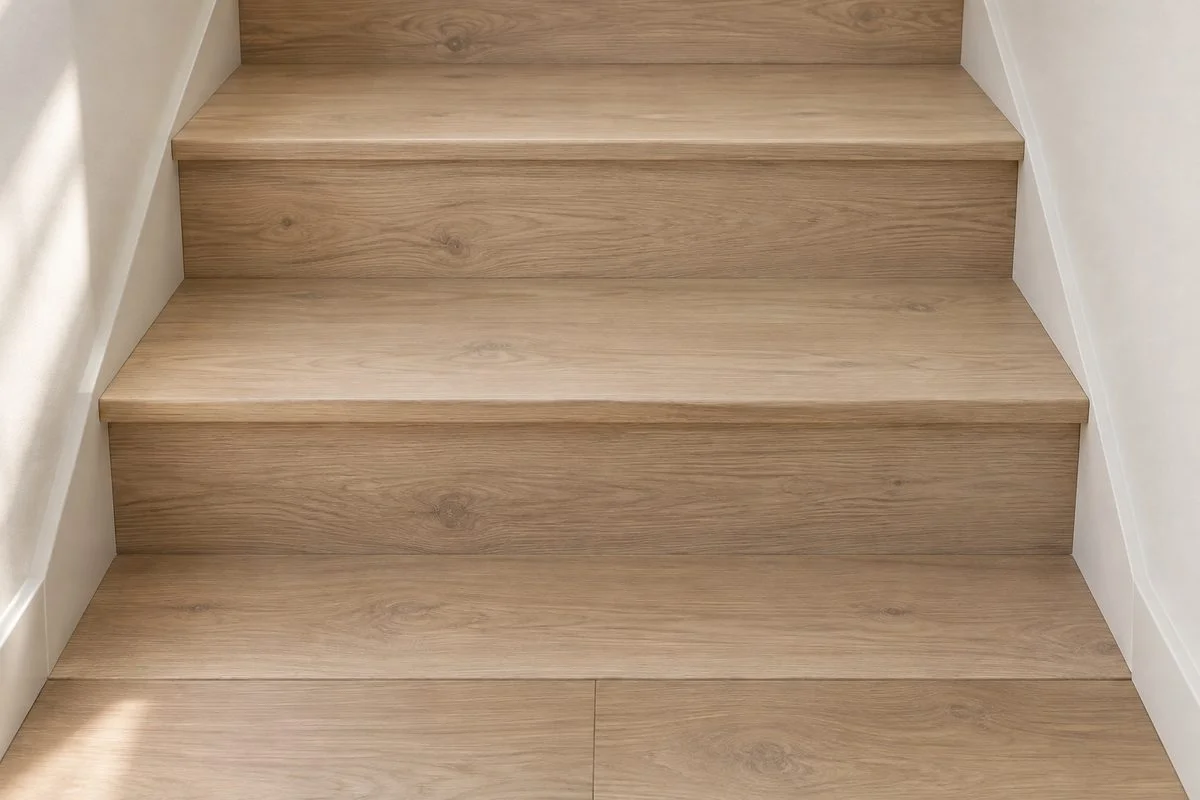
Gather four containers of different heights, eight coins, paper and a pencil. Use three bottom stairs.

Common misconceptions & worked visual for this chapter · 15 practice questions with answers

How to teach it

Arrangements and odd–even patterns

Four containers arranged shortest, tallest, then decreasing heights from left to right.

1. Numbers Tell us Things

Count taller objects ahead, using both height and position.

Show
Put the shortest container first, tallest second, then the others from taller to shorter. The left end is the front. After predicting, record each container’s taller-ahead count.
Ask
Will only the tallest get zero?
Say
The counts are 0, 0, 1, 2. Zero means no taller container ahead.
Used in
Taller containers at the back keep shorter containers visible on a shelf.
If your child says…“Zero means it’s the tallest.”
Ask
Which container behind the shortest one is taller?
What’s true
A taller container can stand behind one whose count is zero.
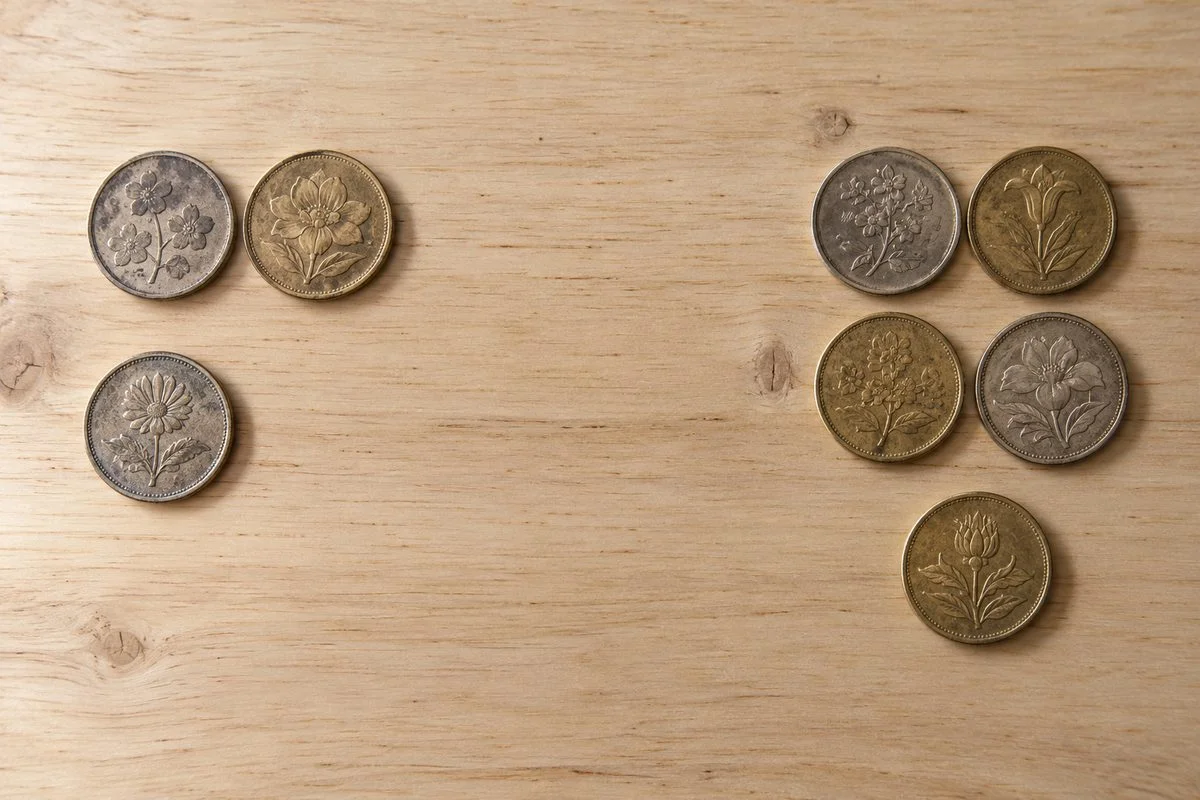
Groups of three and five coins, each with pairs and a spare.

2. Picking Parity

Parity tells whether a whole number is odd or even.

Show
Pair three coins and five coins separately, leaving each spare apart. After predicting, join the groups, then remove the original five.
Ask
Will joining these groups leave a spare?
Say
Joining pairs the spares; removing five leaves one spare.
Used in
Pairing players reveals whether someone will need a partner.
If your child says…“Adding odd numbers always gives an even answer.”
Ask
When five spare coins pair up, what remains?
What’s true
An odd count of odd groups leaves a spare after pairing.
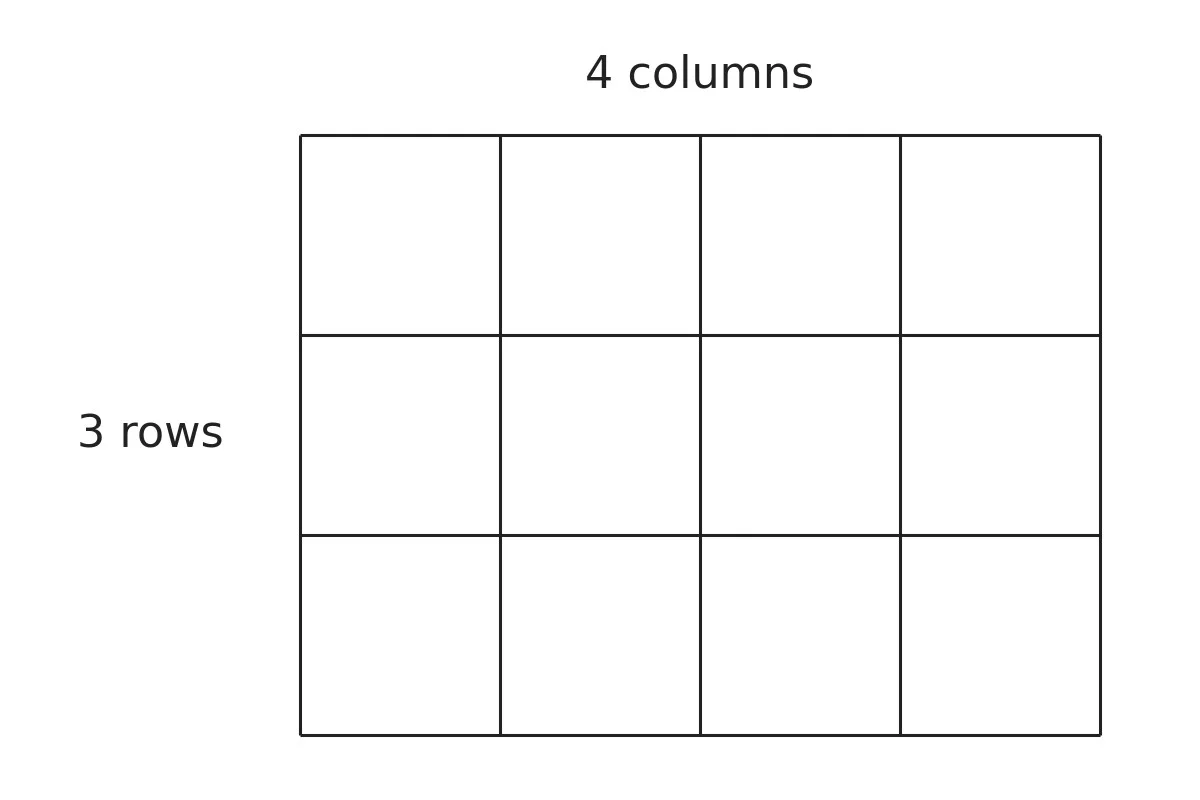
Rectangle divided into three rows and four columns, with both dimensions labelled.

3. Small Squares in Grids

One even factor makes a product even.

Show
Look at the diagram. Find the three rows and four columns. After predicting, trace neighbouring pairs along each row.
Ask
Will every square find a partner, although there are an odd number of rows?
Say
An even side lets every square pair up.
Used in
An even number of seats per row lets an entire seating block divide into pairs.
If your child says…“Both numbers must be even to make an even product.”
Ask
Which row has a square without a partner?
What’s true
An even number of columns pairs every row, whatever the number of rows.
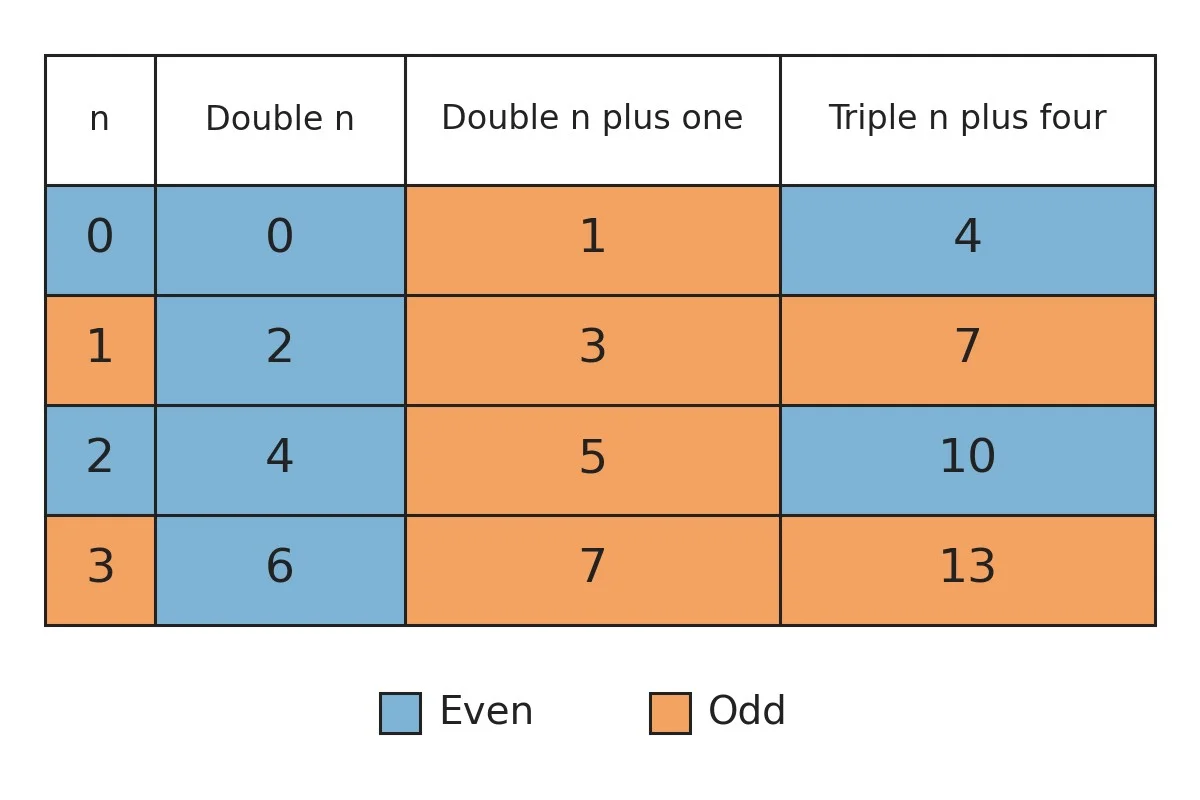
Table comparing expressions that stay even, stay odd, or change parity.

4. Parity of Expressions

An expression’s answers may stay odd, stay even, or change.

Show
Read the diagram’s columns. Here, n is a whole number.
Ask
Which columns stay even, stay odd, or change as n increases?
Say
Doubling makes pairs, so the first stays even. Adding one leaves a spare, so the next stays odd. Tripling and adding four keep n’s parity, so the last changes.
Used in
Expressions help check whether changing an order size can change a bill’s parity.
If your child says…“It gave an odd answer, so it always will.”
Ask
When n is even, do three times n or four leave anything unpaired?
What’s true
Three times n plus four changes parity when n changes between odd and even.

Totals in grids

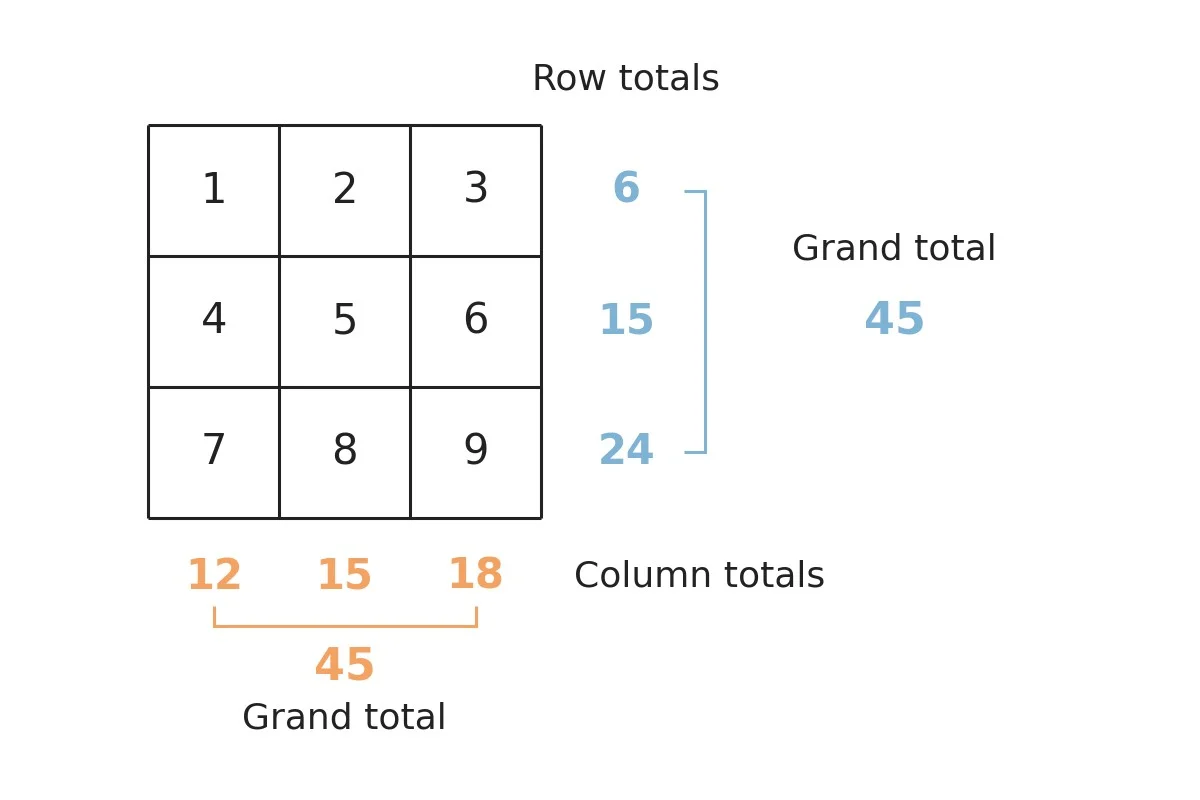
Number grid with row and column totals each adding to 45.

5. Some Explorations in Grids

Totals must fit the numbers inside the grid.

Show
Look at the diagram. Follow the row totals on the right, then the column totals below.
Ask
Could rearranging these numbers make the row totals and column totals add to different amounts?
Say
Both sets add to 45 because each counts every entry once. Rearranging these entries cannot change either grand total.
Used in
Row and column totals cross-check a spending table, helping reveal addition errors.
If your child says…“Moving the numbers could change the grand totals.”
Ask
Which entry would be missed when you add all the row totals?
What’s true
Rearranging the entries leaves both grand totals unchanged because each entry is still counted once.
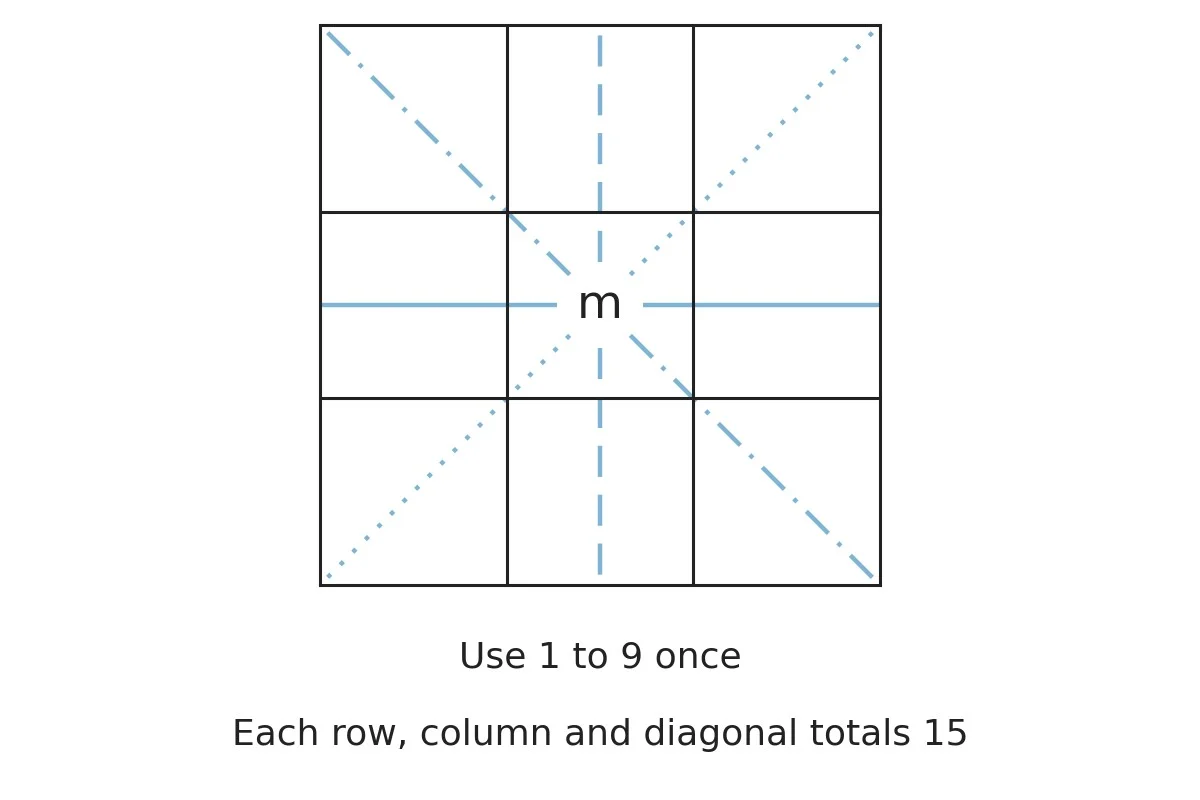
Magic-square grid with four highlighted lines crossing the centre labelled m.

6. Magic Squares

Every row, column and diagonal has the same total.

Show
Read the magic-square diagram; m names its centre. Trace the centre’s row, column and both diagonals. Three equal row totals share 45, so each is 15.
Ask
What must m equal?
Say
The centre must be 5. The four lines total 60, counting every entry once and the centre three extra times. Subtracting 45 leaves 15 for three copies of the centre: 15=3m15 = 3m.
Used in
Magic-square puzzles use equal totals to locate missing entries.
If your child says…“Any number can go in the centre.”
Ask
Could three copies of 9 account for the extra 15?
What’s true
The centre is fixed because those four lines count it three extra times.

Sequences and digit puzzles

The bottom three clear wooden stair treads.

7. Virahāṅka–Fibonacci Numbers

Each new count adds the previous two counts.

Show
Use the bottom three stairs. Your child climbs using single or double steps; record 1–1–1, 1–2 and 2–1. Group these routes by their first move.
Ask
How many routes would four stairs have, using the counts after each possible first move?
Say
There are five routes: three after a single first step, two after a double.
Used in
These counts list possible rhythms made from short and long syllables.
If your child says…“Just double the last number.”
Ask
Do both first moves leave the same number of stairs?
What’s true
The two first moves leave different numbers of stairs, so their route counts differ.

T+T+T=UT‾T + T + T = \overline{UT}

3T=10U+T3T = 10U + T

2T=10U2T = 10U

T=5UT = 5U

8. Digits in Disguise

Letters hide fixed digits whose places determine their values.

Show
Write these lines. Say, “UT means U tens and T ones. U is nonzero. Each letter keeps its digit.”
Ask
Which nonzero digit can U be if five times U is one digit?
Say
U must be 1, so T is 5. Three fives make one ten and five ones.
Used in
Place value keeps carried tens in the correct column when adding bills.
If your child says…“UT means U times T.”
Ask
Which place does U occupy in the two-digit answer?
What’s true
Here, neighbouring letters fill digit places rather than multiply.

A real problem

Odd–even checks expose errors in computer data.

Hamming published his error-correcting code in 1950.

He developed it for computers using punched cards.

A bit is a digit, either zero or one.

Changing one bit switches whether the number of ones in its group is odd or even.

WikipediaCornell UniversityNorthwestern University

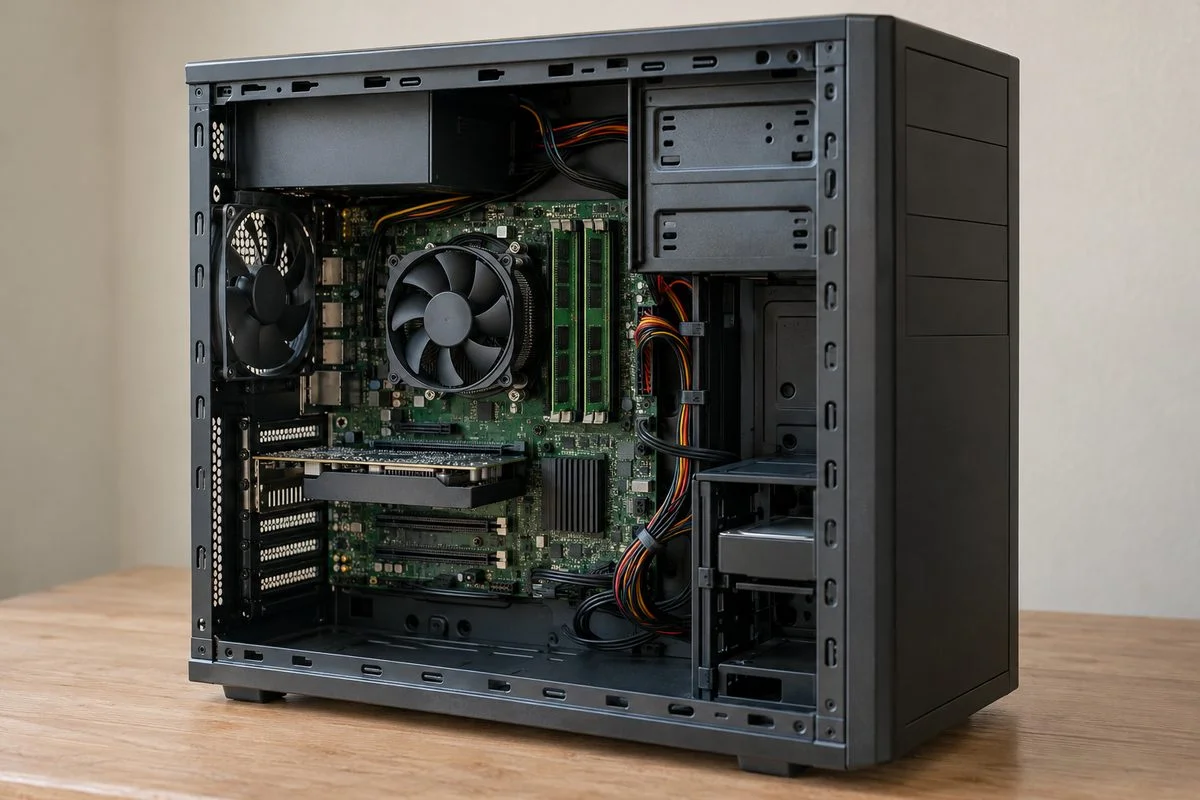
Open desktop computer case with memory modules visible inside.

Concept Lab · Common misconception

The tempting mistake in Number Play

Open standalone misconception page →

Can an even total prove both addends are even?

Wrong

If a sum is even, both numbers were even.

Why it feels right. Even plus even works, so it feels like the only route.

Right

Two odd numbers also add to an even number.

Worked example

Three
●●
●
Five
●●
●●
●
Combined
●●
●●
●●
●●
The leftovers from two odd groups form one last pair.
  1. Pair objects in groups of 3 and 5.
  2. Each group leaves one unpaired object.
  3. Those two form another pair, giving 8.

Ask your child eight quick questions.

One per step. The answer and the reason are given.

  1. What does zero tell you about taller containers behind?

    Nothing. The count checks only containers ahead.

  2. Why can’t five odd groups total 30?

    Their sum must be odd. Their five spares leave one unpaired, while 30 has no spare.

  3. Is 135 multiplied by 654 odd or even?

    Even. The even factor 654 supplies complete pairs.

  4. For even n, is three times n plus four odd or even?

    Even. Tripling an even number keeps pairs complete; adding four adds more pairs.

  5. The row totals add to 45. What must the column totals add to?

    45. Both count exactly the same entries once.

  6. Using 1 to 9 once, what number must occupy the centre?

    5. The four crossing lines total 60, exceeding 45 by three copies of the centre.

  7. What number follows 3 and 5 in this sequence?

    8. Add the previous two numbers, rather than doubling the last.

  8. With U as 1 and T as 5, what number does UT mean?

    15. U occupies the tens place; T occupies the ones place.

15 more questions with answers, 1 with pictures