Skip to content

Teach A Tale of Three Intersecting Lines in eight steps.

For each idea: show it, ask before you tell, then say one line.

Gather scrap paper, a pencil, ruler, scissors and rectangular card.

An adult cuts the paper.

Common misconceptions & worked visual for this chapter · 15 practice questions with answers

How to teach it

Making triangles

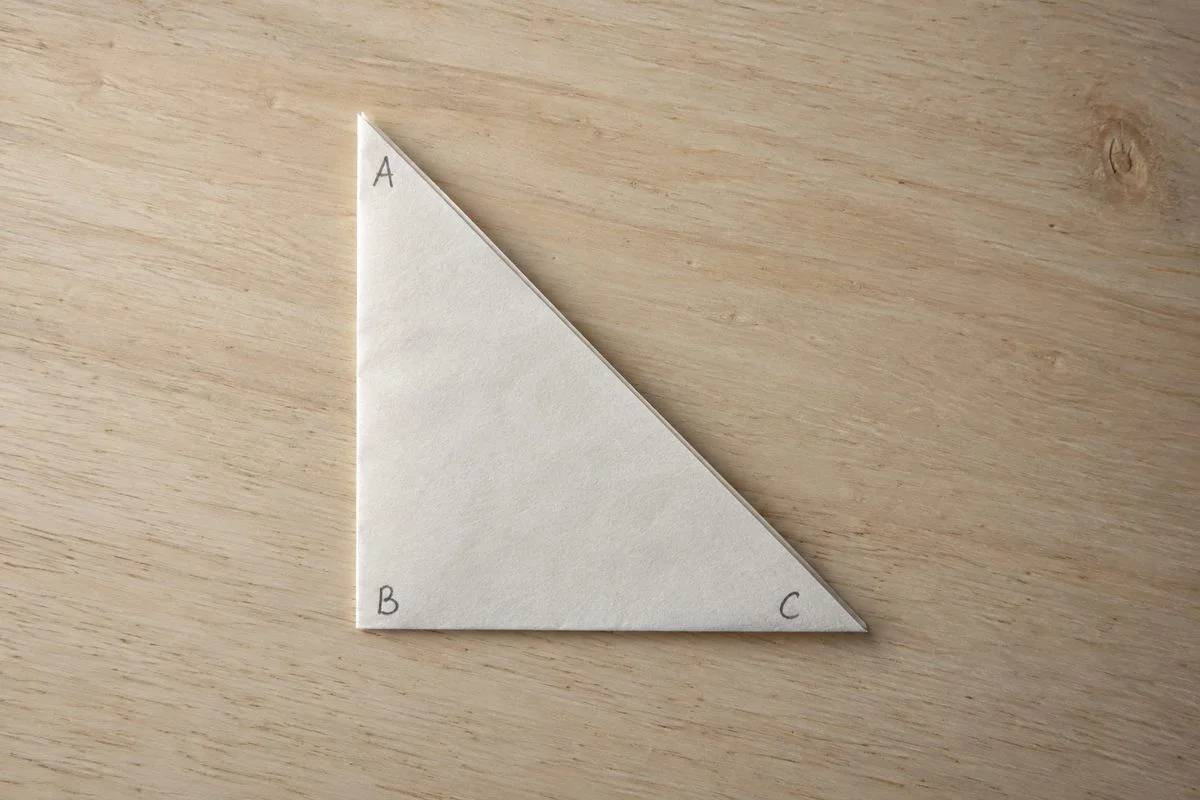
Square scrap paper folded diagonally into a triangle with corners labelled A, B and C.

1. Triangle, vertices, sides and angles

Three straight sides enclose a shape with three corners.

Show
Fold square paper diagonally. Label the corners A, B and C. Trace its boundary from different corners. Point along C to A, pausing before turning towards B.
Ask
Which corner will you turn at when tracing angle CAB?
Say
The corners are vertices. You will turn at A; an angle's middle letter names its corner.
Used in
Corner names help carpenters identify which angle a drawing asks them to cut.
If your child says…“Angle CAB is at C.”
Ask
Where does the path from C through A to B turn?
What’s true
The middle letter A identifies the corner of angle CAB.
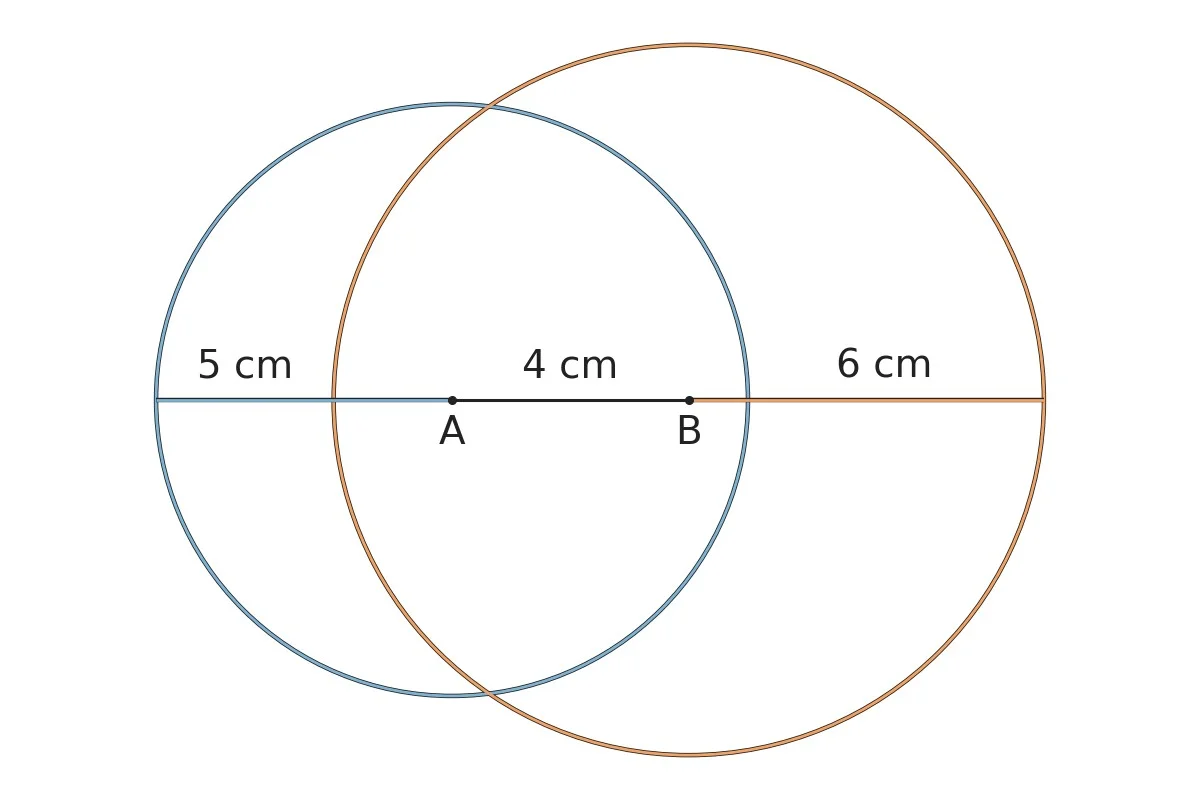
Two unequal labelled circles cross above and below base AB.

2. Constructing a Triangle When its Sides are Given

Crossing arcs locate a corner at both required distances.

Show
Find base AB and both circle crossings in the diagram. Trace the marked radius from each centre to its circle.
Ask
Which crossing will give us both required distances?
Say
Both crossings fit both distances.
Used in
Compass arcs help make triangular craft pieces with specified side lengths, avoiding repeated guesses.
If your child says…“Both circles must have the same radius.”
Ask
Would equal compass openings give us both a 5 cm side and a 6 cm side?
What’s true
Each radius matches its required side, so the radii can differ.
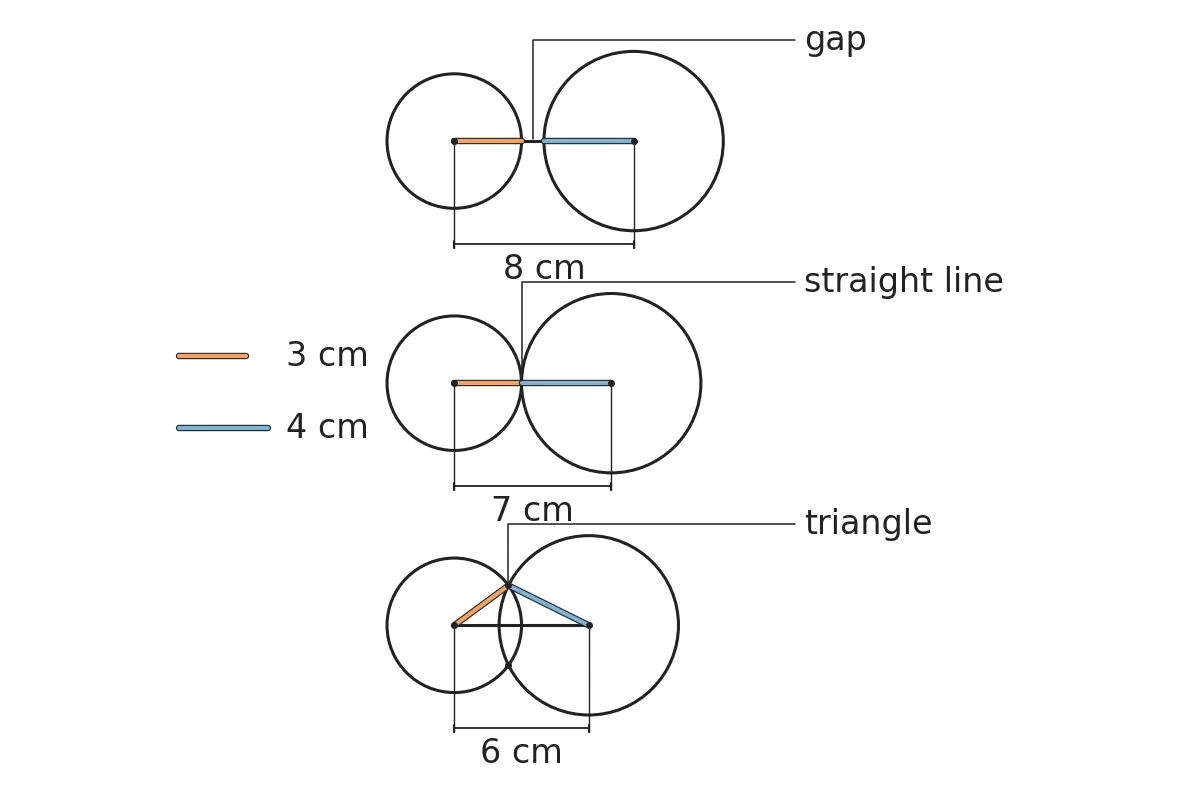
Three circle pairs show a gap, touching on a line, and crossings forming a triangle.

3. Triangle Inequality and Visualising the Construction of Circles

The shorter lengths together must exceed the longest.

Show
Look at the diagram from top to bottom. Compare the gap, the touching point and the crossings.
Ask
Which pair of circles lets these lengths enclose a triangle?
Say
Only the bottom pair crosses away from the base line.
Used in
Checking lengths before cutting a triangular frame prevents wasted material.
If your child says…“The shorter sides just reach, so a triangle fits.”
Ask
In the middle diagram, where could a third corner sit away from the base line?
What’s true
Equal total length leaves a flat line, with nothing enclosed.
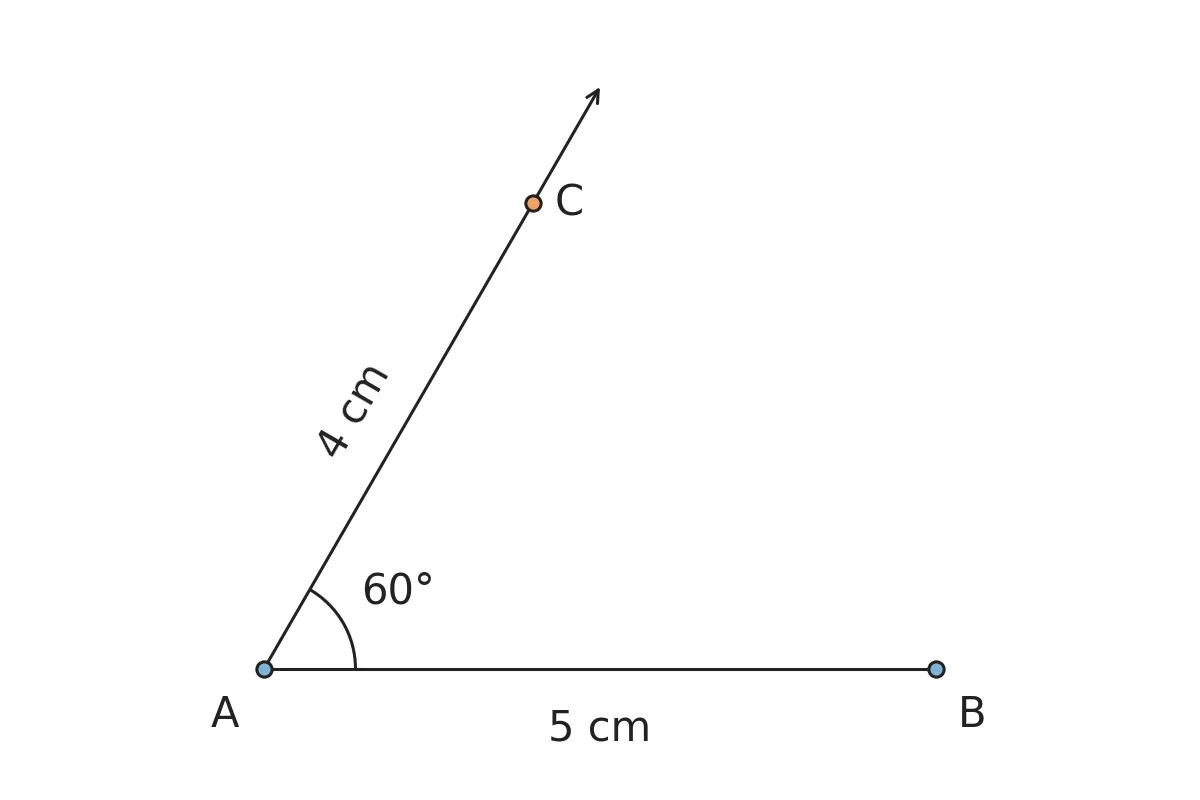
Labelled base AB and arm AC meet at 60°, with BC missing.

4. Two Sides and the Included Angle

Two lengths and their shared angle fix a triangle.

Show
Find AB, the 60° angle at A, and C on the arm in the diagram. Notice that BC is missing.
Ask
Can C move elsewhere on this arm while staying 4 cm from A?
Say
No; the angle fixes the direction, and the length fixes C.
Used in
A carpenter can reproduce a triangular brace from two lengths and their shared angle.
If your child says…“These measurements could give different third sides.”
Ask
Which endpoint could move while keeping all these measurements?
What’s true
Fixing both sides and their included angle fixes the remaining side.
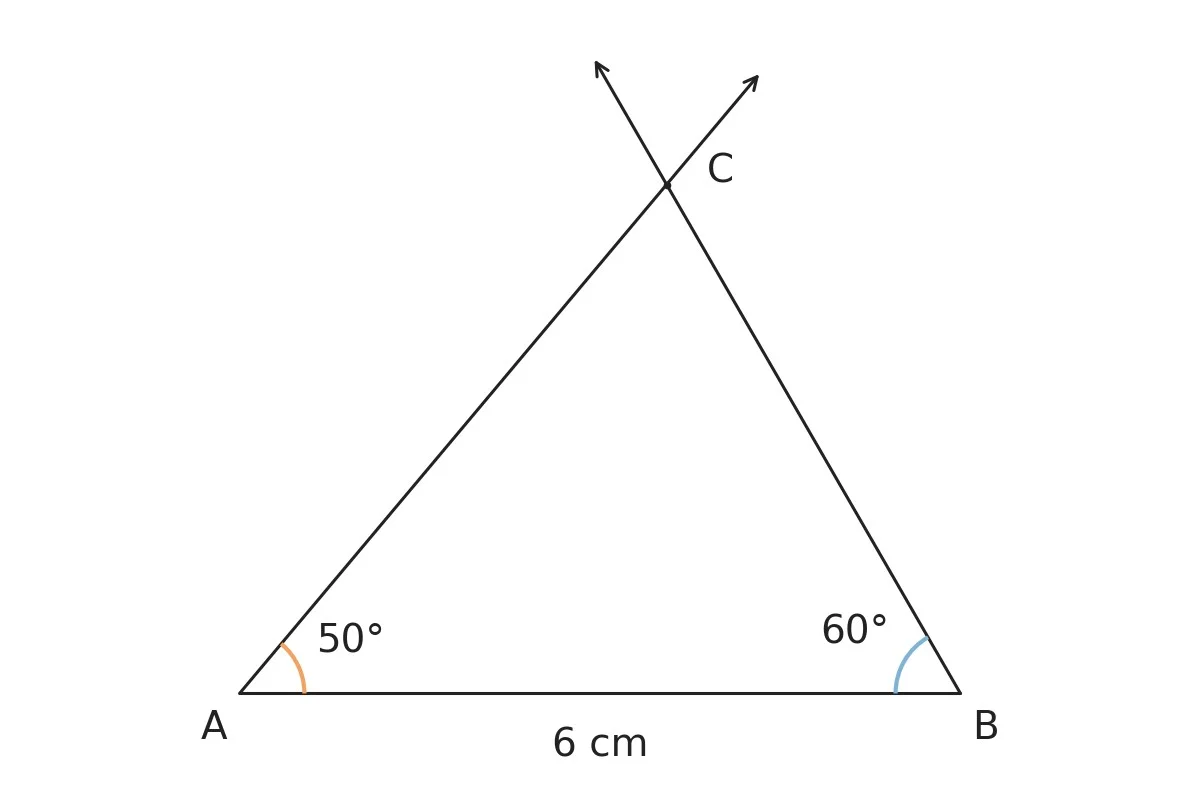
Two rays at the ends of a labelled base meet at C.

5. Two Angles and the Included Side

Two angles set shape; the included side sets size.

Show
Look at the diagram. Find the 6 cm base AB. Follow the 50° and 60° arms to C.
Ask
If this base gets shorter, what will happen to the triangle's size?
Say
The triangle becomes smaller, but its angles stay the same. Both arms keep their directions when the marked angles stay fixed.
Used in
Surveyors use measured sides and angles to calculate inaccessible distances.
If your child says…“A shorter base changes the third angle.”
Ask
With both arm directions unchanged, what could change the angle where they meet?
What’s true
Changing the base length keeps the third angle unchanged when both base angles stay fixed.

Angles and heights

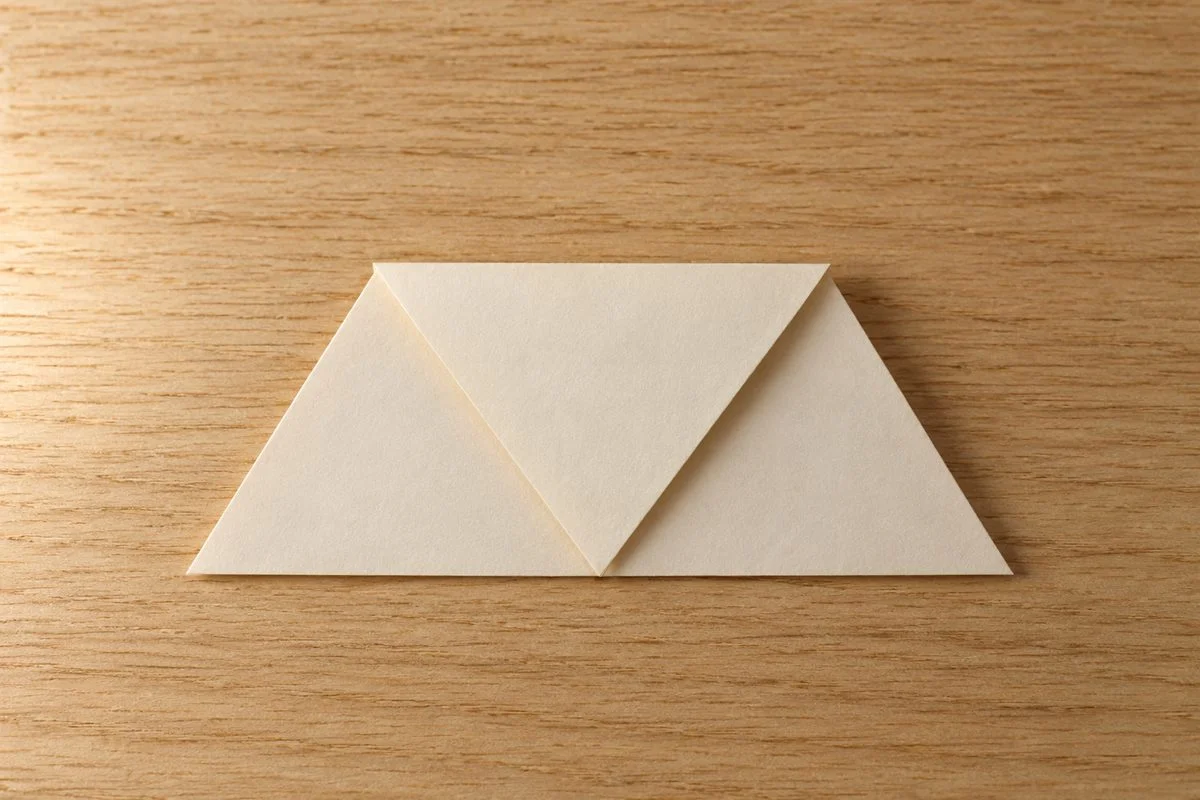
Paper triangle with its top corner folded to the base and bottom corners unfolded.

6. Angle Sum Property

A triangle's corner angles together make a straight angle.

Show
An adult cuts an acute paper triangle. Mark the midpoints of its sloping sides. Fold the top corner down along their joining line. Pause before folding both bottom corners to meet it.
Ask
What angle will the three corners make together?
Say
Fold the bottom corners in: the unchanged corner angles together make 180°.
Used in
A triangular tile's missing corner angle can be calculated without measuring that corner.
If your child says…“A bigger triangle has a bigger angle total.”
Ask
Would larger paper change the angle made by a straight line?
What’s true
Every triangle has the same angle total, regardless of its size.
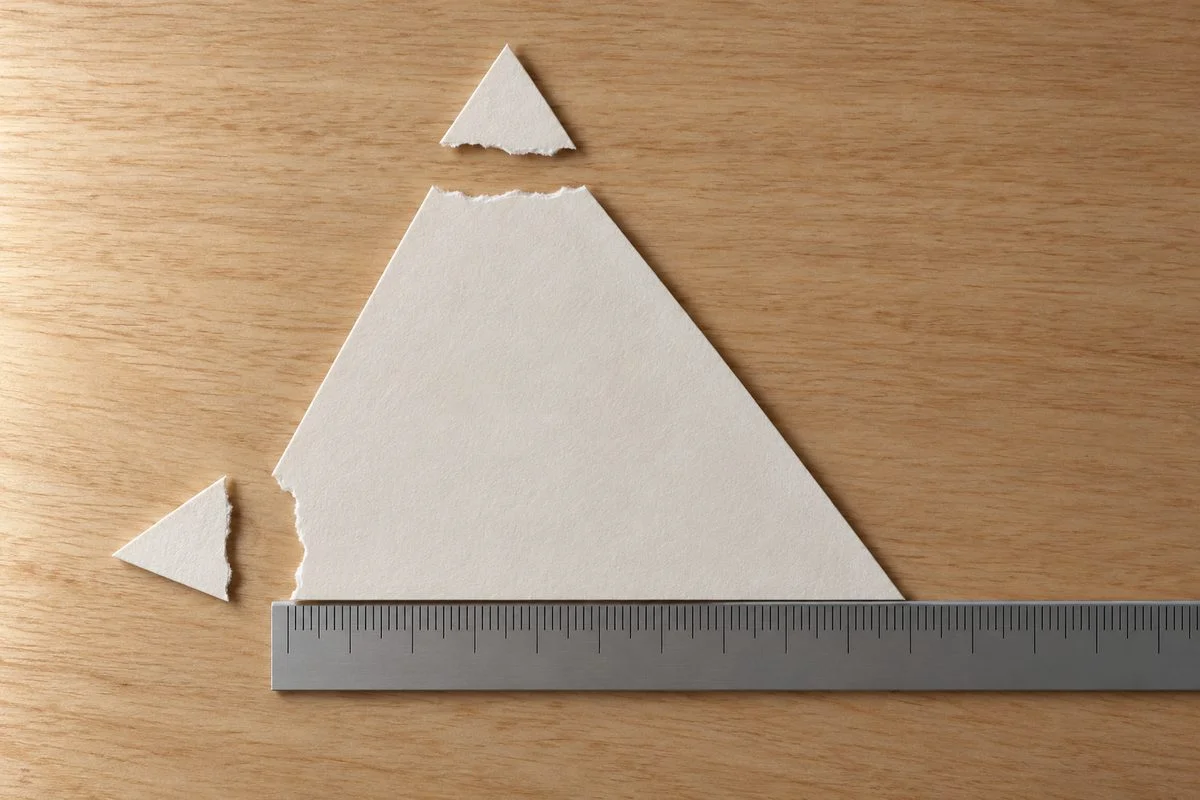
Torn triangle corners beside a ruler extending the base beyond the intact corner.

7. Exterior Angles

Extending a side creates an outside angle.

Show
An adult cuts triangle ABC. Extend BC beyond C with a ruler. Tear off A and B; pause before fitting them into C's outside angle.
Ask
Will one corner or both fill it?
Say
Fit both: together they complete a straight angle with C.
Used in
Exterior angles give the turns needed when marking a triangular garden border.
If your child says…“The outside angle equals just one far corner.”
Ask
What gap remains when you put only one torn corner there?
What’s true
The exterior angle combines both distant interior angles.
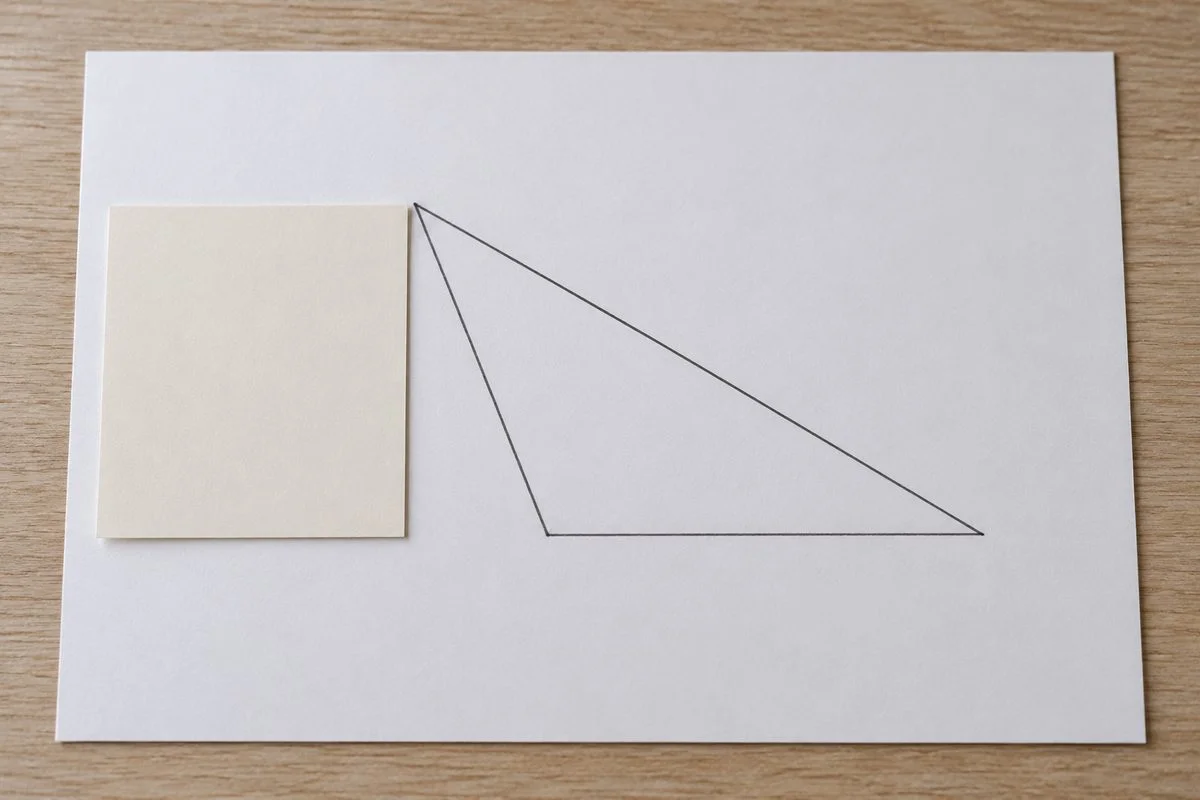
Obtuse pencil triangle beside rectangular card aligned with its base line.

8. Altitudes of Triangles and Types of Triangles

Altitudes are perpendicular heights; sides and angles determine names.

Show
Draw an unequal-sided triangle with a horizontal base. Make its bottom-left angle obtuse. Measure sides; compare angles with card's square corner. Slide the card along the base until its perpendicular edge reaches the opposite vertex.
Ask
Where will this height meet the base line?
Say
Extend the base: it meets outside. Its three sides have different lengths, so it is scalene. One angle exceeds 90°, so it is obtuse-angled.
Used in
Perpendicular height helps calculate cloth needed for triangular panels.
If your child says…“Every height must stay inside the triangle.”
Ask
Can the card's perpendicular edge reach this vertex without extending the base?
What’s true
An altitude can meet an extended side outside the triangle.

A real problem

Triangles helped establish the metre.

In 1792, Delambre and Méchain began surveying between Dunkirk and Barcelona to establish the metre.

Their survey used a chain of adjoining triangles.

Known angles and a measured side let surveyors work out the other side lengths.

Musée des arts et métiersParis ObservatoryNIST

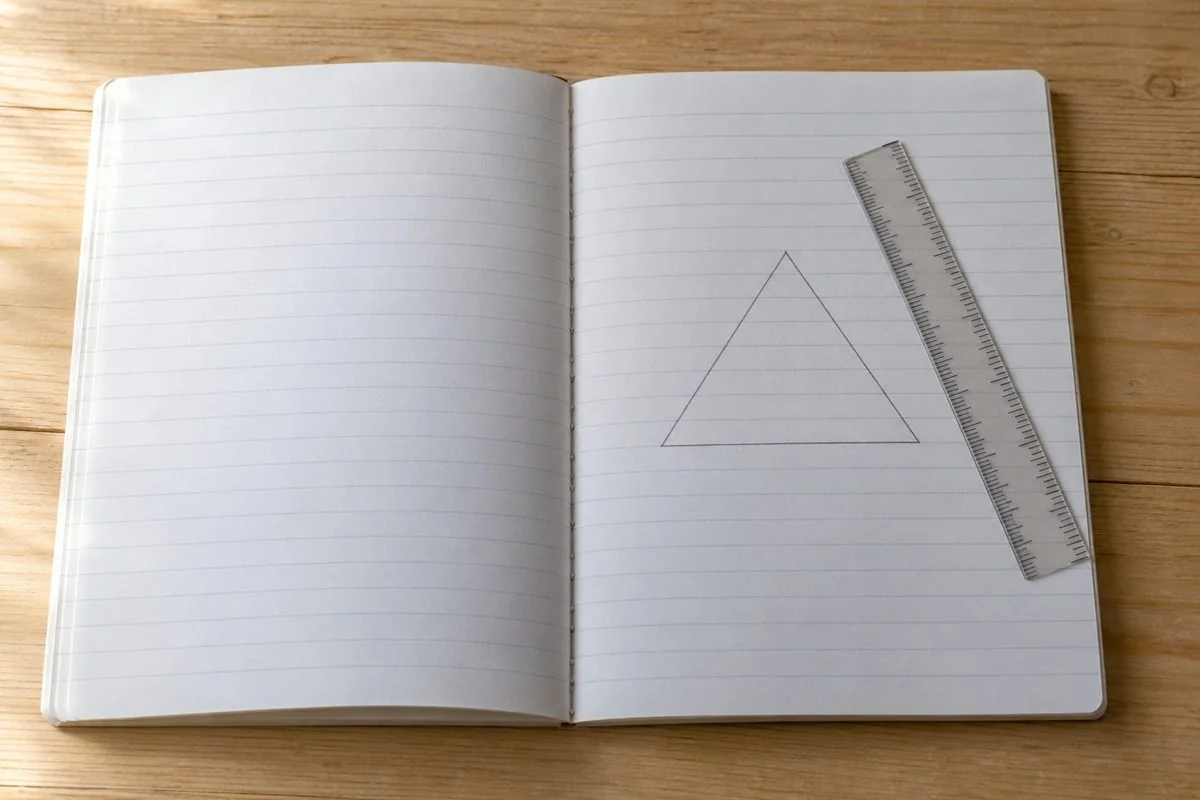
Metric ruler beside a pencil triangle in a school notebook.

Concept Lab · Common misconception

The tempting mistake in A Tale of Three Intersecting Lines

Open standalone misconception page →

Can any three side lengths make a triangle?

Wrong

Sides 2, 3 and 6 make a triangle.

Why it feels right. I can draw three line segments, so I expect them to close.

Right

Any two sides of a triangle must add to more than the third.

Worked example

The 2 cm and 3 cm sticks reach just 5 cm. A 1 cm gap remains beside the 6 cm stick.
  1. Place the 2 cm and 3 cm sticks end to end.
  2. They reach only 5 cm, too short to join both ends of the 6 cm stick.

Ask your child eight quick questions.

One per step. The answer and the reason are given.

  1. Which corner is angle BCA?

    C. C is the middle letter, so it names the corner.

  2. With base 4 cm, what circle radii give the remaining sides of 5 cm and 6 cm?

    5 cm, 6 cm. The radii supply the remaining side lengths; they need not match.

  3. What shape results when lengths 3 cm and 4 cm connect ends 7 cm apart?

    A straight line. Their total only equals the longest length, leaving no enclosed space.

  4. What happens to the third side when both given sides and their included angle stay fixed?

    Its length stays fixed. The two endpoints to be joined cannot move.

  5. What happens to the third angle when the base shortens but both marked angles stay fixed?

    It stays unchanged. The arms keep their directions, so their meeting angle stays unchanged.

  6. If every side doubles in length, what is the triangle's angle total?

    180°. Enlarging changes side lengths, while the angles still form a straight angle.

  7. The distant corners are 50° and 60°. What is the exterior angle?

    110°. The exterior angle contains both distant angles together.

  8. Where does the top vertex's altitude land when the bottom-left angle is obtuse?

    On the extended base. The perpendicular reaches the base line beyond the triangle's side.

15 more questions with answers, 9 with pictures