Skip to content

Teach Another Peek Beyond the Point in eight steps.

For each idea: show it, ask before you tell, then say one line.

Gather paper, two equal scrap sheets, a ruler and a pencil.

Common misconceptions & worked visual for this chapter · 15 practice questions with answers

How to teach it

Decimal places and multiplication

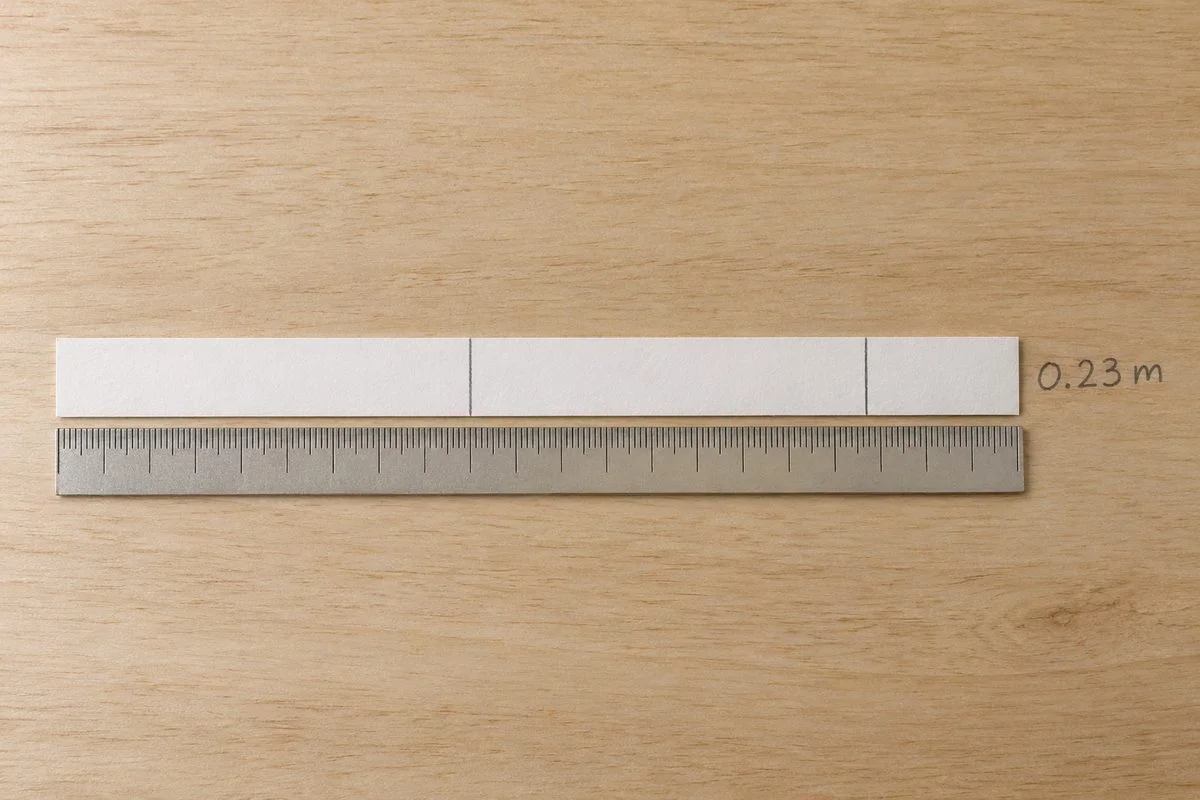
Paper strip beside a ruler, divided by two pencil marks.

1. A Quick Recap of Decimals

Digits count ones, tenths, hundredths and smaller parts.

Show
Measure a 23 cm paper strip. Mark 10 cm and 20 cm. Write 0.23 m beside it.
Ask
If we write 0.230 m instead, will the strip become longer?
Say
The strip contains two tenths and three hundredths of a metre. An extra zero adds no length.
Used in
Decimal lengths help tailors measure cloth accurately.
If your child says…“An extra zero makes the decimal bigger.”
Ask
Where is the extra length when we add that zero?
What’s true
A zero after the final decimal digit adds no amount.
0.4×10=410×100.4\times10=\frac{4}{10}\times10

0.4×10=40100.4\times10=\frac{40}{10}

2. Multiplying and dividing by 10, 100 and 1000

Each factor of ten changes every digit’s place.

Show
Say, 'Ten lots of four tenths give forty tenths.' Write this line.
Ask
What whole-number answer comes next?
Say
Forty tenths make four.
Used in
Metric conversions let builders compare measurements written in different units.
If your child says…“Multiplying by ten just adds a zero at the end.”
Ask
Would adding an empty hundredths place make four tenths ten times larger?
What’s true
For multiplication, digits shift left: one place for 10, two for 100, three for 1000. Division shifts them right instead. Use zeroes to hold any empty places.
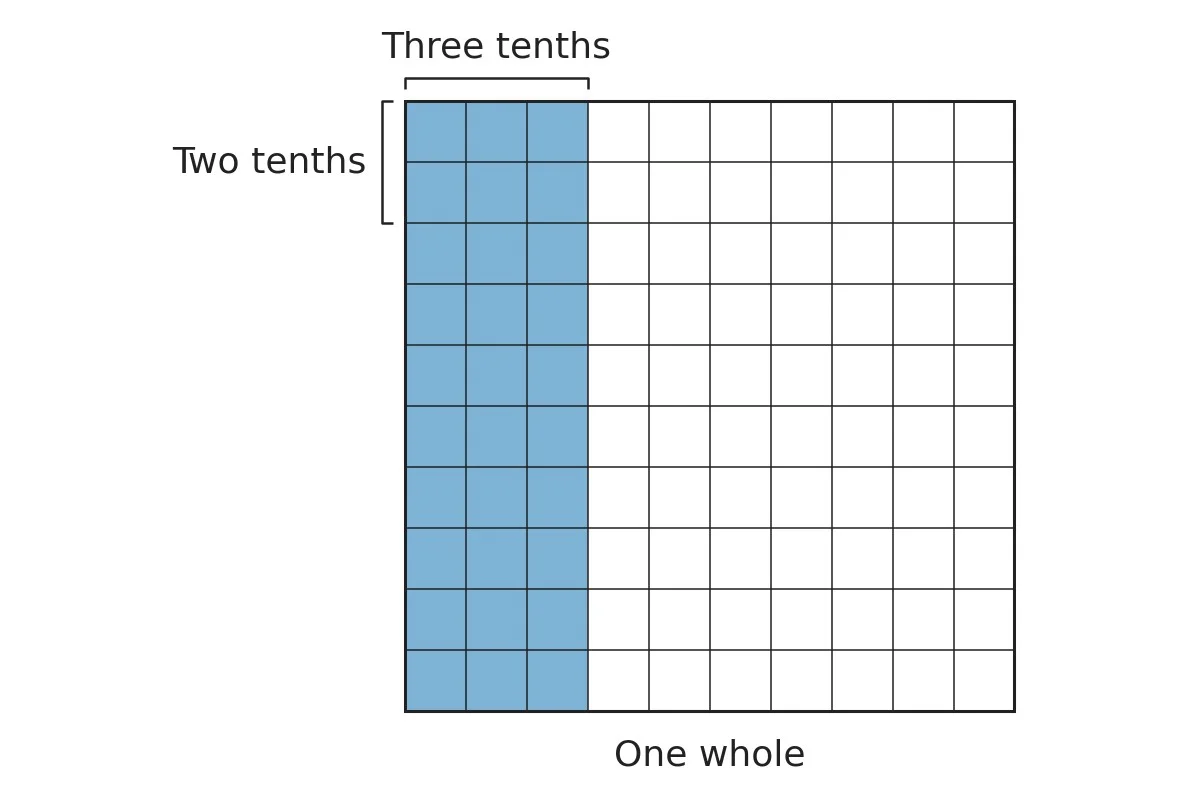
Square grid with three shaded columns and a bracket marking the top two rows.

3. Decimal Multiplication

Decimal places show the size of the parts being multiplied.

Show
Find the three shaded columns in the diagram. Then find their top two rows.
Ask
What fraction of the whole square would those top two rows cover?
Say
Two tenths of three tenths gives six hundredths: 0.2×0.3=0.060.2\times0.3=0.06.
Used in
Multiplying a rectangular floor’s length by its width gives its area for estimating flooring needs.
If your child says…“I count decimal places in only one factor.”
Ask
Does each little square occupy a tenth or a hundredth of the whole?
What’s true
Multiply as whole numbers first. Give the answer as many decimal places as both factors have together. Add zeroes before the product’s digits if needed.

Dividing beyond whole numbers

5÷2=2+1÷25\div2=2+1\div2

5÷2=2+(10×0.1)÷25\div2=2+(10\times0.1)\div2

5÷2=2+5×0.15\div2=2+5\times0.1

4. Division using place value

Regroup leftovers into smaller parts to keep dividing.

Show
Say, 'Share five ones equally, then change the leftover one into ten tenths.' Write this line.
Ask
What decimal answer comes next?
Say
Each share gets two ones and five tenths, making two point five.
Used in
Decimal division shares measured quantities equally without leaving whole-unit remainders.
If your child says…“The remainder goes straight after the point.”
Ask
When one whole is shared equally between two, does each share get just one tenth?
What’s true
Leftover ones become tenths, and leftover tenths become hundredths before sharing continues.

0.6÷0.2=0.60.20.6\div0.2=\frac{0.6}{0.2}

0.60.2=0.6×100.2×10\frac{0.6}{0.2}=\frac{0.6\times10}{0.2\times10}

0.6×100.2×10=6÷2\frac{0.6\times10}{0.2\times10}=6\div2

5. Decimal Division

Scale both numbers equally to make the divisor whole.

Show
Say, 'We are counting groups of two tenths within six tenths.' Multiply both numbers by ten and write this line.
Ask
How many groups of two tenths fit into six tenths, using the last line?
Say
Three groups of two tenths fit into six tenths. Counting both amounts in tenths keeps the group count unchanged.
Used in
Decimal division finds how many equal lengths can be taken from a ribbon.
If your child says…“I only need to remove the divisor’s decimal point.”
Ask
If the group size becomes ten times larger, can the group count stay unchanged?
What’s true
Changing just the divisor changes how many groups fit.
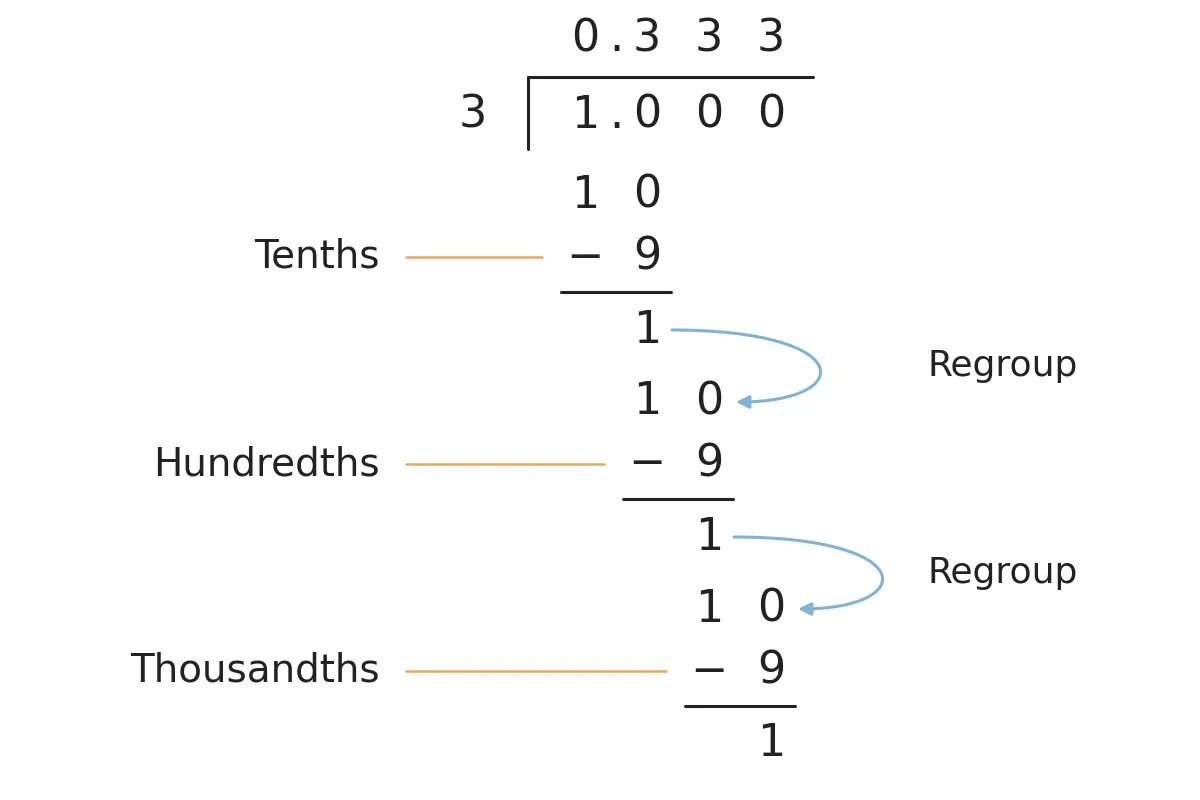
Long division of one by three, with the same remainder at each decimal place.

6. Does This Ever End?

A returning nonzero remainder makes decimal digits repeat.

Show
Look at the diagram. Follow each remainder of one as it becomes ten in the next place.
Ask
Will adding more decimal places ever finish this division?
Say
This division never finishes. Each new place gives another three and leaves one again. That remainder starts the same steps again.
Used in
Recognising repeating decimals helps us distinguish exact shares from rounded amounts.
If your child says…“Every division ends if I keep going.”
Ask
What would change next time if the same remainder returns?
What’s true
Possible remainders are limited, so division either reaches zero or repeats.
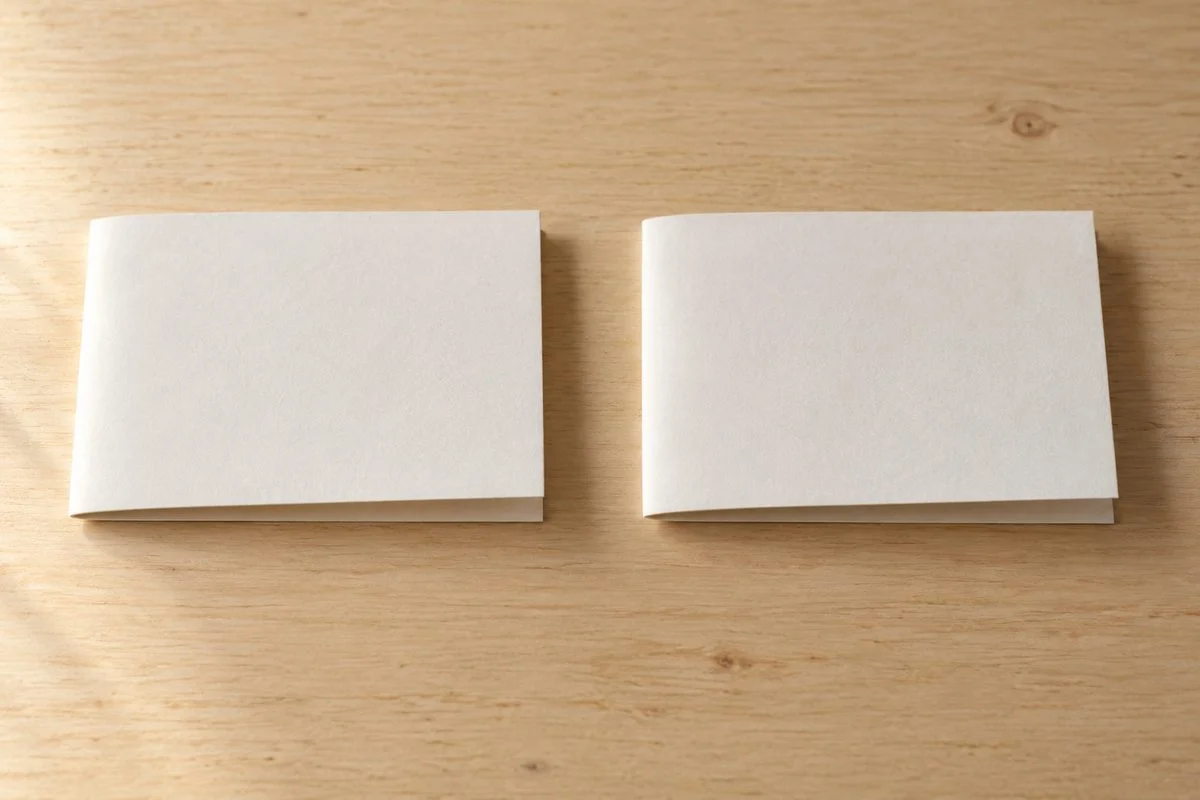
Two intact scrap-paper sheets folded in half, lying separately.

7. Decimal Division

Smaller portions can give more groups than the starting number.

Show
Take two equal scrap sheets. Fold each in half. After the prediction, tear along the folds and count the pieces.
Ask
How many half-sheet notes will the two sheets give?
Say
Two sheets give four half-sheet portions: 2÷0.5=42\div0.5=4.
Used in
Dividing a food quantity by portion size helps plan how many servings it provides.
If your child says…“Division always makes the answer smaller.”
Ask
Are we counting whole sheets now, or smaller portions?
What’s true
For positive amounts, divisors above one reduce the answer, while dividing by one changes nothing.

Using decimal calculations

d=100×0.2422d=100\times0.2422

d=100×242210000d=100\times\frac{2422}{10000}

d=2422100d=\frac{2422}{100}

8. Look Before You Leap!

Small repeated amounts can make a large total.

Show
Use a year of approximately 365.2422 days and a 365-day calendar. Say, 'Let d count days lost over 100 years without leap days.' Write this line.
Ask
How many days will that give?
Say
The shortfall reaches 24.22 days.
Used in
Leap days help calendars keep pace with the year.
If your child says…“That little decimal is too small to matter.”
Ask
Does leaving out the same amount each year make the total difference disappear?
What’s true
Repeated small differences accumulate, so dropping them changes the total.

A real problem

India changed its coinage to decimal counting.

India adopted decimal coinage on 1 April 1957.

Decimal counting offered simpler calculations.

Government accounts changed from rupees, annas and pies to rupees and naye paise.

Gulf NewsThePrintPress Information Bureau

Indian coins beside an open household account book.

Concept Lab · Common misconception

The tempting mistake in Another Peek Beyond the Point

Open standalone misconception page →

Does a trailing zero make a decimal bigger?

Wrong

0.50 is bigger than 0.5.

Why it feels right. 50 looks larger than 5.

Right

A trailing zero after the decimal can describe the same amount at a finer scale.

Worked example

Five tenths and fifty hundredths shade the same length. Both end at the midpoint.
  1. Five tenths covers the same bar length as fifty hundredths.
  2. Both lie at the halfway mark.

Ask your child eight quick questions.

One per step. The answer and the reason are given.

  1. Which is greater: 2.250 or 2.25?

    They are equal. The final zero adds no thousandths.

  2. What is 5.7 multiplied by 10?

    57 Each digit becomes worth ten times as much.

  3. What is 0.5 multiplied by 0.3?

    0.15 Tenths multiplied by tenths give hundredths, so the product is fifteen hundredths.

  4. What is 29 divided by 2 as a decimal?

    14.5 The leftover one becomes ten tenths, giving five tenths to each share.

  5. Multiply 0.13 by 100 to get 13. What must 4.68 become to keep the quotient unchanged?

    468 Both numbers must be multiplied by 100 to preserve the quotient.

  6. What digit follows 0.333 in one divided by three?

    3 The returning remainder starts the same division again.

  7. Is 128 divided by 0.4 greater or less than 128?

    Greater than 128. More than one portion of size 0.4 fits inside each whole.

  8. A tap leaks 0.5 mL each minute. How many litres leak in 10 000 minutes?

    5 litres Multiplication gives 5000 mL, and division by 1000 converts millilitres into litres.

15 more questions with answers