
Skip to content

Teach Finding the Unknown in eight steps.

For each idea: show it, ask before you tell, then say one line.

Gather paper and a pencil.

Common misconceptions & worked visual for this chapter · 15 practice questions with answers

How to teach it

From balances to equations

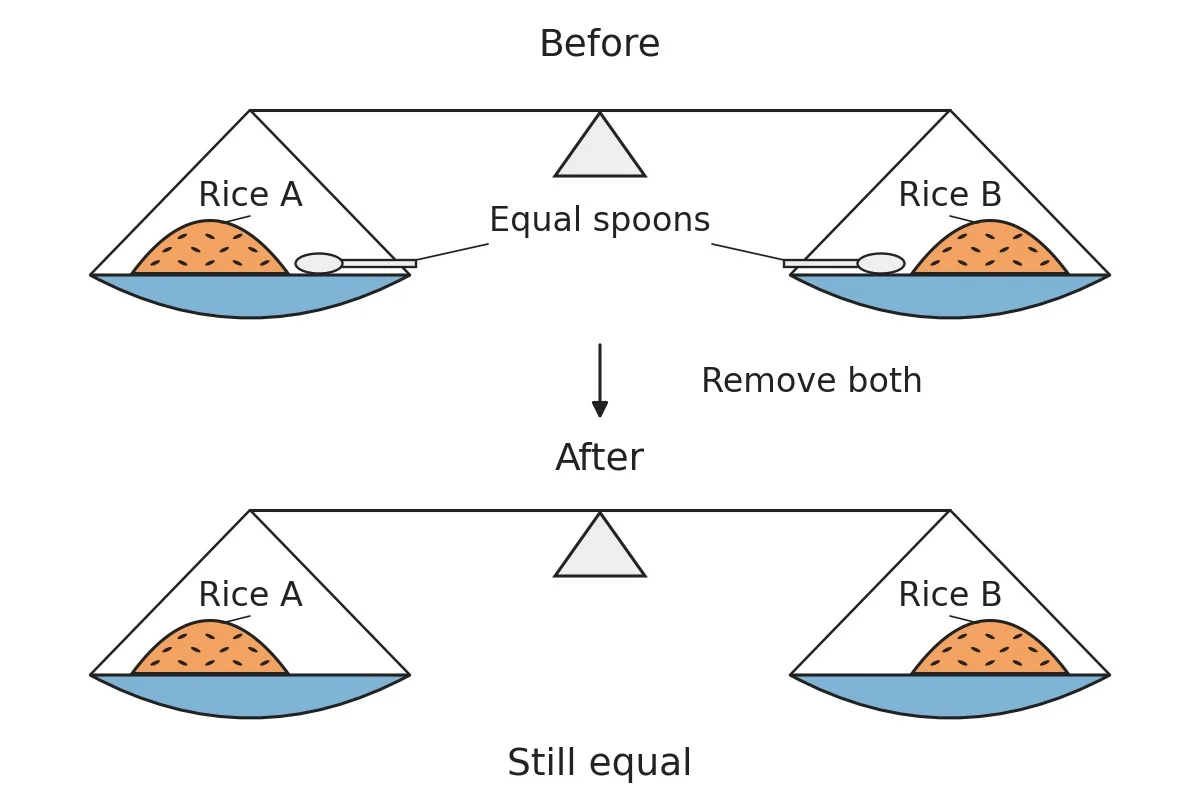
Two balanced scales show equal rice weights before and after removing equal spoons.

1. Unknown Weights

Equal total weights remain equal when equal weights are removed.

Show
Cover the lower diagram. In the upper diagram, point to the rice heaps, then the equally heavy spoons. Uncover the lower diagram after your child answers.
Ask
Will the rice weights remain equal after both spoons are removed, without knowing either weight?
Say
The rice weights stay equal. Removing equally heavy spoons takes the same weight from each side.
Used in
A vegetable seller measures produce against known weights to give customers the quantity they buy.
If your child says…“Removing just one spoon keeps it balanced.”
Ask
What would match the weight removed from that pan?
What’s true
Removing equal weights preserves the balance.
p=number of pencilsp=\text{number of pencils}

total cost=2p+1\text{total cost}=2p+1

2. Framing an Equation

Write the given relationship using a letter for the unknown.

Show
Write these lines. Say: “Let p count pencils. Each costs ₹2. The bag costs ₹1 once. The bill is ₹7.”
Ask
What next line connects the total cost to the bill?
Say
The pencil costs and bag charge together equal seven rupees: 2p+1=72p+1=7.
Used in
Including delivery in an order total helps buyers plan what they can afford.
If your child says…“Each pencil gets another bag charge.”
Ask
Does buying more pencils add more bags here?
What’s true
The bag charge appears once because there is only one bag.

2x+1=72x+1=7

Replace x with three.

6+1=76+1=7

3. Solution of an Equation

A number that makes the original equation true.

Show
Write these lines. Say: “Let x name the unknown. Test three by replacing x in the original equation.”
Ask
What final equality shows whether three works?
Say
Three works because seven equals seven.
Used in
Checking a calculated length against the required total helps avoid cutting material incorrectly.
If your child says…“Getting a number on the left proves it.”
Ask
What must your result match?
What’s true
A solution, including zero, must make both original sides equal.

Keeping both sides equal

2k+1=52k+1=5

Add two to each side.

2k+3=5+22k+3=5+2

4. Performing the Same Operation on Both Sides

Matching changes preserve equality and can reveal another expression’s value.

Show
Write these lines. Say: “Let k name the unknown. Add two to each equal total.”
Ask
What next line gives the new left side’s value?
Say
Adding two to each side keeps equality: twice k plus three equals seven. We found the new total without finding k.
Used in
Scaling recipe quantities helps cooks prepare a larger batch.
If your child says…“The changed expression still equals five.”
Ask
What happened to the right side when we added two?
What’s true
The totals increase equally, while the same unknown value still works.

x+2=5x+2=5

Subtract two from each side.

x=5−2x=5-2

5. Removing a Term

Undo an addition or subtraction equally on both sides.

Show
Write these lines. Say: “Let x name the unknown. Subtract two on each side to undo the addition.”
Ask
What value of x follows on the next line?
Say
Subtracting two from each side leaves x equal to three.
Used in
Subtracting packaging weight from a parcel’s total gives the weight of its contents.
If your child says…“The plus two becomes plus two on the right.”
Ask
Which operation cancelled the added two on the left?
What’s true
The subtraction on the right records what we did to both sides.

2x=62x=6

Divide each whole side by two.

6. Removing a Factor or Divisor

Undo nonzero factors by division, and nonzero divisors by multiplication.

Show
Write these lines. Say: “Let x name the unknown. Two equal copies total six. Halve each whole side.”
Ask
What next line gives the value of one copy?
Say
Dividing both sides by two leaves one copy, so x equals three.
Used in
For equally priced items, dividing the packet’s price by its item count gives each price.
If your child says…“I'll subtract the two to leave x.”
Ask
Does the first line show two added to x or two copies of x?
What’s true
Here, two multiplies x rather than being added.

Solving longer equations

2x+1=x+32x+1=x+3

Subtract x from each side.

x+1=3x+1=3

Subtract one from each side.

7. Unknowns on Both Sides

Remove an equal unknown amount from each side.

Show
Write these lines. Say: “Every x names the same unknown number. Subtract one copy from each side, then subtract one.”
Ask
What value follows from the final subtraction?
Say
Equal subtractions leave x equal to two.
Used in
Comparing savings plans shows when their balances will match.
If your child says…“I'll add the x terms from opposite sides.”
Ask
Would adding x remove the copy on the right?
What’s true
Subtracting x from each side removes the right-hand copy.

2(x−1)=62(x-1)=6

2x−2=62x-2=6

2x=82x=8

Divide each side by two.

8. Equations with Brackets

The outside factor multiplies every term inside, with its sign.

Show
Write these lines. Say: “Let x name the unknown. There are two copies of x and two subtractions of one.”
Ask
What value follows from the final division?
Say
Dividing eight by two gives four, so x equals four.
Used in
Counting identical stationery sets helps a school order enough of every item.
If your child says…“Two multiplies x, but leaves minus one alone.”
Ask
How many times are we subtracting one?
What’s true
Taking the whole bracket twice also repeats its subtraction.

A real problem

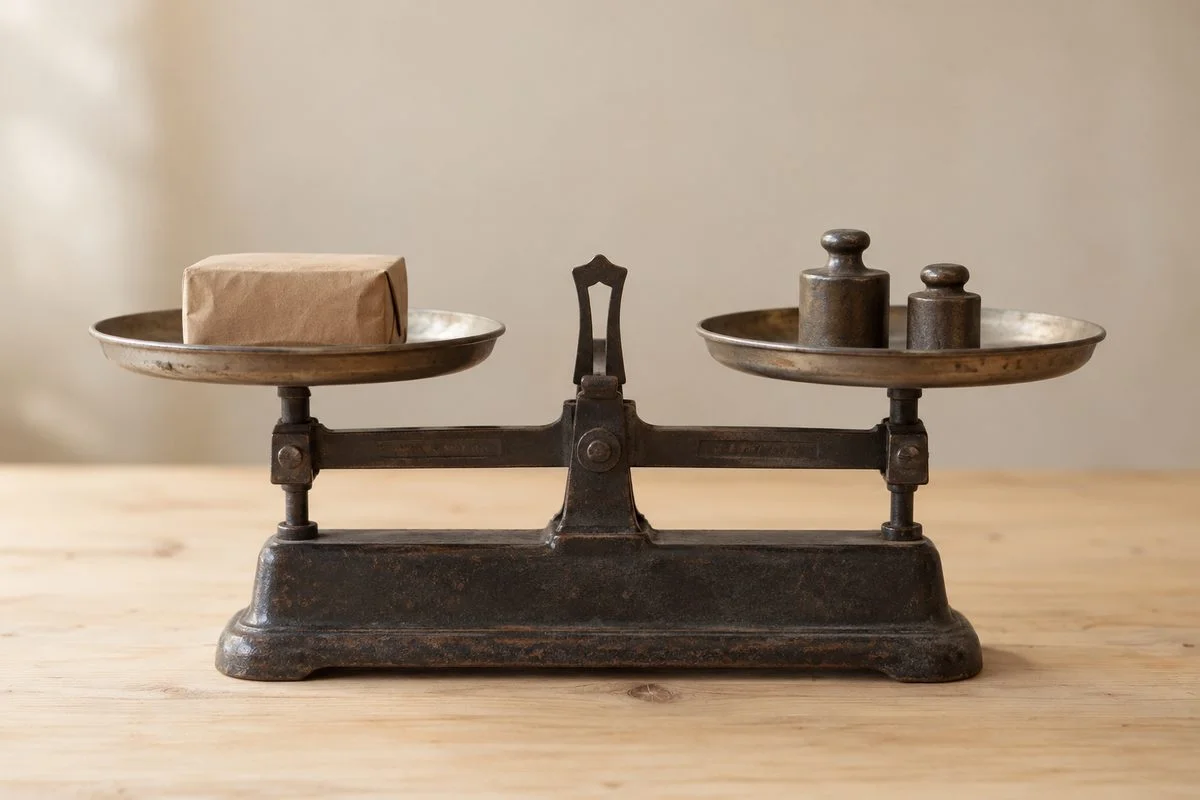
A balance finds an unknown mass.

Roberval’s balance dates from 1669.

At balance, the object matches the known masses, wherever they sit on the plates.

The General Post Office used this type of balance to weigh parcels.

Ethnography Museum of BalamandWikipediaScience Museum Group

Parcel balanced against metal weights on a countertop pan balance.

Concept Lab · Common misconception

The tempting mistake in Finding the Unknown

Open standalone misconception page →

What happens when you move a term across an equals sign?

Wrong

From x + 3 = 10, move +3 to the right as +3 and get x = 13.

Why it feels right. I see the term move but keep the same sign.

Right

Subtract 3 from both sides to undo adding 3.

Worked example

Check 13
13 + 3→16 ≠ 10
Solve
x + 3 = 10→x + 3 − 3 = 10 − 3→x = 7
Subtracting three from both sides keeps the equation balanced.
  1. For x = 13, the original left side is 13 + 3 = 16, which fails the check.
  2. Subtracting 3 from both sides gives x = 7.
  3. Now 7 + 3 = 10.

Ask your child eight quick questions.

One per step. The answer and the reason are given.

  1. If you remove one spoon, what must you remove from the other pan?

    An equal weight. The other spoon works because it weighs the same.

  2. Which cost is multiplied by the pencil count?

    The ₹2 pencil price. The bag costs ₹1 for the whole purchase.

  3. What must you compare with the calculated left side?

    The original right side. A calculated number alone does not establish equality.

  4. What is the new right side’s value?

    Seven. It increases by two, just like the left side.

  5. To remove the added two, what must happen to five?

    Subtract two. Both sides need the same subtraction.

  6. Which division leaves x alone on the left?

    Divide both sides by two. Halving two equal copies leaves one.

  7. After subtracting x from both sides, how many copies remain on the left?

    One. Two copies minus one leaves one, even before its value is known.

  8. When opening this bracket, what must two multiply besides x?

    Minus one. The multiplier applies to every term, including its sign.

15 more questions with answers