Skip to content

Teach Constructions and Tilings in eight steps.

For each idea: show it, ask before you tell, then say one line.

Gather plain paper, scrap paper, a pencil, ruler, school compass and scissors.

An adult handles scissors; keep the compass point away from fingers.

Common misconceptions & worked visual for this chapter · 15 practice questions with answers

How to teach it

Make equal parts

Unequal-sized arc pairs locate a line across a horizontal segment.

1. Perpendicular Bisector

A line that halves a segment and crosses it squarely.

Show
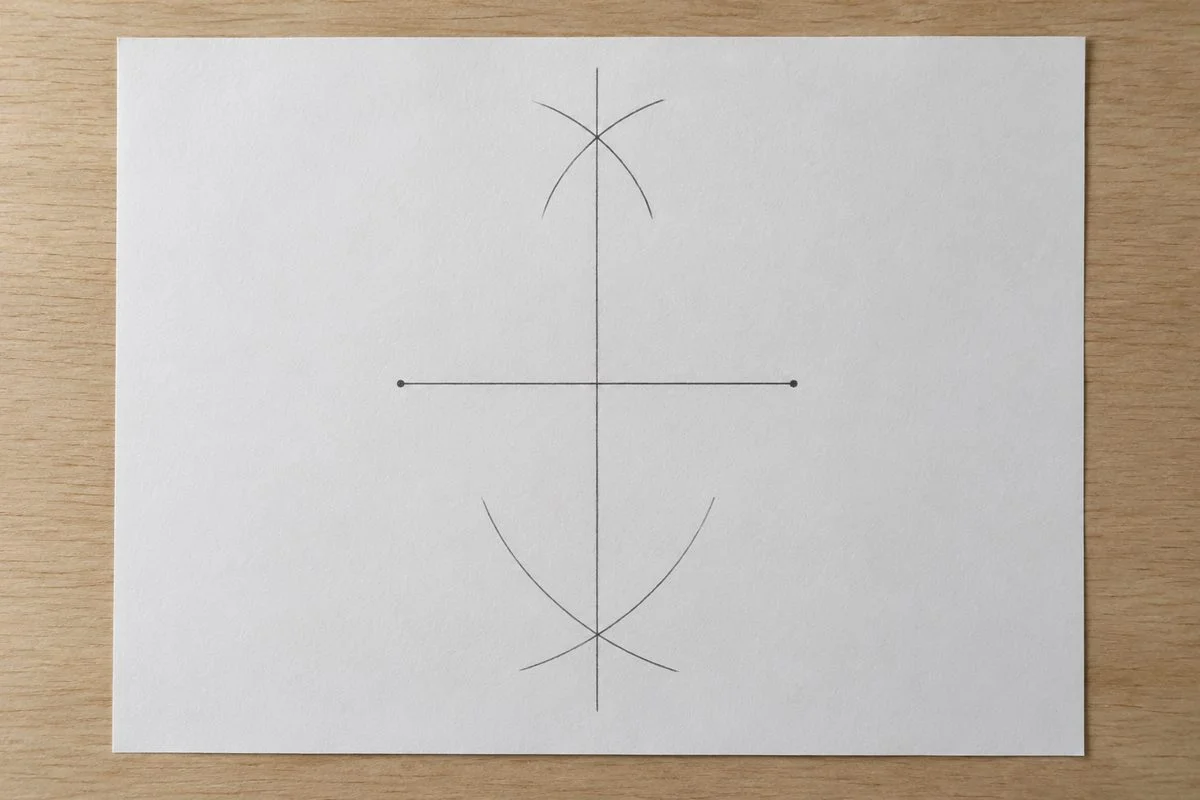
Draw XY 6 cm long. An adult makes crossing compass arcs above it, using 4 cm from each end. Make another crossing below, using 5 cm from each end. Join the crossings, ready to fold X onto Y.
Ask
Where will the fold fall?
Say
Fold to check: the line halves XY at right angles. Radii must match within each pair, but different pairs may differ.
Used in
Perpendicular bisectors help centre decorative patterns on wooden panels.
If your child says…“Every arc must use the same opening.”
Ask
Did our different openings move either crossing away from the fold?
What’s true
Each crossing needs matching radii, but separate crossings can use different openings.
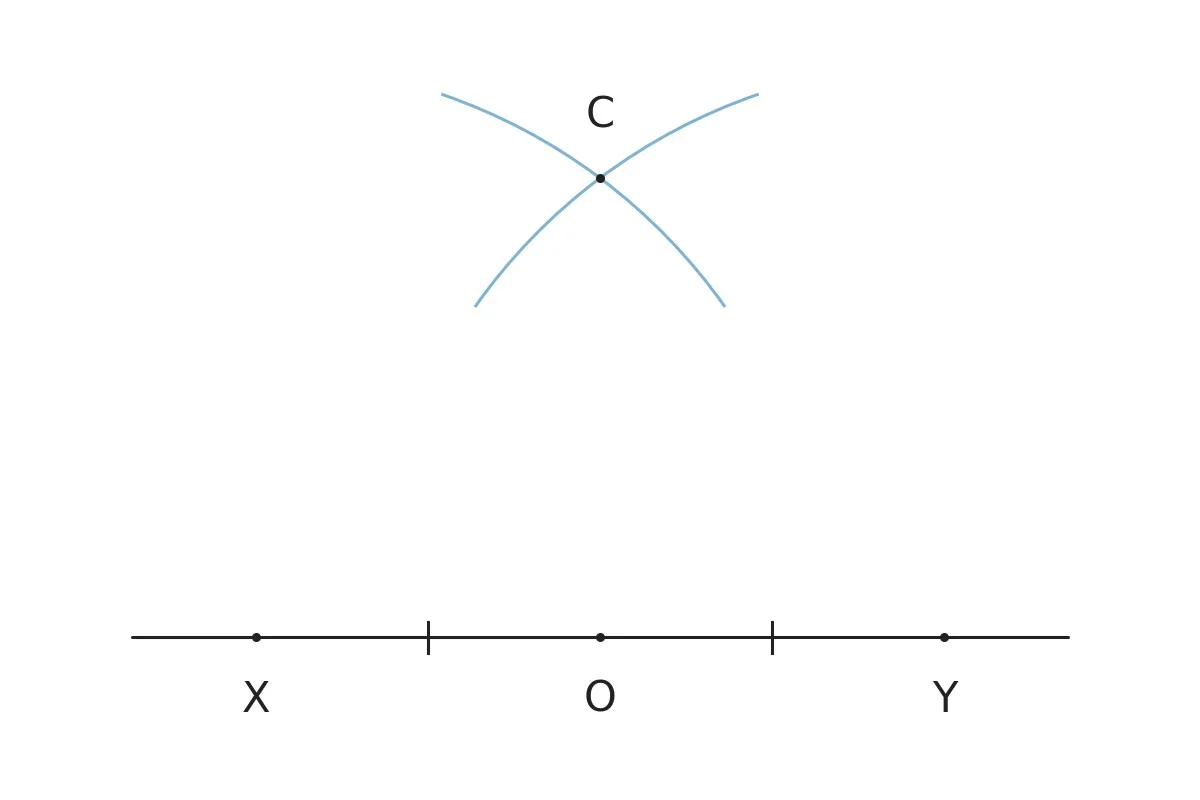
Diagram with midpoint O and arc crossing C awaiting their joining line.

2. Construction of a 90° Angle at a Given Point

Make a square corner exactly where it is needed.

Show
In the diagram, find O midway between X and Y. Find the arc crossing C above them.
Ask
Will joining O to C give a right angle without another crossing?
Say
O and C are each equally far from X and Y. The line through them therefore halves XY at right angles.
Used in
Right angles make cardboard box corners fit squarely.
If your child says…“We still need a crossing below.”
Ask
Which two points already have matching distances to X and Y?
What’s true
O already supplies one point, so C supplies the only additional point needed.
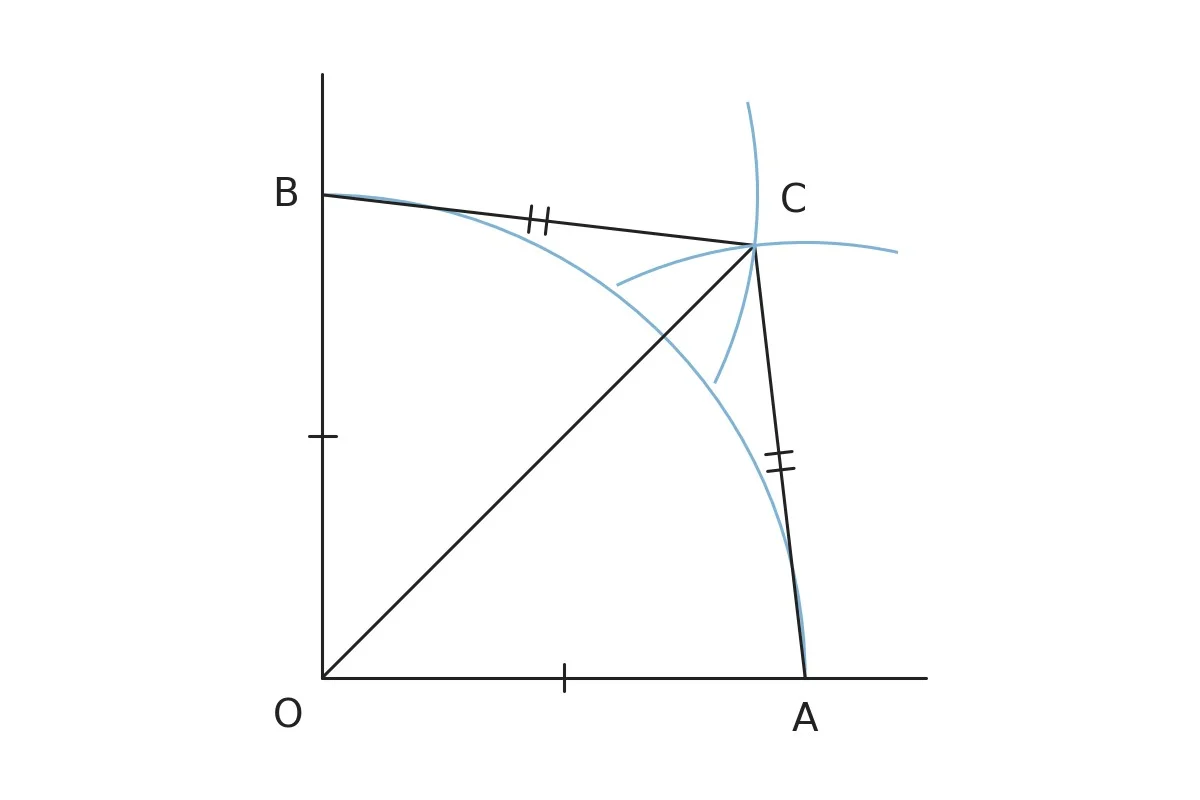
Diagram of two triangles sharing OC inside a right angle, with matching sides marked.

3. Bisection of an Angle

Split an angle into equal halves.

Show
In the diagram, find the right angle at O and equally distant marks A and B. Follow the matching arcs to C, beyond AB. Find the two triangles sharing OC.
Ask
Will the angles beside OC match?
Say
The triangles have matching side lengths, including their shared side. Their corners at O therefore match, giving 45° each.
Used in
Bisecting corner angles helps cut frame joints that meet neatly.
If your child says…“The arm marks can be different distances from O.”
Ask
Which triangle sides would stop matching if A moved closer to O?
What’s true
Matching arm distances and matching crossing radii give triangles with matching sides.

Copy corners and directions

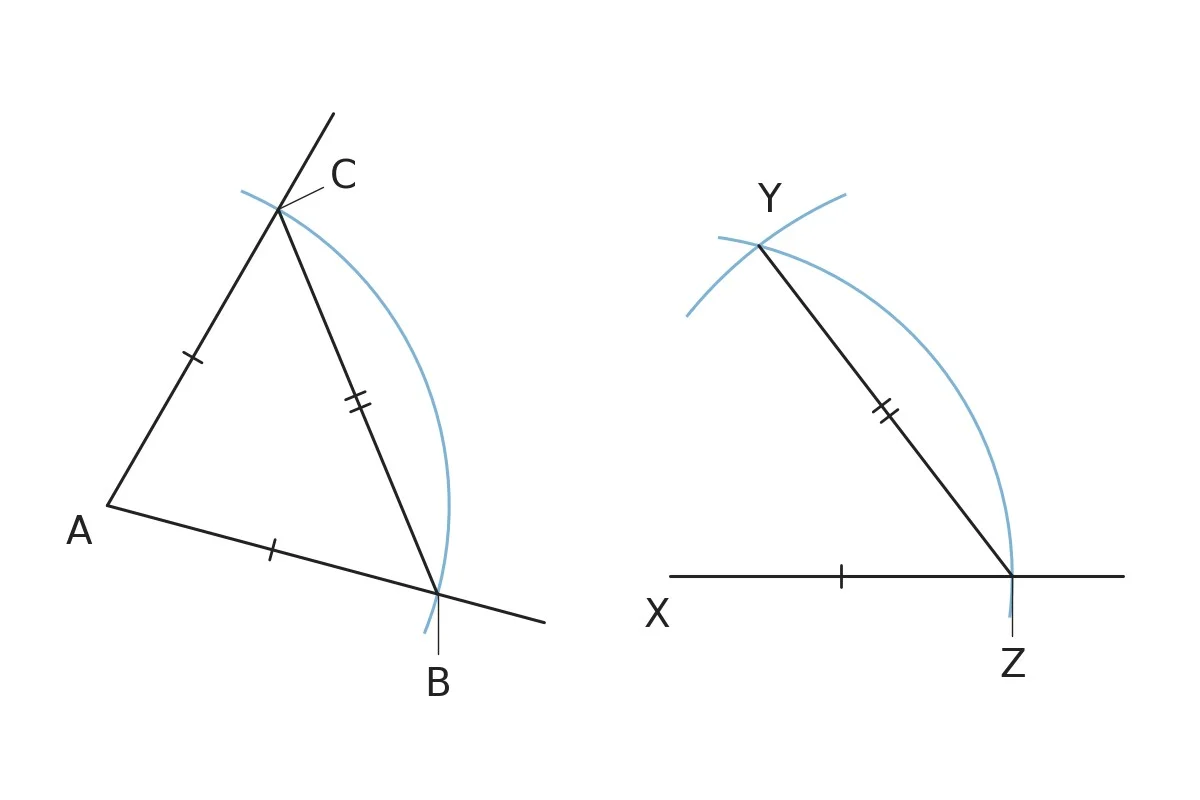
Diagram comparing an original angle with matching arcs and a missing copied arm.

4. Copying an Angle

Make another angle with the same opening.

Show
Find the angle at A and the starting ray at X in the diagram. Compare the vertex arcs and the straight gaps BC and ZY.
Ask
Will joining X to Y copy the opening at A?
Say
Joining X to Y would copy the opening. All three triangle sides would match, so the angles would match too.
Used in
Copied angles keep repeated stencil corners consistent.
If your child says…“Copying the straight gap is enough.”
Ask
Would a larger new arc still give three matching triangle sides?
What’s true
The vertex arcs must also have matching radii.
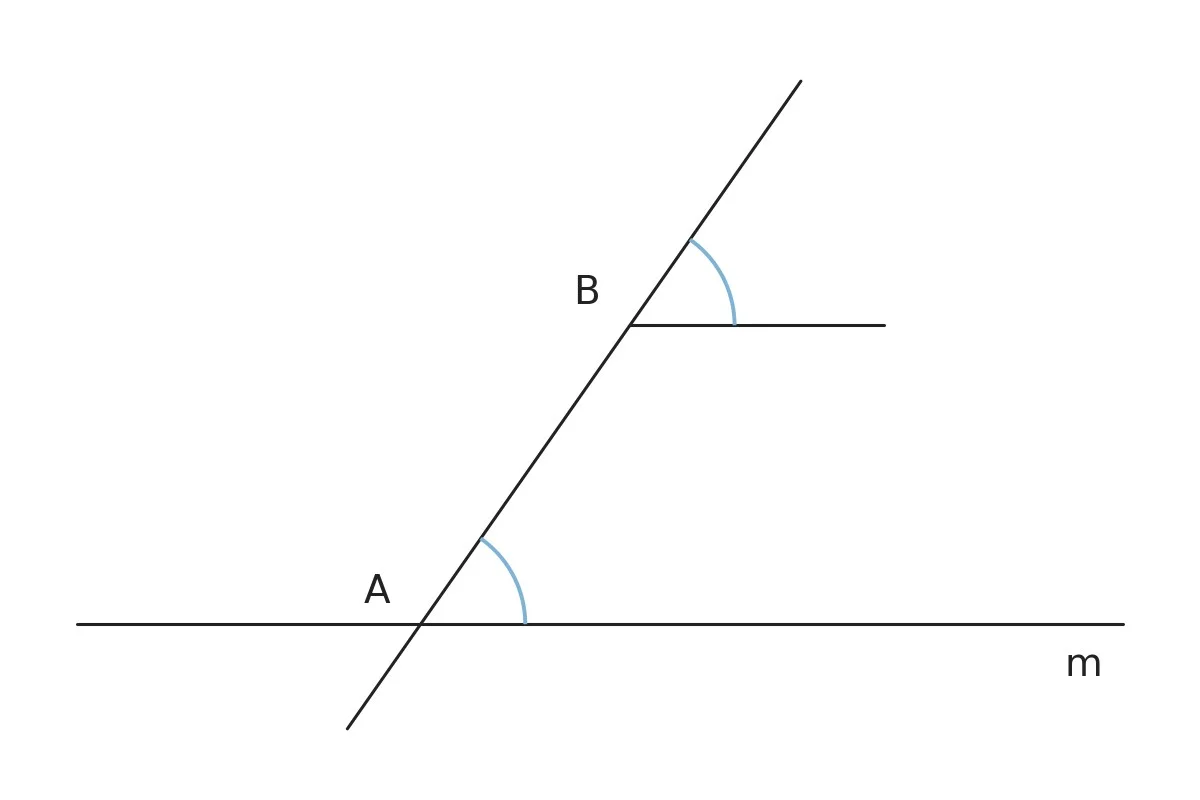
Diagram with matching upper-right angles placing a short arm above line m.

5. Construction of a Line Parallel to the Given Line

Copy a corner's size and position to keep lines apart.

Show
In the diagram, find line m and the crossing line through A and B. Find the short arm at B. Compare the marked upper-right angles at A and B.
Ask
Will extending the new arm make a line parallel to m?
Say
Extending the short arm would give a line parallel to m. The corresponding angles against the same crossing line are equal.
Used in
Parallel edges keep a straight fabric border evenly wide.
If your child says…“The copied angle can go on either side.”
Ask
Are both copied openings above their lines and right of the crossing line?
What’s true
Equal angle sizes need the correct positions against the same crossing line.

Build shapes and test tilings

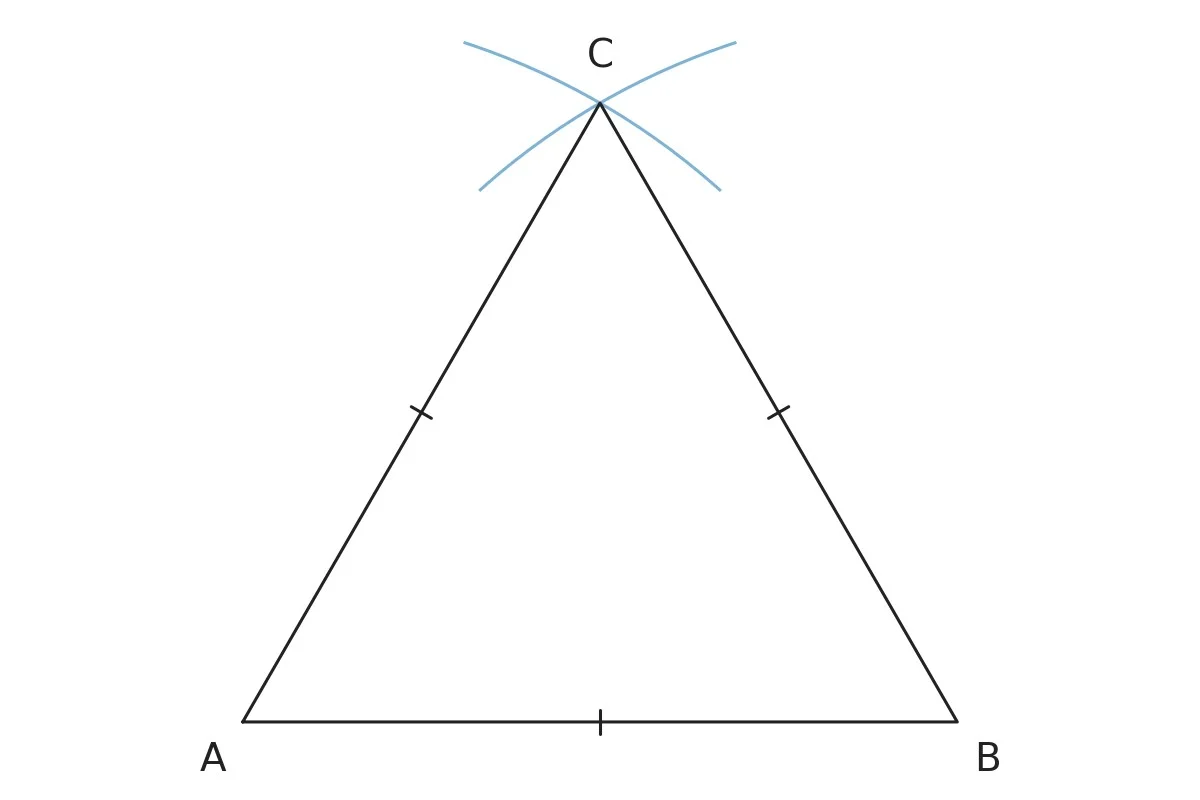
Diagram of an equilateral triangle with matching side marks and intersecting construction arcs.

6. Construction of a 60° Angle

Equal triangle sides give a precise 60° corner.

Show
Find A, B and C in the diagram. Compare the triangle’s three sides and the matching construction arcs.
Ask
What angle will halving the corner at A make?
Say
The triangle’s equal sides give 60° corners. Halving the angle at A gives 30°.
Used in
Constructed equilateral triangles give patchwork pieces matching corners, helping repeated pieces fit together.
If your child says…“Bisecting 60° gives three 20° pieces.”
Ask
How many equal angles does one bisecting line make?
What’s true
Bisection makes two equal angles, so halving 60° gives 30°.
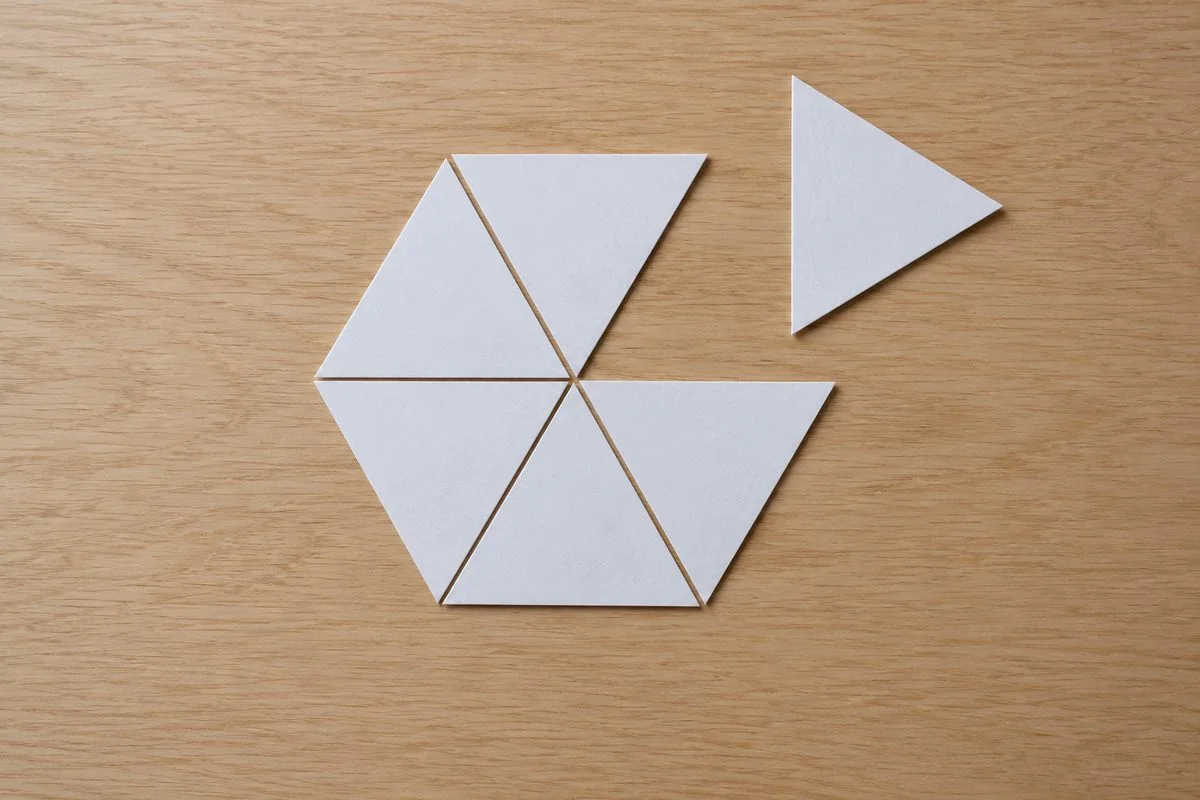
Five paper triangles surround a central point, with the sixth beside the gap.

7. Regular Hexagon

A shape with six equal sides and six equal corners.

Show
An adult traces the constructed triangle and cuts six matching copies. Say each triangle corner is 60°. Place five triangles edge to edge around one central point, without overlaps, leaving one gap. Leave the sixth beside the gap.
Ask
What angle must the final piece fill?
Say
The final piece must fill 60°: six 60° corners complete a turn of 360°.
Used in
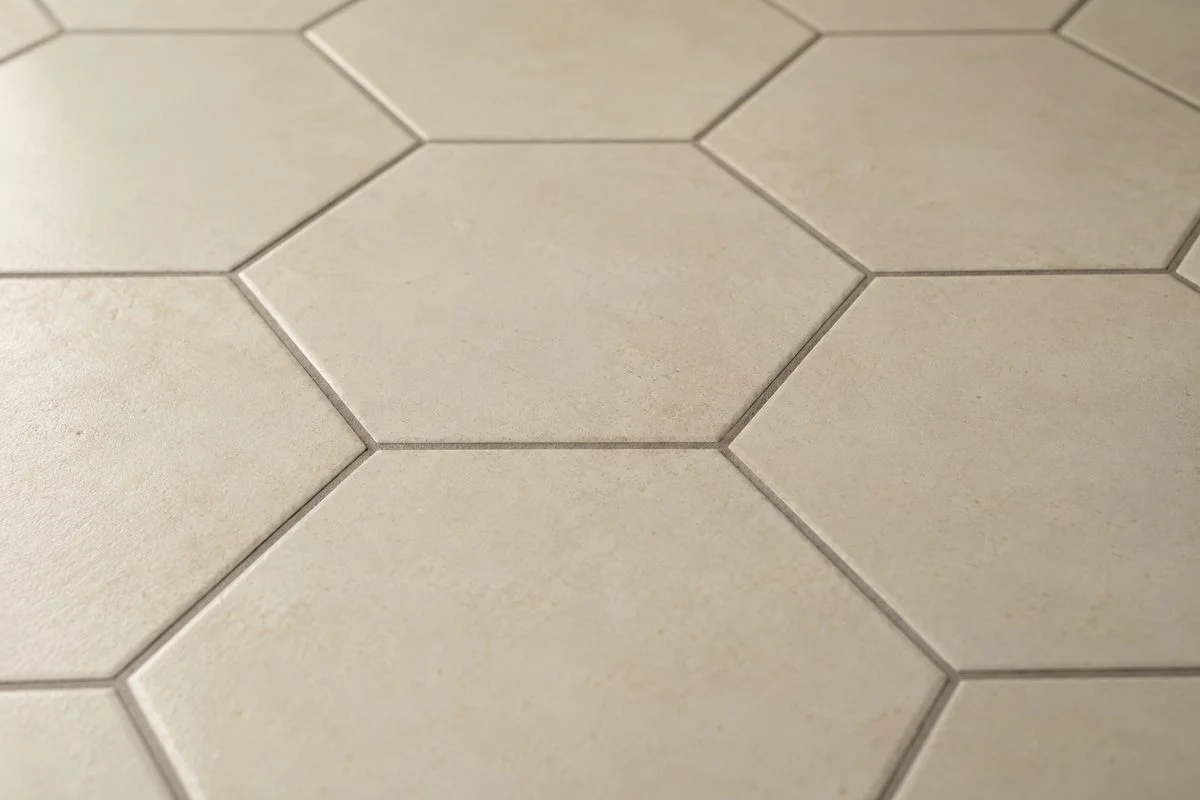
Hexagonal floor tiles cover surfaces without gaps between their corners.
If your child says…“The hexagon's corners are 60° too.”
Ask
How many triangle corners meet at one outer corner?
What’s true
Each outer corner combines two triangle corners, making 120°.
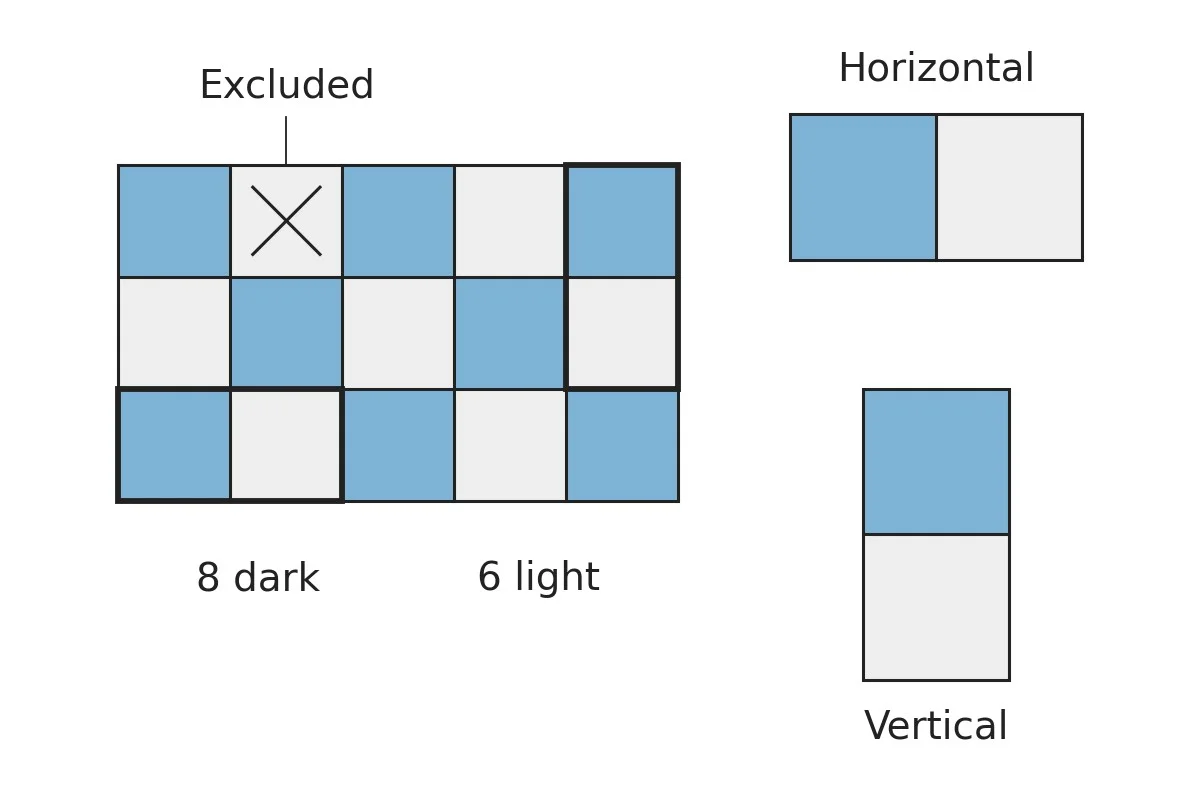
A checkerboard with one excluded square shows unequal colour counts and two tile orientations.

8. Tiling

Cover a region with shapes, leaving no gaps or overlaps.

Show
Find the excluded square in the diagram. Compare the horizontal and vertical tile outlines. Count the remaining dark and light squares.
Ask
Will seven two-square rectangles cover these fourteen squares without gaps or overlaps?
Say
No. Each rectangle covers one dark square and one light square. Eight dark squares cannot pair with six light squares.
Used in
Planning rectangular floor tiling avoids gaps and wasted cuts.
If your child says…“Fourteen squares means seven tiles will fit.”
Ask
Where could the extra dark squares find their light partners?
What’s true
Unequal colour counts prevent tiling; equal counts alone still do not guarantee it.

A real problem

Hexagonal pieces minimise wasted space in Webb's mirror.

Webb launched on 25 December 2021.

A single undivided primary mirror would have been too large for existing launch vehicles.

Hexagonal segments form a roughly circular mirror with minimal wasted space between pieces.

ESAWikipediaNASA

Hexagonal floor tiles meet neatly at their corners.

Concept Lab · Common misconception

The tempting mistake in Constructions and Tilings

Open standalone misconception page →

Is every line through the midpoint a perpendicular bisector?

Wrong

Passing through the midpoint is enough.

Why it feels right. The line already cuts the segment into equal halves.

Right

A perpendicular bisector also meets the segment at 90°.

Worked example

Both lines through the midpoint cut the segment in half. The vertical line also makes a right angle.
  1. Draw a 6 cm segment and its midpoint at 3 cm.
  2. A slanted line through 3 cm bisects it.
  3. The line at a right angle is its perpendicular bisector.

Ask your child eight quick questions.

One per step. The answer and the reason are given.

  1. Which radii must match: those within each crossing pair, or every radius?

    Those within each pair. Each crossing must have equal distances to the segment's endpoints.

  2. Which existing point replaces the need for a crossing below?

    O. O is already equally distant from the two outer marks.

  3. How must the two arm marks’ distances from O compare?

    They must be equal. Unequal arm distances remove the matching sides that justify equal angles.

  4. Besides the straight gap, what compass setting must be copied?

    The vertex arc's radius. Both radii and the straight gap must match to fix the angle.

  5. Where must the upper copy of the lower upper-right angle go?

    In the upper-right position. Matching positions against the same crossing line make these equal angles corresponding.

  6. After halving 60° to get 30°, what does halving again give?

    15°. Each bisection halves the angle being divided.

  7. What is the angle at an outer corner of this hexagon?

    120°. Each outer corner contains two 60° triangle corners.

  8. What prevents these fourteen squares from being tiled?

    Unequal dark and light counts. Each tile pairs opposite colours, leaving dark squares without light partners.

15 more questions with answers, 13 with pictures