Skip to content

Teach Finding Common Ground in eight steps.

For each idea: show it, ask before you tell, then say one line.

Gather plain paper, a ruler, a pencil and scissors.

An adult cuts the paper strips.

Common misconceptions & worked visual for this chapter · 15 practice questions with answers

How to teach it

Factors and equal pieces

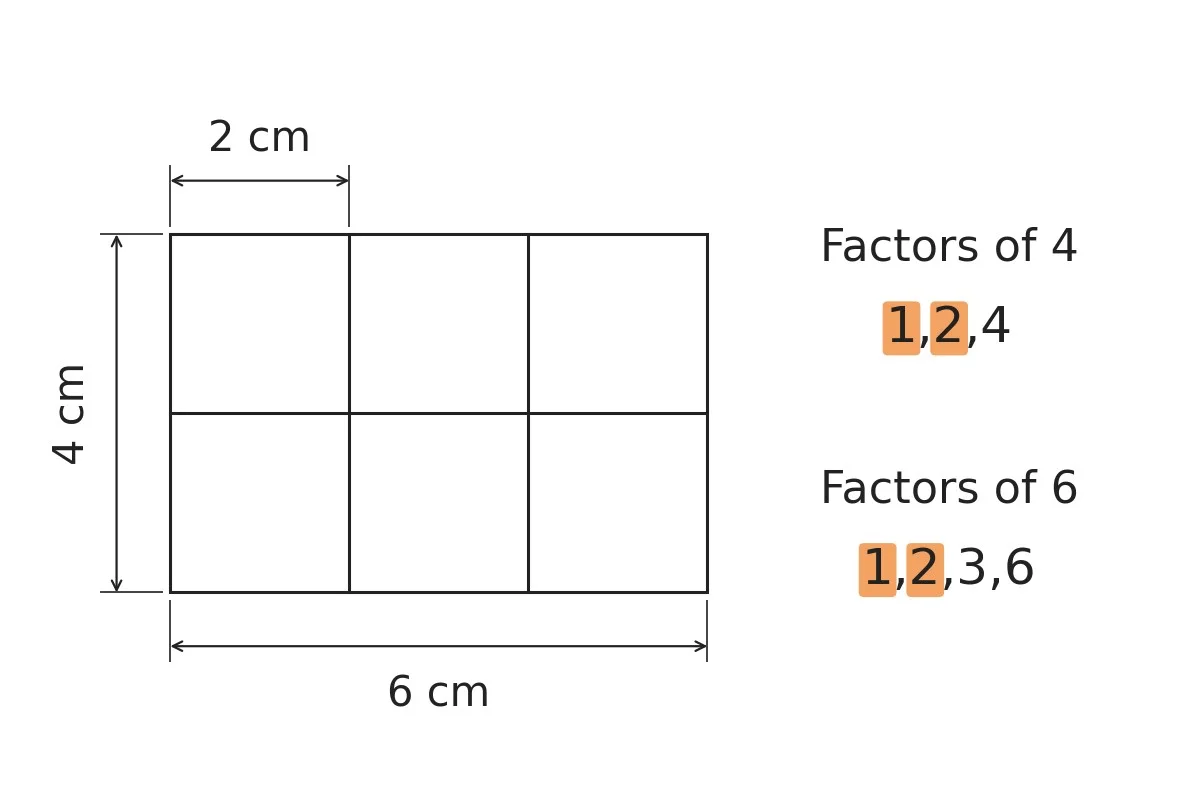
Rectangle tiled with equal squares beside lists of factors of its measurements.

1. Highest Common Factor (HCF)

The largest whole number that divides each given number exactly.

Show
Look at the diagram. Point to the rectangle's measurements, then a square's side. Compare the factor lists on the right.
Ask
What is the largest square tile that covers this rectangle without cutting?
Say
The largest square tile has a side of 2 cm. Its side must divide both measurements, and their greatest shared factor is 2.
Used in
Finding the largest square tile that fits a floor reduces the number needed.
If your child says…“The HCF should be 1 because factors are small.”
Ask
Do the 2 cm squares also fit both edges?
What’s true
Choose the greatest factor shared by the measurements.
Twelve is three times four.

Four is two times two.

2. Prime Factorisation

Writing a whole number greater than 1 as multiplied primes.

Show
Write these lines. Say, 'Primes exceed 1 and have exactly two factors: 1 and themselves.'
Ask
What multiplication using only primes comes next?
Say
Writing only primes gives 12=2×2×312 = 2 \times 2 \times 3.
Used in
Factors give possible pack sizes for dividing stock without leftovers.
If your child says…“Only the primes are factors.”
Ask
What do the two 2s multiply to?
What’s true
Multiplying available primes together also makes factors of the original number.

8=2×2×28 = 2 \times 2 \times 2

12=2×2×312 = 2 \times 2 \times 3

3. Finding the HCF of Numbers Using Prime Factorisation

Multiply shared primes, keeping the smaller count of each.

Show
Write these lines. Match the two 2s in 12 with two in 8. Say, 'These copies occur in both.'
Ask
What does the matched product give?
Say
Both have two 2s, so HCF⁡(8,12)=2×2=4\operatorname{HCF}(8,12) = 2 \times 2 = 4.
Used in
The HCF finds the longest equal ribbon pieces that leave no offcuts.
If your child says…“I'll take all three 2s.”
Ask
Where is the third 2 in 12?
What’s true
A shared factor cannot use more copies than either number contains.

Multiples and matching lengths

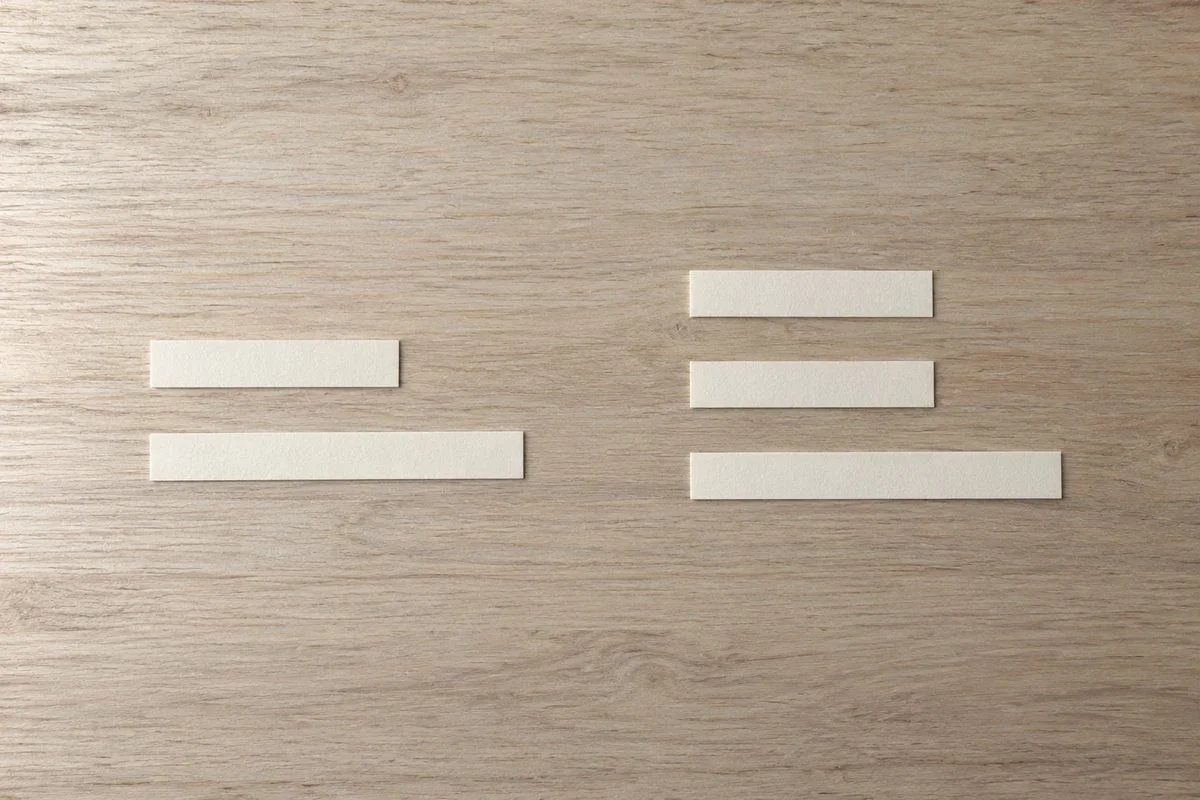
Unequal paper strips aligned at the left, with loose strips beside them.

4. Lowest Common Multiple (LCM)

The smallest positive whole number divisible by each given number.

Show
An adult cuts three 4 cm strips and two 6 cm strips, all equally wide. Align a strip of each length at the left. After the prediction, your child extends each row using matching strips.
Ask
What is the shortest length where both rows will end together?
Say
Both rows first reach 12 cm together.
Used in
When schedules coincide, the LCM of their intervals gives the wait until they coincide again.
If your child says…“6 works because it's the longer strip.”
Ask
Can whole 4 cm strips make a 6 cm row?
What’s true
A shared multiple must divide exactly by each strip length.

Four is two times two.

Six is two times three.

LCM⁡(4,6)=2×2×3\operatorname{LCM}(4,6) = 2 \times 2 \times 3

5. Finding the LCM Using Prime Factorisation

Include every prime, keeping the larger count of each.

Show
Write these lines. Say, 'We need two 2s for 4 and a 3 for 6.'
Ask
What does the last product give?
Say
We need two 2s and one 3: LCM⁡(4,6)=2×2×3=12\operatorname{LCM}(4,6) = 2 \times 2 \times 3 = 12.
Used in
The LCM finds matching totals when supplies come in different packet sizes.
If your child says…“Leave out 3 because only 2 is shared.”
Ask
Without a 3, how will 6 divide this product?
What’s true
Leaving out any required prime prevents one number from dividing the result.

Finding HCF and LCM together

Six is two times three.

HCF⁡(2,6)=2\operatorname{HCF}(2,6) = 2

LCM⁡(2,6)=2×3\operatorname{LCM}(2,6) = 2 \times 3

6. Patterns, Properties, and a Pretty Procedure!

When one number divides another, they themselves give HCF and LCM.

Show
Write these lines. Say, '2 divides 6, and 2 also divides itself.'
Ask
What does the last line become?
Say
Two divides both numbers, so their HCF is two. Six is already a multiple of both: LCM⁡(2,6)=6\operatorname{LCM}(2,6) = 6.
Used in
When shelf capacity is a multiple of box capacity, whole boxes fill shelves without leftovers.
If your child says…“The HCF must be smaller than both numbers.”
Ask
What prevents 2 from dividing both 2 and 6?
What’s true
A number divides itself, so it can be the HCF.

Six is three times two.

Nine is three times three.

Their HCF is three.

LCM⁡(6,9)=3×2×3\operatorname{LCM}(6,9) = 3 \times 2 \times 3

7. Efficient Procedures for HCF and LCM

Shared divisors give the HCF; remaining parts complete the LCM.

Show
Write 3 left of 6 and 9, then their quotients 2 and 3 underneath. Write these lines, saying, 'Only 1 divides both quotients.'
Ask
What does the final product equal?
Say
The HCF is three. Including both final quotients gives LCM⁡(6,9)=3×2×3=18\operatorname{LCM}(6,9) = 3 \times 2 \times 3 = 18.
Used in
HCF and LCM help simplify fractions and find common denominators.
If your child says…“The side divisor gives the LCM too.”
Ask
Does the side divisor 3 contain enough factors for 6 or 9?
What’s true
The LCM also needs both final quotients when they share only 1.

Four supplies two 2s.

6=2×36 = 2 \times 3

8. Property Involving both the HCF and the LCM

Multiplying HCF by LCM gives the original two numbers' product.

Show
Write these lines. Say, 'The outside 2 is the HCF; the bracket contains the LCM.'
Ask
What will you get when you multiply the HCF and LCM of 4 and 6?
Say
Regrouping keeps the product unchanged: 4×6=2×(2×2×3)4 \times 6 = 2 \times (2 \times 2 \times 3). The outside two is the HCF. The bracket contains the LCM.
Used in
This relation checks whether calculated grouping sizes and matching totals agree.
If your child says…“Add the HCF and LCM to get the product.”
Ask
What operation joins the outside 2 to the bracket?
What’s true
For two positive whole numbers, multiplication joins the HCF and LCM into their product.

A real problem

Prime factors helped researchers reconstruct an ancient calculator's gears.

Researchers announced their proposed reconstruction of the Antikythera Mechanism in 2021.

Prime factors narrowed the gear tooth counts that could reproduce astronomical cycles.

The proposal required testing.

UCLScientific ReportsThe Guardian

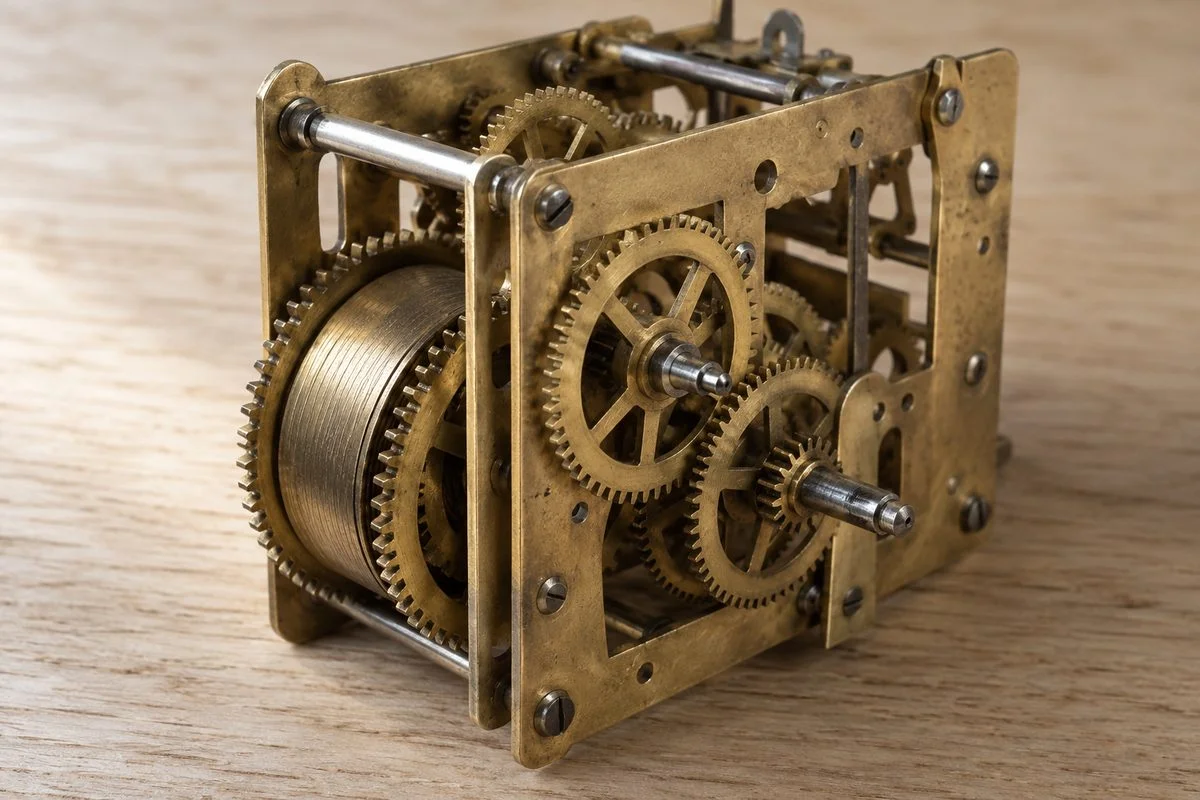
Interlocking toothed gears inside an opened mechanical clock.

Concept Lab · Common misconception

The tempting mistake in Finding Common Ground

Open standalone misconception page →

When do you need a common factor?

Wrong

The greatest equal packet size for 12 blue beads and 18 red beads is 36.

Why it feels right. I remember finding a common number and use the least common multiple.

Right

To split both colours into equal-sized packs with no leftovers, the pack size must divide both totals.

Worked example

12 blue
🔵🔵🔵🔵🔵🔵
🔵🔵🔵🔵🔵🔵
18 red
🔴🔴🔴🔴🔴🔴
🔴🔴🔴🔴🔴🔴
🔴🔴🔴🔴🔴🔴
A pack of six uses the blue beads in two packs and the red beads in three.
  1. A 36-bead pack cannot be filled from either colour.
  2. Packs of 6 use all 12 blue beads in two packs and all 18 red beads in three.
  3. No larger pack size divides both.

Ask your child eight quick questions.

One per step. The answer and the reason are given.

  1. What is the largest square side that fits both rectangle edges exactly?

    2 cm. 2 is the greatest factor appearing in both lists.

  2. Which non-prime factor comes from multiplying the two 2s?

    4. The unused 3 supplies its partner: three groups of four make twelve.

  3. Why can't 8 be the HCF of 8 and 12?

    It doesn't divide 12. 12 contains only two copies of 2.

  4. Why doesn't a 6 cm row work for both strip lengths?

    4 doesn't divide 6. A matching length must use whole strips of either size.

  5. Which prime does 6 need that 4 does not?

    3. 6 needs a factor of 3, even though 4 doesn't.

  6. What is the HCF of 6 and 18?

    6. 6 divides both numbers, and nothing larger divides 6.

  7. Which remaining numbers must multiply the side divisor to give the LCM?

    2 and 3. With the shared 3, the leftover 2 completes 6 and another 3 completes 9.

  8. Given the product and HCF, what operation finds the LCM?

    Divide by the HCF. Division undoes the multiplication of HCF by LCM.

15 more questions with answers