Skip to content

Teach Geometric Twins in eight steps.

For each idea: show it, ask before you tell, then say one line.

Gather paper, a pencil, ruler, protractor, compass and scissors.

An adult cuts paper and handles the sharp compass point.

Common misconceptions & worked visual for this chapter · 15 practice questions with answers

How to teach it

Copying and matching shapes

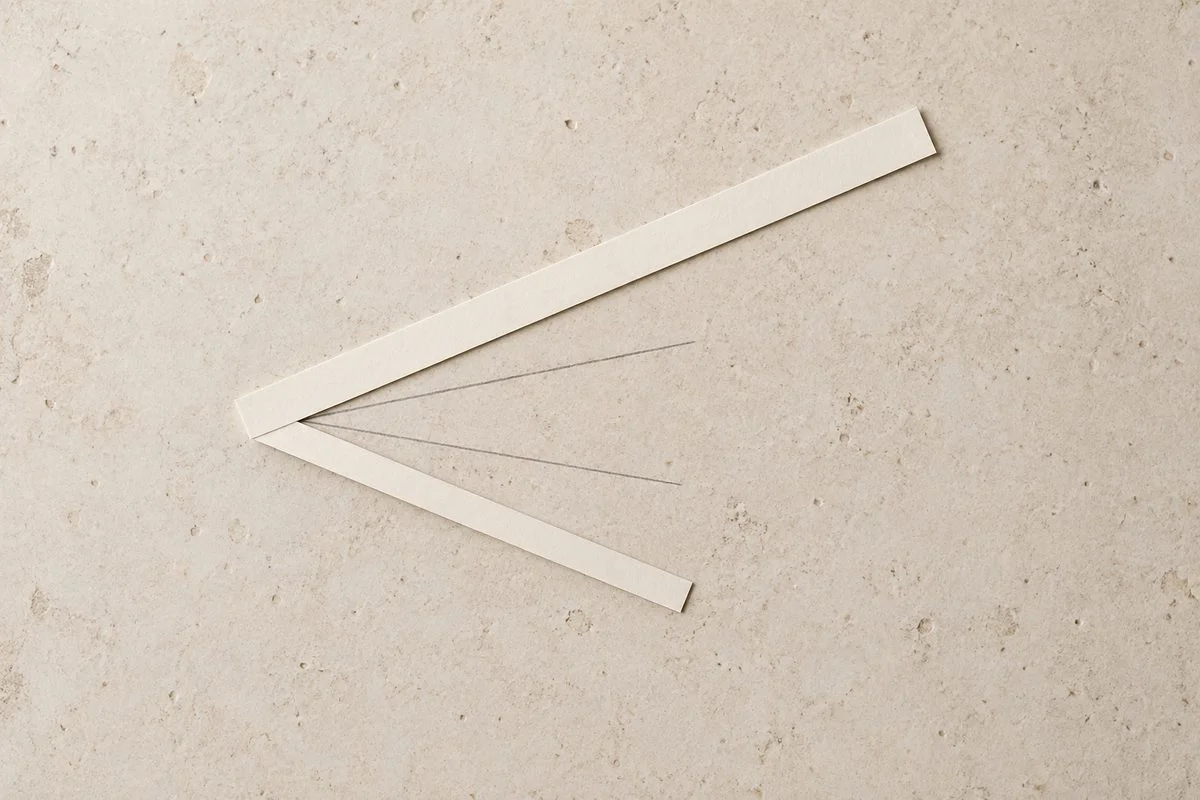
Joined paper strips opened wider than their traced arrangement.

1. Geometric Twins

Enough measurements let you copy a shape exactly.

Show
An adult prepares paper strips measuring 4 cm and 8 cm. Join their endpoints and trace the arrangement. Widen the opening. After the prediction, measure the traced angle and restore it.
Ask
What extra measurement would let you restore the first arrangement?
Say
The lengths stay unchanged, but the opening changes. Both lengths and their meeting angle fix this shape.
Used in
Matching bends help replacement wire hooks fit their supports.
If your child says…“The arm lengths tell me everything.”
Ask
Which measurement changed when you opened the strips?
What’s true
Unchanged arm lengths allow different openings.
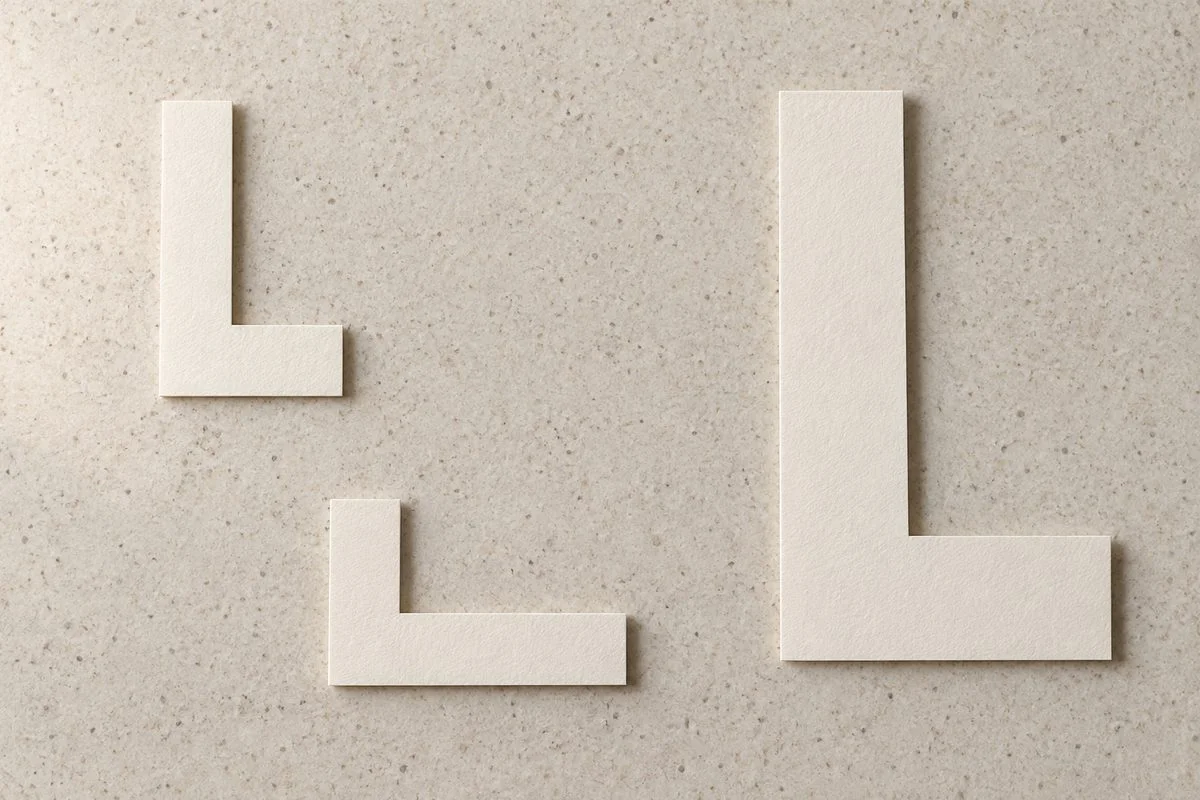
Matching L-shaped pieces facing different directions beside a larger L-shaped piece.

2. Congruent Figures

Shapes that fit exactly after moving, turning or flipping.

Show
An adult cuts matching unequal-armed L-shapes from stacked paper, then a copy with every length doubled. Separate and turn the pieces. After the prediction, slide, turn or flip them to compare.
Ask
Which pieces will fit exactly over each other?
Say
The matching pieces fit even after turning or flipping. The larger piece cannot fit.
Used in
Congruent tiles can replace damaged tiles without changing the layout.
If your child says…“The bigger piece is congruent because its shape matches.”
Ask
When their corners line up, do their edges also line up?
What’s true
An enlarged copy keeps its shape but loses the exact fit.

Measurements that fix triangles

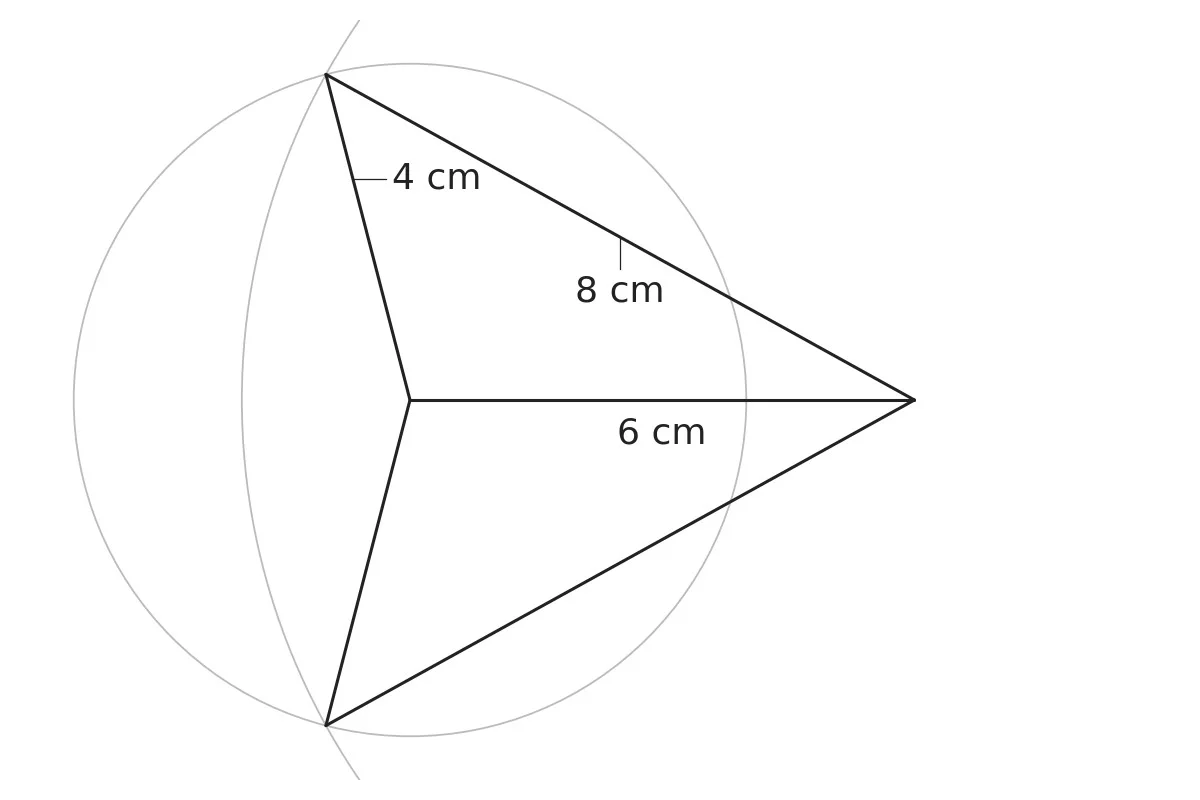
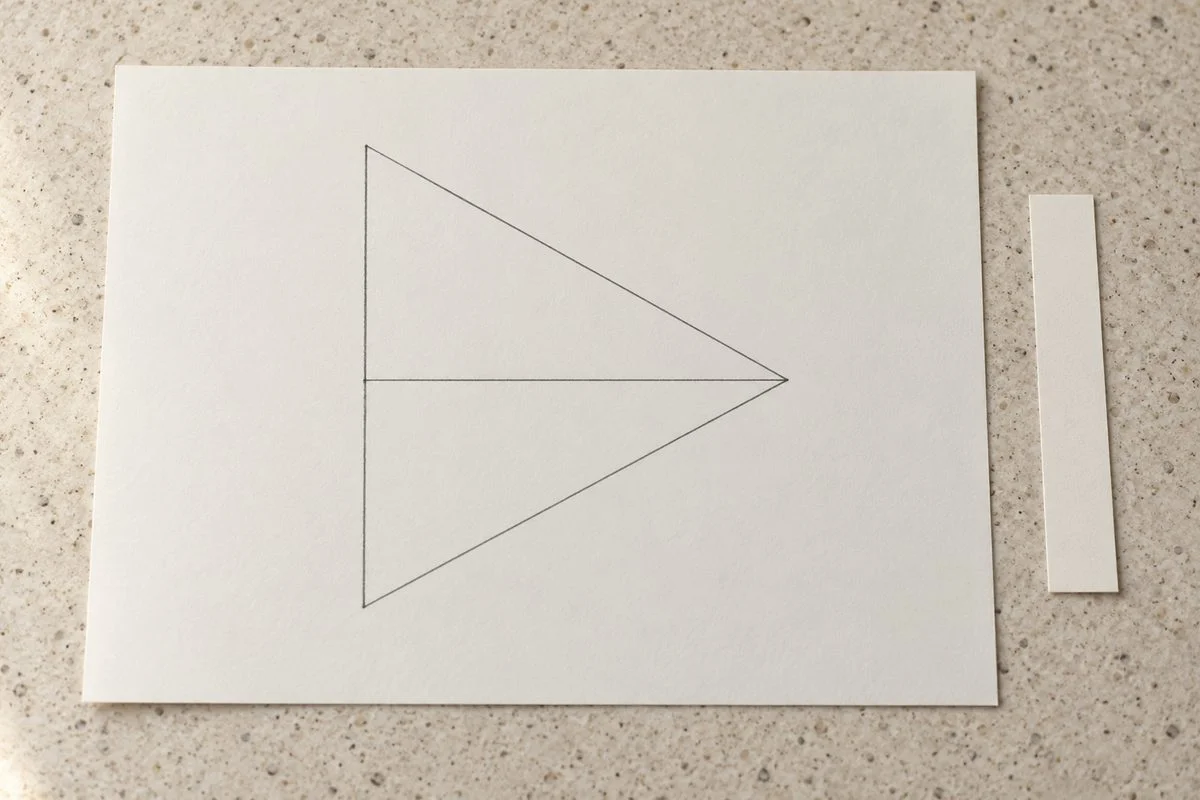
A 6 cm base with circles of radius 4 cm and 8 cm at its ends; both crossings are joined to the ends.

3. SSS Condition

Side–side–side: matching side lengths fixes a triangle’s shape and size.

Show
Draw a 6 cm base. An adult draws circles centred at its ends, with radii 4 cm and 8 cm. Join each crossing to both ends. After the prediction, fold along the base.
Ask
Will these triangles fit when folded together?
Say
They overlap completely.
Used in
Matching frame lengths produce matching triangular panels.
If your child says…“We still need to measure the angles.”
Ask
Can either corner move while staying on both circles?
What’s true
Once all side lengths match, the angles cannot vary.
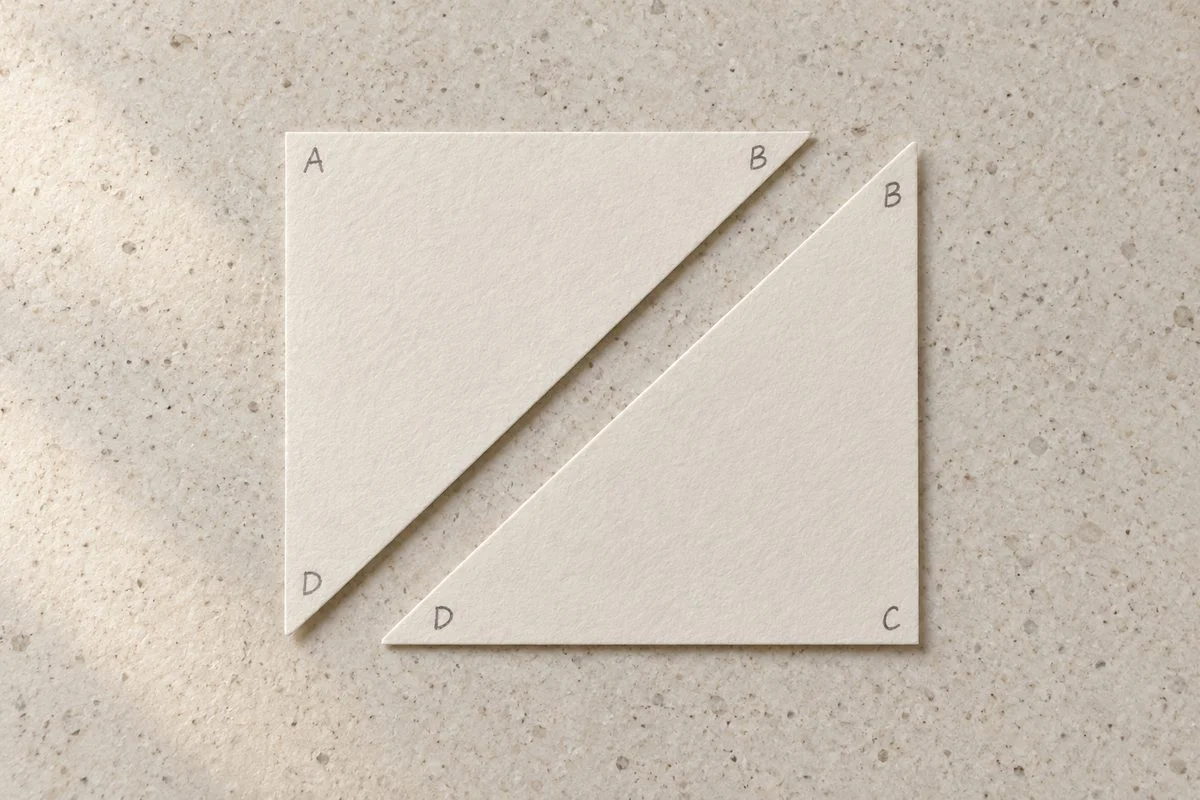
Paper rectangle divided into triangular halves, slightly separated along the diagonal.

4. Conventions to Express Congruence

Write matching corners in matching positions.

Show
Label an 8 cm by 4 cm paper rectangle ABCD around its boundary. Trace triangles ABD and CDB. An adult cuts along BD. After the prediction, turn one triangle onto the other.
Ask
Which corners will overlap?
Say
Opposite sides match, and shared BD completes SSS: ABD matches CDB.
Used in
Matching corners in sewing patterns helps corresponding edges meet.
If your child says…“I can rearrange either triangle’s letters however I like.”
Ask
Which corner actually covers B when the pieces fit?
What’s true
Changing the order on one side can change which corners you pair.
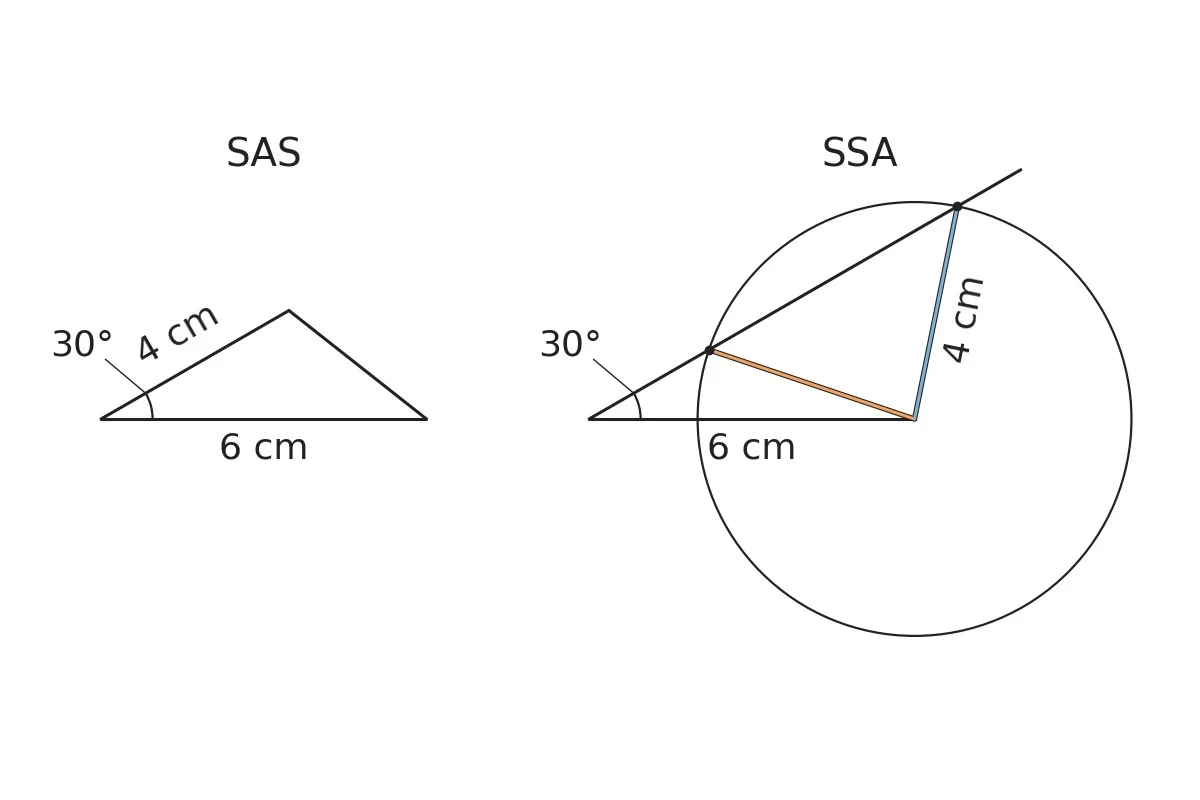
SAS fixes one triangle; a circle shows two possible triangles for SSA.

5. SAS Condition and the Included Angle

The measured angle lies between the measured sides.

Show
Look at the diagram’s left triangle, where the measured sides meet. On the right, find both crossings of the circle and ray.
Ask
Which arrangement fixes one triangle when we know the side lengths and angle?
Say
The left arrangement fixes both free endpoints, so joining them completes one triangle. This is SAS: the angle lies between the measured sides. On the right, the angle lies elsewhere, allowing two different triangles.
Used in
Matching lengths and openings make shelf brackets fit alike.
If your child says…“Matching sides and any matching angle are enough.”
Ask
On the right, does the marked angle lie between the base and a circle radius?
What’s true
An angle away from the sides’ meeting point can leave different triangles possible.
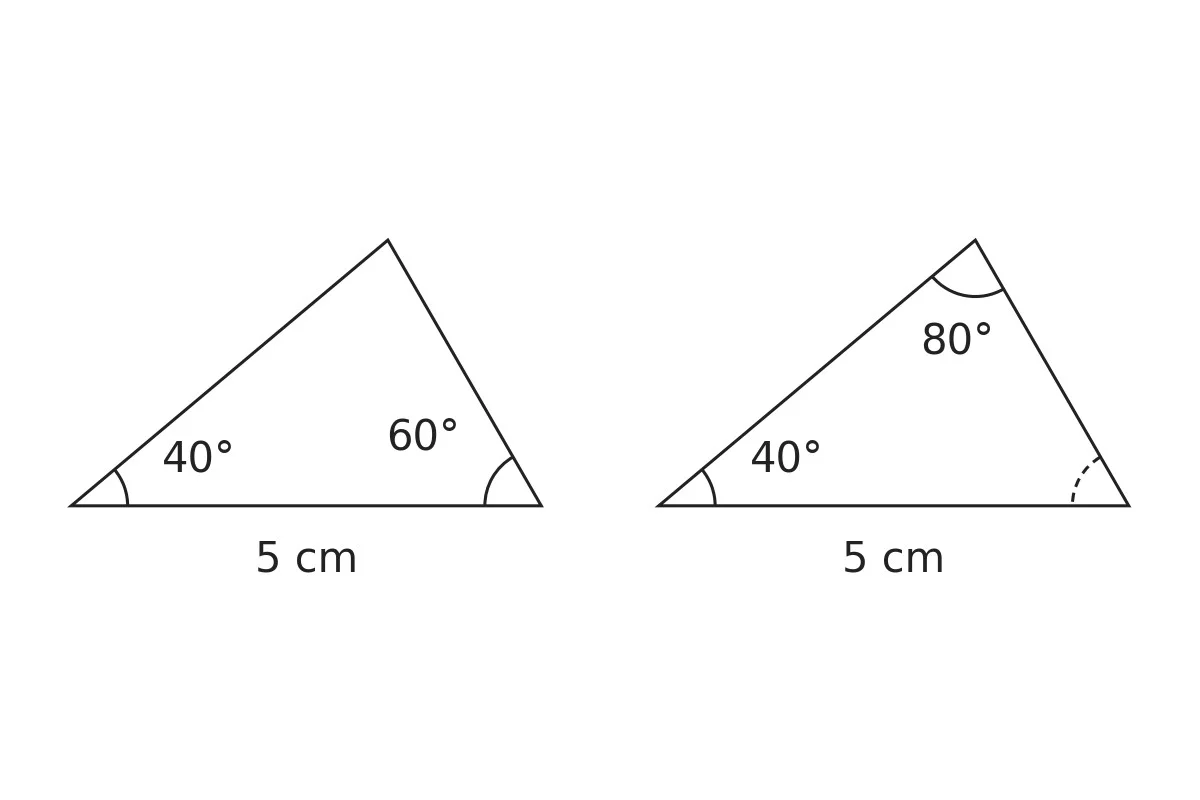
Matching triangles show a known side between given angles and away from them.

6. ASA and AAS Conditions

Two matching angles and a corresponding side fix a triangle.

Show
Look at the diagram. Find each base, then the marked angles.
Ask
Will the triangles match despite the different positions of their given angles?
Say
The missing angle is 60°: triangle angles total 180°. Matching base angles and equal bases give ASA congruence.
Used in
Matching widths and roof slopes helps triangular gable panels fit.
If your child says…“Matching angles are enough, whatever the side lengths.”
Ask
What would stop the triangle growing if we left its base length free?
What’s true
Equal angles allow larger copies unless a corresponding side also matches.
Right triangles sharing a base, with matching sloping sides above and below.

7. RHS Condition

Right angle–hypotenuse–side: match hypotenuses and another side in right triangles.

Show
Draw QR measuring 4 cm. Use a paper corner to draw a perpendicular through Q, extending both ways. Pivot a 5 cm strip at R; mark both meetings and join them to R. Fold along QR after the prediction.
Ask
Will these triangles overlap exactly?
Say
They fit by RHS. Each hypotenuse faces a right angle; it and another side match.
Used in
RHS helps copy triangular supports that fit square frame corners.
If your child says…“Any triangles with matching sides can use RHS.”
Ask
Which corner in each triangle makes RHS available here?
What’s true
RHS requires right angles as well as the specified matching sides.

Equal sides and equal angles

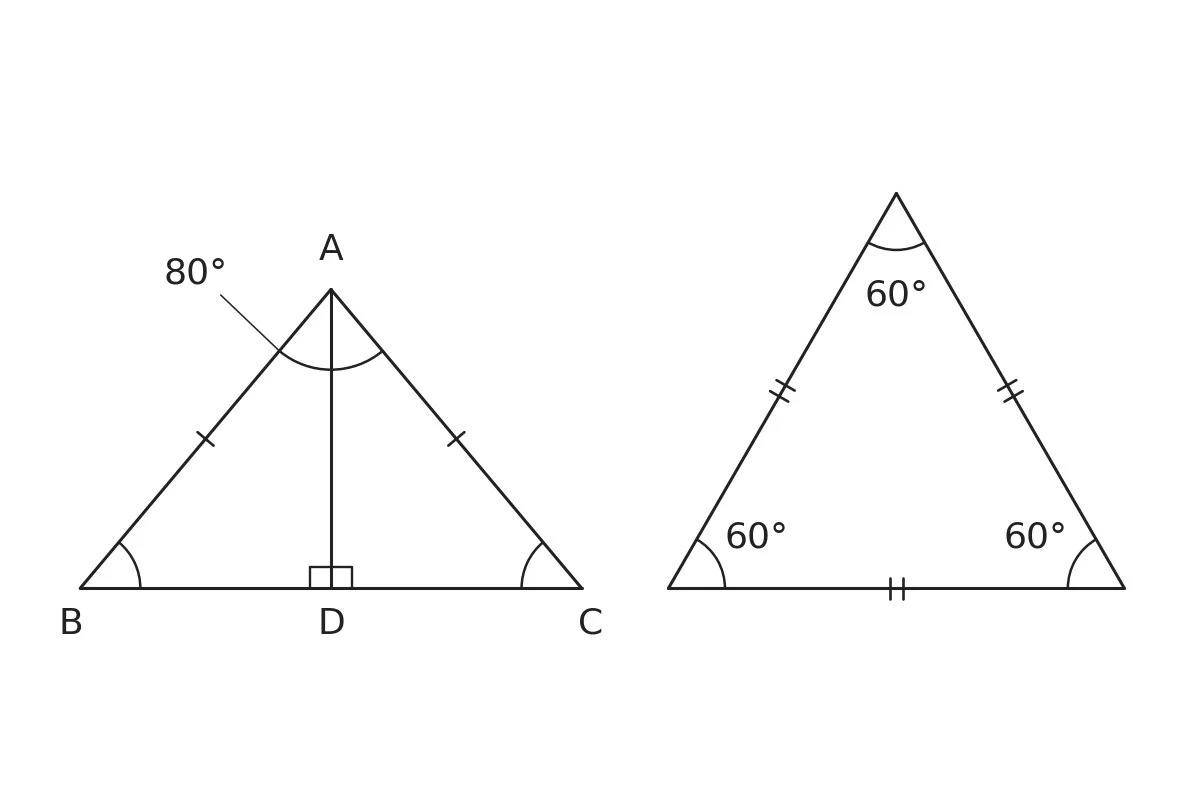
An isosceles triangle split perpendicularly beside an equilateral triangle with equal angles.

8. Angles of Isosceles and Equilateral Triangles

Equal sides face equal angles.

Show
Look at the diagram’s left triangle and its perpendicular AD. Then find the equilateral triangle’s matching sides.
Ask
With equal sloping sides, what do you predict each unlabelled base angle will be?
Say
The halves match by RHS: their hypotenuses match, and they share AD. The equal base angles share 100°, giving 50° each. An equilateral triangle’s angles are all equal, so each gets 60° of the 180° total.
Used in
Equal edges give triangular bunting matching base corners.
If your child says…“Equal sides make every angle equal.”
Ask
Does the top corner match either base corner?
What’s true
Only the angles facing equal sides must match.

A real problem

Repeating frames made room for exhibitions.

New Delhi’s Hall of Nations was built in 1972.

Its pyramid units used equal-length members for their square bases and triangular sides.

The structure provided a vast exhibition space without interior columns.

Architexturez — University of Chicago Press book excerptImpart Encyclopedia of Art

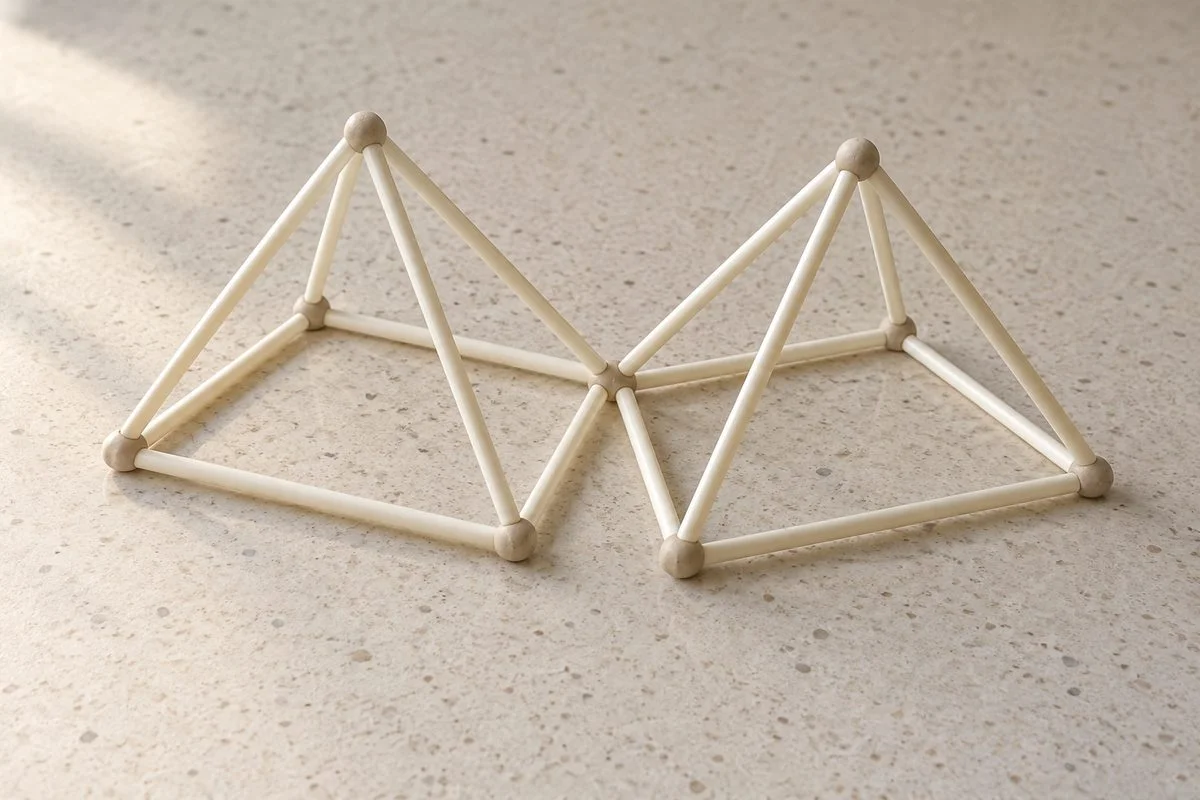
Tabletop straw model with repeating triangular frames and square-based pyramid units.

Concept Lab · Common misconception

The tempting mistake in Geometric Twins

Open standalone misconception page →

Does the same shape guarantee congruence?

Wrong

A 3–4–5 triangle and a 6–8–10 triangle are congruent.

Why it feels right. The angles and shape look the same.

Right

Congruence preserves both shape and size.

Worked example

The larger triangle has every side twice as long. Matching shape does not make the side lengths match.
  1. Put the shortest sides together.
  2. One is 3 units and the other is 6.
  3. A slide, turn or flip cannot make their lengths match.

Ask your child eight quick questions.

One per step. The answer and the reason are given.

  1. The arm lengths match, but the openings differ. Which angle still needs matching?

    The angle between the arms. Matching lengths leave the opening free to change.

  2. Which change prevents an exact fit: turning, flipping or enlarging?

    Enlarging. Enlarging changes size; turning and flipping preserve it.

  3. All side lengths match. Which angles still need measuring to establish congruence?

    None. The side lengths already determine the angles.

  4. ABD matches CDB. Which ordered name matches ADB?

    CBD. A pairs with C, D with B, and B with D.

  5. For measured sides AB and BC, which corner must supply the SAS angle?

    B. B is where those measured sides meet.

  6. Matching angles alone allow different sizes. What must match a 5 cm side for congruence?

    A corresponding 5 cm side. Angles alone allow triangles of different sizes.

  7. Two right triangles have equal hypotenuses. What other side measurement would establish congruence by RHS?

    Another corresponding side must match. RHS needs equal hypotenuses and another matching side in right triangles.

  8. With equal sloping sides and an 80° top angle, what are the base angles?

    50° each. The equal base angles share the remaining 100°.

15 more questions with answers, 8 with pictures