Skip to content

Teach Parallel and Intersecting Lines in eight steps.

For each idea: show it, ask before you tell, then say one line.

Gather paper, thin tracing paper, a pencil, ruler, protractor and a rectangular paper scrap.

Common misconceptions & worked visual for this chapter · 15 practice questions with answers

How to teach it

At one crossing

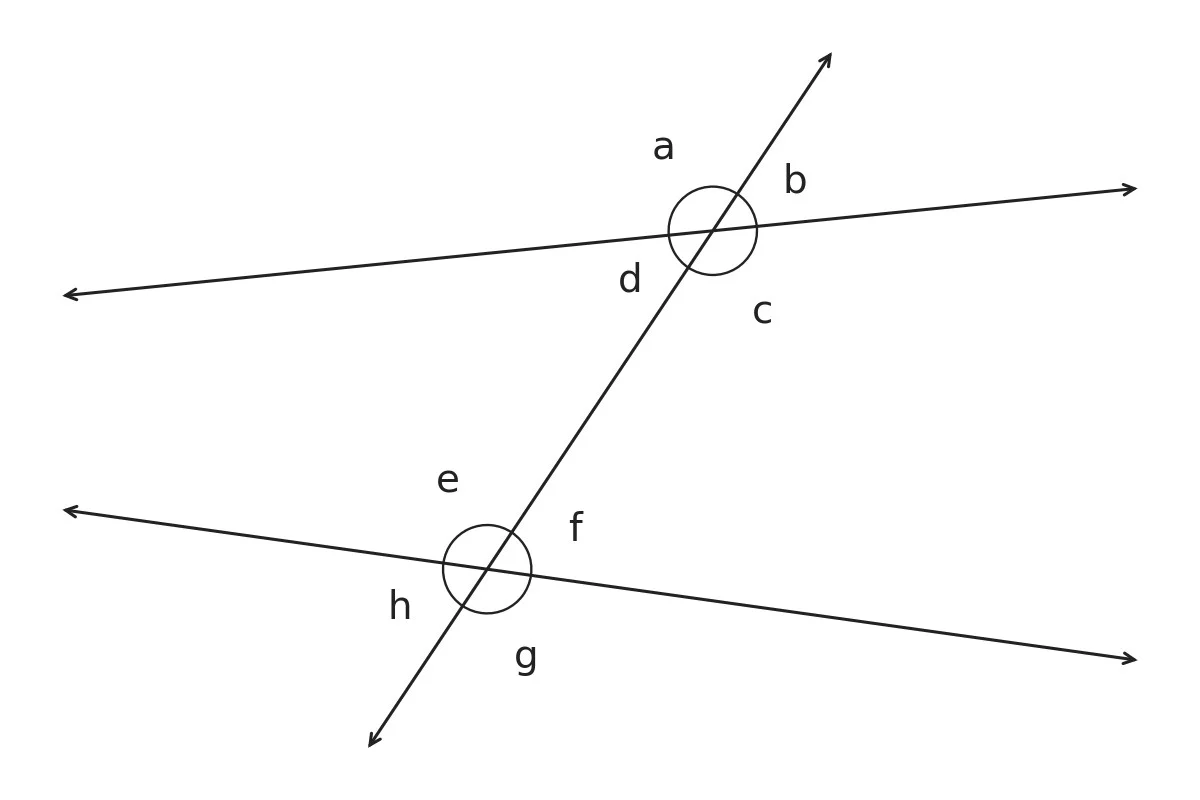
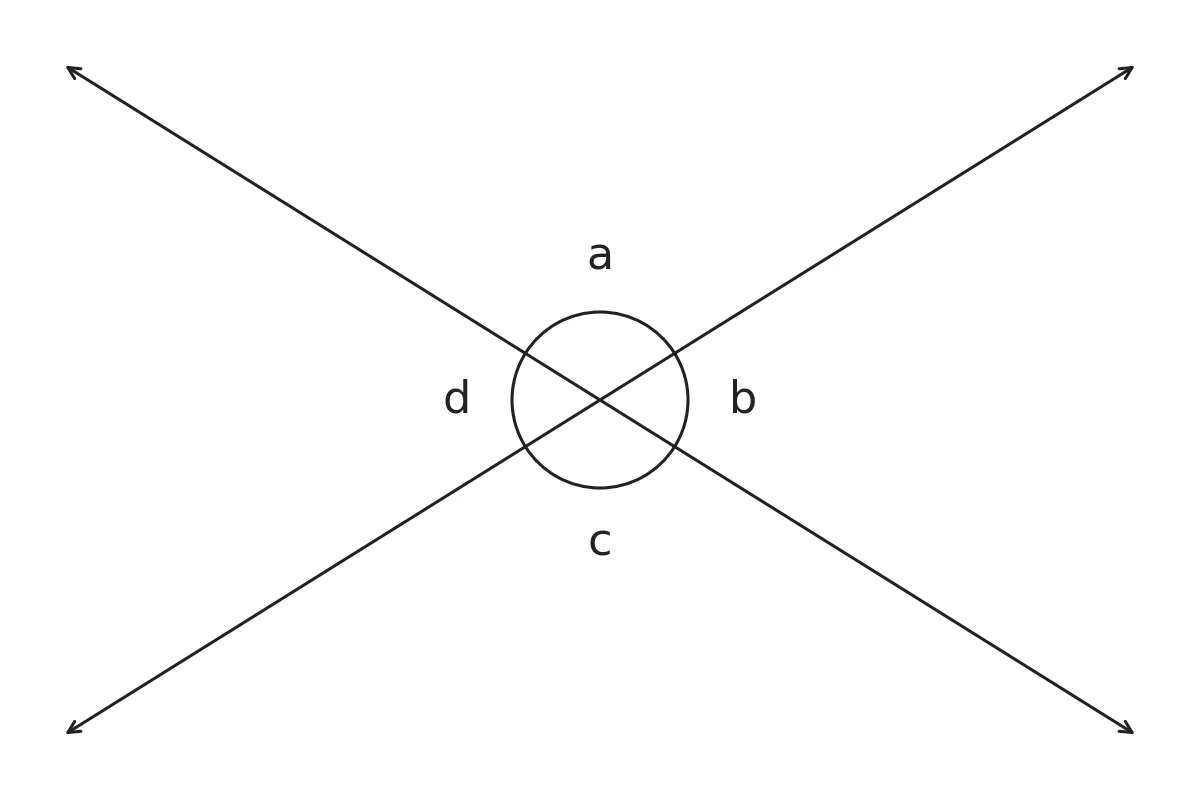
Two oblique lines cross, with four angles labelled a, b, c and d.

1. Intersecting lines, linear pairs and vertically opposite angles

Opposite angles match; neighbouring angles fill a straight angle.

Show
Find angle a, its opposite angle and its two neighbours in the diagram. Measure a. Follow the straight line formed by each neighbouring pair's outer arms.
Ask
What will the other three angles measure?
Say
A linear pair fills a straight angle, totalling 180°. Vertically opposite angles match because each completes 180° with the same neighbour.
Used in
Crossing gate braces need matching opposite angles for their joints to fit.
If your child says…“The opposite angle must add to 180° with this one.”
Ask
What remains when you subtract the same neighbour from each straight angle?
What’s true
Opposite angles have equal sizes.
Opened sheet with perpendicular creases and four square angle marks.

2. Perpendicular lines

Lines meeting at 90°, whatever their direction.

Show
Fold a sheet once. Fold again, laying the folded edge's halves together. Open it and mark each right angle with a square.
Ask
What will happen to these angles when we turn the sheet diagonally?
Say
Turn it: the perpendicular creases still meet at 90°. Folding halved each straight angle, and turning changes no angle.
Used in
A rectangular picture frame needs right-angled corners so its glass fits.
If your child says…“Slanting lines cannot be perpendicular.”
Ask
Did turning the sheet open or close any angle?
What’s true
The angle determines perpendicularity, not the sheet's direction.

Making parallel lines

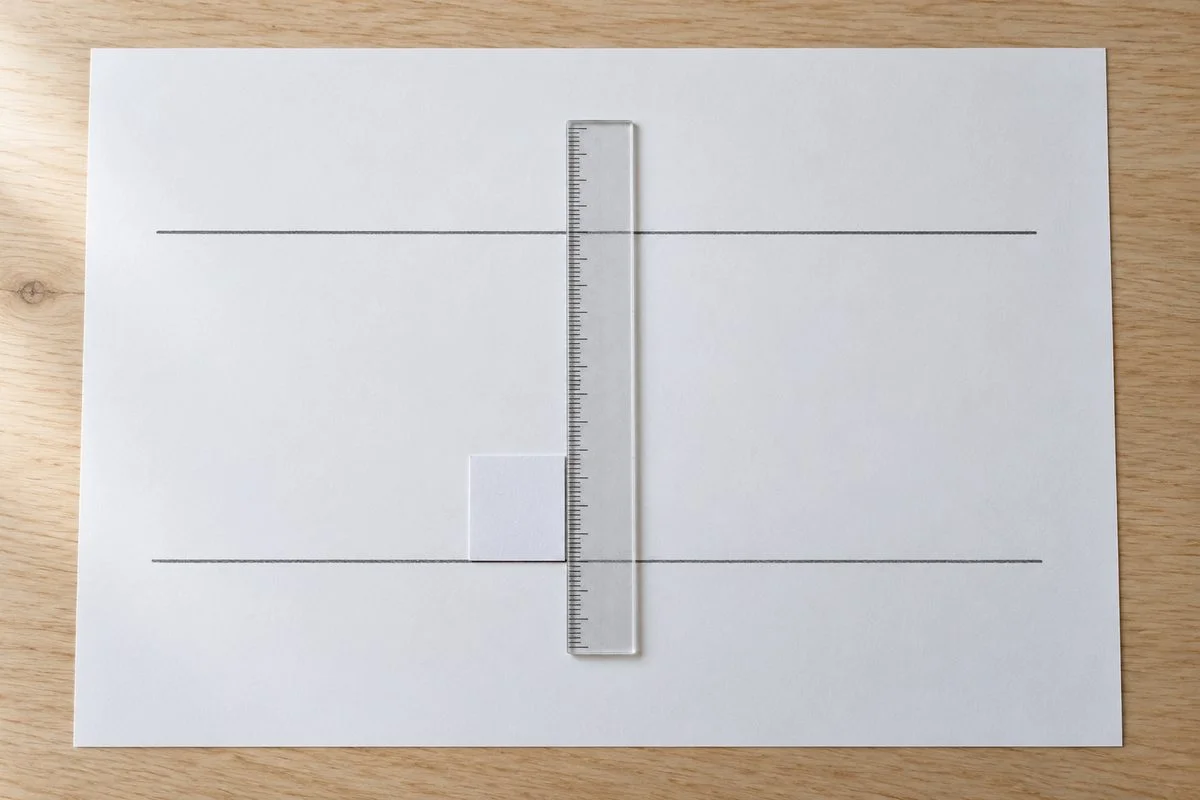
Paper corner and ruler checking the gap between pencil lines.

3. Parallel lines

Lines on one flat surface, never meeting however far they extend.

Show
Rule a line. Use a scrap's square corner to measure 2 cm gaps at right angles. Mark two points well apart, both on the same side. Join the points and check the gap elsewhere.
Ask
If this gap stays unchanged, will extending the lines make them meet?
Say
These parallel lines will not meet. Their right-angle gap stays unchanged beyond the drawn ends.
Used in
Parallel drawer runners keep a drawer moving straight.
If your child says…“These short pieces don't touch, so they must be parallel.”
Ask
What would happen farther along if the gap kept shrinking?
What’s true
Separate pieces can belong to lines that meet beyond their ends.
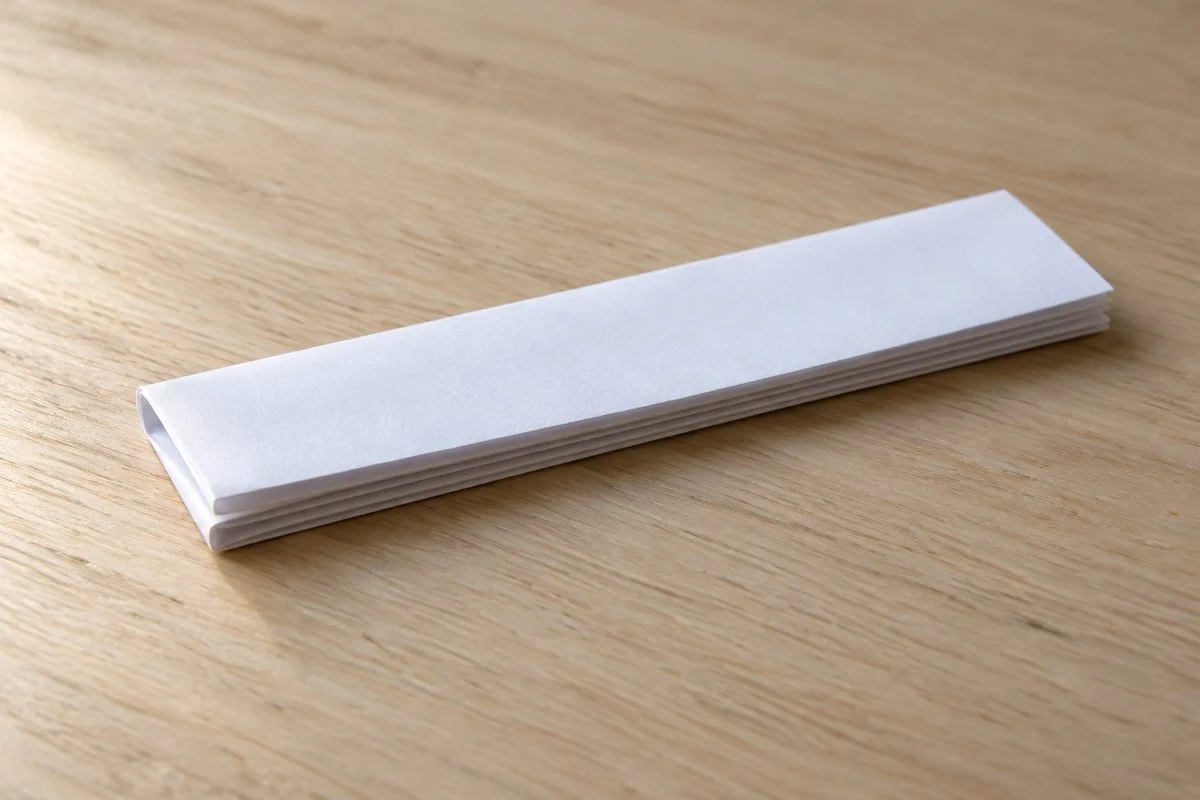
Narrow paper stack after repeated folding in the same direction.

4. Parallel and perpendicular lines in paper folding

Creases perpendicular to one edge run parallel to each other.

Show
Fold a rectangle in half. Halve the folded stack twice more, keeping the folding direction unchanged. Match the edges each time. Pause before opening.
Ask
How many strip boundaries will appear, counting both outside edges?
Say
Open it: eight strips have nine boundaries. The creases meet one edge at 90°, making them parallel.
Used in
Parallel shelves meet upright supports at right angles, keeping their surfaces level.
If your child says…“Each fold doubles the number of boundary lines.”
Ask
Count each strip's left boundary from left to right. Which outside boundary remains uncounted?
What’s true
Halving doubles the strips; their boundaries number one more.

Across two crossings

A transversal crosses two nonparallel lines, forming eight labelled angles.

5. Transversals

A line crossing two others at separate points.

Show
Find both crossings and their four angles in the diagram. Measure a and e. Use the crossing rules to predict the remaining angles.
Ask
Could these eight angles have five different sizes?
Say
The third line is a transversal. Opposite angles match at each crossing, leaving at most four sizes altogether.
Used in
A road crossing two streets creates separate junctions where traffic routes connect.
If your child says…“Five different sizes should be possible.”
Ask
How many sizes remain when you pair the opposite angles at each crossing?
What’s true
Each crossing contributes no more than two angle sizes.
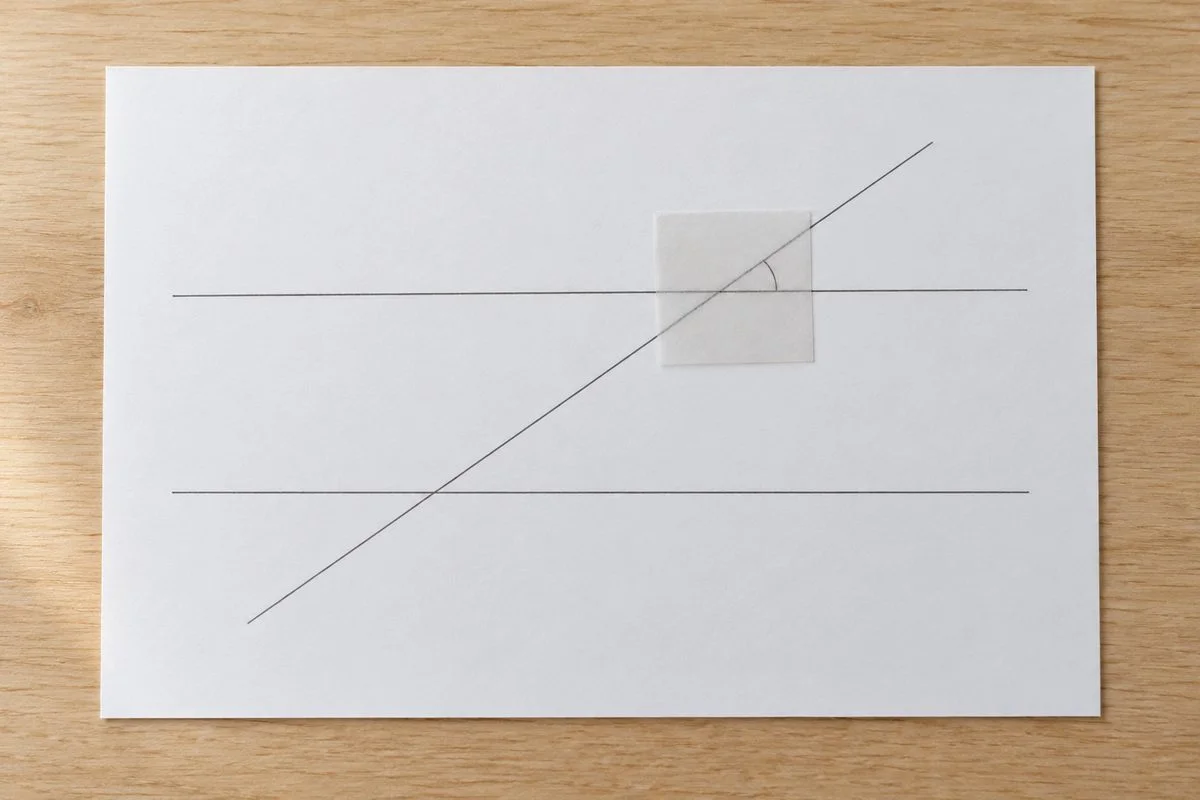
Small tracing over the upper crossing, ready to slide downward.

6. Corresponding angles

Angles occupying matching corners at separate crossings.

Show
Draw a sloping line across parallel lines. Trace the upper crossing's upper-right angle. After predicting, slide along the sloping line until the tracing covers the lower crossing. Do not turn it.
Ask
Will it fit the lower crossing's upper-right angle?
Say
Sliding keeps the traced angle unchanged. Both arms fit again because the crossed lines are parallel.
Used in
Sliding a set square copies angles to draw parallel borders accurately.
If your child says…“Matching positions always mean equal angles.”
Ask
Could both traced edges fit if the lower line sloped differently?
What’s true
These positions have equal angles exactly when the crossed lines are parallel.
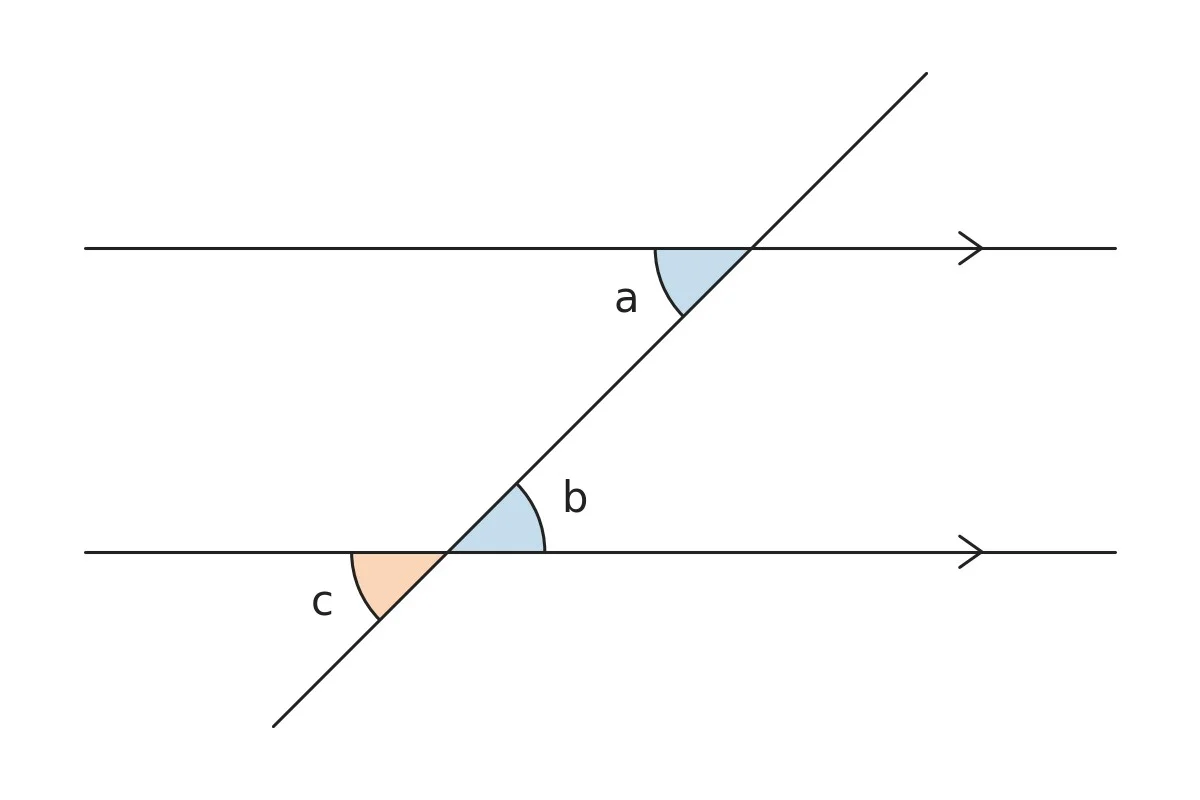
Alternate angles a and b linked by helper angle c on parallel lines.

7. Alternate angles

Inside angles at different crossings, across the transversal from each other.

Show
Find a and b inside the diagram's parallel lines, on opposite sides of the transversal. Find c opposite b.
Ask
Will a and b match, using c to connect them?
Say
Angles a and c correspond, so they match on these parallel lines. Angles c and b are vertically opposite, so they match too. Therefore, a and b are equal.
Used in
A sloping brace between parallel frame edges uses equal alternate angles for matching cuts.
If your child says…“These inside angles must add to 180°.”
Ask
If a and b both match c, how do their sizes compare?
What’s true
Inside parallel lines, alternate angles have matching sizes.
Same-side interior angles a and b, with c beside b forming a straight angle.

8. Interior angles on the same side of the transversal

Inside angles on one side of the transversal.

Show
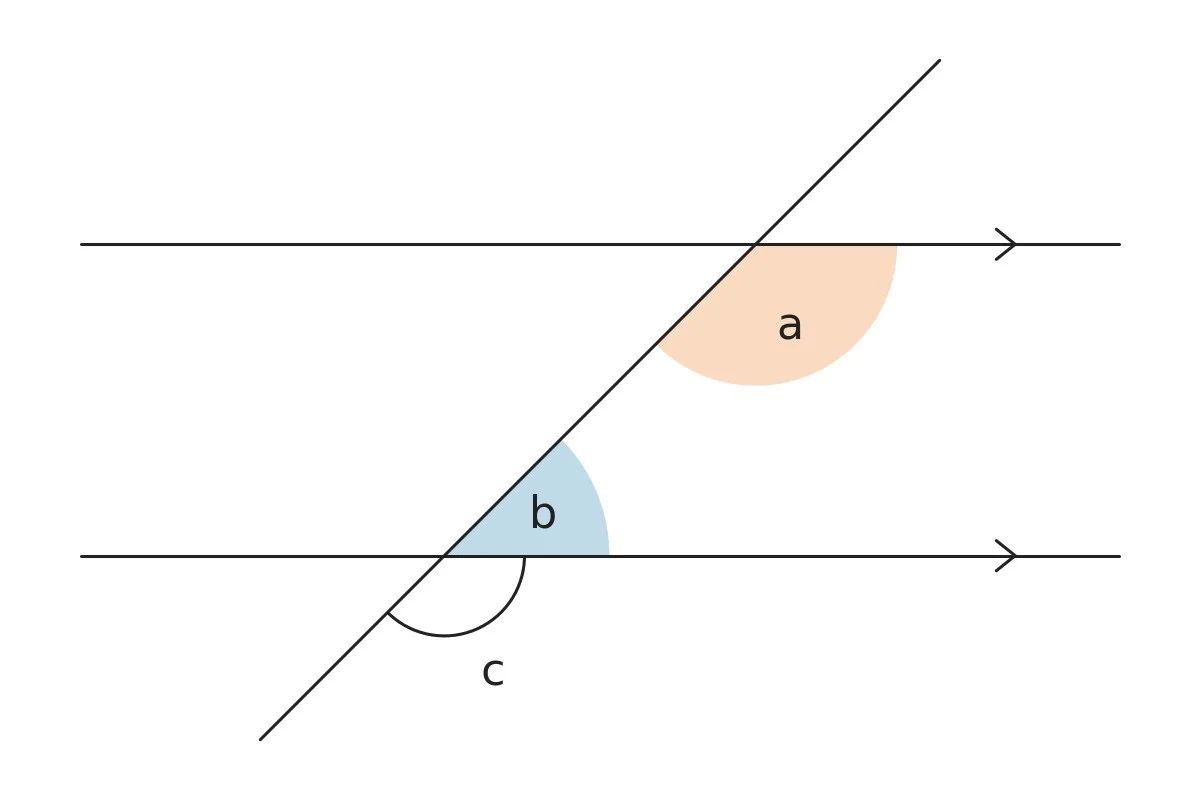
Find a and b inside the diagram's parallel lines, both right of the transversal. Find c beside b.
Ask
What will a and b total, using c to connect them?
Say
Angles a and c correspond, so they match on these parallel lines. Angles b and c fill a straight angle. Replacing c with its equal a gives a total of 180°.
Used in
Window makers use these paired angles to fit sloping sides between parallel edges.
If your child says…“The two inside angles on this side are equal.”
Ask
Which angle equals a and also fills a straight angle with b?
What’s true
Their sizes total 180°; they match only when both are right angles.

A real problem

Perpendicular light paths helped test an idea about Earth's motion.

Michelson and Morley carried out their experiment in 1887.

Their apparatus split light along paths at right angles.

They tested Earth's motion through a supposed substance called ether.

The expected change in the pattern formed by the light did not appear.

American Physical SocietyCase Western Reserve UniversityHarvard University

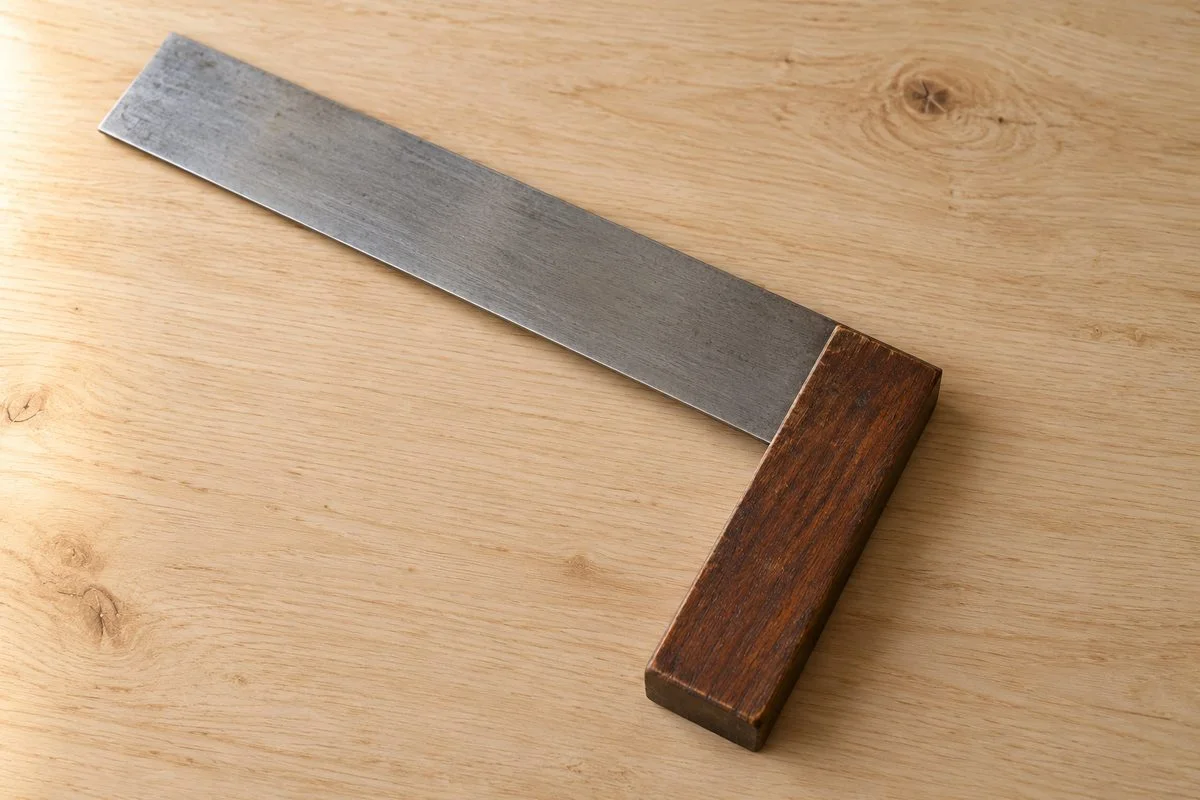
Carpenter's square showing perpendicular directions.

Concept Lab · Common misconception

The tempting mistake in Parallel and Intersecting Lines

Open standalone misconception page →

Are alternate angles always equal?

Wrong

Alternate angles are equal even when a transversal crosses two nonparallel lines.

Why it feels right. The zigzag shape seems to be the whole rule.

Right

A transversal makes equal alternate angles when the two lines are parallel.

Worked example

The upper line stays fixed. Tilting the lower line changes the alternate angle at its crossing.
  1. Draw two parallel lines and a transversal.
  2. Tilt the lower line about its intersection.
  3. The lower angle changes while the upper angle keeps its original size.

Ask your child eight quick questions.

One per step. The answer and the reason are given.

  1. One angle is 120°. What is the angle directly opposite it?

    120°. Both angles complete a straight angle with the same neighbour.

  2. After turning this sheet diagonally, how many right angles remain at the crossing?

    Four. Turning the whole sheet leaves every angle unchanged.

  3. Two straight pieces do not touch, but their gap narrows. Are their lines parallel?

    No. Parallel lines keep an unchanged right-angle gap.

  4. After two halvings, how many boundaries enclose the four strips, including outside edges?

    Five. Four strips need five boundaries, including the two outside edges.

  5. A line crosses two others separately. What is the greatest possible number of angle sizes?

    Four. Each crossing has at most two sizes because opposite angles match.

  6. Matching-position angles measure exactly 60° and 61°. What does this reveal about the crossed lines?

    They are not parallel. Even a small exact difference rules out parallel lines.

  7. An inside angle is 120°. What is its alternate partner's size when the lines are parallel?

    120°. Corresponding angles match, and vertically opposite angles match, linking the alternate pair.

  8. One same-side inside angle between parallel lines is 120°. What is the other?

    60°. Together they fill 180°, leaving 60° beside 120°.

15 more questions with answers, 12 with pictures