Skip to content

Teach Operations with Integers in eight steps.

For each idea: show it, ask before you tell, then say one line.

Gather four coins, paper and a pencil.

Common misconceptions & worked visual for this chapter · 15 practice questions with answers

How to teach it

Sums, differences and movement

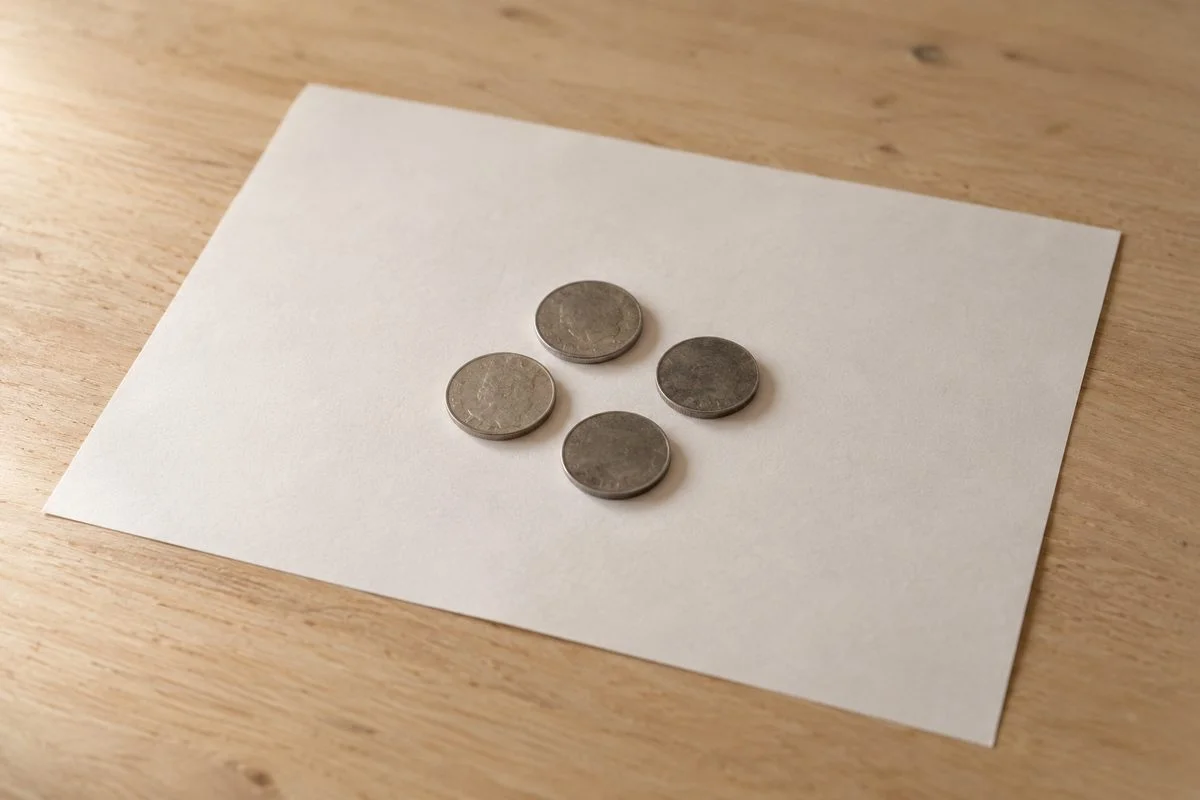
Four loose coins on paper, ready to divide into piles.

1. Rakesh’s Puzzle: A Number Game

Find two numbers that satisfy both clues.

Show
Place four coins on paper. Point to spaces for the first and second piles. After the prediction, let your child divide the coins and check both clues.
Ask
How can the first pile have two more coins than the second?
Say
Three and one fit both clues.
Used in
A total and a difference help recover two missing quantities in stock records.
If your child says…“Swapping the numbers keeps their difference the same.”
Ask
After swapping, does the first pile have extra coins or fewer coins?
What’s true
First minus second changes sign when unequal numbers exchange places.
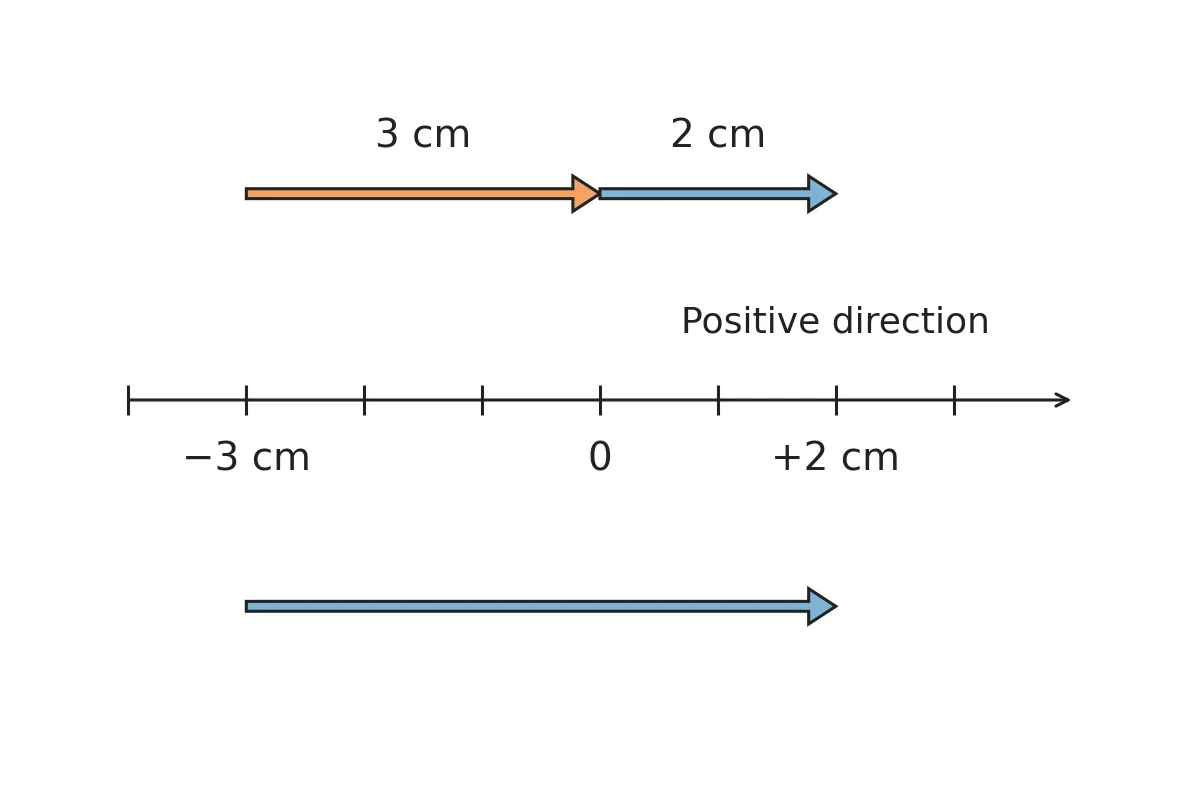
Number line showing rightward movement from negative three through zero to positive two.

2. Carrom Coin Integers

Signed movement records both distance and direction.

Show
Look at the diagram. Find −3 cm on the left and +2 cm on the right. Follow the arrows through zero.
Ask
What movement takes you from −3 cm to +2 cm, across zero?
Say
Move five centimetres right: three to zero, then two more.
Used in
Signed position changes help lifts calculate travel between floors.
If your child says…“I subtract the smaller distance from the larger one.”
Ask
Does moving just 1 cm right even reach zero?
What’s true
Movement across zero includes the distance on both sides.

Multiplication and signed changes

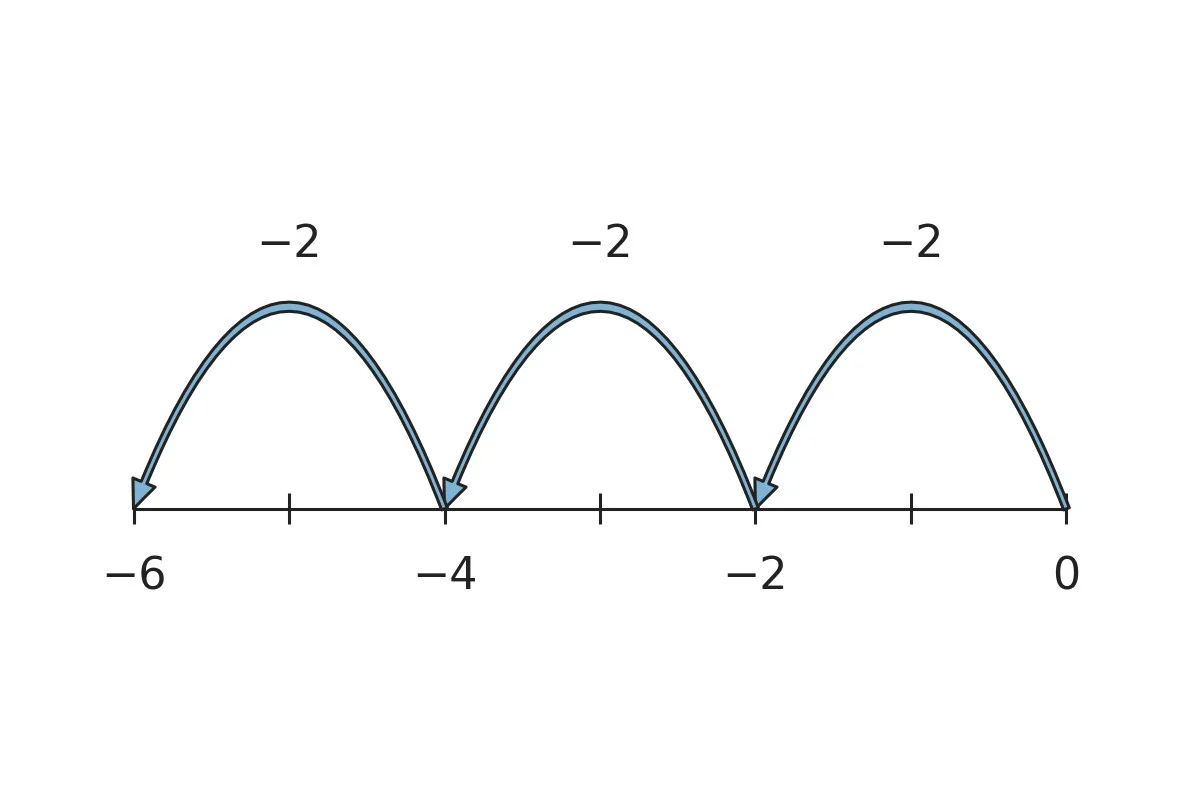
Three equal leftward jumps of negative two lead from zero to negative six.

3. Multiplication of Integers

A positive multiplier counts equal groups of a signed amount.

Show
Look at the diagram. Start at zero and follow the three leftward jumps of minus two.
Ask
What multiplication will give the final position after these three equal jumps?
Say
Three times negative two adds negative two three times. The jumps finish at negative six: 3×(−2)=−63\times(-2)=-6.
Used in
Repeated withdrawals use negative amounts to calculate the total reduction in savings.
If your child says…“Three is positive, so the answer must be positive.”
Ask
If every jump goes left from zero, can the final position be positive?
What’s true
Repeating a negative amount a positive number of times gives a negative total.

1×(−2)=−21\times(-2)=-2

0×(−2)=00\times(-2)=0

(−1)×(−2)=0+2(-1)\times(-2)=0+2

4. Patterns in Integer Multiplication

Multiplication tables keep their regular changes beyond zero.

Show
Write these lines. Say, 'Each row removes one group of negative two. The answer rises by two.'
Ask
What answer completes the last line?
Say
The answer is positive two. Removing another negative group continues the increase past zero.
Used in
Cancelling equal charges raises an account balance by the same amount each time.
If your child says…“The answers stay at zero once the table reaches zero.”
Ask
Why would removing the next negative group leave the answer unchanged?
What’s true
The same change continues when the first factor passes zero.

T=3+2×(−2)T=3+2\times(-2)

T=3+(−4)T=3+(-4)

5. Applications of Integer Operations

Add a signed change to the starting value.

Show
Say, 'Temperature starts at 3°C and falls 2°C hourly for two hours. Falls are negative. T means the final temperature in degrees Celsius.' Write these lines.
Ask
What final temperature completes the calculation?
Say
The final temperature is −1°C. Adding the negative change already accounts for the fall.
Used in
Signed temperature changes help track whether stored food is warming or cooling.
If your child says…“I must subtract a loss even when it already has a minus sign.”
Ask
Would subtracting negative four make this cooling temperature rise?
What’s true
Add a change already written as negative; subtracting it would reverse the loss.

Division and multiplication properties

q=(−6)÷2q=(-6)\div2

2×q=−62\times q=-6

6. Division of Integers

Division finds the missing factor in a multiplication.

Show
Say, 'Let q mean the division answer. Two multiplied by that answer must give negative six.' Write these lines. After the prediction, write, 'Two groups of negative three total negative six.'
Ask
What must q be?
Say
The answer is negative three, because two groups of negative three total negative six.
Used in
Dividing a total loss into equal shares shows each share’s signed value.
If your child says…“I multiply the answer by the first number to check division.”
Ask
In our multiplication line, which number multiplies q?
What’s true
Multiply the answer by the divisor to recover the number being divided.
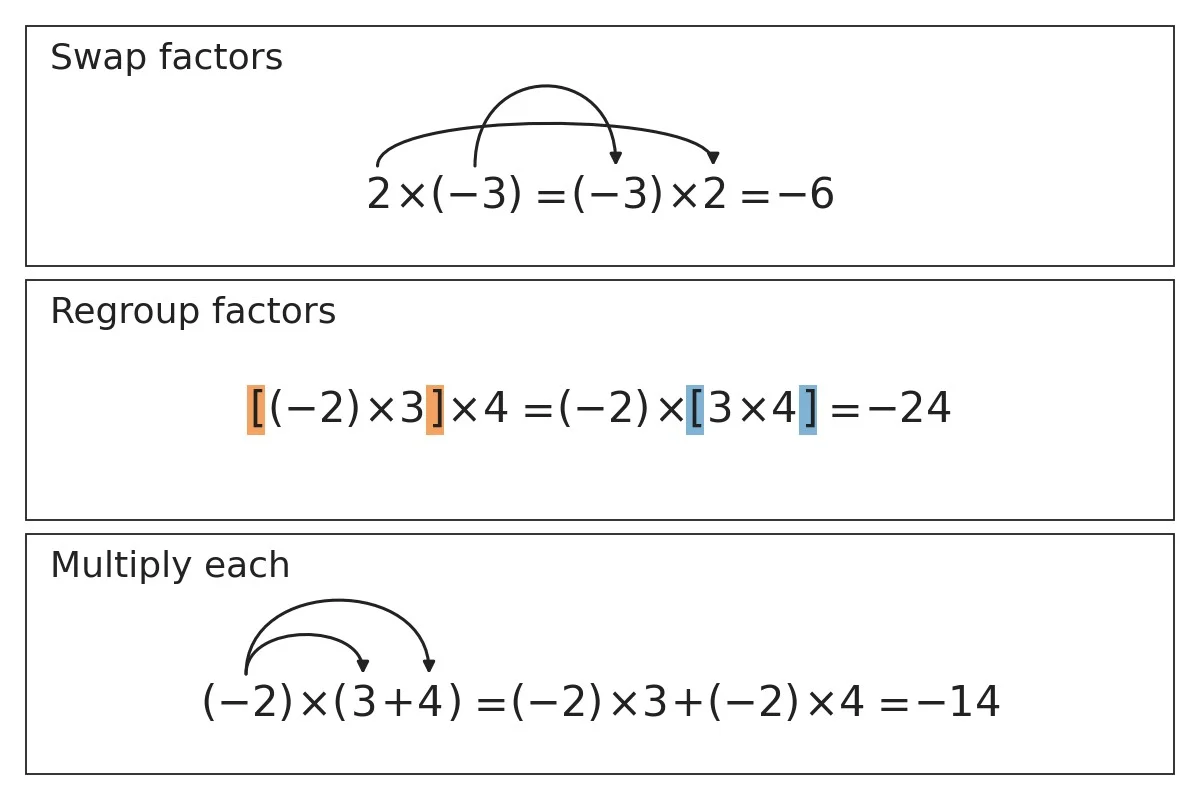
Three panels show swapping factors, regrouping factors, and multiplying both terms inside brackets.

7. Expressions Using Integers

Swap or regroup factors; multiply both terms when multiplying a sum.

Show
Read the diagram downwards. Follow the swapping arrows, changed brackets, then arrows to both terms.
Ask
Which changes keep the answer unchanged?
Say
All three preserve the answer.
Used in
Distributing multiplication helps calculate repeated purchases and refunds together.
If your child says…“The outside number multiplies only the first number inside brackets.”
Ask
If every group has two parts, can multiplying whole groups leave one part unchanged?
What’s true
Each term inside an addition bracket receives the outside multiplier.

(−1)×2×(−1)=[(−1)×(−1)]×2(-1)\times2\times(-1)=[(-1)\times(-1)]\times2

The product is one times two.

8. Multiplication of Many Integers

Pairs of negative factors give a positive product.

Show
Say, 'Bring the two negative factors together. Their product is positive one.' Write these lines.
Ask
What product completes the last line?
Say
The product is positive two. Negative pairs give positive products.
Used in
Signed scaling calculations track whether repeated reversals restore or reverse a drawing’s direction.
If your child says…“Three factors always give a negative answer.”
Ask
Which of these three factors actually carry negative signs?
What’s true
Without zero factors, count negative factors alone to choose the product’s sign.

A real problem

A computer method handles multiplication with either sign.

Booth published his multiplication procedure in 1951.

His method uses one process to multiply positive and negative numbers written in binary.

Computer hardware can carry out this method efficiently.

IEEE Computer SocietyUC Davis — Booth’s original paperMIT

Desktop computer beside a sheet of handwritten calculations.

Concept Lab · Common misconception

The tempting mistake in Operations with Integers

Open standalone misconception page →

What does subtracting a negative do?

Wrong

3 − (−2) = 1

Why it feels right. Subtract means move left, so I moved two places left.

Right

Subtracting −2 reverses the effect of adding −2.

Worked example

Starting at 3, subtracting 2 lands at 1. Subtracting −2 reverses that direction and lands at 5.
  1. On a number line, 3 − 2 takes two steps left to 1.
  2. For 3 − (−2), reverse the two leftward steps represented by −2.
  3. Two steps right from 3 land on 5.

Ask your child eight quick questions.

One per step. The answer and the reason are given.

  1. The numbers are 7 and 18. Which comes first for a first-minus-second difference of −11?

    7. The smaller number must come first for the difference to be negative.

  2. From −4, what signed movement reaches 5?

    +9. Moving right takes four units to zero, then five more.

  3. What is four times negative two?

    −8. Four equal negative amounts add to a negative total.

  4. After zero times three gives zero, what does negative one times three give?

    −3. Removing another group of three lowers zero by three.

  5. Temperature starts at 3°C and changes by −4°C. What is its final value?

    −1°C. Adding negative four lowers the starting temperature by four degrees.

  6. To check negative one hundred divided by twenty-five, which number multiplies the answer?

    25. The divisor times the answer must recover negative one hundred.

  7. When negative five multiplies the sum of eighteen and negative three, which terms receive it?

    Both 18 and −3. The multiplier acts on the whole sum, so it reaches both terms.

  8. What sign results from multiplying negative two, three, four and five?

    Negative. Only one factor is negative; counting all four factors gives the wrong sign.

15 more questions with answers