Skip to content

Teach Anatomy of Flowering Plants in five steps.

For each idea: show it, ask before you tell, then say one line.

Gather an onion scale, a dark plate and water.

Common misconceptions & worked visual for this chapter · 15 practice questions with answers

How to teach it

Tissues and their jobs

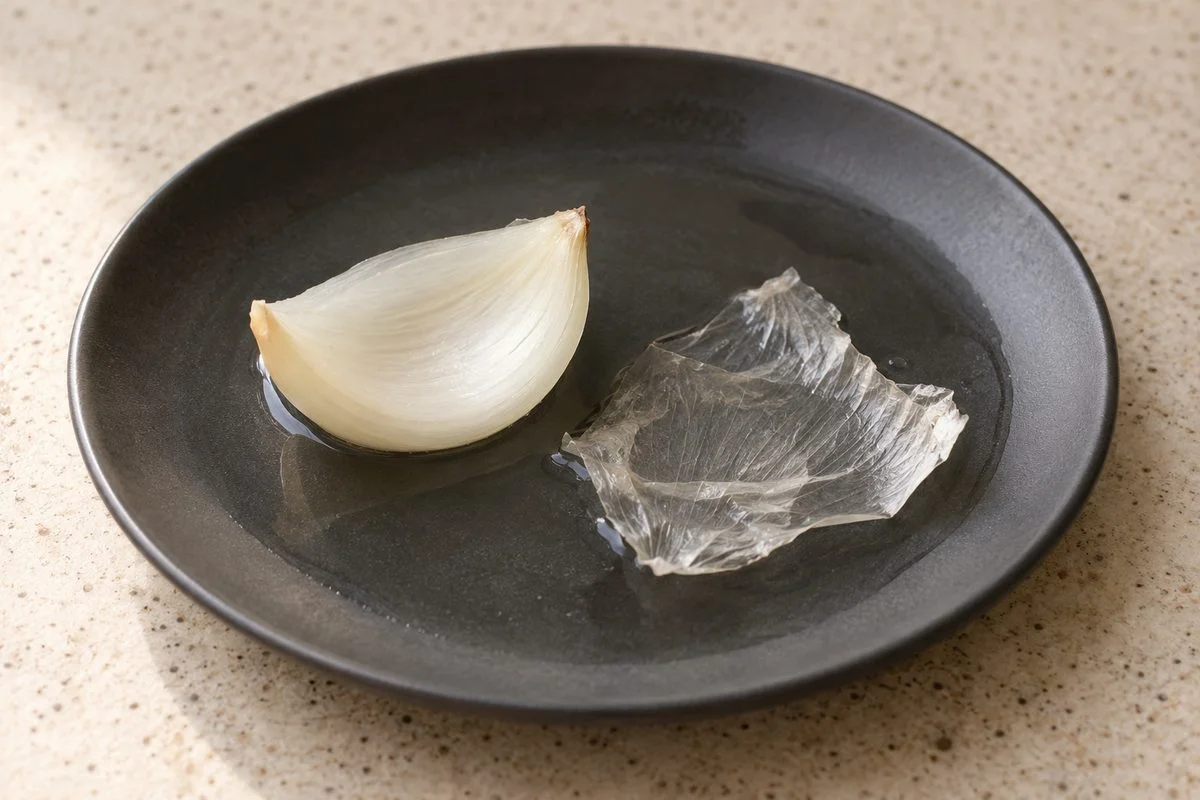
Onion scale beside its translucent inner peel spread in water on a dark plate.

1. The Tissue Systems

Plant tissues cover surfaces, fill interiors, or carry water and sugars.

Show
Place an onion scale on a dark plate with water. After the prediction, lift its inner peel with fingernails. Spread the peel in water.
Ask
Will a thin sheet separate from the thicker onion tissue?
Say
Yes, the peel is epidermis, and the thicker flesh beneath is mainly ground tissue.
Used in
Single-cell root hairs absorb water and minerals, helping plants grow.
If your child says…“Roots have a waterproof coat too.”
Ask
How would a water-repelling coat affect a root hair's water uptake?
What’s true
Absorbing roots lack a cuticle, while shoot cuticles and hairs help reduce water loss.
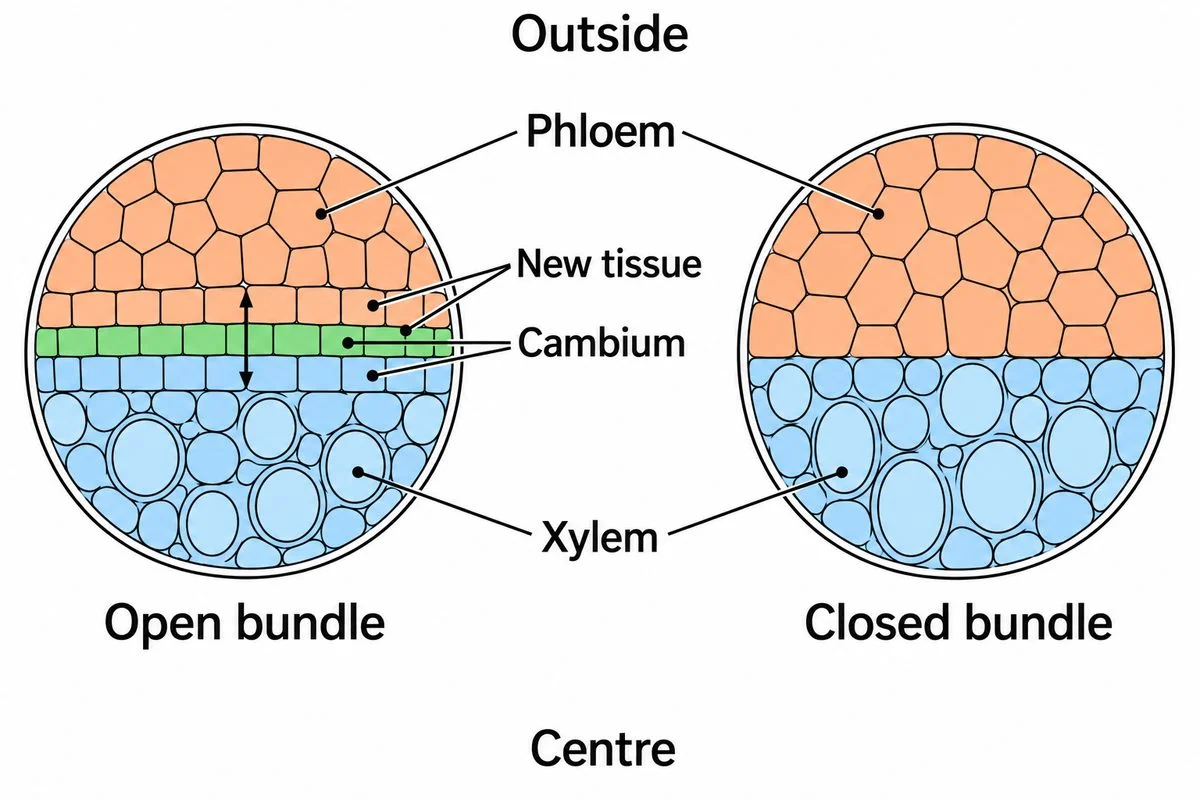
Open and closed bundles compared, with arrows showing tissue production from cambium.

2. The Vascular Tissue System

Cambium adds tissue between water-carrying xylem and sugar-carrying phloem.

Show
Look at the diagram, with the stem's outside above and centre below. Find phloem above xylem in both bundles. Follow the arrows from cambium in the left bundle.
Ask
Which bundle could add more tissue to carry water and sugars?
Say
The left bundle can because it contains cambium. This dividing layer can add xylem inward and phloem outward.
Used in
Aligned cambium helps grafted shoots reconnect with rootstock transport tissues.
If your child says…“Open means there is an empty gap.”
Ask
What lies between xylem and phloem in the open bundle?
What’s true
An open bundle contains dividing cambium, whether or not any gap is visible.

Inside roots, stems and leaves

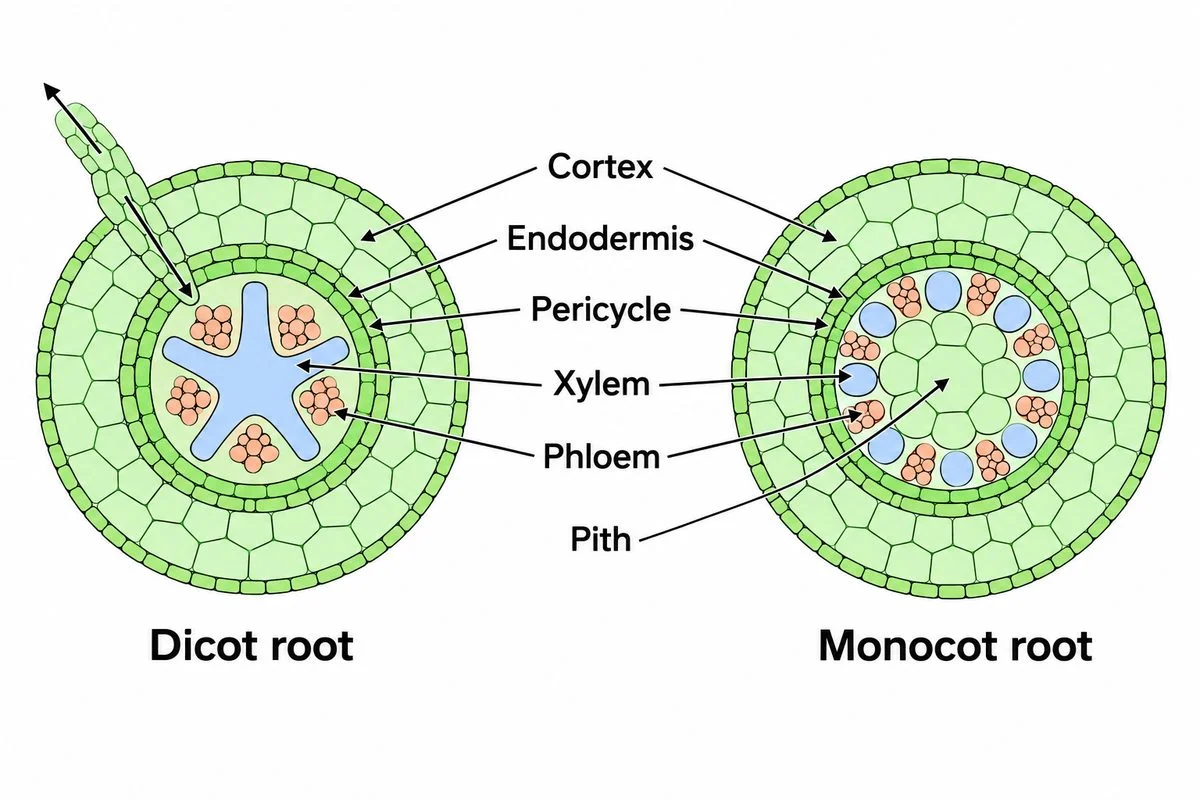
Dicot and monocot root sections showing inner layers, contrasting centres and a developing side root.

3. Dicotyledonous Root and Monocotyledonous Root

Root layers surround transport tissues and the pericycle that starts branches.

Show
Compare both root centres in the diagram. Follow the side root from the pericycle outwards.
Ask
Where would another side root begin?
Say
Both roots branch from the pericycle. Typical monocot roots have more xylem strands and larger pith than dicot roots.
Used in
Lateral roots reach more soil, increasing access to water and minerals.
If your child says…“Side roots start in the endodermis.”
Ask
Which ring must a new branch cross immediately after leaving the pericycle?
What’s true
The pericycle produces lateral roots from just inside the endodermis.
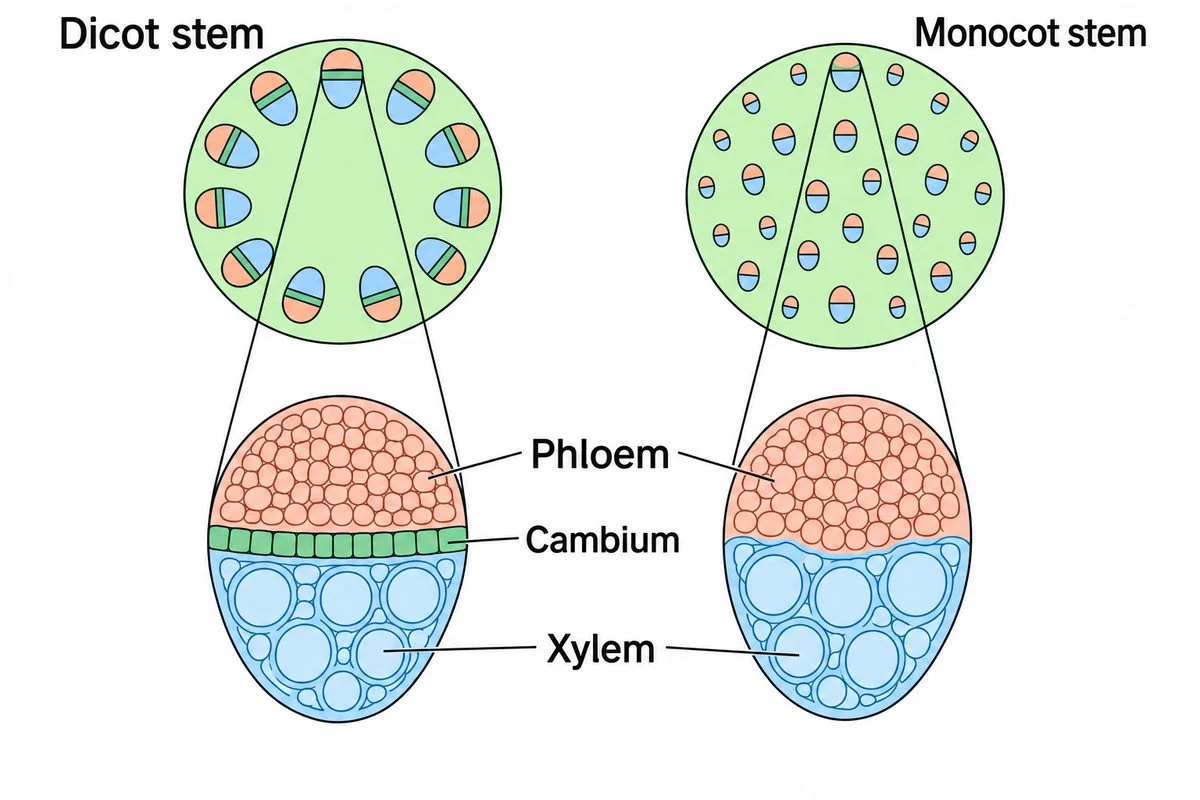
Stem sections compare ringed and scattered bundles, with cambium visible only in the dicot enlargement.

4. Dicotyledonous Stem and Monocotyledonous Stem

Typically, dicot stem bundles form rings, while monocot bundles lie scattered.

Show
Compare bundle positions in the diagram. Find cambium in the enlargements.
Ask
Which stem could add tissue through cambium?
Say
The dicot's cambium can add transport tissue. Its bundles usually form a ring; typical monocot bundles are scattered and lack cambium.
Used in
Stem bundles supply leaves with water and carry sugars to growing parts.
If your child says…“Both kinds of stem have cambium inside their bundles.”
Ask
Which enlarged bundle has cambium between its xylem and phloem?
What’s true
Typical monocot stem bundles lack the dividing layer found in dicot stem bundles.
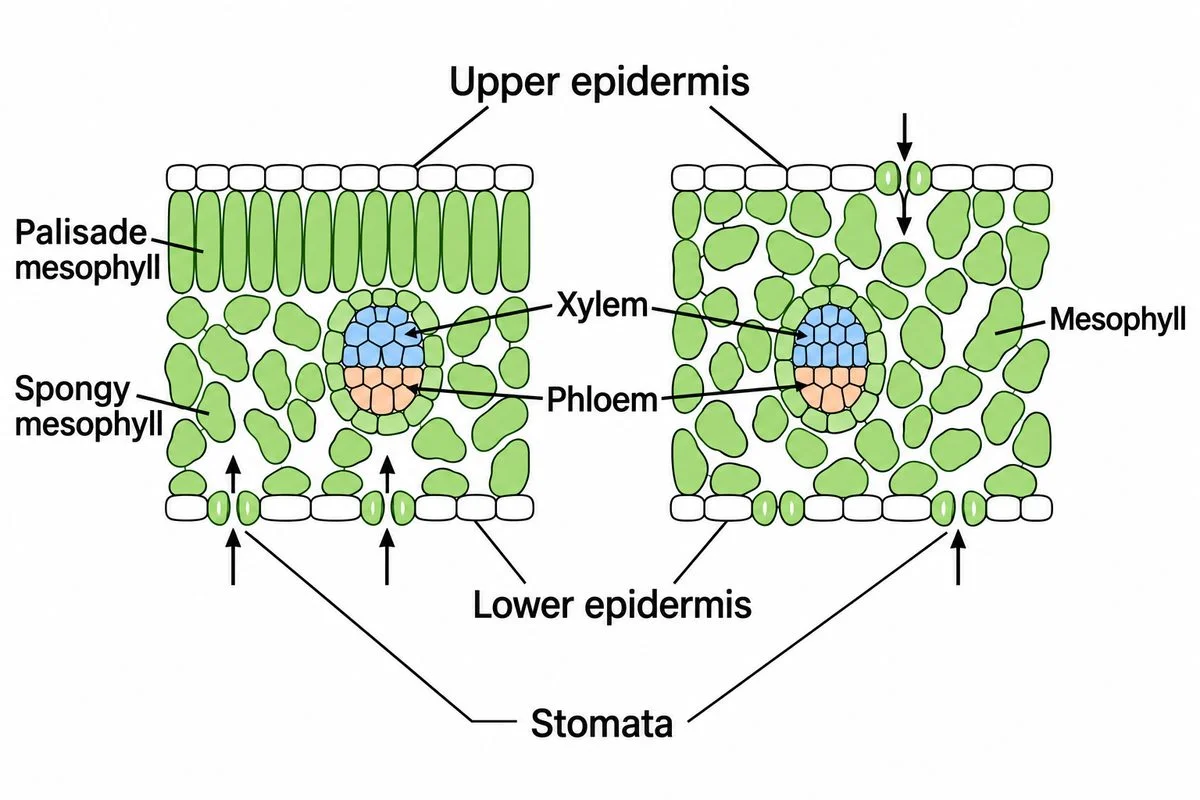
Dicot and grass leaf sections compare inner cells, stomata and paths into air spaces.

5. Dorsiventral Leaf and Isobilateral Leaf

Typical dicot mesophyll has distinct layers, unlike typical grass mesophyll.

Show
Follow the diagram's arrows through stomata. Compare the inner layers and locate xylem above phloem.
Ask
Where could incoming carbon dioxide reach food-making cells?
Say
Air spaces carry it beside cells. This dicot has palisade above spongy cells. The grass mesophyll lacks this division.
Used in
Leaf air spaces let carbon dioxide reach cells that make food.
If your child says…“Grass leaves have pores only underneath.”
Ask
Where do the arrows enter the grass leaf?
What’s true
Typical grass leaves exchange gases through stomata on their upper and lower surfaces.

A real problem

Grafting helped rebuild French vineyards.

In 1870, Riley began sending resistant grape rootstocks to Planchon in France.

European grape shoots were grafted onto American roots resistant to phylloxera.

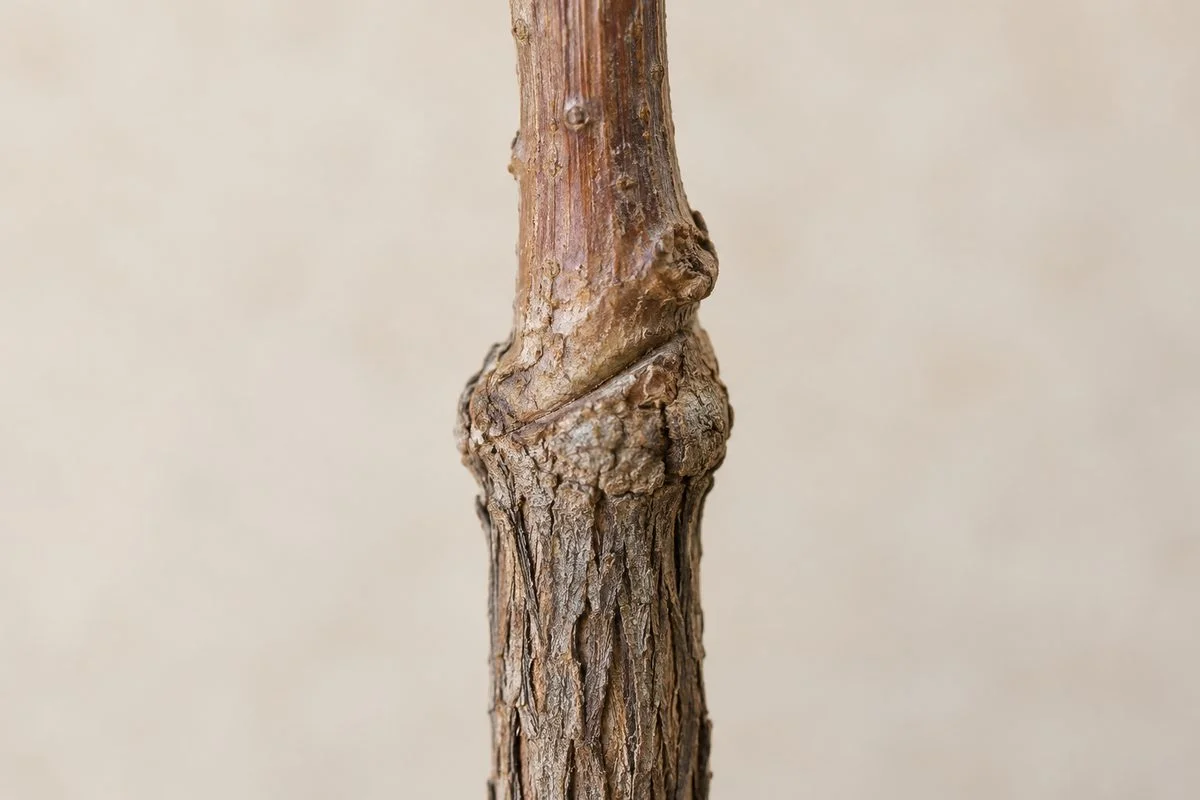
Matching cambium regions lets the shoot and rootstock transport systems reconnect.

Rebuilding the vineyards succeeded despite enormous costs and labour.

NC State UniversityCambridge University PressUniversity of Florida

Grapevine stem with a visible healed graft union.

Concept Lab · Common misconception

The tempting mistake in Anatomy of Flowering Plants

Open standalone misconception page →

Does phloem always carry sugars downward?

Wrong

Food moves down through phloem in every plant.

Why it feels right. Leaves are usually above the roots.

Right

Transport follows the source-to-sink relationship.

Worked example

Leaf source
Mature leaf→Phloem upward→Growing shoot tip
Storage source
Stored reserves mobilised→Phloem→Growing shoot
Transport is from source to sink. A growing shoot can receive sugars from a mature leaf below it.
  1. A mature leaf can supply a growing shoot tip above it.
  2. A storage organ can also supply a growing shoot when reserves are mobilised.

Ask your child five quick questions.

One per step. The answer and the reason are given.

  1. Which lacks a cuticle: an absorbing root surface or a typical aerial leaf surface?

    The absorbing root surface. Root hairs need to take in water rather than resist its entry.

  2. A tightly packed bundle contains active cambium. Which transport tissues can it produce?

    Xylem and phloem. Cambium divides to add transport tissues even when no empty gap exists.

  3. A side root begins just inside the endodermis. Which layer is dividing?

    The pericycle. The branch starts in the pericycle and grows out through surrounding tissues.

  4. Which dividing tissue occurs inside typical dicot stem bundles but not typical monocot stem bundles?

    Cambium. Typical monocot stem bundles are closed because they lack cambium.

  5. Which surfaces of a typical grass leaf have stomata?

    Both upper and lower surfaces. Grass leaves have stomata on both sides, unlike the usual lower-heavy dicot pattern.

15 more questions with answers, 9 with pictures