Skip to content

Teach Structural Organisation in Plants and Animals in eight steps.

For each idea: show it, ask before you tell, then say one line.

Gather mango and neem twigs, flowering mustard, mango, a plate, knife and cutting board.

An adult cuts the mango on a cutting board.

Common misconceptions & worked visual for this chapter · 15 practice questions with answers

How to teach it

Roots, stems and leaf arrangement

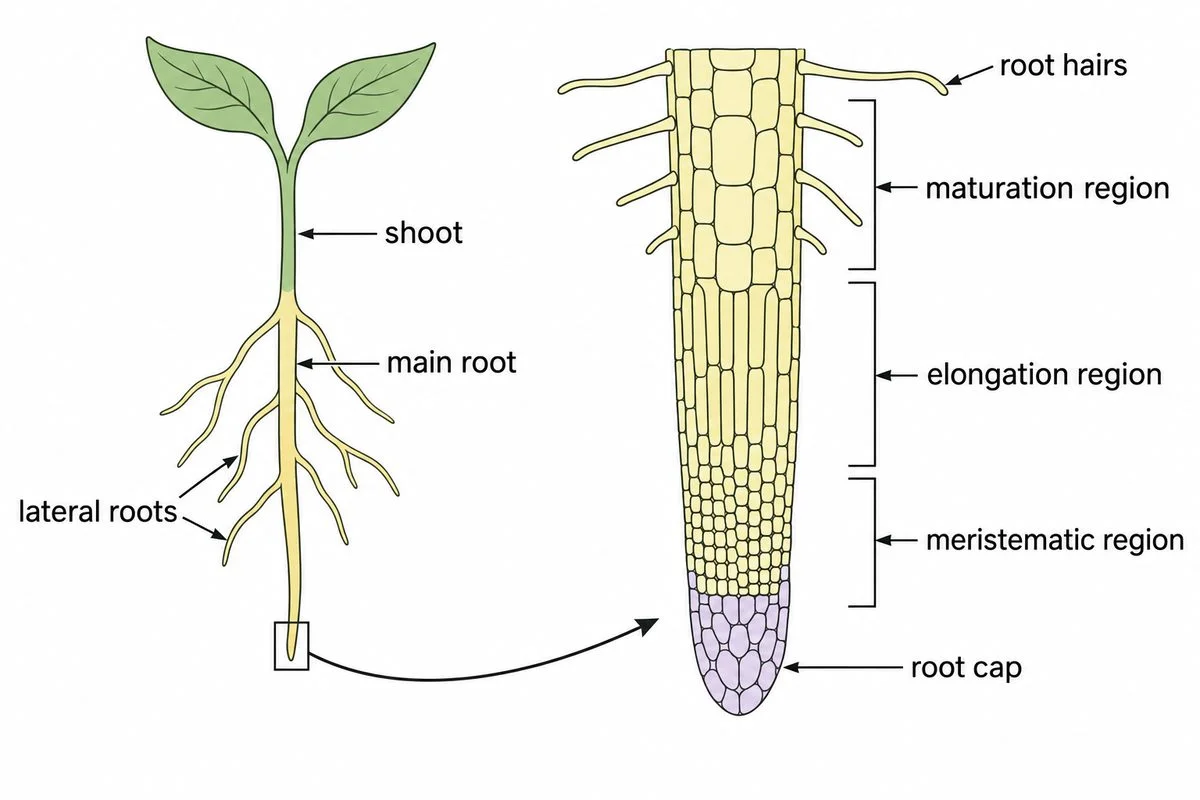
Bean seedling beside an enlarged root tip showing growth regions and root hairs.

1. Morphology of Flowering Plants: The Root

Morphology describes outer form, including connected root and shoot systems.

Show
Read the bean seedling diagram together, tracing its shoot, main root and branches. Locate the cap and hair-bearing region in the enlarged root tip.
Ask
Where would absorbing hairs appear as new root cells mature?
Say
This main root and its branches form a tap system. Absorbing hairs would appear where cells mature, behind the cap.
Used in
Protecting roots during transplanting preserves anchorage and water uptake.
If your child says…“Root hairs grow right on the tip.”
Ask
Where are the hairs in the diagram compared with the protected tip?
What’s true
Root hairs develop from surface cells in the maturation region, farther behind the cap.
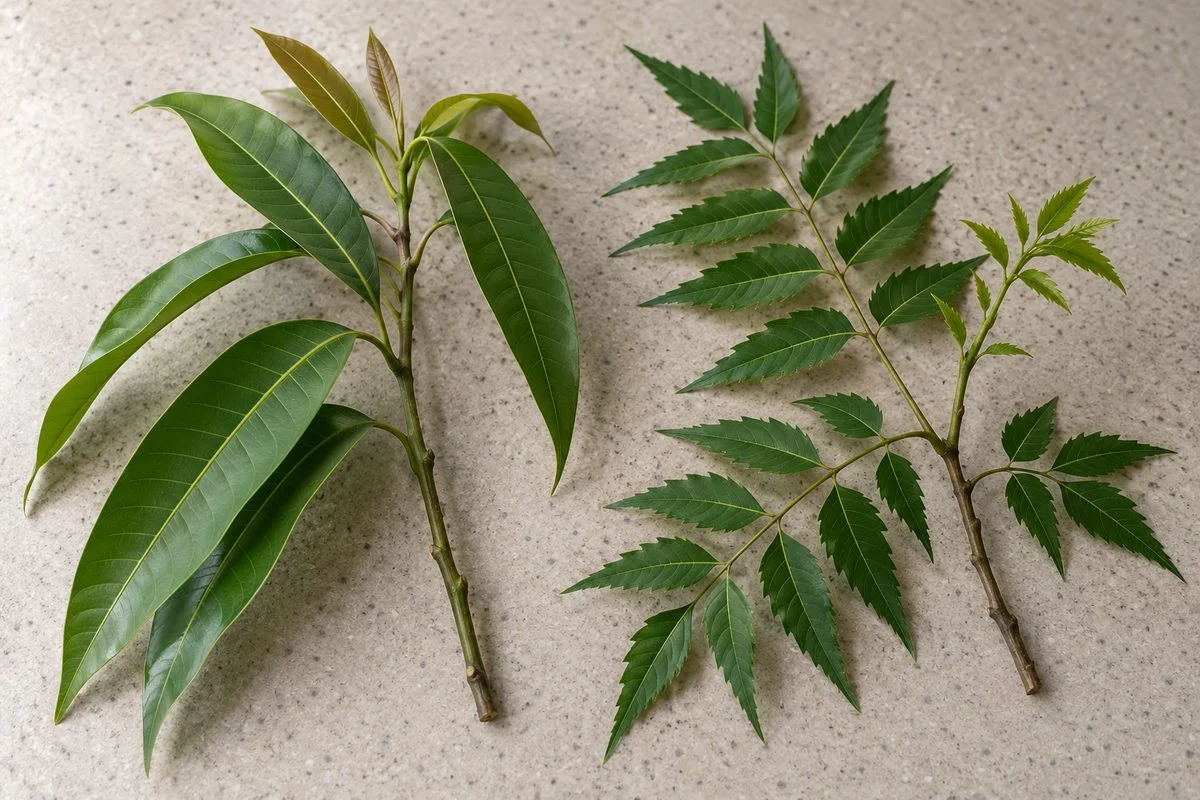
Mango and neem twigs with complete leaves and visible stem attachments.

2. The Stem and The Leaf

Stems bear simple leaves or compound leaves made of leaflets.

Show
Compare mango and neem twigs. Trace leaf bases, stalks and blades, then mango’s vein network. Name attachment points nodes and intervening stretches internodes.
Ask
Where would you expect a bud: beside a neem leaflet or beside the whole leaf?
Say
You would expect a bud beside the whole leaf. Mango’s blade is simple, while neem’s pinnate leaflets line a shared axis.
Used in
Branching stems spread leaves into light and carry water and sugars.
If your child says…“Every neem leaflet is a whole leaf.”
Ask
Where does the shared stalk meet the stem and its side shoot?
What’s true
The axillary bud belongs beside the whole leaf’s attachment, not beside each leaflet.
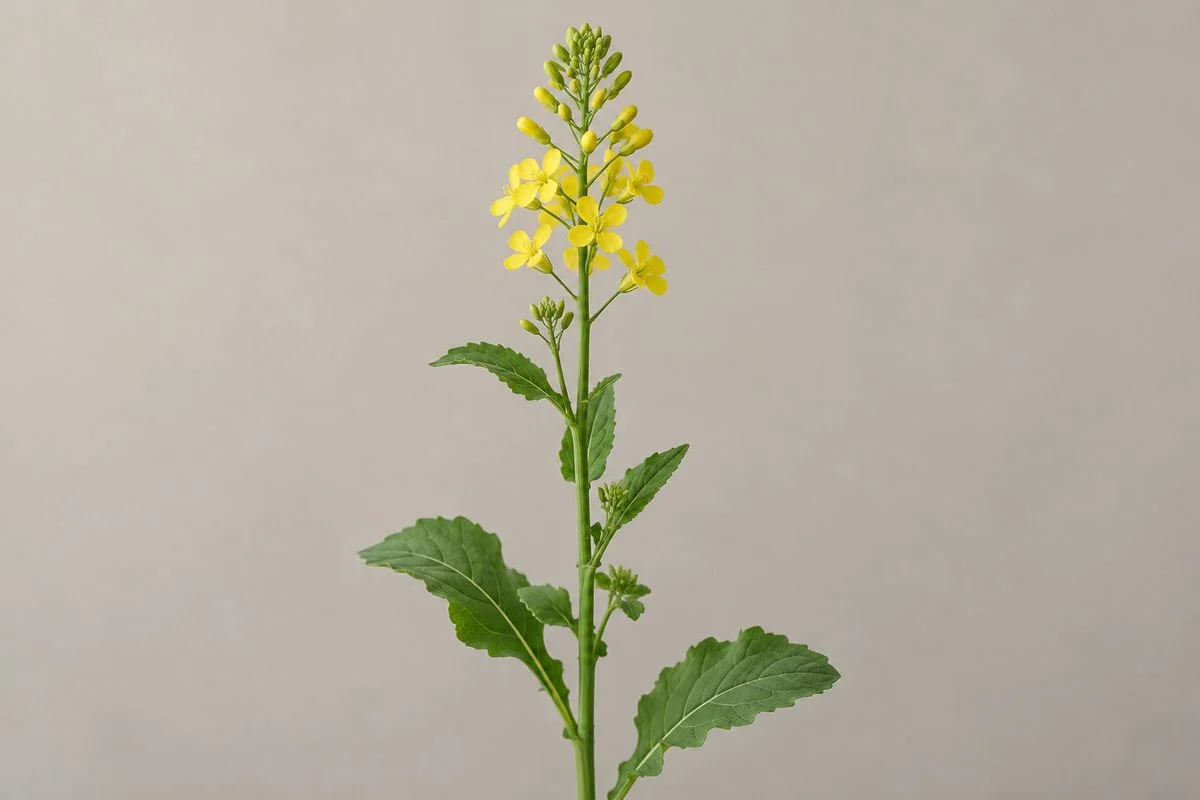
Mustard shoot with leafy nodes below open flowers and younger upper buds.

3. Phyllotaxy and Inflorescence

Leaf attachment and flower arrangement describe different parts of a shoot.

Show
Follow one flowering mustard shoot upwards. Count leaves at each node, then locate open flowers and younger buds.
Ask
Where would you expect the next younger buds: above or below the open flowers?
Say
You would expect younger buds above the open flowers. One leaf at each node gives alternate phyllotaxy.
Used in
Recognising developing buds helps gardeners preserve future flowers while trimming shoots.
If your child says…“Lots of flowers means the cluster is racemose.”
Ask
Does counting flowers tell you whether the main tip has become a flower?
What’s true
Both types can carry several flowers, so inspect the main tip and flowering order.

Flower parts and their positions

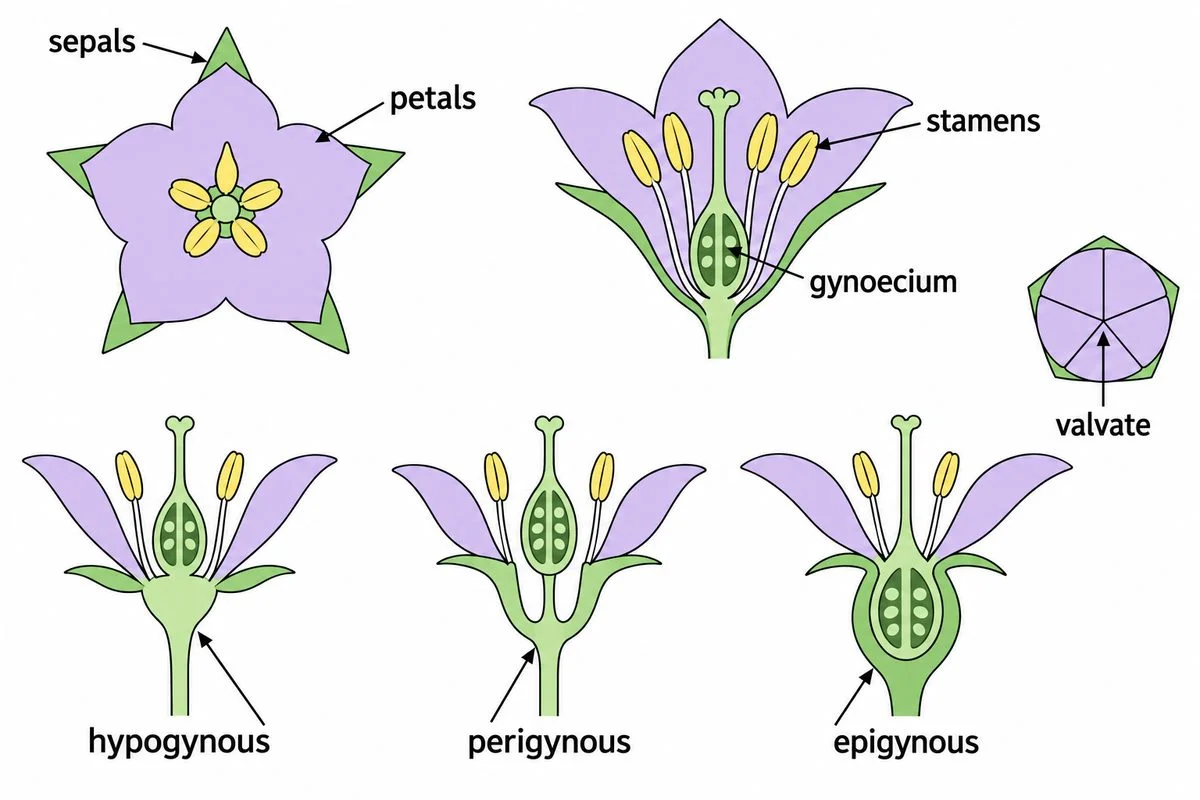
Flower views showing floral whorls, ovary attachment levels and touching petal edges inside a bud.

4. The Flower: Whorls, Ovary Position and Aestivation

Different views reveal flower parts and their positions.

Show
Read the diagram’s whorls, attachment sections, then bud inset.
Ask
Would overlapping bud edges still count as valvate?
Say
Sections show attachments below, around or above the ovary. This flower has both reproductive whorls, making it bisexual. No, valvate bud edges touch without overlapping.
Used in
Sepals protect developing buds.
If your child says…“Valvate petals can overlap.”
Ask
Does touching require covering?
What’s true
Overlap rules out valvate aestivation.
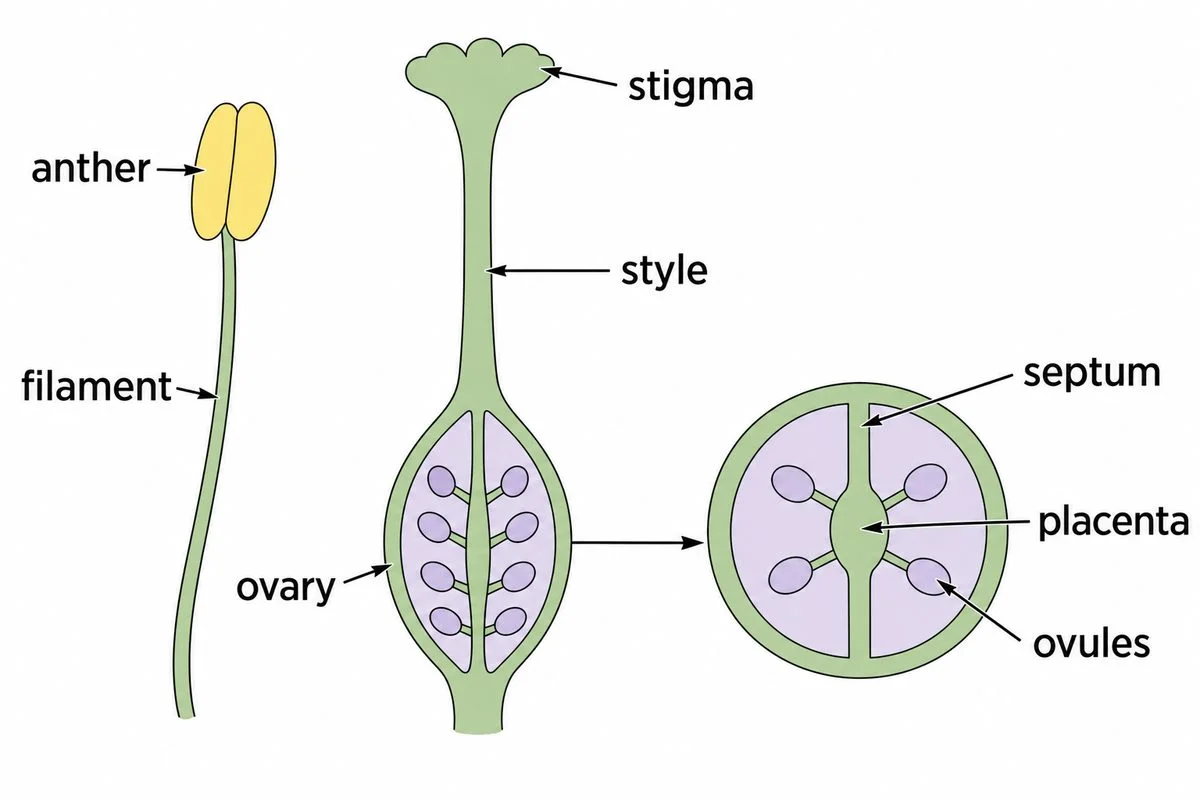
Stamen and pistil beside an enlarged ovary section showing partitions and centrally attached ovules.

5. Androecium, Gynoecium and Placentation

Flower organs produce pollen, receive it and contain arranged ovules.

Show
Trace the diagram’s stamen, pistil, then enlarged ovary.
Ask
Without partitions, would these central ovules indicate axile placentation?
Say
No, axile placentation needs central attachment and partitions.
Used in
Plant breeders place selected pollen on stigmas to control crosses.
If your child says…“Central ovules always mean axile.”
Ask
What separates these chambers?
What’s true
Central attachment without partitions is free-central.

Fruits, seeds and plant identification

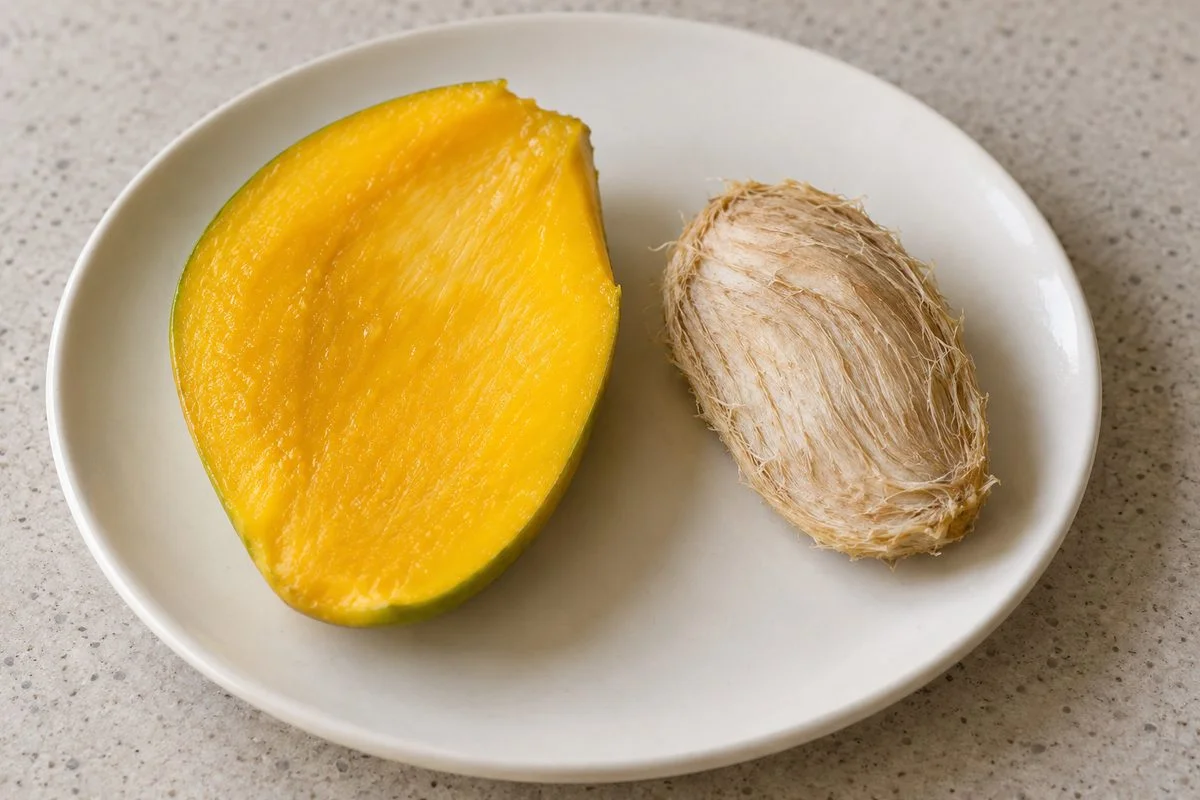
Opened mango with its skin, flesh and hard stone visible on a plate.

6. The Fruit

The pericarp is the whole fruit wall surrounding the seeds.

Show
An adult opens a mango with a knife. Trace its skin, flesh and hard stone around the enclosed seed.
Ask
Would removing the flesh remove the whole fruit wall?
Say
Removing the flesh would not remove the whole fruit wall. Skin, flesh and stone form the epicarp, mesocarp and endocarp: together, the pericarp.
Used in
A mango’s hard inner fruit wall protects its enclosed seed.
If your child says…“The mesocarp is the whole fruit wall.”
Ask
After the flesh is removed, which fruit-wall layers remain?
What’s true
Mesocarp names the middle layer, while pericarp includes all the fruit-wall layers.
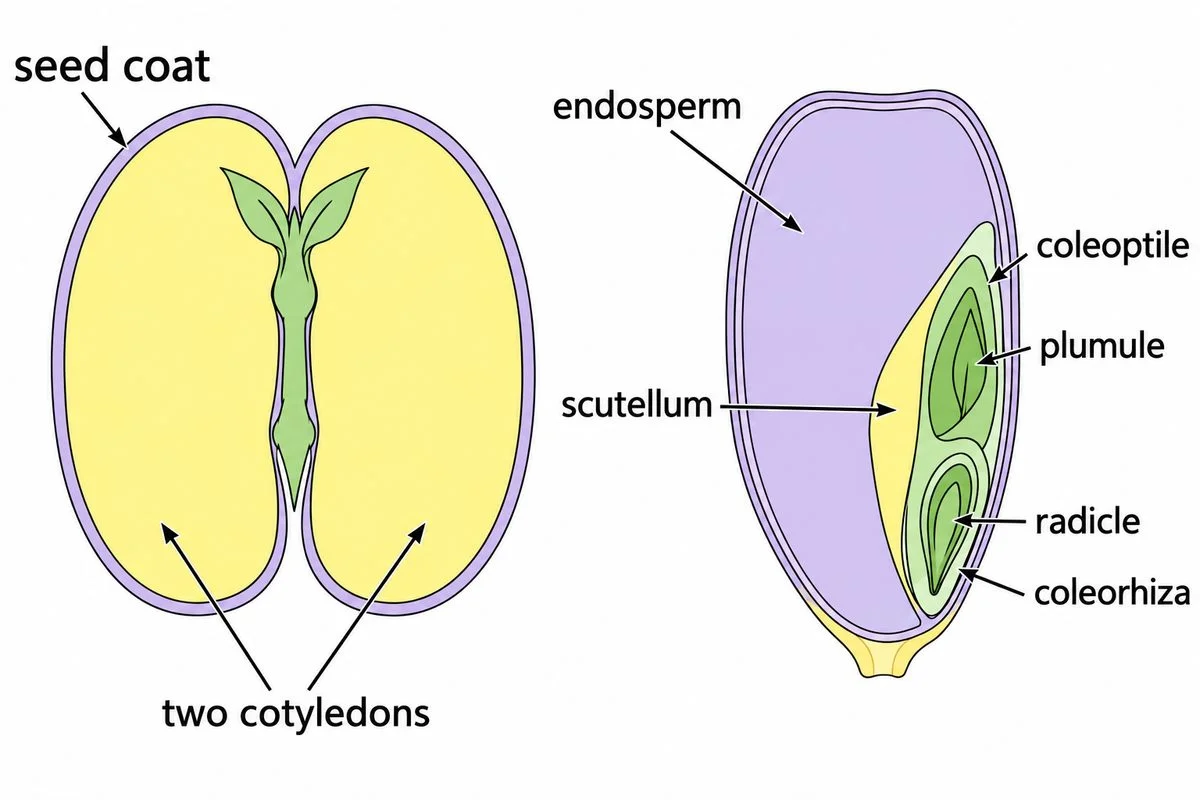
Rajma and maize sections comparing cotyledons, stored food, young shoots and roots.

7. Dicotyledonous and Monocotyledonous Seeds

Dicot embryos have two cotyledons; monocot embryos have one.

Show
Compare cotyledons and food stores in the seed diagram.
Ask
Would retaining only embryos retain both main food stores?
Say
Only rajma’s would: its two cotyledons store food. Maize’s single cotyledon, the scutellum, lies beside endosperm.
Used in
Stored seed food supports early growth.
If your child says…“The endosperm’s covering is its cotyledon.”
Ask
Which part lies beside the young root?
What’s true
Aleurone belongs to endosperm; scutellum belongs to the embryo.
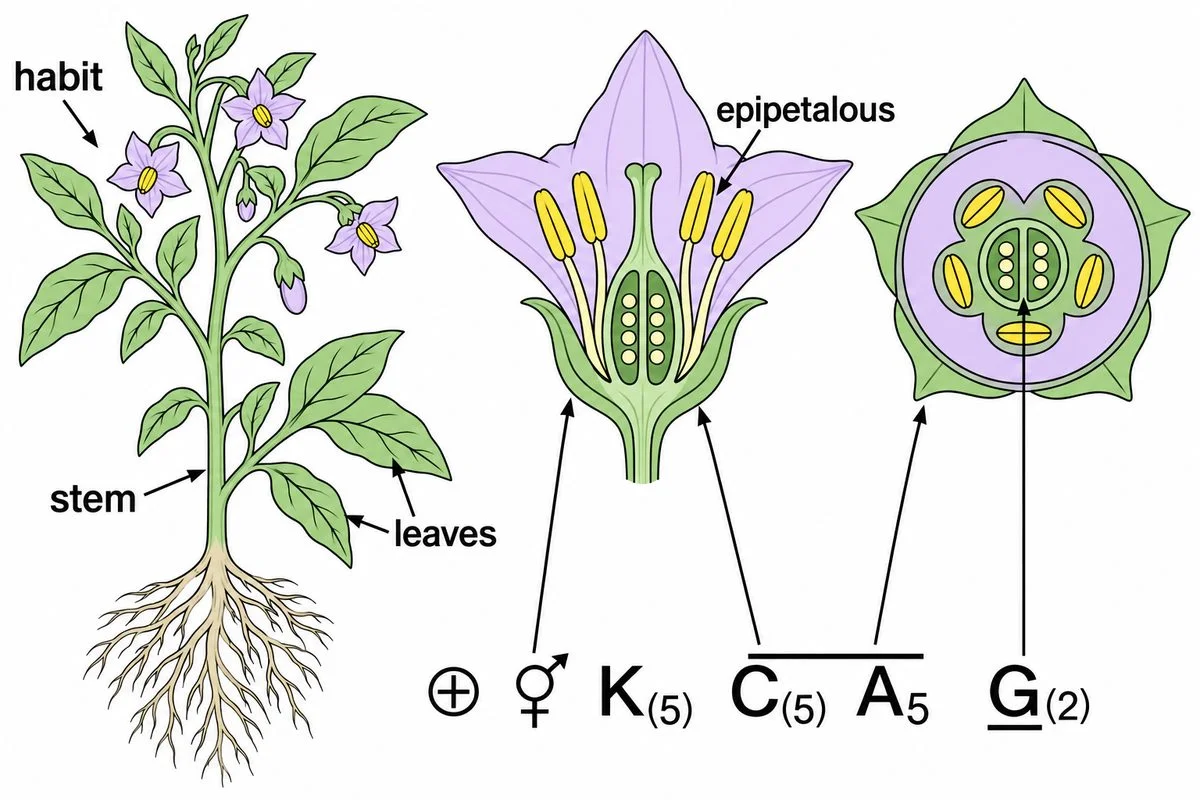
Brinjal plant and flower views linked to symbols recording floral structure.

8. Semi-technical Description of a Typical Flowering Plant: Solanaceae

Descriptions and flower symbols record features used to identify families.

Show
Trace the diagram’s plant, flower, then matching formula symbols.
Ask
Would counts alone describe this flower?
Say
No, they miss joining and position. Brackets show fusion, the C–A link shows attachment, and underlined G marks a superior ovary.
Used in
Structural comparisons help growers identify plants.
If your child says…“Formulas only count parts.”
Ask
What do the petal brackets add?
What’s true
Symbols also describe relationships.

A real problem

Locating flower organs made deliberate vanilla pollination possible.

Vanilla grown in French and English botanical gardens failed to produce seeds.

Edmond Albius developed an efficient hand-pollination method in 1841.

He lifted a floral barrier with bamboo, then pressed the anther against the stigma, transferring pollen.

Smithsonian MagazineRoyal Botanic Gardens, KewSmithsonian NMAAHC

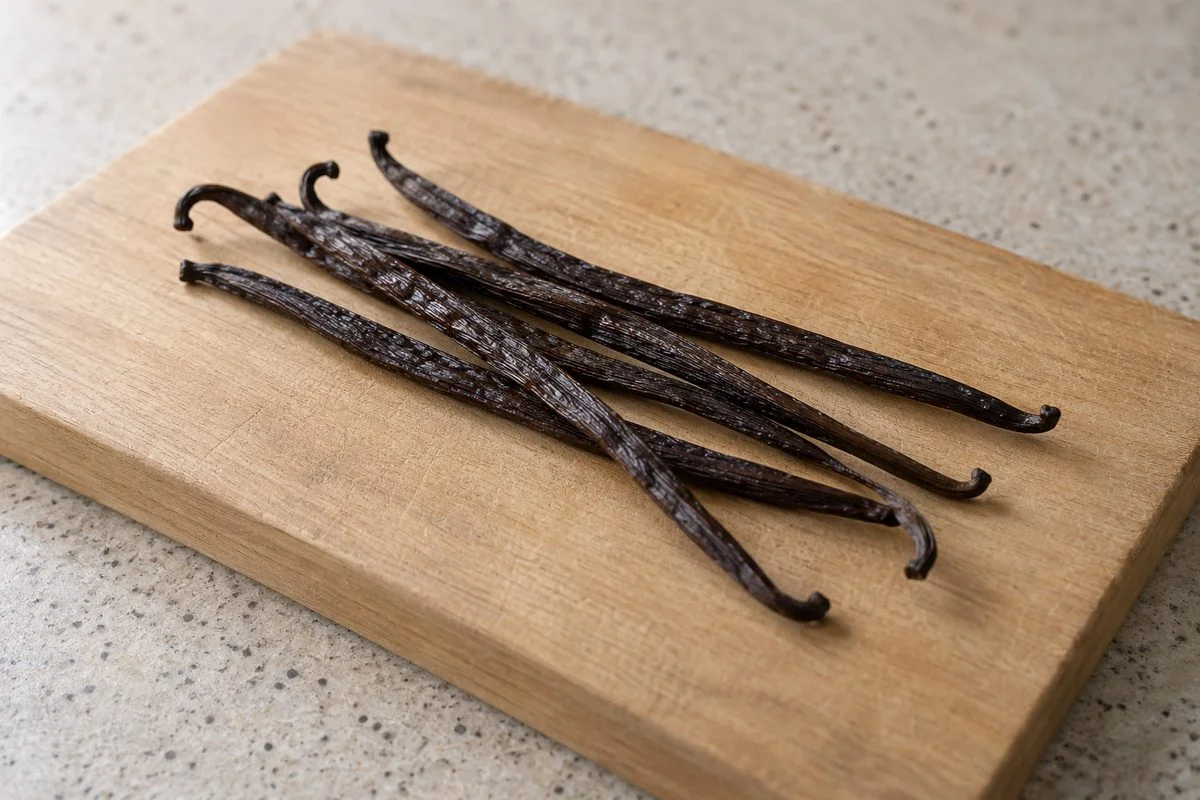
Dried vanilla pods resting on a plain kitchen chopping board.

Concept Lab · Common misconception

The tempting mistake in Structural Organisation in Plants and Animals

Open standalone misconception page →

Do roots only absorb water?

Wrong

A root can only take up water and minerals.

Why it feels right. That is its most familiar job.

Right

Roots can be modified for storage or other functions.

Worked example

The thickened part of the carrot below the leaves is a root that stores reserves.
  1. A carrot has a thickened storage root.
  2. It retains root identity even though it stores reserves.

Ask your child eight quick questions.

One per step. The answer and the reason are given.

  1. Which region supplies the root hairs protected during transplanting?

    The maturation region. Its specialised surface cells form hairs that absorb water and minerals.

  2. Several neem leaflets share one stalk, with a bud beside its attachment to the stem. How many whole leaves is that?

    One whole leaf. The bud sits beside the whole leaf’s attachment, not each leaflet.

  3. What happens to the main tip in a cymose cluster?

    It ends in a flower. The terminal flower limits further growth of that main axis.

  4. What rules out valvate aestivation when neighbouring petal edges touch?

    Their edges overlap. Valvate edges meet without covering one another.

  5. What distinguishes axile from free-central attachment when both have central ovules?

    Partitions dividing the ovary. Axile ovaries have separate chambers; free-central ovaries lack these partitions.

  6. What collective name includes mango skin, flesh and the hard stone?

    Pericarp. The flesh alone is mesocarp, only the middle fruit-wall layer.

  7. Which maize part corresponds to one rajma cotyledon?

    The scutellum. It is maize’s single seed leaf, whereas aleurone belongs to the endosperm.

  8. What do the brackets around the petal count add beyond the number?

    The petals are joined. A floral formula records relationships between parts as well as their counts.

15 more questions with answers, 15 with pictures