Skip to content

Teach Biomolecules in eight steps.

For each idea: show it, ask before you tell, then say one line.

Gather paper and a pencil.

Common misconceptions & worked visual for this chapter · 15 practice questions with answers

How to teach it

What living things contain

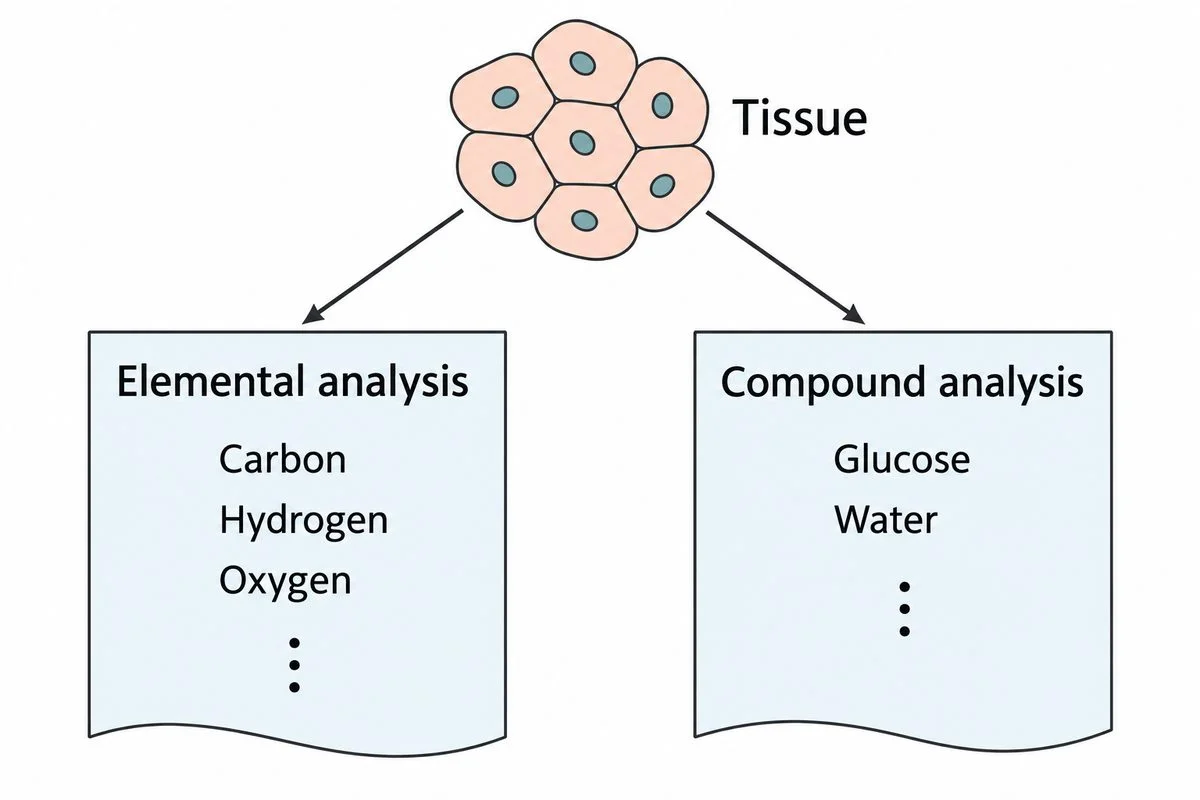
One tissue sample branches into reports identifying elements and compounds.

1. How to Analyse Chemical Composition?

Elemental analysis identifies elements; compound analysis identifies the substances containing them.

Show
Look at the diagram. Follow the arrows from the tissue to its two analysis reports.
Ask
Would finding carbon, hydrogen and oxygen alone tell us whether glucose is present?
Say
No. Different compounds can contain the same elements. Compound analysis identifies which substances are present.
Used in
Food analysis identifies nutrients, helping people compare foods.
If your child says…“Finding these elements tells us which molecules are there.”
Ask
Could these elements belong to compounds other than glucose?
What’s true
The same elements can combine into different compounds.
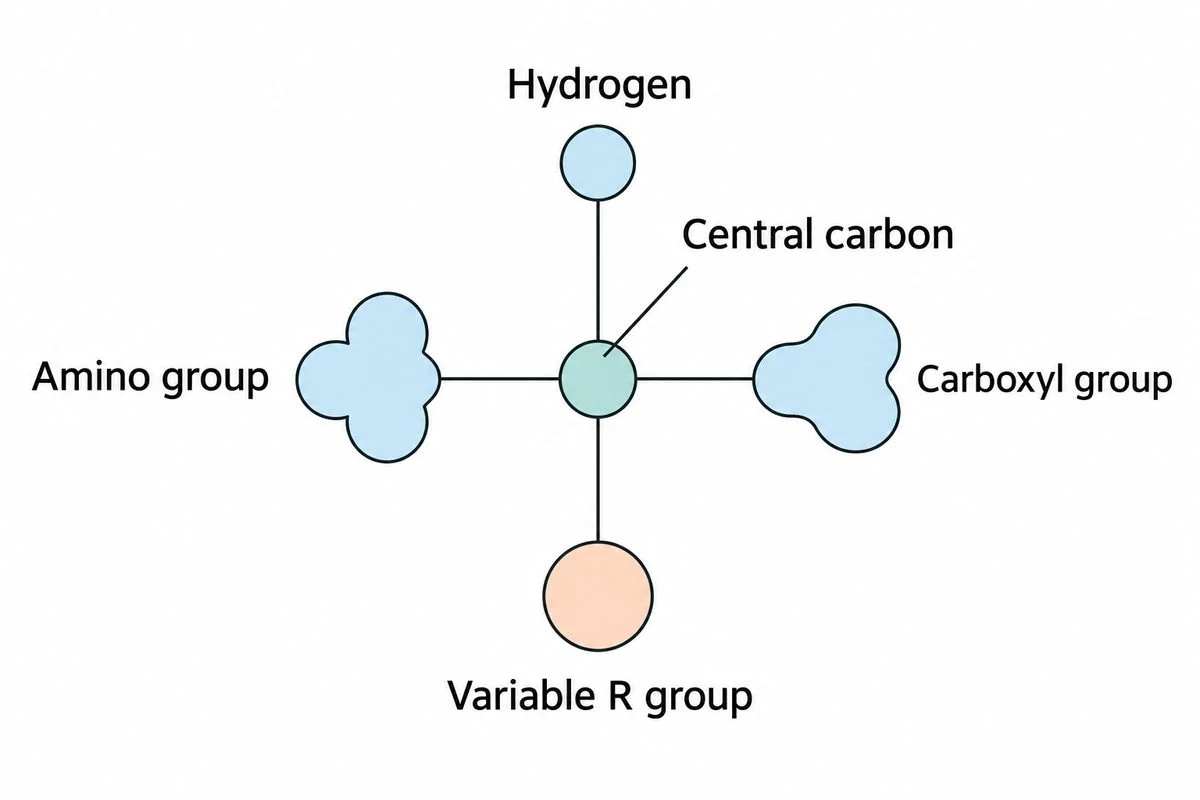
An amino acid's central carbon with four labelled attachments, highlighting the variable R group.

2. Amino Acids, Sugars and Lipids

Small molecules include protein building blocks, sugars and fats.

Show
Find the central carbon and its four attachments in the diagram. Identify the variable R group.
Ask
Which attachment would change in another amino acid?
Say
In this amino-acid diagram, R distinguishes amino acids.
Used in
Cooking oils supply fatty acids needed for making cell membranes.
If your child says…“The amino group is the part called R.”
Ask
Which attachment is labelled separately from the amino and carboxyl groups?
What’s true
The amino and carboxyl groups are shared features, while R is the variable attachment.
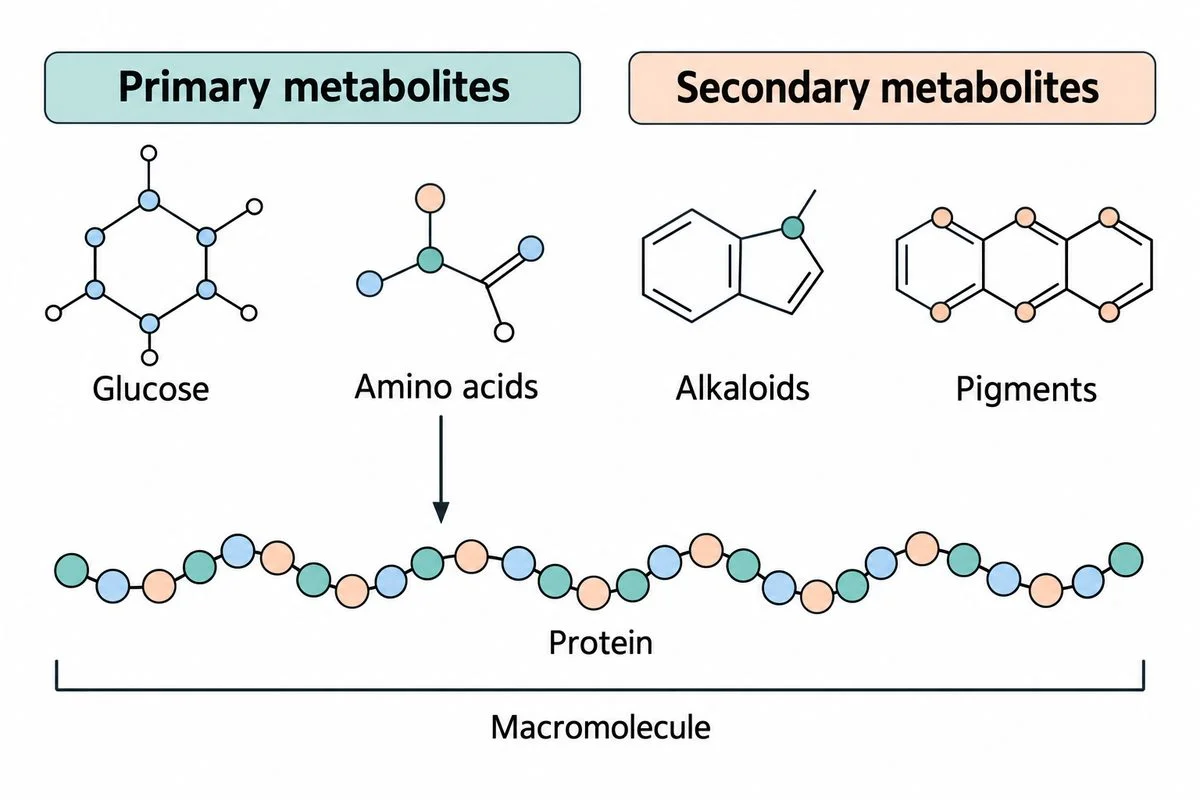
Metabolite categories beside amino acids joining into a large protein chain.

3. Primary and Secondary Metabolites; Biomacromolecules

Metabolite categories describe roles; macromolecules are large molecules.

Show
Look at the diagram. Compare the two metabolite columns, then follow amino acids into the protein chain.
Ask
What might happen to a plant's colour if it stopped making these pigments?
Say
The plant's colour might change. Primary metabolites support basic cell processes; secondary metabolites can help with defence or colour. Amino acids join into proteins, which are macromolecules because they are large. The diagram groups substances by role and molecular size.
Used in
Plant fragrances scent soaps, making them pleasant to use.
If your child says…“Secondary metabolites are useless waste.”
Ask
Would a substance that helps defend a plant count as useless waste?
What’s true
Secondary metabolites can support defence and other ecological roles, although some roles remain unknown.

Large biological molecules

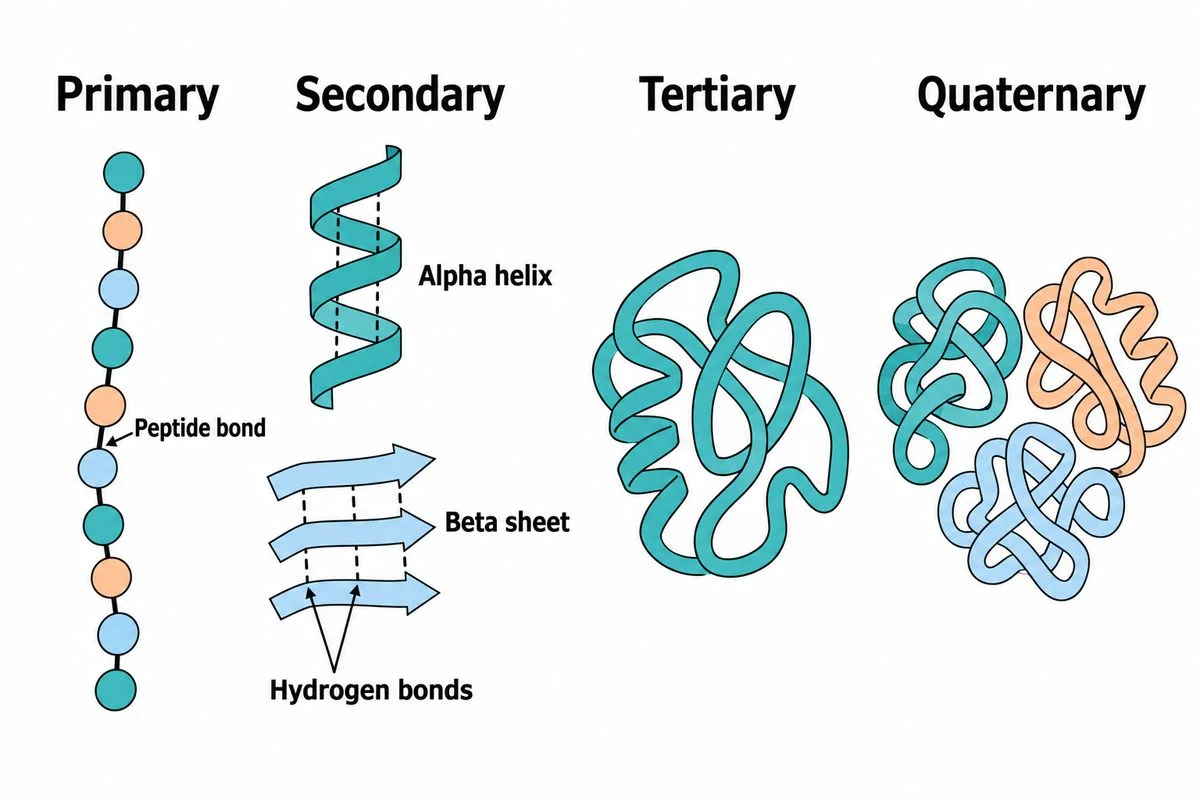
Protein sequence, local folds, one folded chain and an assembly of chains.

4. Proteins and Structure of Proteins

Amino-acid chains fold into shapes suited to different jobs.

Show
Read the diagram from sequence to local folds, then compare one chain with several.
Ask
Could changing amino-acid order change the shape?
Say
Yes; order influences folding. Primary means sequence, secondary means local folds, and tertiary means one chain's overall shape. Quaternary requires several chains.
Used in
Antibodies are proteins that help defend against infection.
If your child says…“Every protein has quaternary structure.”
Ask
Where are the additional chains needed for quaternary structure in the single-chain panel?
What’s true
A protein with only one chain has no separate chains to assemble.
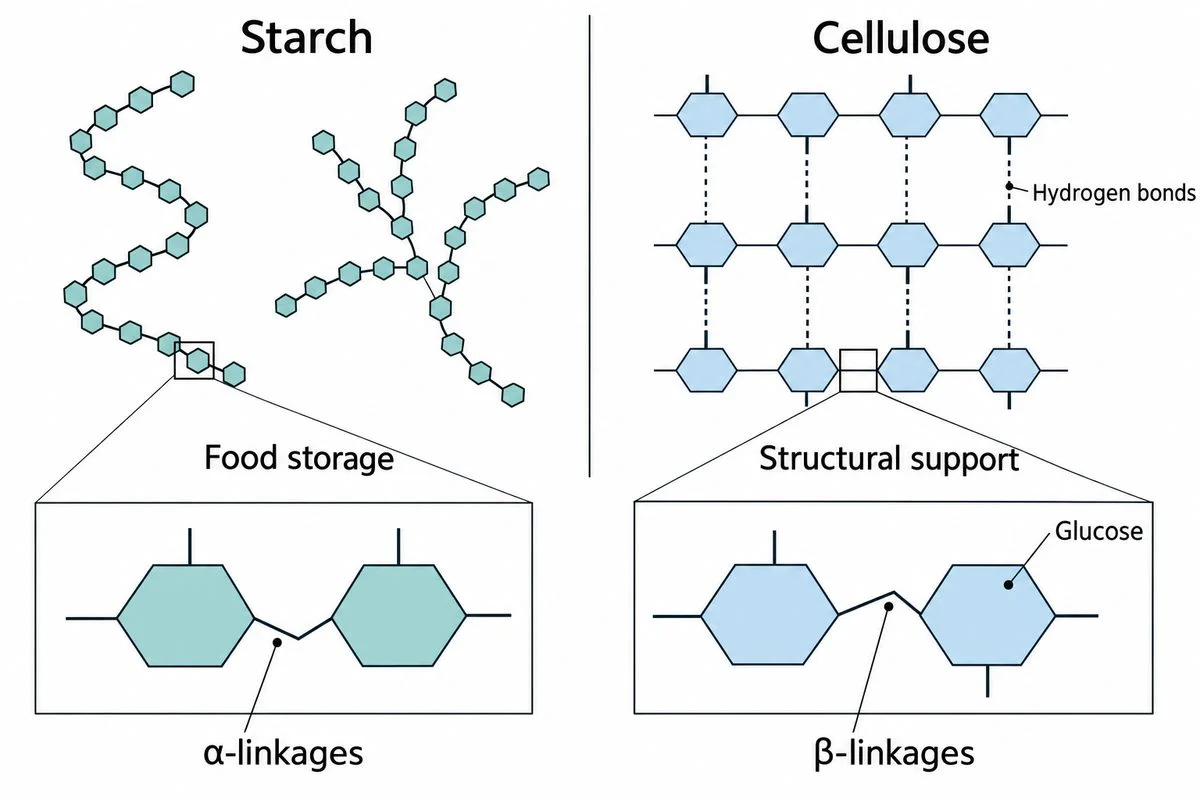
Starch and cellulose contain glucose joined differently into coiled, branched or straight chains.

5. Polysaccharides

Sugar chains store food or provide support through different arrangements.

Show
Look at the diagram. Find glucose in both materials, then compare their links and chain arrangements.
Ask
Would joining the same glucose units differently change what these chains can do?
Say
Their glucose units join differently, giving the chains different arrangements. Starch stores food; cellulose's straight chains form supporting fibres.
Used in
Cotton's cellulose fibres make strong threads for clothing.
If your child says…“Starch and cellulose must have different sugar building blocks.”
Ask
Could changing the links change a chain without changing its building blocks?
What’s true
Different links between glucose units give starch and cellulose different properties.
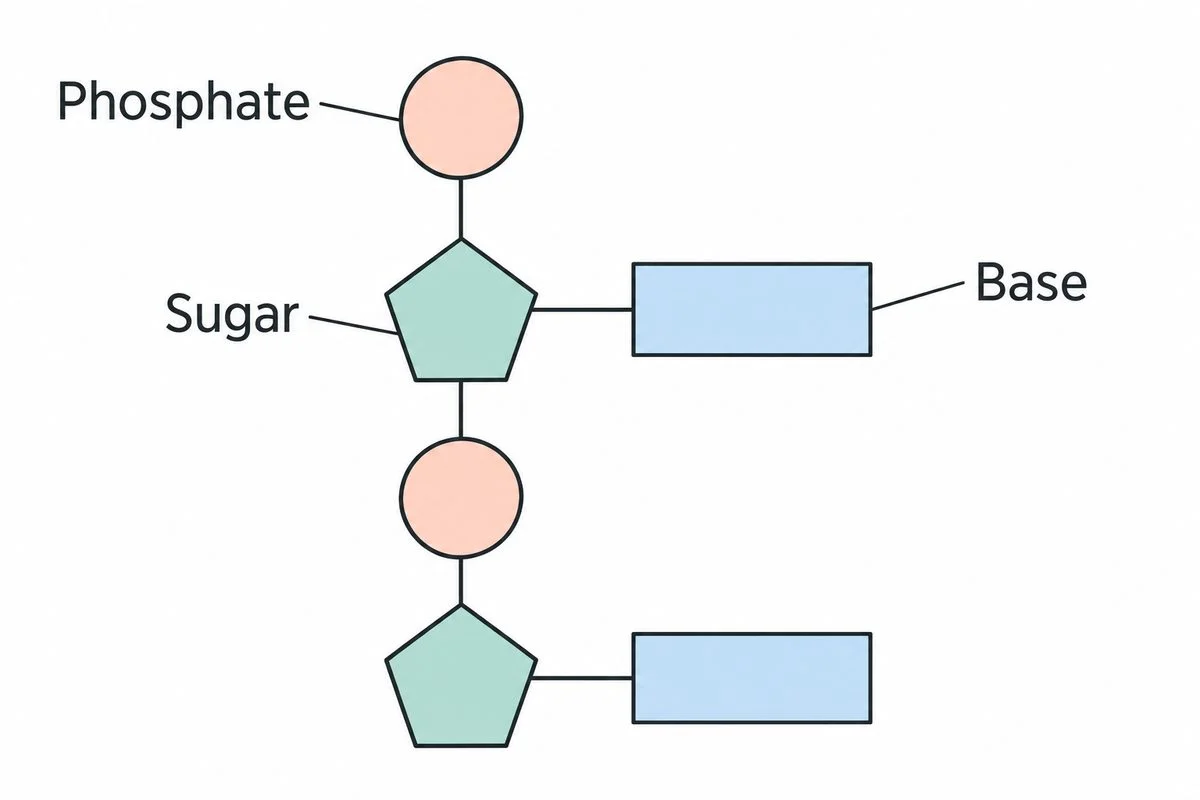
Labelled phosphate circles link sugar pentagons, each attached to a base rectangle.

6. Nucleic Acids

DNA and RNA are chains of sugar–phosphate–base units.

Show
Find the phosphate circles, sugar pentagons and base rectangles in the diagram. Cover the middle phosphate and its connections; look at the bottom sugar–base pair.
Ask
What building unit will form when we restore phosphate to the sugar?
Say
Sugar with base is a nucleoside; adding phosphate makes a nucleotide.
Used in
DNA comparisons help identify biological relationships.
If your child says…“Sugar and base already make a nucleotide.”
Ask
Which component disappears when we cover the phosphate?
What’s true
A nucleotide also needs phosphate attached through its sugar.

How enzymes work

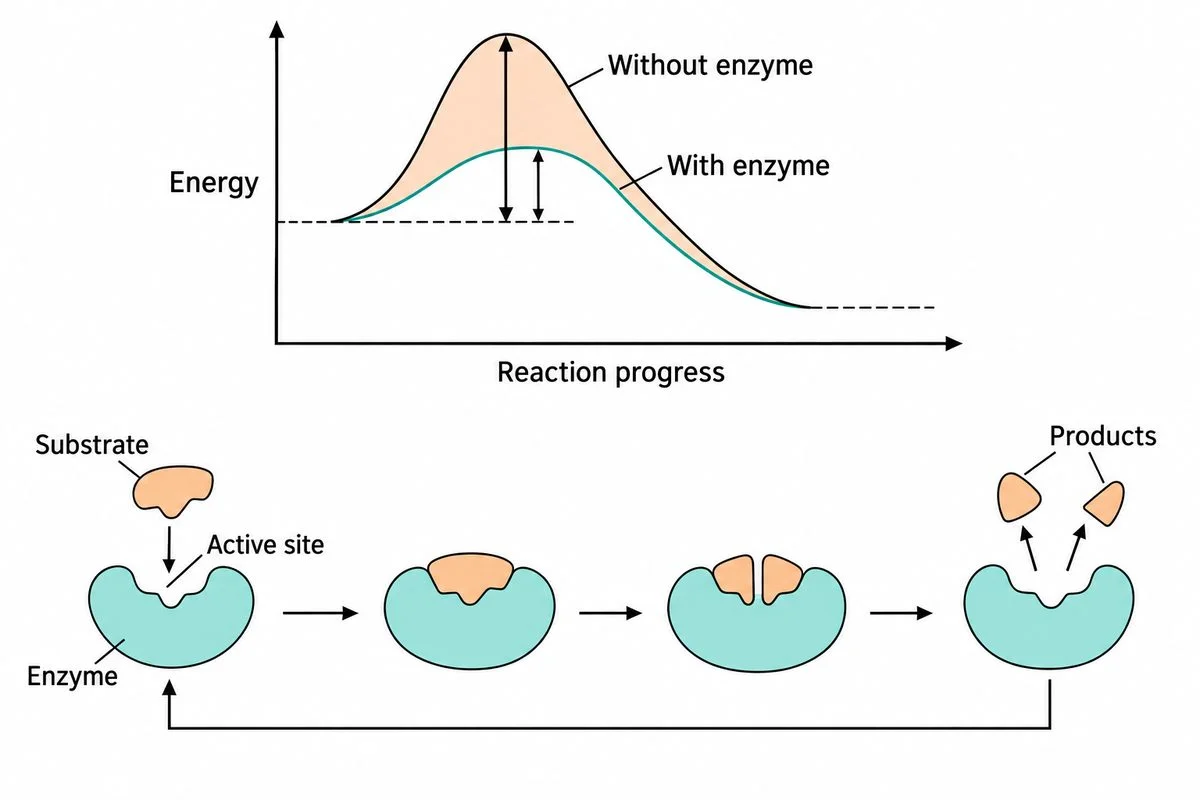
Different energy barriers above an enzyme cycle showing binding, product release and reuse.

7. Enzymes: Chemical Reactions and Mechanism of Enzyme Action

Enzymes lower reaction barriers and remain available for another cycle.

Show
Compare the diagram's peaks and endpoints. Follow substrate binding, product release and the return arrow.
Ask
How would the lower barrier affect reaction speed?
Say
Lower activation energy speeds the reaction. Starting and finishing energies stay unchanged. The enzyme binds substrate, releases products and can work again.
Used in
Detergent enzymes break down food stains, helping clean clothes.
If your child says…“An enzyme gets used up when it releases the product.”
Ask
What does the return arrow show happening to the enzyme after products leave?
What’s true
Product release leaves the enzyme available to bind another starting molecule.
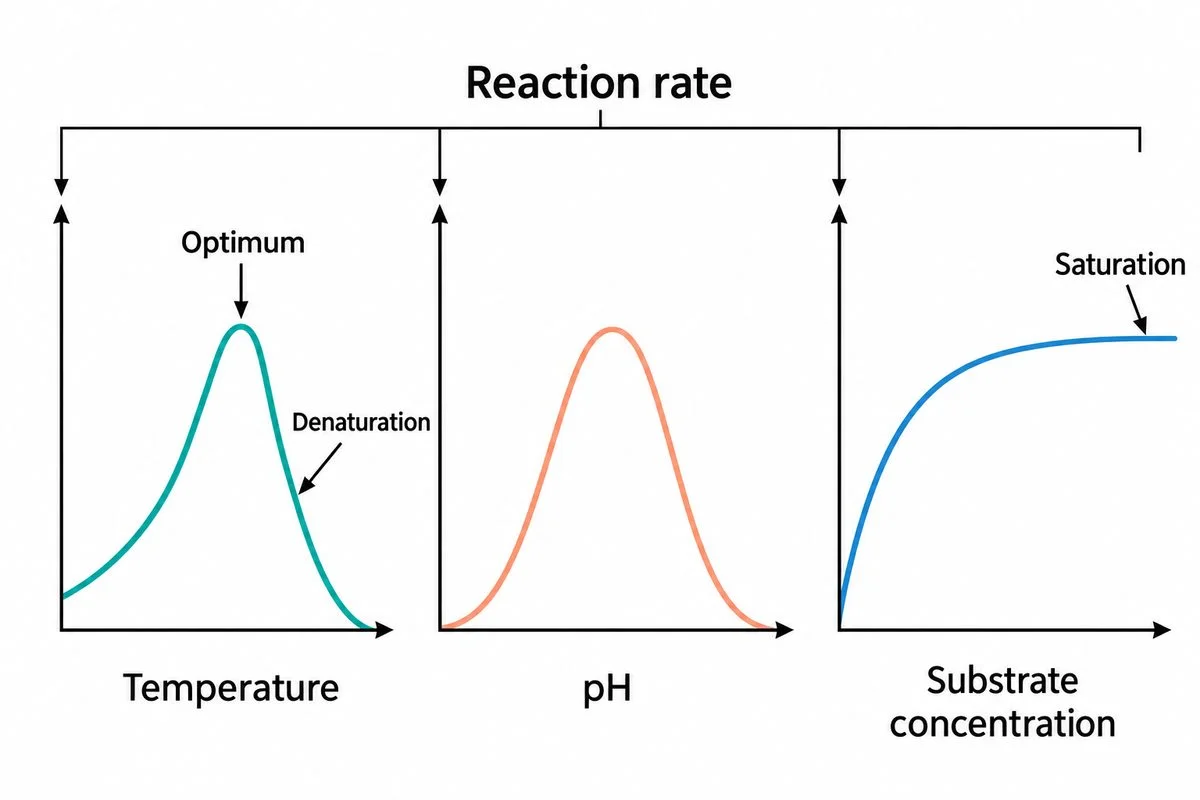
Enzyme activity graphs show temperature and pH peaks and a substrate saturation plateau.

8. Factors Affecting Enzyme Activity; Classification and Cofactors

Conditions and required helpers affect how quickly enzymes work.

Show
Compare the diagram's peaks and plateau; each graph changes one condition.
Ask
Will more substrate always increase speed?
Say
No; enzymes become saturated, while excessive heat can disrupt their shape. Temperature and pH have optima.
Used in
Refrigeration slows enzyme activity, helping food retain its quality longer.
If your child says…“Adding more substrate always makes the reaction faster.”
Ask
When every active site is occupied, where could extra substrate bind immediately?
What’s true
With enzyme amount fixed, extra substrate cannot keep raising the rate once enzymes are saturated.

A real problem

An enzyme electrode helped develop glucose monitoring.

Leland Clark and Champ Lyons invented their pioneering biosensor in 1962.

It used a thin layer of glucose oxidase on an oxygen electrode.

Clark's design underpins devices that help people monitor diabetes.

WikipediaWikipediaAmerican Chemical Society

An unbranded blood-glucose meter beside a test strip on a kitchen table.

Concept Lab · Common misconception

The tempting mistake in Biomolecules

Open standalone misconception page →

Are all enzymes proteins?

Wrong

Every biological catalyst must be a protein.

Why it feels right. Protein enzymes are the examples I encounter first.

Right

Some RNA molecules also catalyse reactions.

Worked example

Peptide bond
Growing peptide + next amino acid→Ribosomal RNA catalytic centre→Peptide chain extends
The ribosome's rRNA-containing catalytic centre helps form the bond between amino acids.
  1. The ribosome’s catalytic centre uses ribosomal RNA in forming peptide bonds.
  2. This shows that RNA can have a catalytic role.

Ask your child eight quick questions.

One per step. The answer and the reason are given.

  1. Which analysis identifies glucose rather than just its elements?

    Compound analysis. An element list does not reveal how those elements combine.

  2. Which attachment distinguishes glycine from alanine?

    The R group. Their amino and carboxyl groups are shared; their R groups differ.

  3. A leaf-eating insect avoids these leaves. What happens to the feeding damage it causes?

    It reduces insect damage. The substance discourages feeding, helping protect the leaves.

  4. Which structural level is absent from a protein containing just one folded chain?

    Quaternary structure. Quaternary structure requires multiple chains arranged together.

  5. What differs between starch and cellulose: their glucose building blocks or their links?

    Their links. Both contain glucose, but different links give their chains different properties.

  6. What is sugar joined to a base called when phosphate is absent?

    A nucleoside. Adding phosphate to the sugar makes it a nucleotide.

  7. What can the enzyme do after releasing its products?

    Bind another substrate. The enzyme remains available rather than being consumed during the reaction.

  8. Why does extra substrate barely change the rate near the plateau?

    The enzymes are saturated. Nearly all active sites are occupied, so extra substrate must wait.

15 more questions with answers, 10 with pictures