Skip to content

Teach Respiration in Plants in eight steps.

For each idea: show it, ask before you tell, then say one line.

Gather moong sprouts, a plain plate, paper and a pencil.

Common misconceptions & worked visual for this chapter · 15 practice questions with answers

How to teach it

Releasing energy from food

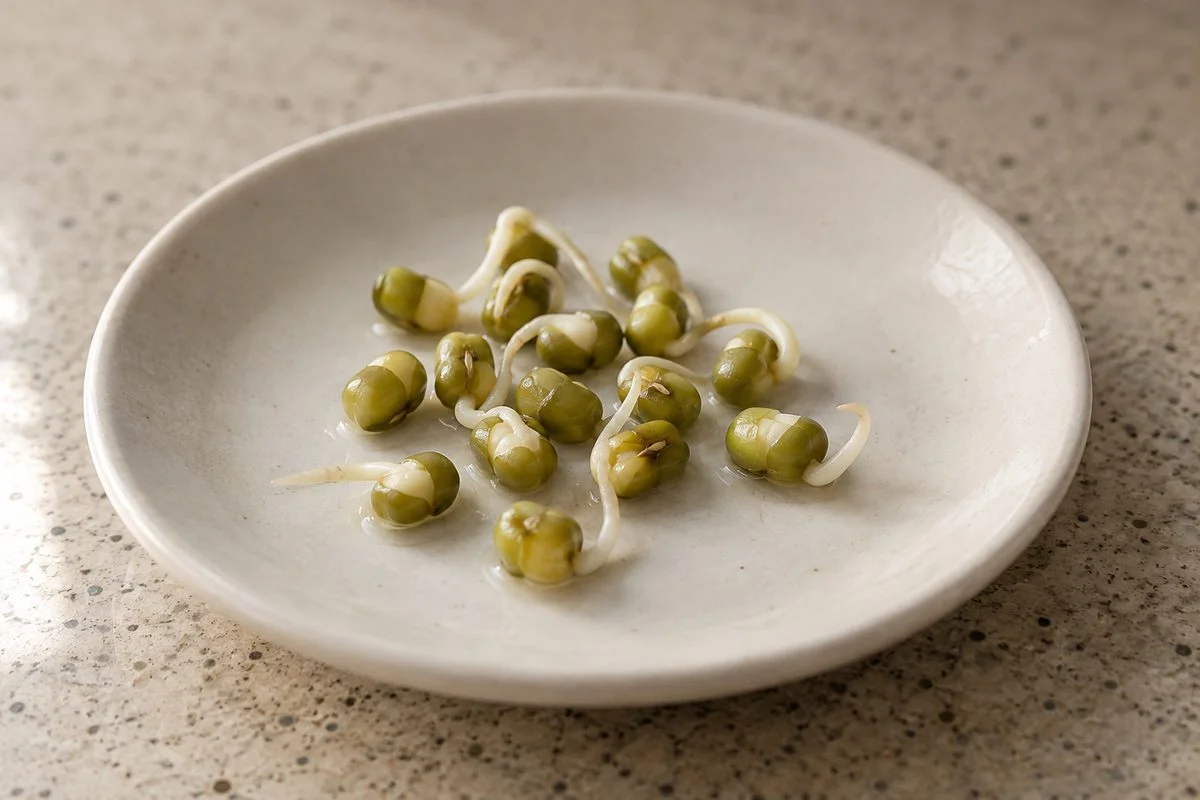
Moong sprouts with pale roots on a plain plate.

1. Do Plants Breathe?

Living plant cells release food energy and exchange gases locally.

Show
Place kitchen-grown moong sprouts on a plate. Point to their pale roots.
Ask
What will power further root growth before green leaves appear?
Say
These pale roots use food stored in the seed.
Used in
Draining waterlogged pots restores air spaces, helping roots respire.
If your child says…“Only green plant cells respire.”
Ask
What supplies energy to these growing roots without green leaves?
What’s true
Living root cells also release energy from food.
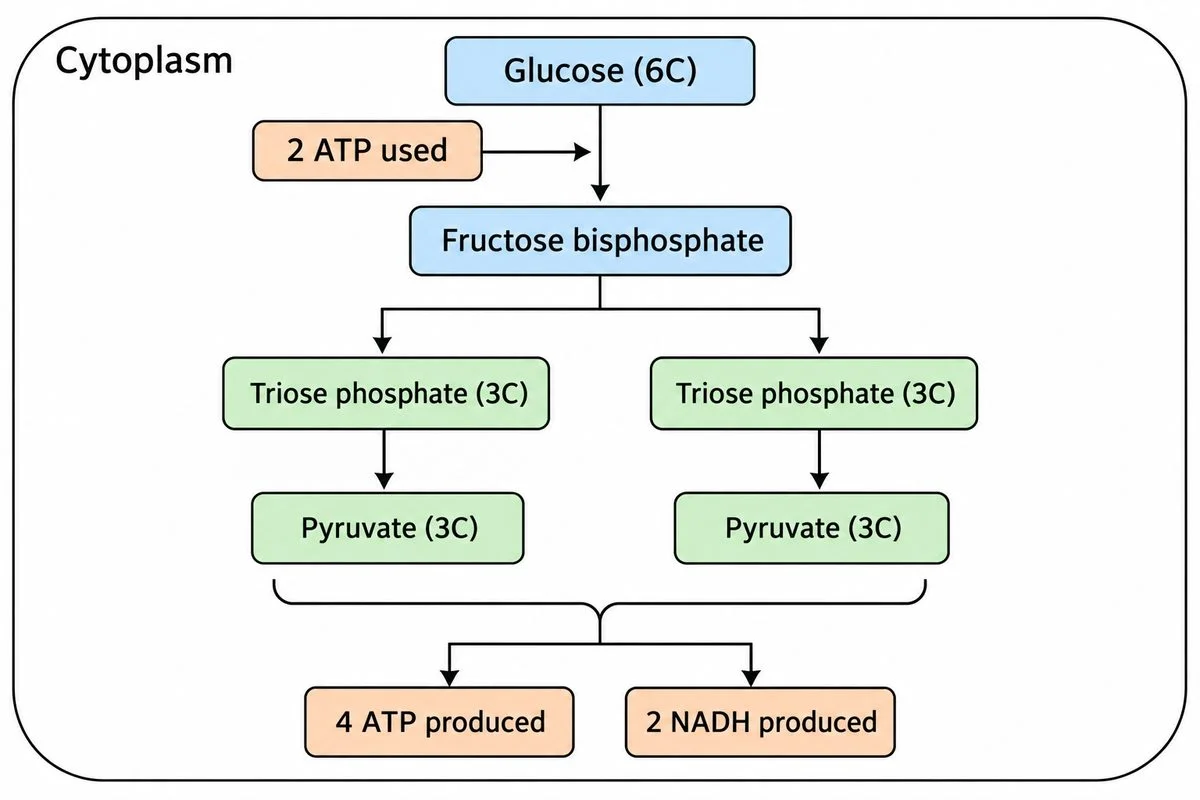
Glycolysis diagram showing two pyruvate branches, ATP investment, and combined ATP and NADH outputs.

2. Glycolysis

Glucose splits into two pyruvates, with a net ATP gain.

Show
Look at the diagram. Follow glucose through both branches to pyruvate. Compare ATP used before the split with ATP produced afterwards.
Ask
How much ATP will remain after these branches repay the ATP used at the start?
Say
Two ATP remain after subtracting the two used from the four produced. Both branches end as pyruvate.
Used in
Muscle cells can keep making some ATP when oxygen becomes scarce.
If your child says…“Four ATP are produced, so four are gained.”
Ask
If two ATP were spent first, how many of the four are extra?
What’s true
The net gain subtracts the ATP spent earlier.
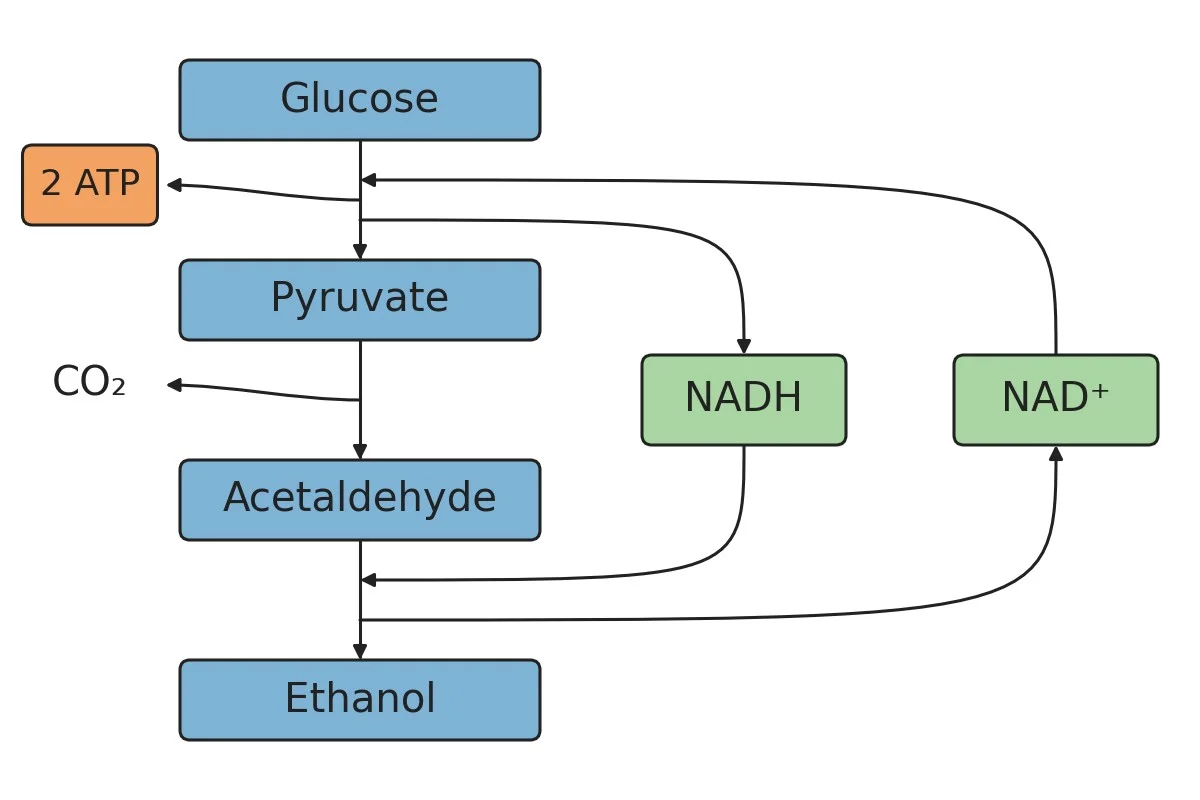
Yeast fermentation pathway showing carbon dioxide release and the carrier loop that sustains glycolysis.

3. Fermentation

Fermentation partly breaks down glucose, restoring NAD⁺ so glycolysis can continue.

Show
Look at the yeast diagram. Follow glucose through pyruvate and acetaldehyde to ethanol, noting where carbon dioxide leaves. Trace the carrier loop back to glycolysis.
Ask
Without oxygen, how could yeast keep glycolysis running when its NAD⁺ starts running out?
Say
Making ethanol restores NAD⁺, so glycolysis can continue without oxygen.
Used in
Yeast fermentation produces ethanol used in fuel blends.
If your child says…“Making alcohol or lactate adds more ATP.”
Ask
If this conversion restores a carrier, where were the two ATP actually made?
What’s true
These conversions restore NAD+ from NADH without making additional ATP.

Energy capture in mitochondria

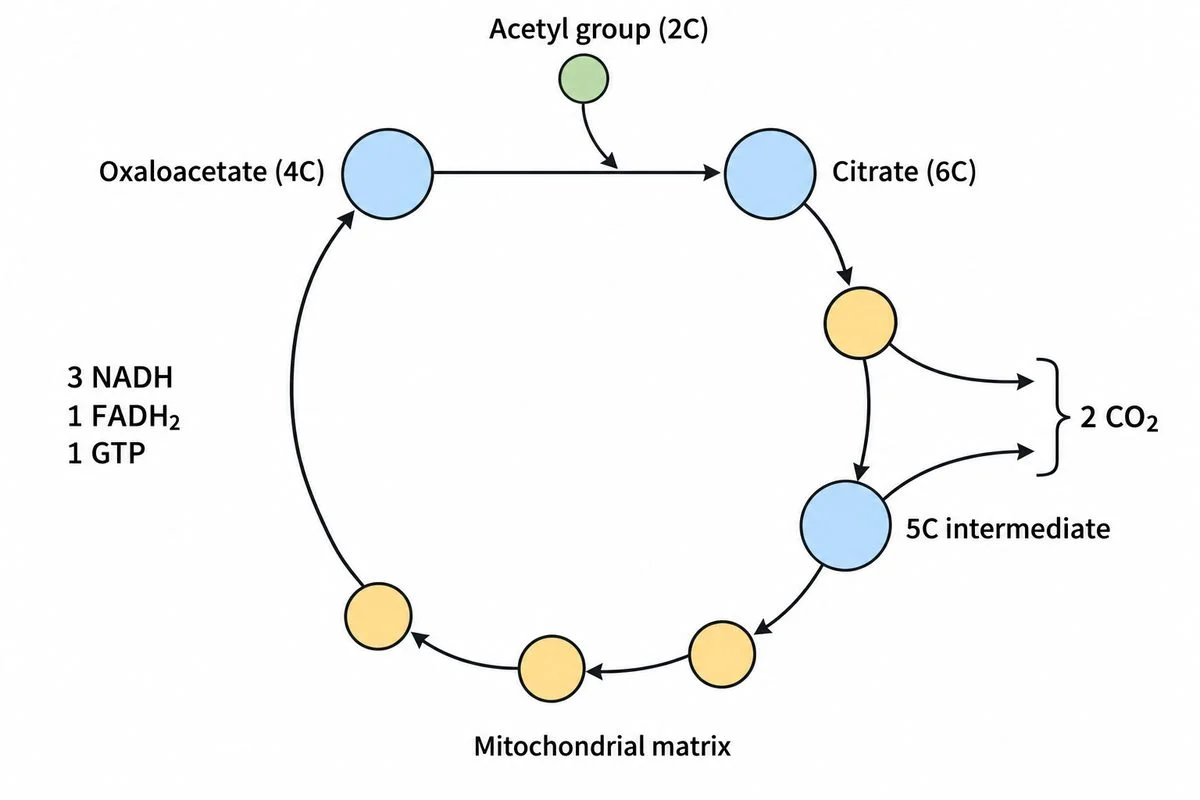
Cycle diagram showing acetyl entry, oxaloacetate regeneration, carbon dioxide release and outputs per turn.

4. Tricarboxylic Acid Cycle

Acetyl groups enter a cycle that restores its starting acceptor.

Show
Look at the diagram. Trace acetyl entry, the loop and its outputs.
Ask
What will let this cycle accept another acetyl group after this turn?
Say
The cycle rebuilds oxaloacetate to accept another acetyl group. Each turn produces two carbon dioxide, three NADH, one FADH₂ and one GTP.
Used in
Respiration supplies developing fruits with energy for growth.
If your child says…“The cycle uses up its oxaloacetate.”
Ask
How could this cycle keep turning if its starting acceptor never returned?
What’s true
Later reactions rebuild the oxaloacetate that accepted the acetyl group.
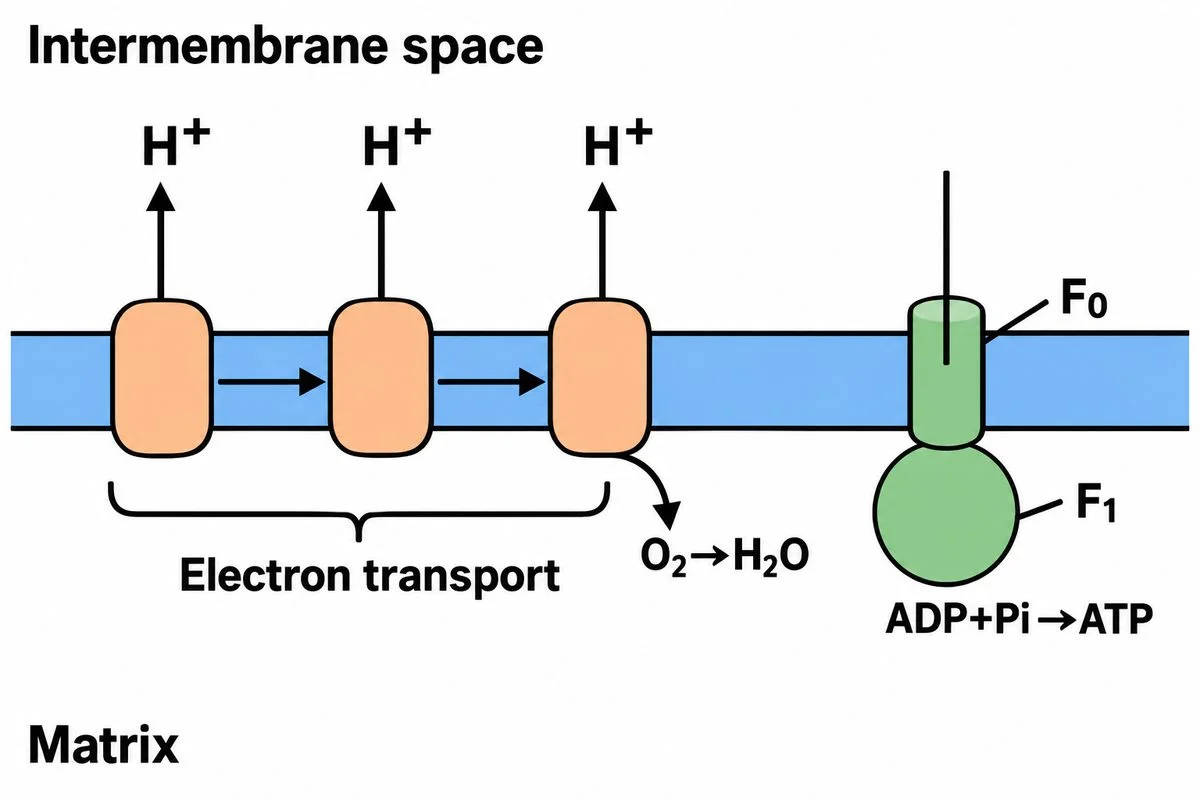
Membrane diagram showing electron routes, proton pumps and ATP synthase.

5. Electron Transport System and Oxidative Phosphorylation

Electron transport builds a proton gradient that drives ATP formation.

Show
Look at the membrane diagram. Find the proton pumps and the compartments above and below. Find the F₀ channel and its F₁ head.
Ask
Which way must protons return through the channel to help make ATP?
Say
Protons return into the matrix through F0, driving ATP production at F1.
Used in
Respiratory ATP powers mineral uptake by root cells, supporting plant growth.
If your child says…“Protons flow out of the matrix to make ATP.”
Ask
If protons were pumped above the membrane, which way would their return point?
What’s true
ATP production uses proton flow from the intermembrane space back into the matrix.

NATP=4+10×3+2×2N_{\mathrm{ATP}}=4+10\times3+2\times2

NATP=4+30+4N_{\mathrm{ATP}}=4+30+4

6. The Respiratory Balance Sheet

The calculated ATP yield depends on simplifying assumptions.

Show
Write these lines. Say, 'N means net ATP equivalents per glucose.' Four are gained directly after subtracting glycolysis's investment. Credit each of ten NADH with three ATP. Credit each of two FADH2 with two.
Ask
What theoretical total belongs on the next line?
Say
The theoretical total is 38 ATP.
Used in
Germinating seeds spend respiratory ATP on growth, so their ATP stores continually change.
If your child says…“Every cell gets exactly 38 ATP from each glucose.”
Ask
Can the same total hold if some fuel leaves before completing the pathway?
What’s true
Diverting pathway materials can change ATP yield per glucose. Using ATP changes how much remains available.

Different fuels and their gas exchange

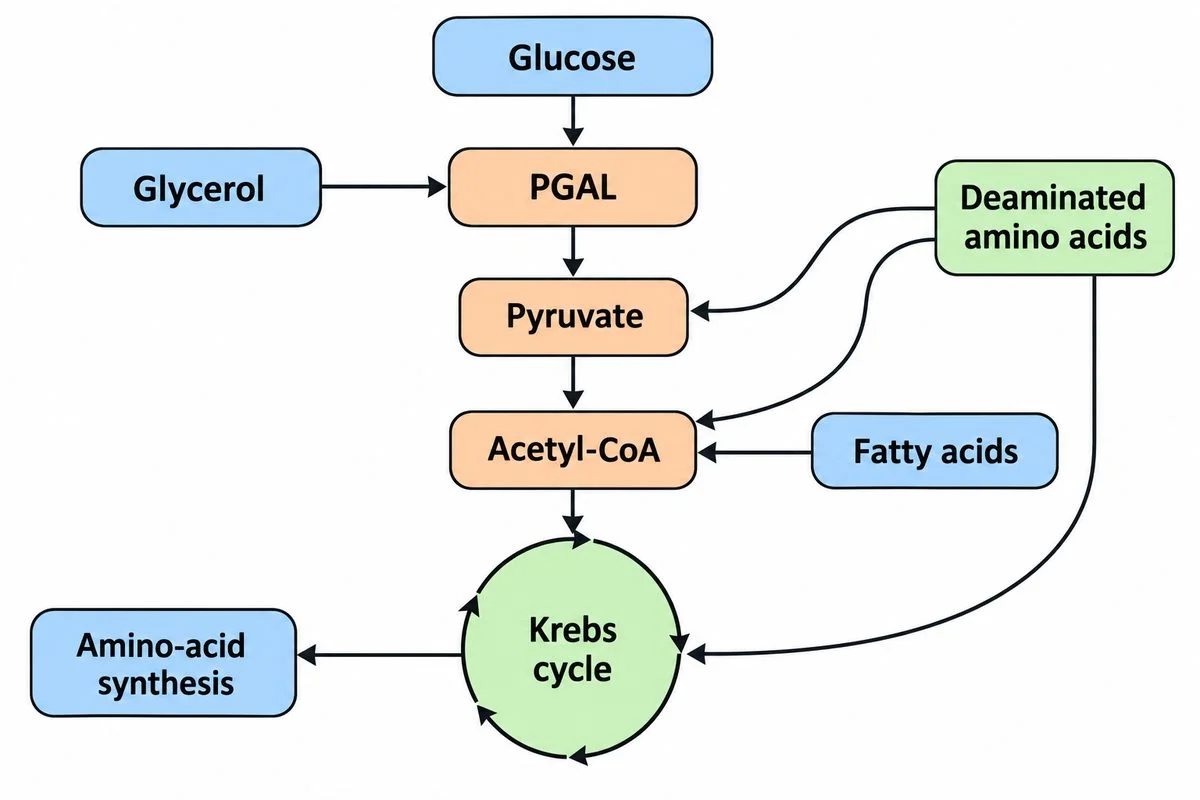
Respiratory pathway diagram showing separate fuel entries and an amino-acid synthesis exit.

7. Amphibolic Pathway

Respiration accepts different fuels and supplies materials for building molecules.

Show
Look at the branching diagram. Trace the fuel entry arrows. Find the exit towards amino-acid synthesis.
Ask
If fatty acids supplied the fuel, where would their breakdown products join this route?
Say
Fatty acids enter through acetyl-CoA, while glycerol enters through PGAL. Respiration also supplies starting materials for building molecules.
Used in
Oil-rich seeds draw on stored fats to fuel early growth.
If your child says…“Every fuel must turn into glucose first.”
Ask
Where does the fatty-acid branch join your route?
What’s true
Fuel breakdown products enter at stages matching their chemical forms.

RQ=VCO2 releasedVO2 consumedRQ=\frac{V_{\mathrm{CO_2\ released}}}{V_{\mathrm{O_2\ consumed}}}

RQ=66RQ=\frac{6}{6}

8. Respiratory Quotient

Released carbon dioxide divided by consumed oxygen gives fuel clues.

Show
Write these lines. Say, 'RQ means respiratory quotient, and V means gas volume.' Divide released carbon dioxide by consumed oxygen. For glucose, use six volumes of each gas at matching temperature and pressure.
Ask
For these equal gas volumes, what RQ would you predict?
Say
RQ is one because the gas volumes are equal.
Used in
Measuring respiratory gases helps investigate fuel use without extracting substances from cells.
If your child says…“I divide oxygen used by carbon dioxide released.”
Ask
Which gas is the output measured per unit of oxygen input?
What’s true
Carbon dioxide output belongs above oxygen input.

A real problem

Controlled-atmosphere storage helps preserve apples.

Kidd and West's respiration research led to the first commercial controlled-atmosphere storage facility in 1929.

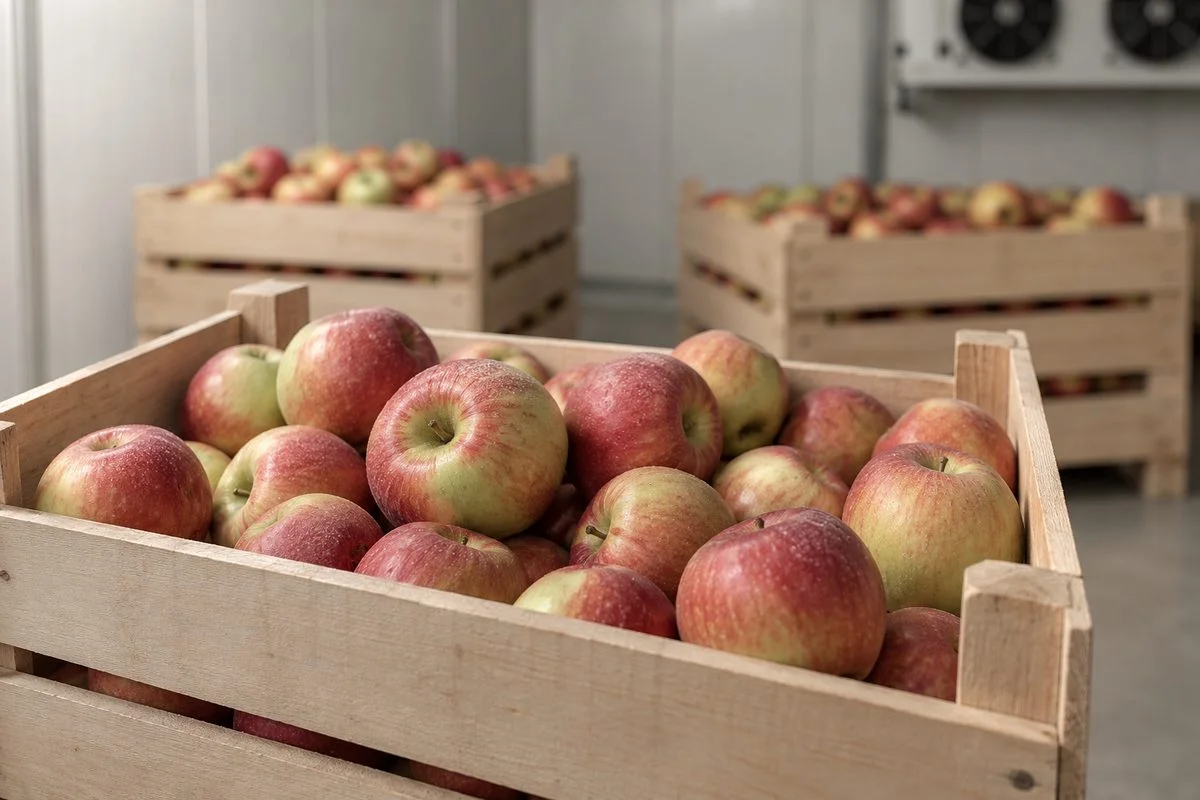
Lower oxygen levels around stored apples slow their respiration.

This storage helps apples stay firmer, crisper and more flavourful.

WikipediaUniversity of Maryland ExtensionUSDA Agricultural Research Service

Crates of fresh apples in a refrigerated storage room.

Concept Lab · Common misconception

The tempting mistake in Respiration in Plants

Open standalone misconception page →

Do plants only respire at night?

Wrong

Photosynthesis replaces respiration in daylight.

Why it feels right. The leaf releases oxygen overall in bright light, so I think none is being used.

Right

A lit leaf can photosynthesise and respire at the same time.

Worked example

Photosynthesis
Light-driven reactions→O₂ released
Respiration
Mitochondria→O₂ consumed
Net in bright light
Release exceeds use→O₂ leaves the leaf
Both pathways operate in a lit leaf. Net release depends on the difference between them.
  1. Mitochondria in a lit leaf keep using oxygen during aerobic respiration.
  2. If photosynthesis produces more oxygen than respiration consumes, the leaf still releases oxygen overall.

Ask your child eight quick questions.

One per step. The answer and the reason are given.

  1. Which living cells respire: pale root cells or green leaf cells?

    Both. Both need energy for cell work; respiration does not require chlorophyll.

  2. Glycolysis uses two ATP and produces four. What is its net gain?

    Two ATP. Subtract the two ATP spent from the four produced.

  3. Which stage supplies fermentation's net two ATP?

    Glycolysis. Converting pyruvate into ethanol or lactate restores carriers without adding ATP.

  4. After a complete turn, what accepts the next acetyl group?

    Regenerated oxaloacetate. The cycle rebuilds its starting acceptor instead of permanently consuming it.

  5. To which compartment do protons flow through ATP synthase while ATP forms?

    The mitochondrial matrix. The proton gradient drives their return from the intermembrane space.

  6. What happens to the 38-ATP prediction when intermediates leave to build fats?

    It must be reconsidered. Diverted molecules no longer complete every energy-yielding step.

  7. As what do fatty-acid breakdown products enter this respiratory pathway?

    Acetyl-CoA. They reach acetyl-CoA without first becoming glucose.

  8. With 102 carbon dioxide volumes released and 145 oxygen volumes consumed, which number goes underneath?

    145. RQ divides carbon dioxide released by oxygen consumed.

15 more questions with answers, 4 with pictures