Skip to content

Teach Cell Cycle and Cell Division in seven steps.

For each idea: show it, ask before you tell, then say one line.

Gather paper and a pencil.

Common misconceptions & worked visual for this chapter · 15 practice questions with answers

How to teach it

Preparing to divide

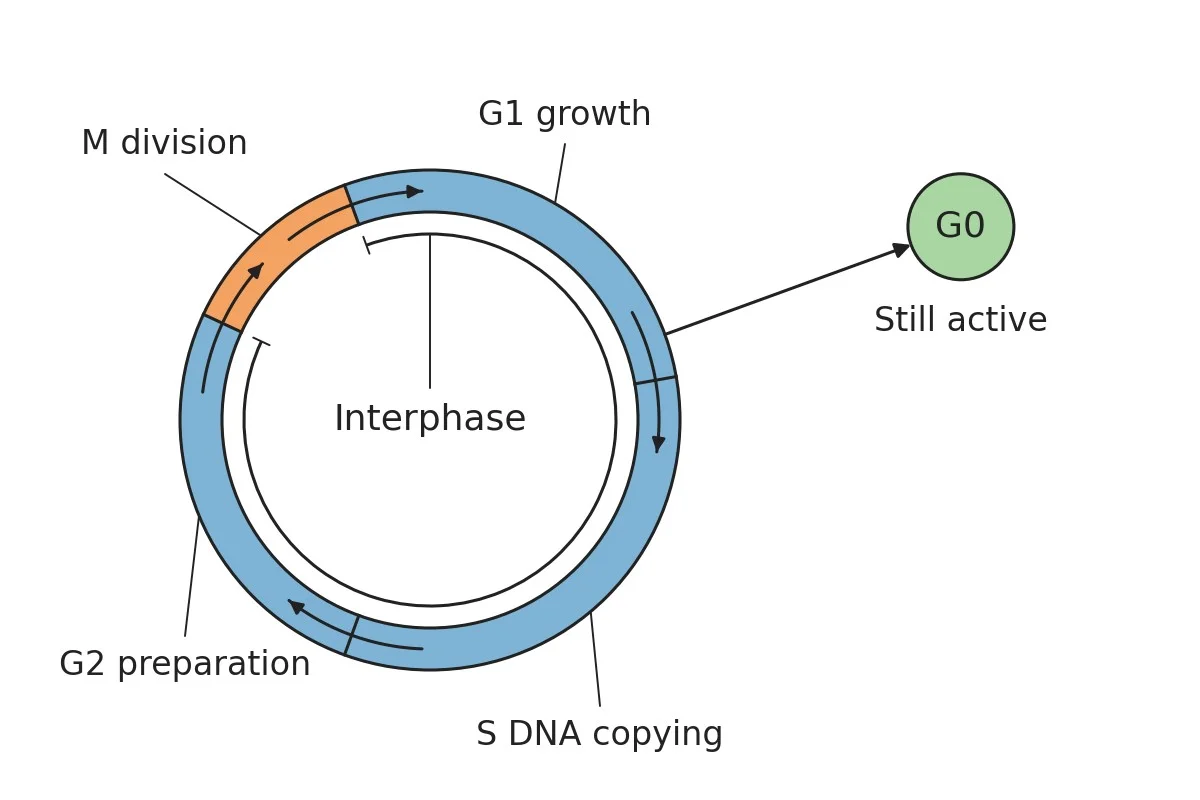
Cell-cycle diagram with interphase, division and an active G0 branch.

1. Cell Cycle: Interphase, M Phase and G0

Cells prepare, divide or leave the cycle while continuing their work.

Show
Follow G1, S, G2 and M around the diagram, then find G0 branching from G1. Compare the longer interphase arc with the shorter division arc. These lengths show a typical cycle, but timing varies between cell types.
Ask
Will a cell taking the G0 branch shown here stop its normal work?
Say
Cells keep working during interphase and G0.
Used in
Growing roots produce new cells that help plants reach water.
If your child says…“A cell that stops dividing is dead.”
Ask
Does stopping division require a cell to stop its other work?
What’s true
G0 cells remain alive and active without dividing.
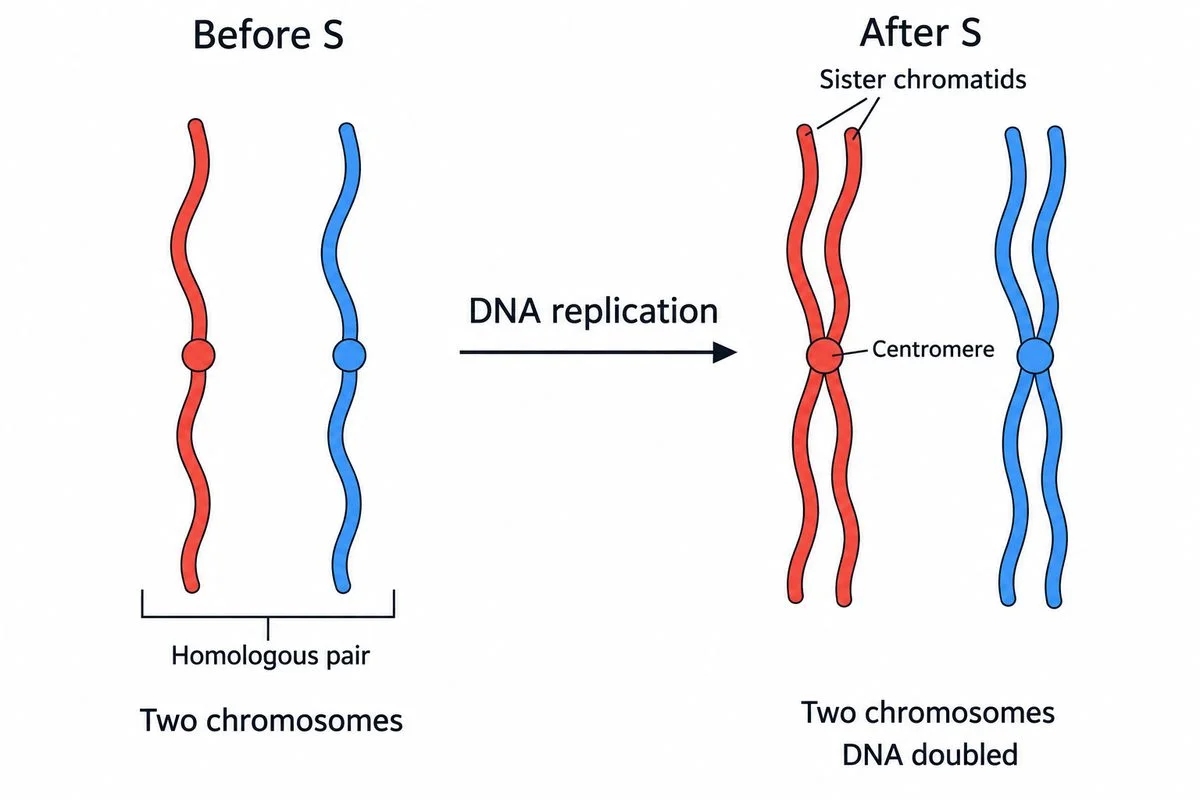
Before and after DNA copying, two chromosomes remain while each gains a joined sister.

2. S Phase: DNA Replication

DNA doubles while joined copies retain the original chromosome count.

Show
Look at the diagram's left panel, covering the right panel with paper. Count the chromosomes. After predicting, uncover the right panel and find each chromosome's joined copy.
Ask
How many chromosomes will this cell have after copying its DNA?
Say
It still has two chromosomes because each copy stays joined to its sister. The DNA amount has doubled.
Used in
DNA copying supplies genetic instructions for new cells during growth.
If your child says…“Copying DNA doubles the chromosome count.”
Ask
Does adding a joined copy create another separate chromosome?
What’s true
Joined sister chromatids count as one chromosome until they separate.

Mitosis and cell separation

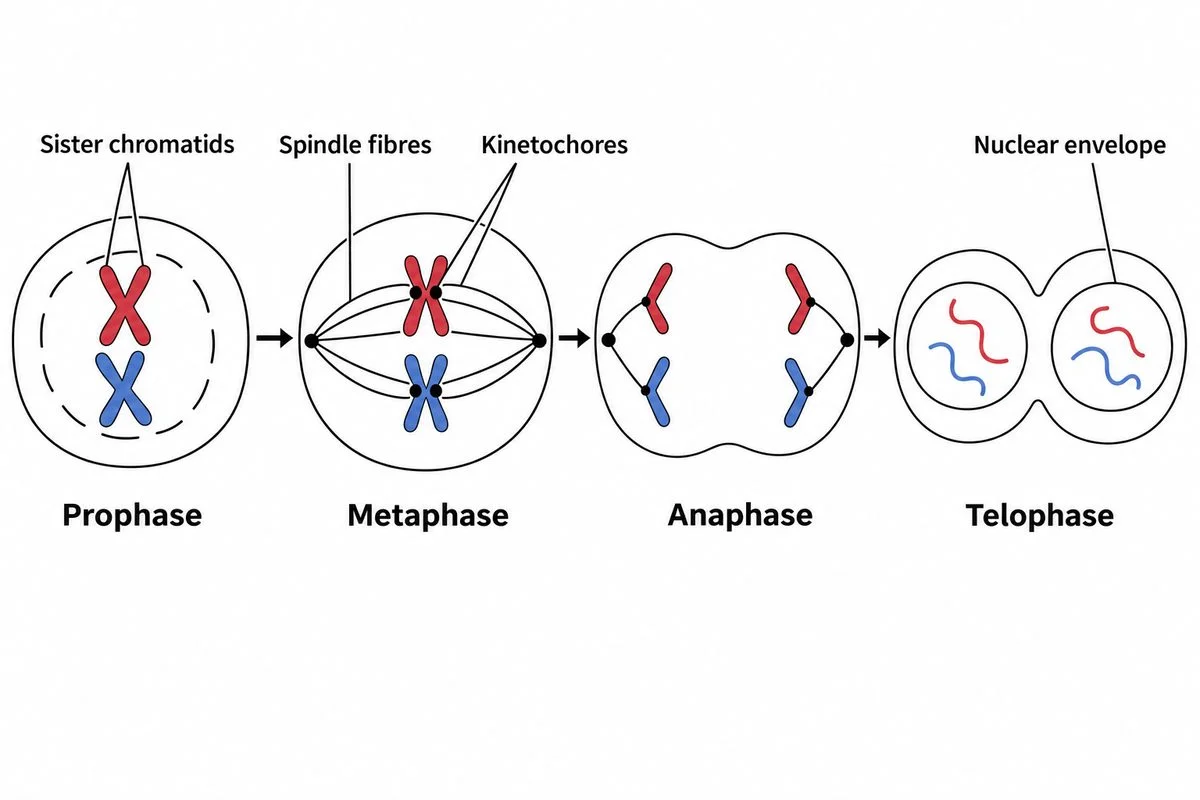
Four mitotic stages show sister chromatids separating and two nuclei forming.

3. Mitosis: Prophase to Telophase

Chromosome copies separate into new nuclei.

Show
Look at prophase and metaphase in the diagram, covering the last two stages. Trace fibres from opposite poles to sister kinetochores. After predicting, uncover anaphase and telophase.
Ask
When these sisters separate, what will each new nucleus receive?
Say
Each nucleus receives a copy of every chromosome because sister chromatids move to opposite poles. Nuclear envelopes then form around both groups.
Used in
Mitosis replaces worn-out skin cells.
If your child says…“Mitosis separates homologues.”
Ask
Would separating the red chromosome from the blue give both nuclei both colours?
What’s true
Mitosis separates sister chromatids, rather than matching maternal and paternal chromosomes.
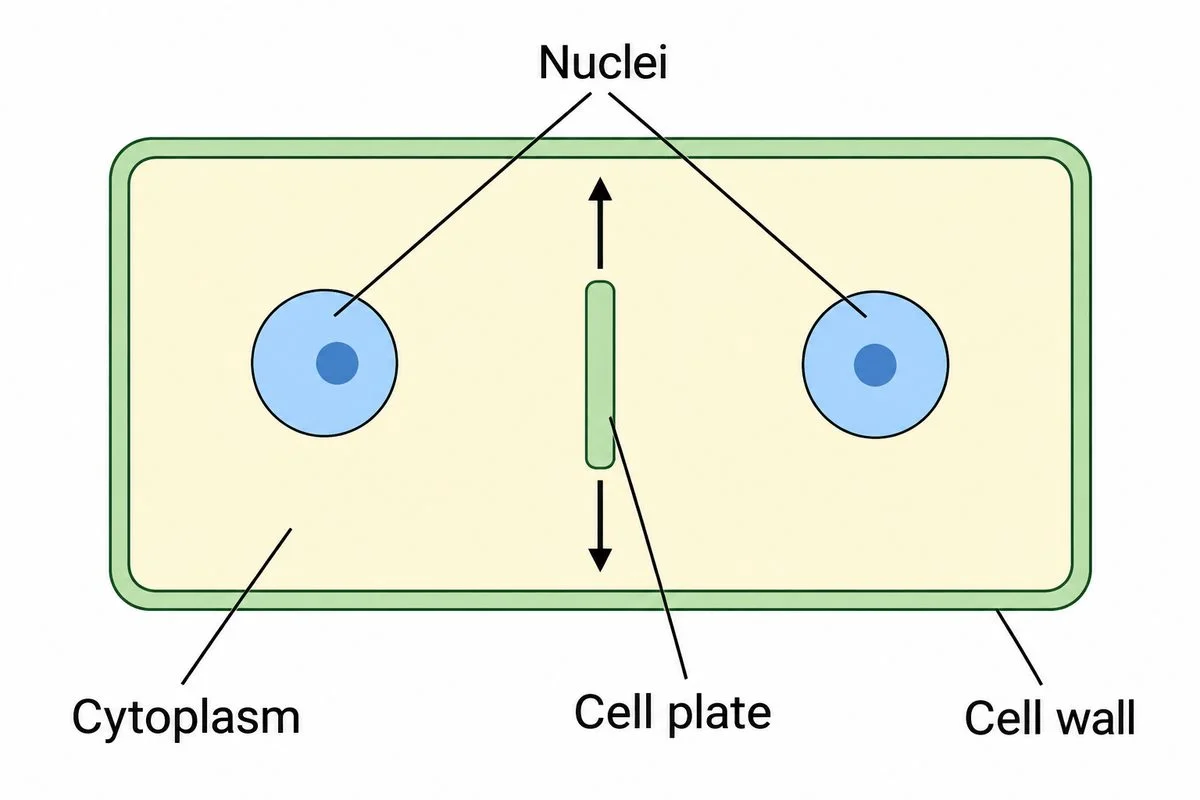
Plant-cell diagram with two nuclei and an incomplete central cell plate.

4. Cytokinesis and Significance of Mitosis

Dividing the cytoplasm completes cell separation after nuclear division.

Show
Find the two nuclei and central cell plate in the diagram. Locate the gaps between the plate and walls.
Ask
Will extending the central plate to both walls separate the cell's contents?
Say
Yes, extending the central plate to both walls separates the cell's contents. Plant cell plates grow from the centre towards the walls.
Used in
Mitosis supplies replacement cells that help wounds close.
If your child says…“Two nuclei always mean two separate cells.”
Ask
What still connects the contents around these nuclei?
What’s true
Nuclear division can occur without cytokinesis.

Meiosis and sexual reproduction

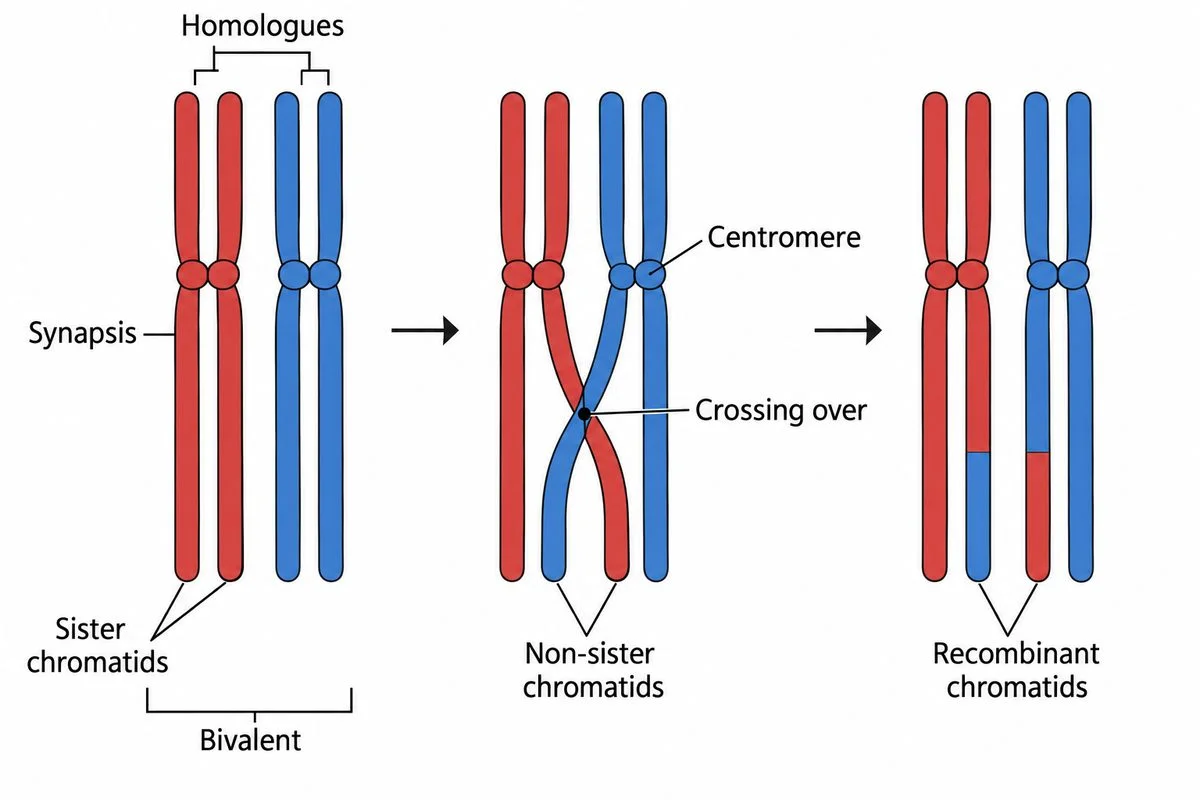
Paired homologues exchange corresponding segments between non-sister chromatids, producing new DNA combinations.

5. Prophase I: Synapsis and Crossing Over

Homologues pair and exchange DNA.

Show
Look at the diagram's paired homologues and count their four chromatids. Follow the exchange between the inner chromatids, keeping the final panel covered. After predicting, uncover the result.
Ask
What will exchanging these segments change about the DNA each chromosome carries?
Say
Non-sister chromatids exchange corresponding DNA segments. This creates new combinations of material from both parents.
Used in
Seedling variation gives growers traits to select.
If your child says…“Sisters exchange DNA.”
Ask
Do the exchanging strands belong to the same chromosome or different homologues?
What’s true
Meiotic crossing over exchanges DNA between non-sister chromatids of homologues.
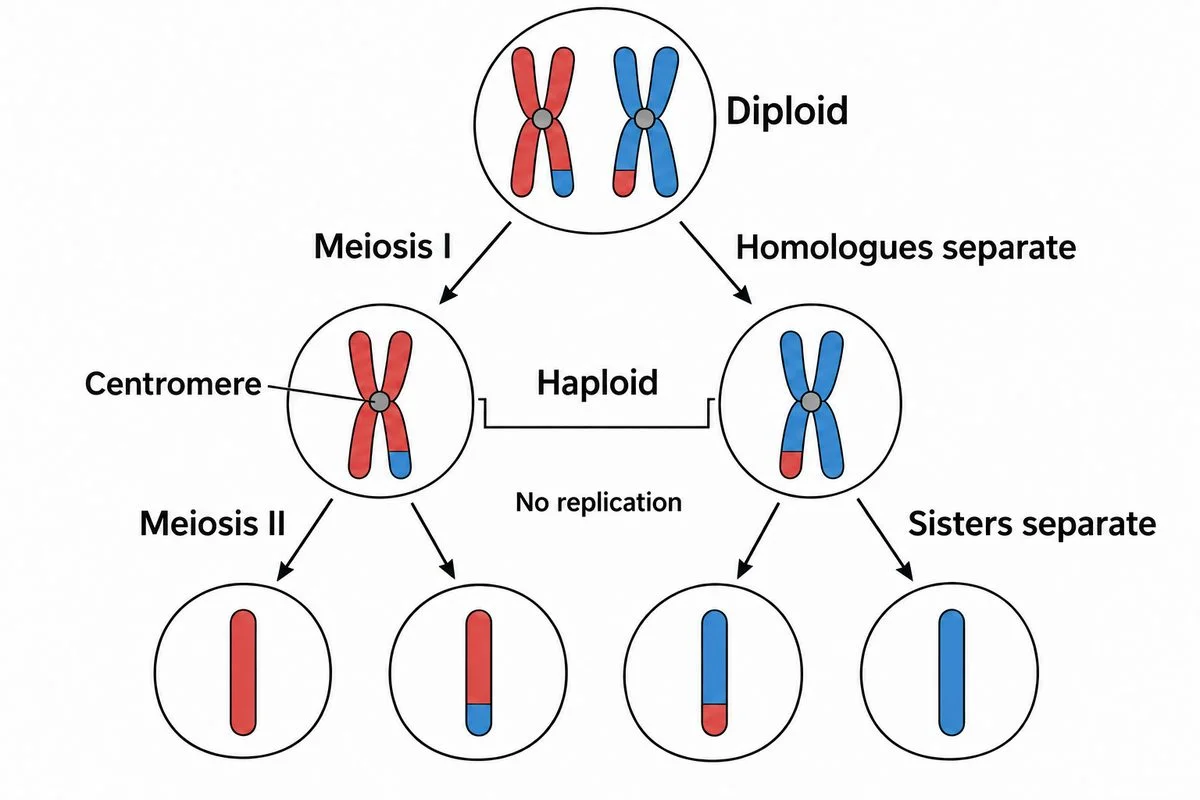
Homologues separate into two cells, then sisters separate into four haploid cells.

6. Meiosis I and Meiosis II

Homologues separate first, then sisters separate without another DNA-copying round.

Show
Follow the diagram from the top cell to the two middle cells. Find the joined sisters, keeping the bottom row covered. After predicting, uncover the final division.
Ask
Will these joined sisters need another DNA copy before meiosis II?
Say
Meiosis I separates homologues, leaving each cell with one chromosome set and joined sisters. Meiosis II separates those existing sisters, producing four haploid cells without more DNA copying.
Used in
Meiosis helps form pollen for sexual reproduction in flowering plants.
If your child says…“DNA must be copied before both divisions.”
Ask
What would another copy supply that these joined sisters do not already provide?
What’s true
Interkinesis has no DNA copying because the sister chromatids are already present.
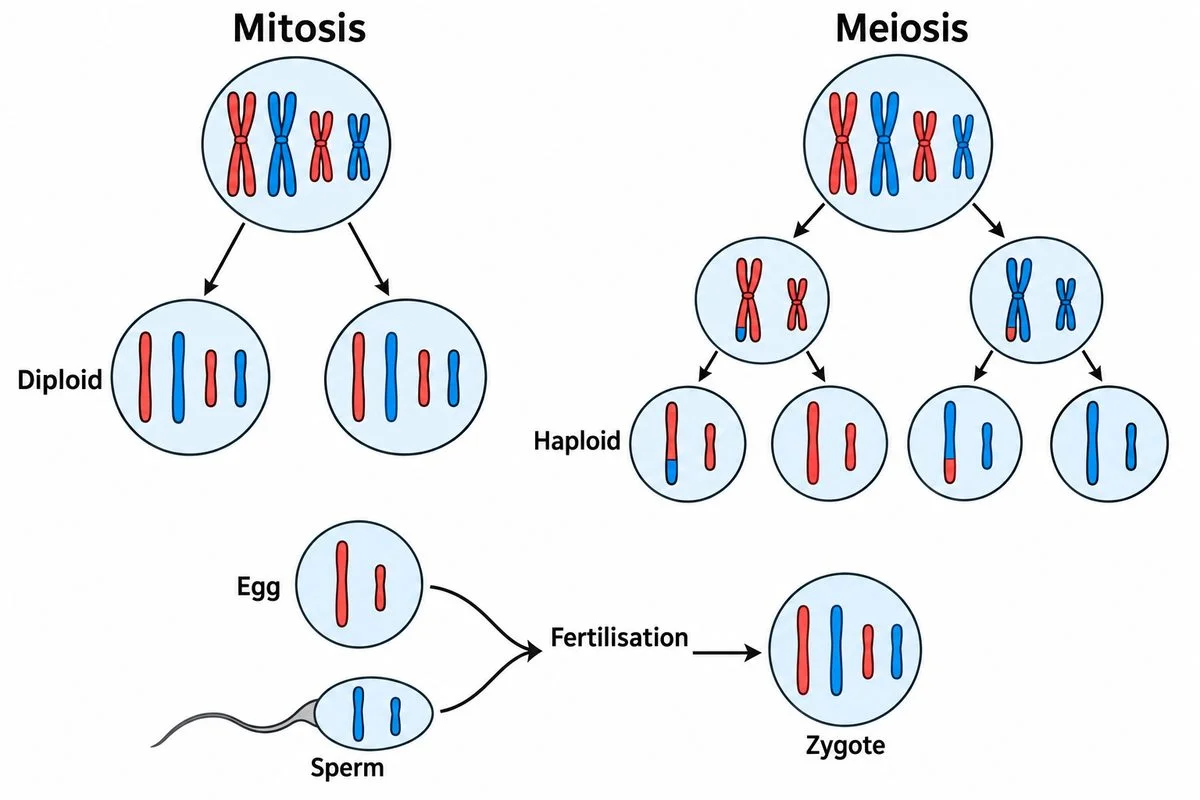
Mitosis preserves sets, meiosis halves sets, and egg–sperm fusion restores paired sets.

7. Significance of Meiosis: Comparison with Mitosis

Mitosis preserves sets; meiosis halves them; fertilisation restores them.

Show
Compare chromosome sets after mitosis and meiosis in the diagram's upper rows. Below, find the egg and sperm, covering the zygote. After predicting, uncover their combined sets.
Ask
When this egg and sperm join, how many chromosome sets will the zygote contain?
Say
The zygote receives two sets, restoring what meiosis halved. Mitosis keeps chromosome sets unchanged.
Used in
These processes maintain chromosome number across sexual generations.
If your child says…“Chromosome numbers keep halving.”
Ask
What happens when single sets unite?
What’s true
Fertilisation restores paired sets.

A real problem

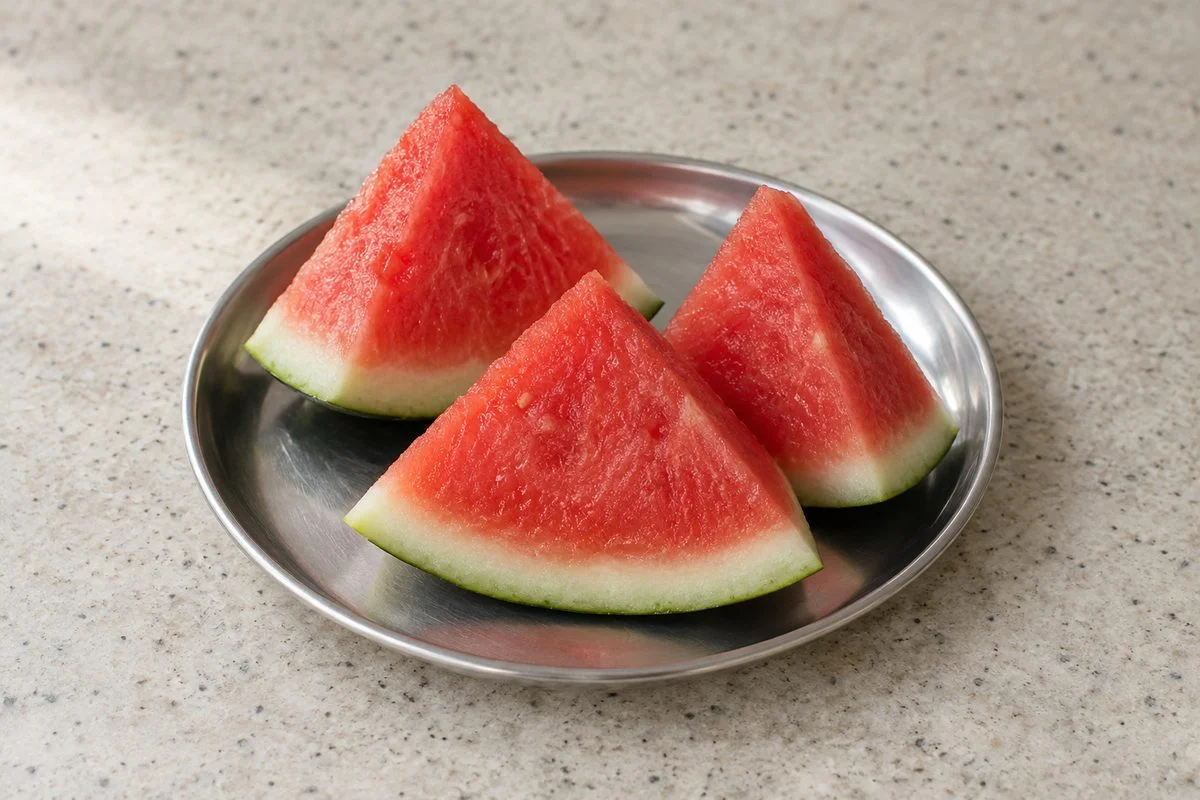
Disrupted meiosis helps produce seedless watermelons.

Kyoto University scientist H. Kihara described his seedless-watermelon method in 1951.

Colchicine can double chromosome sets from two to four.

Crossing plants with four sets and two sets produces triploid offspring, which have three sets.

In triploid watermelons, disrupted meiosis prevents normal seed formation, producing seedless fruit.

University of ArkansasNC State UniversityPlant Science via PubMed

Sliced seedless watermelon on a steel kitchen plate.

Concept Lab · Common misconception

The tempting mistake in Cell Cycle and Cell Division

Open standalone misconception page →

Does DNA replication double the chromosome count immediately?

Wrong

After S phase a cell has twice as many chromosomes.

Why it feels right. The amount of DNA doubles.

Right

A replicated chromosome has two sister chromatids counted together until they separate.

Worked example

The chromosome count stays at four. Each chromosome has two chromatids after DNA replication.
  1. A diploid cell with 4 chromosomes enters S phase.
  2. After replication it has 4 chromosomes and 8 chromatids.

Ask your child seven quick questions.

One per step. The answer and the reason are given.

  1. Does metabolic activity stop when a cell enters G0?

    No. Leaving the dividing cycle does not end the cell's work.

  2. An onion cell starts with 16 chromosomes. How many does it have after S?

    16 chromosomes. DNA doubles, but each joined sister pair still counts as one chromosome.

  3. What separates during mitotic anaphase?

    Sister chromatids. Separating copies gives each new nucleus every chromosome type.

  4. What must divide to separate the contents around these nuclei?

    The cytoplasm. Extra nuclei alone do not partition the cell's contents.

  5. Which chromatids exchange DNA during meiotic crossing over?

    Non-sister chromatids of homologues. Exchange joins material from the matching chromosomes, not merely one chromosome's copies.

  6. Which chromatids separate from each other during anaphase II?

    The existing sister chromatids. The sisters were made before meiosis I, so another copying round is unnecessary.

  7. What restores paired chromosome sets between sexual generations?

    Fertilisation. Fusion brings together one chromosome set from each reproductive cell.

15 more questions with answers, 8 with pictures