Skip to content

Teach Neural Control and Coordination in eight steps.

For each idea: show it, ask before you tell, then say one line.

Gather a clock, chair, ruler, paper and a pencil.

Common misconceptions & worked visual for this chapter · 15 practice questions with answers

How to teach it

Coordination and nerve pathways

Clock beside a chair and clear floor space.

1. Neural System

Nerve signals coordinate organs; the endocrine system uses hormones.

Show
Notice breathing and wrist pulse while seated. After predicting, march comfortably for one minute. Notice both again.
Ask
Will only the working muscles change their activity?
Say
No; organs coordinate.
Used in
Coordination links seeing food with reaching for it, helping you eat.
If your child says…“Each organ works on its own.”
Ask
If breathing changed, how could that help the working muscles?
What’s true
Working muscles depend on other organs adjusting their activity.
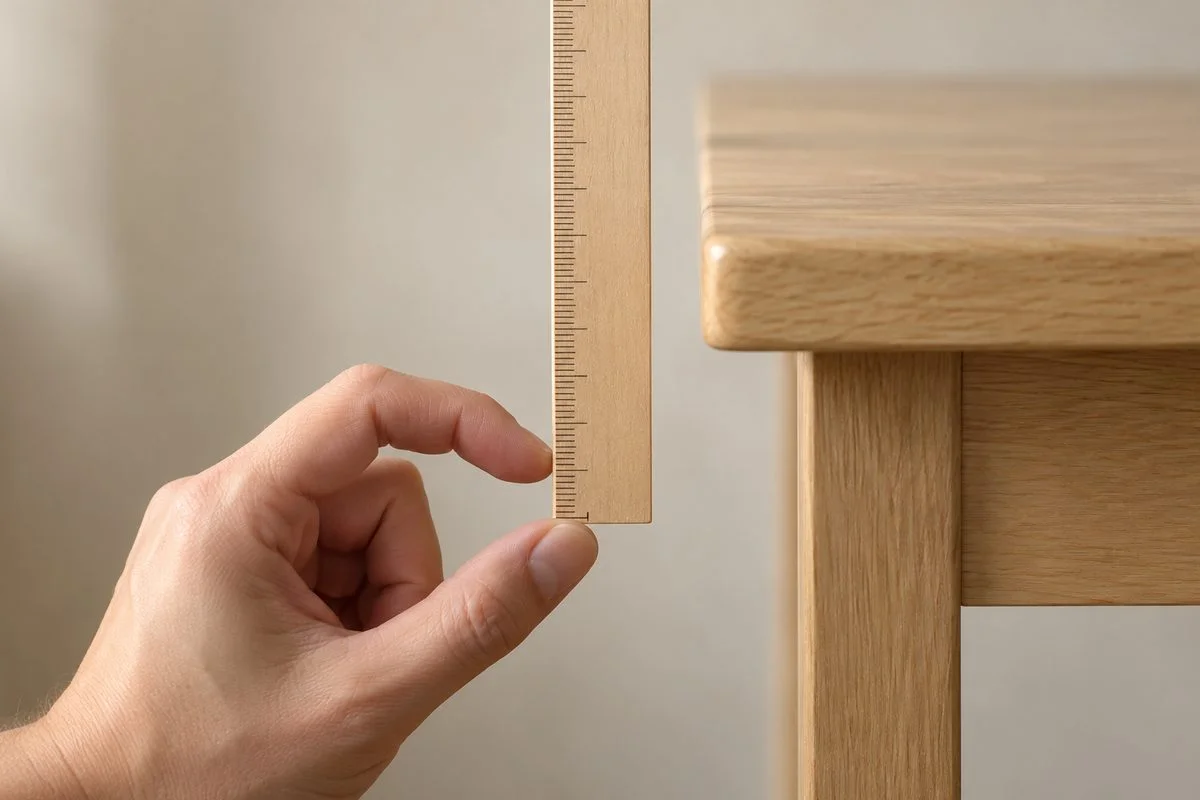
Vertical ruler with its zero mark between one hand’s open thumb and finger.

2. Human Neural System

Incoming signals reach central control; outgoing signals reach responding tissues.

Show
Hold a ruler vertically, zero between your child’s open finger and thumb. After predicting, release without warning. Let your child catch it. Name brain and spinal cord 'CNS', and associated nerves 'PNS'.
Ask
Will the fingers close before the brain receives news of the fall?
Say
No; signals reach the CNS, and signals leave it.
Used in
Signals from skin help you adjust your grip before a cup slips.
If your child says…“Signals going to muscles are afferent.”
Ask
Does a command to close the fingers travel towards the CNS or away?
What’s true
Commands travelling from the CNS to muscles follow efferent pathways.

How nerve cells pass signals

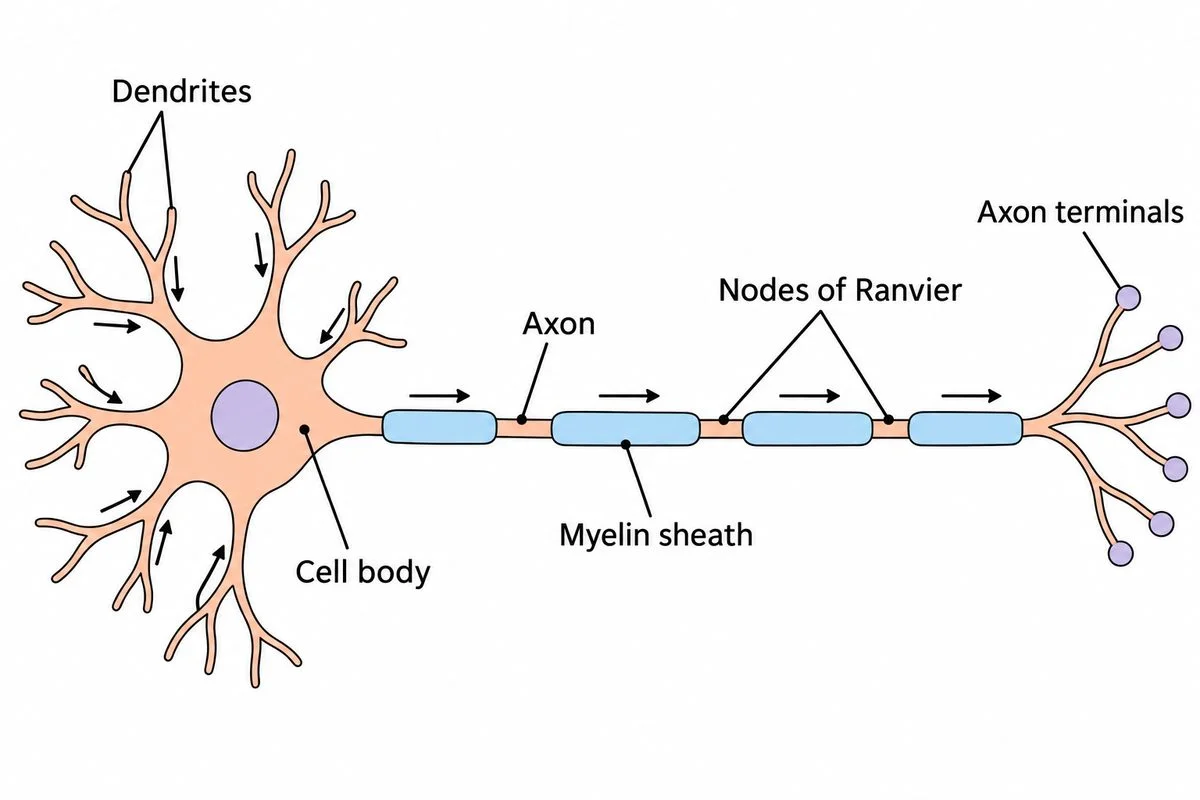
Neuron diagram showing receiving branches, an axon, myelin gaps and signal direction.

3. Neuron as Structural and Functional Unit of Neural System

A nerve cell receives and sends signals.

Show
In the neuron diagram, find the dendrites and cell body. Follow the axon past myelin and gaps to terminals.
Ask
Would these branches let this neuron receive signals from several other cells?
Say
Dendrites usually receive signals towards the cell body. The axon carries signals away to its terminals. Myelin covers sections of the axon, leaving gaps called nodes of Ranvier.
Used in
Touch signals help you notice insects on skin.
If your child says…“Dendrites send signals away from the cell body.”
Ask
Where do these short branches meet before the long axon begins?
What’s true
Dendrites receive signals towards the cell body in this pathway.
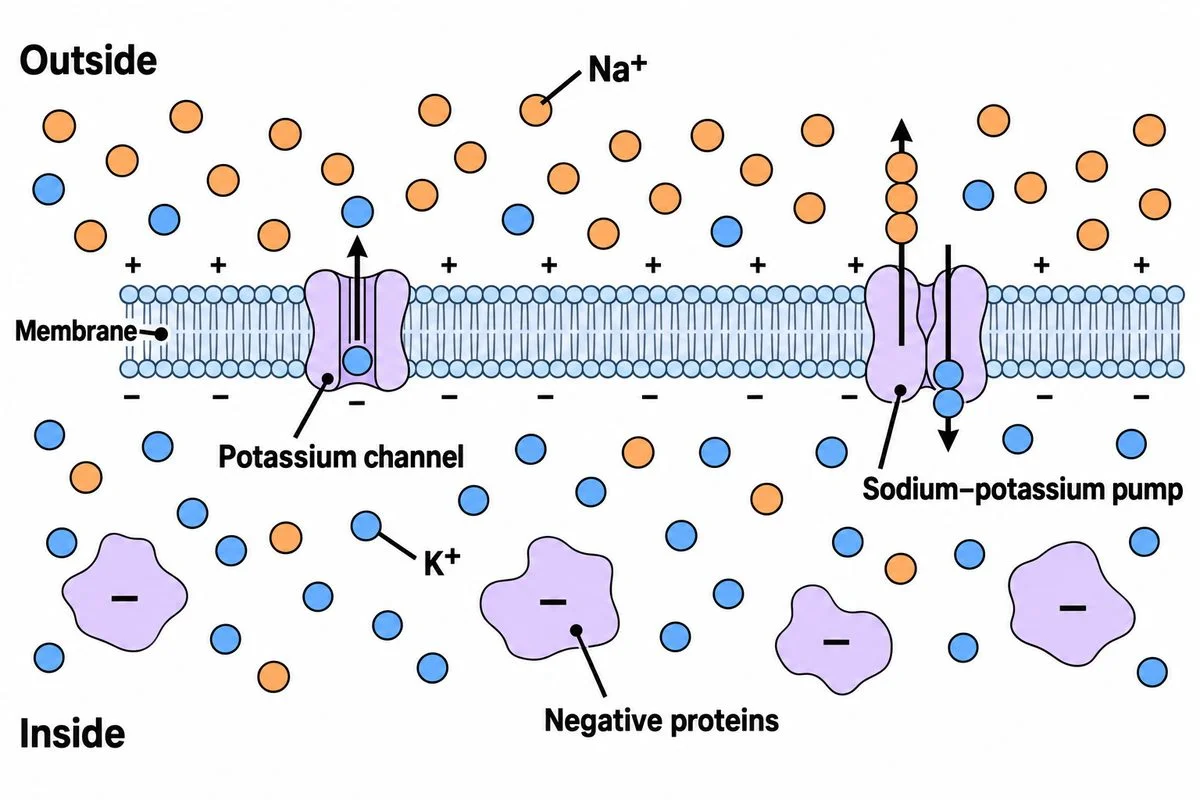
Resting membrane diagram showing unequal ions, potassium leakage, pump transport and surface charges.

4. Resting Potential

At rest, the inside is electrically negative relative to outside.

Show
In the diagram, compare ions outside and inside the membrane. Follow the potassium channel and pump arrows.
Ask
If potassium stopped leaking out here, would the resting voltage stay the same?
Say
Unequal ion concentrations and selective passage make the inside negative relative to outside. Potassium escapes more easily than sodium enters. Using energy, the pump moves three sodium ions out and two potassium ions in.
Used in
Resting voltage prepares nerves to respond to touch.
If your child says…“The voltage would stay unchanged if the ions became equally distributed.”
Ask
What would maintain this voltage if concentrations became equal and all ions crossed equally easily?
What’s true
Resting voltage depends on unequal ion concentrations and selective passage, with pumping maintaining the concentrations.
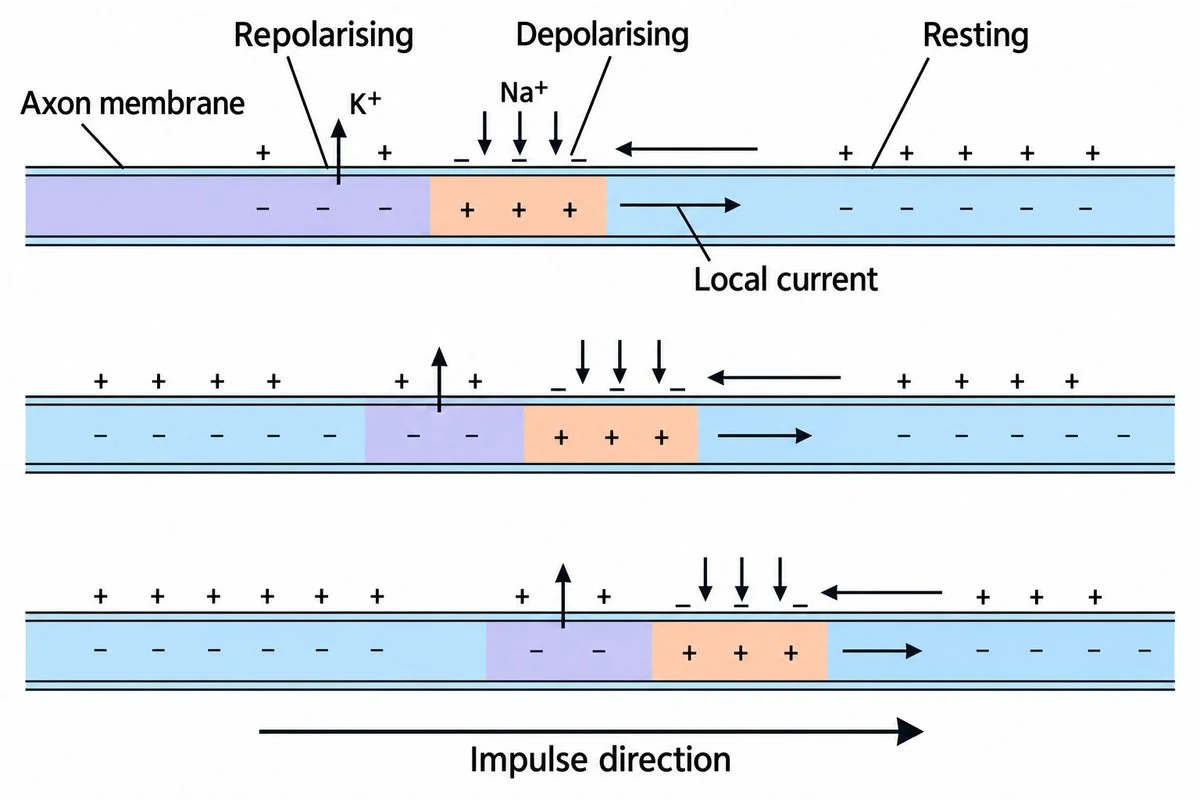
Successive axon snapshots show sodium entry, local currents and potassium exit as an impulse advances.

5. Generation and Conduction of Nerve Impulse

A voltage change travels along an axon.

Show
Read the axon diagram from top to bottom. Follow sodium entry, local currents towards resting membrane, and potassium exit behind the advancing impulse.
Ask
What will happen next to the resting region beside this active region?
Say
Sodium entry makes the active region positive inside. Local currents trigger the next resting region, carrying the impulse onwards. Behind it, potassium leaves and the inside becomes negative again.
Used in
Travelling impulses command finger movements for fastening buttons.
If your child says…“The whole axon switches on at once.”
Ask
Which area must change before it can trigger its neighbour?
What’s true
An active region triggers the next resting region, so the impulse travels.
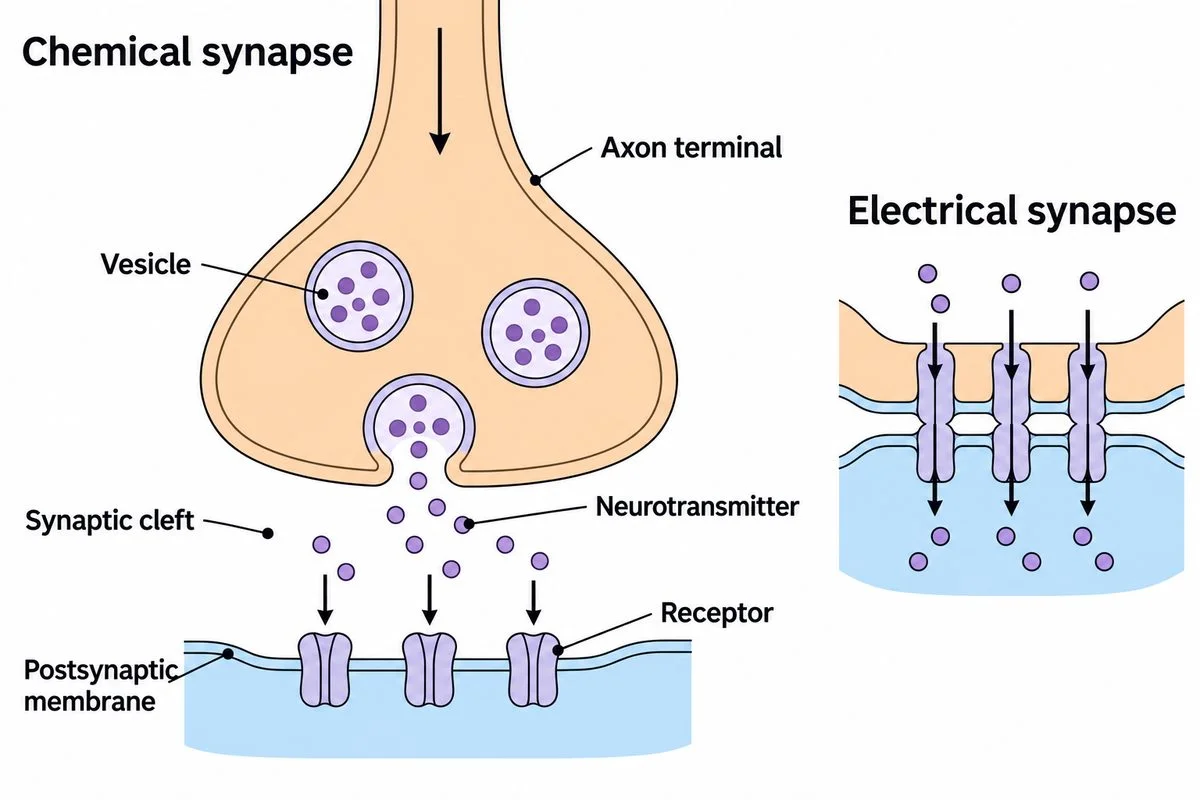
Chemical synapse with messenger release and receptors, beside an electrical synapse with connecting pores.

6. Transmission of Impulses

Nerve cells communicate across junctions.

Show
In the diagram, find neurotransmitter leaving a vesicle. Follow it across the gap to the receiving receptors. Compare the connected membranes in the electrical synapse inset.
Ask
If these receiving receptors were blocked, would the released messenger still change ion flow here?
Say
An arriving impulse releases messengers that cross the gap and bind the receiving cell's receptors. These receptors change ion flow, making an impulse more or less likely. At electrical synapses, ions pass directly between connected cells.
Used in
Synapses relay information needed for reading aloud.
If your child says…“Electric current jumps straight across a chemical synapse.”
Ask
What must reach the receiving receptors before ion flow changes?
What’s true
Chemical transmission needs messenger release and binding to receptors on the receiving cell.

What brain regions do

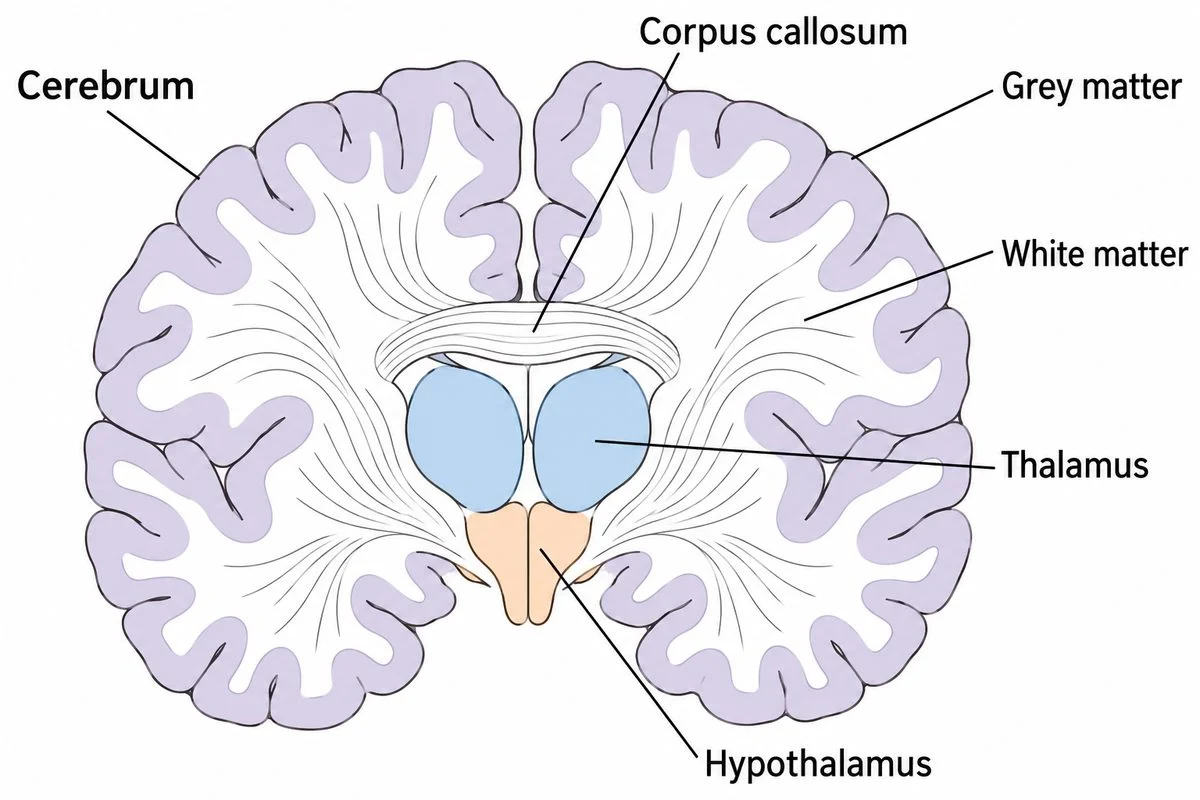
Labelled forebrain cutaway showing grey matter, white matter and central structures.

7. Forebrain

Brain regions combine information and regulate internal needs.

Show
In the diagram, find the cerebrum and connecting corpus callosum. Find the central thalamus and hypothalamus below it. Compare the outer grey matter with the inner white matter.
Ask
What might happen to thirst if the hypothalamus stopped working properly?
Say
Thirst could be affected. The hypothalamus below the thalamus helps regulate thirst.
Used in
Thirst regulation helps you replace water your system needs.
If your child says…“The thalamus controls thirst and hunger.”
Ask
Which region below the thalamus have we linked with internal needs?
What’s true
The hypothalamus regulates internal needs, while the thalamus coordinates sensory and movement signals.
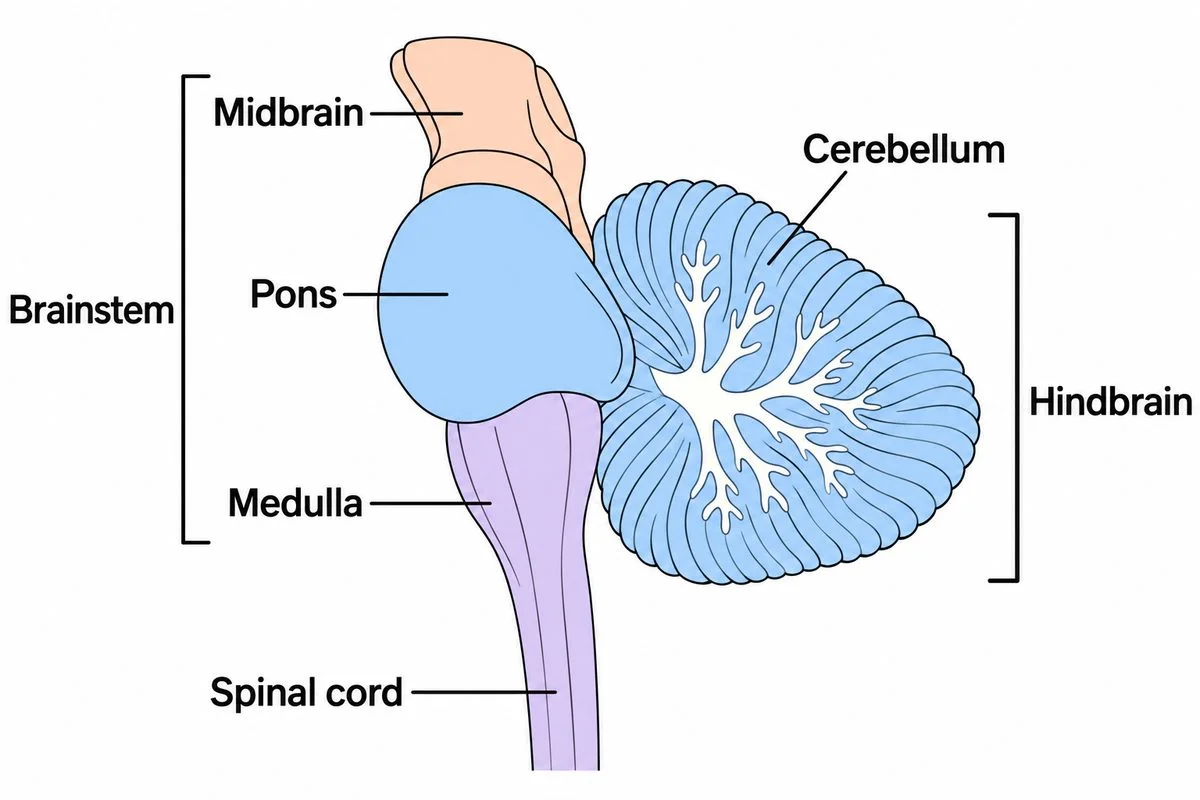
Labelled side-view diagram showing brainstem and hindbrain groupings beside the spinal cord.

8. Midbrain and Hindbrain

Brain regions connect pathways, coordinate movement and control automatic functions.

Show
In the diagram, find midbrain above pons, medulla below, and cerebellum behind. Follow the medulla into the spinal cord. Follow each bracket to identify the parts of the brainstem and hindbrain.
Ask
Would breathing stop during sleep when conscious commands stop?
Say
No. The medulla continues into the spinal cord and helps regulate breathing without conscious commands.
Used in
The cerebellum helps coordinate movements needed to ride a bicycle.
If your child says…“The medulla only controls movements I choose.”
Ask
When you stop consciously directing breaths during sleep, what keeps regulating them?
What’s true
The medulla regulates several involuntary functions, including breathing.

A real problem

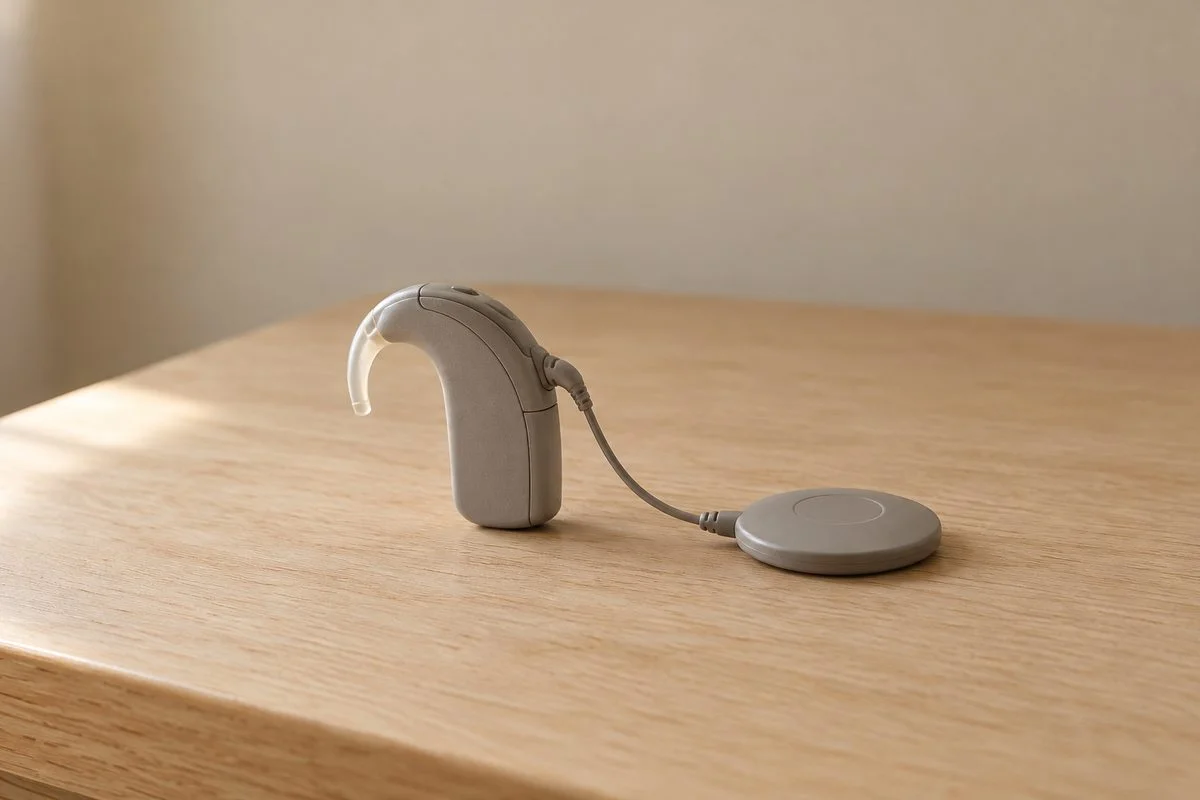
A cochlear implant turns sound into nerve signals.

Graeme Clark and colleagues implanted their prototype with multiple electrodes in 1978.

It bypasses damaged ear structures by converting sound into electrical signals for the auditory nerve.

Electrical pulses stimulating nerves inside the inner ear produced hearing sensations.

Museums VictoriaUniversity of MelbourneRoyal Victorian Eye and Ear Hospital

An external cochlear-implant sound processor resting on a bedside table.

Concept Lab · Common misconception

The tempting mistake in Neural Control and Coordination

Open standalone misconception page →

Is every synapse a continuous electrical wire?

Wrong

An impulse jumps directly between cells at a chemical synapse.

Why it feels right. The signal is electrical along the axon.

Right

At a chemical synapse, a transmitter carries the signal across the gap.

Worked example

Signal path
Impulse arrives→Neurotransmitter released→Crosses gap→Binds next cell's receptor
An impulse arriving at one cell releases a chemical messenger that crosses the synaptic gap.
  1. An arriving impulse causes neurotransmitter release.
  2. The molecules cross the narrow gap and bind to receptors on the next cell.

Ask your child eight quick questions.

One per step. The answer and the reason are given.

  1. What biological process means that organs adjust their activities together?

    Coordination between organs. Several organs adjust together to support the working muscles.

  2. Which fibres carry the command from the spinal cord to the hand muscles?

    Efferent fibres. The command travels away from the CNS.

  3. Which part carries the signal away from the cell body towards the terminals?

    The axon. Dendrites receive towards the cell body, while the axon carries signals onwards.

  4. What happens to resting voltage if ion differences and selective passage both disappear?

    It cannot be maintained. Resting voltage depends on both unequal concentrations and selective ion movement.

  5. What makes the next resting axon region begin changing voltage?

    Local currents. Currents from the active region trigger its resting neighbour.

  6. What crosses the gap at a chemical synapse?

    Neurotransmitters. These chemical messengers bind receptors on the receiving cell.

  7. Which forebrain region helps regulate hunger and temperature?

    The hypothalamus. Its centres regulate internal needs, including hunger, thirst and temperature.

  8. Which brain region continues into the spinal cord and helps regulate breathing without conscious commands?

    The medulla. It contains centres regulating involuntary functions.

15 more questions with answers