Skip to content

Teach Plant Physiology in eight steps.

For each idea: show it, ask before you tell, then say one line.

Gather a plant with green-and-white leaves, paper and a pencil.

Common misconceptions & worked visual for this chapter · 15 practice questions with answers

How to teach it

Leaves, chloroplasts and light

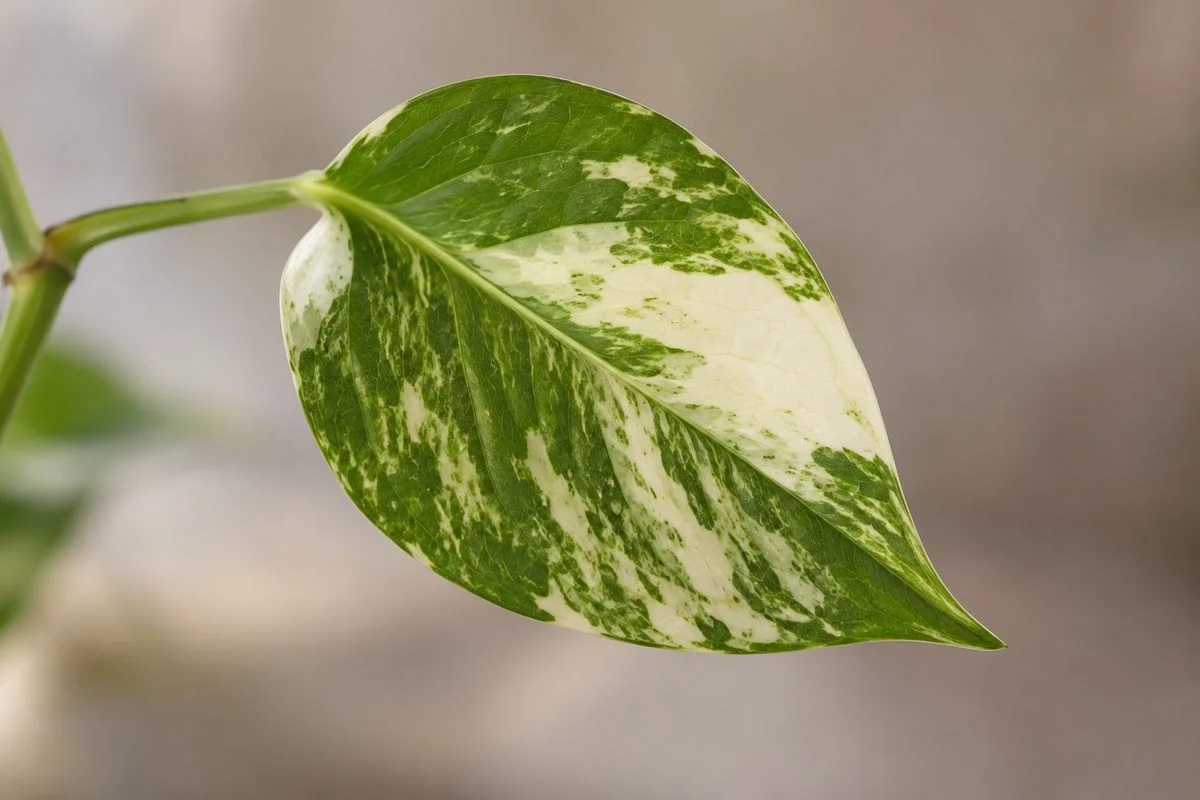
An attached leaf with distinct green and white patches.

1. Early Experiments

Experiments reveal what green tissues need to make food.

Show
Find an attached leaf with green and white patches. Point out both colours before predicting starch formation.
Ask
After stored starch is removed, which patches could make new starch with light and carbon dioxide?
Say
Only the green patches could make new starch by photosynthesis. Seeing their colour alone cannot confirm starch.
Used in
Crop leaves make carbohydrates that supply food for people and animals.
If your child says…“The white patches make starch just like the green patches.”
Ask
If both patches receive light and carbon dioxide, what requirement does the white patch lack?
What’s true
New starch formation requires green tissue, light and carbon dioxide in this experiment.
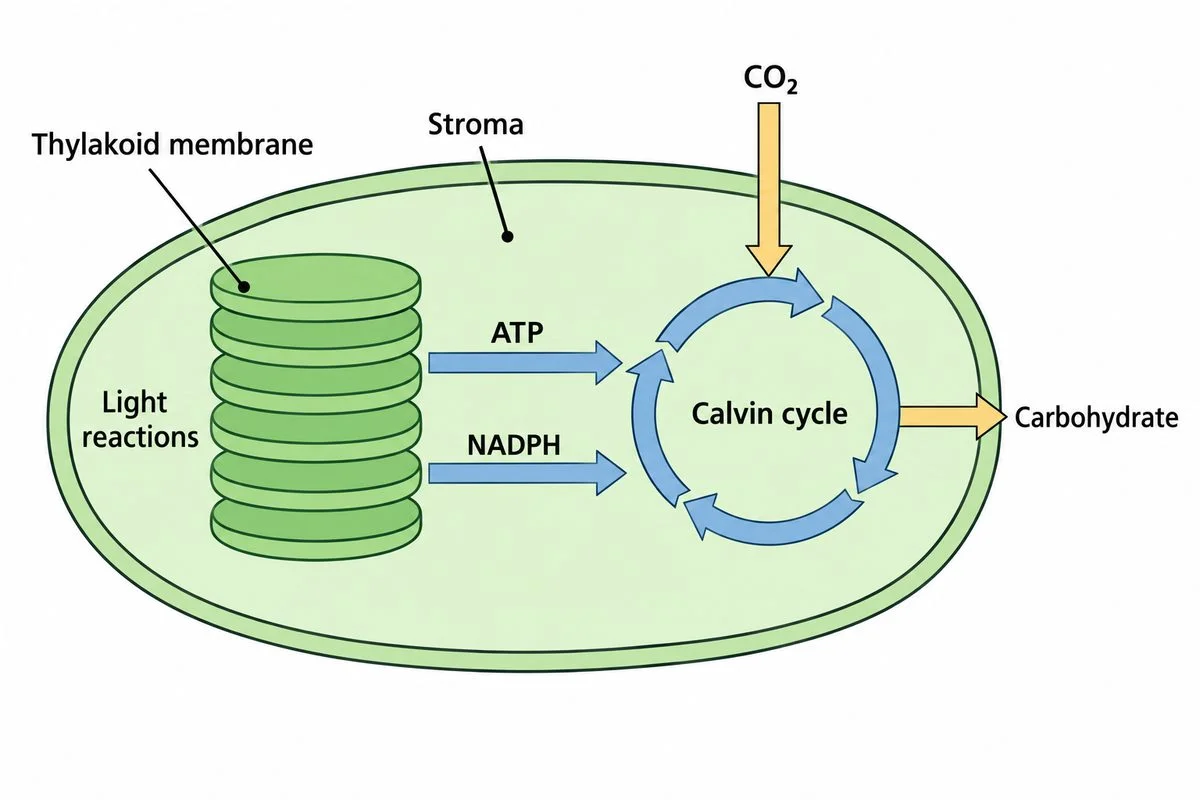
Chloroplast diagram connects membrane light reactions with carbohydrate formation in the stroma.

2. Where does Photosynthesis take place?

Membranes capture light; surrounding stroma supports sugar formation.

Show
Look at the chloroplast diagram. Find the thylakoid membranes, then the surrounding stroma. Follow adenosine triphosphate (ATP) and reduced nicotinamide adenine dinucleotide phosphate (NADPH) towards the Calvin cycle.
Ask
If these membranes stop supplying ATP and NADPH, what will happen to carbohydrate production?
Say
Thylakoid membranes capture light and make ATP and NADPH. Carbon reactions in the stroma use both supplies to make carbohydrate. Without renewed supplies, these reactions cannot keep running.
Used in
Green stems capture light too, adding to plant food supplies.
If your child says…“Dark reactions only happen in darkness.”
Ask
When are the light reactions supplying ATP and NADPH?
What’s true
Carbon reactions can run in light because light reactions supply what they need.
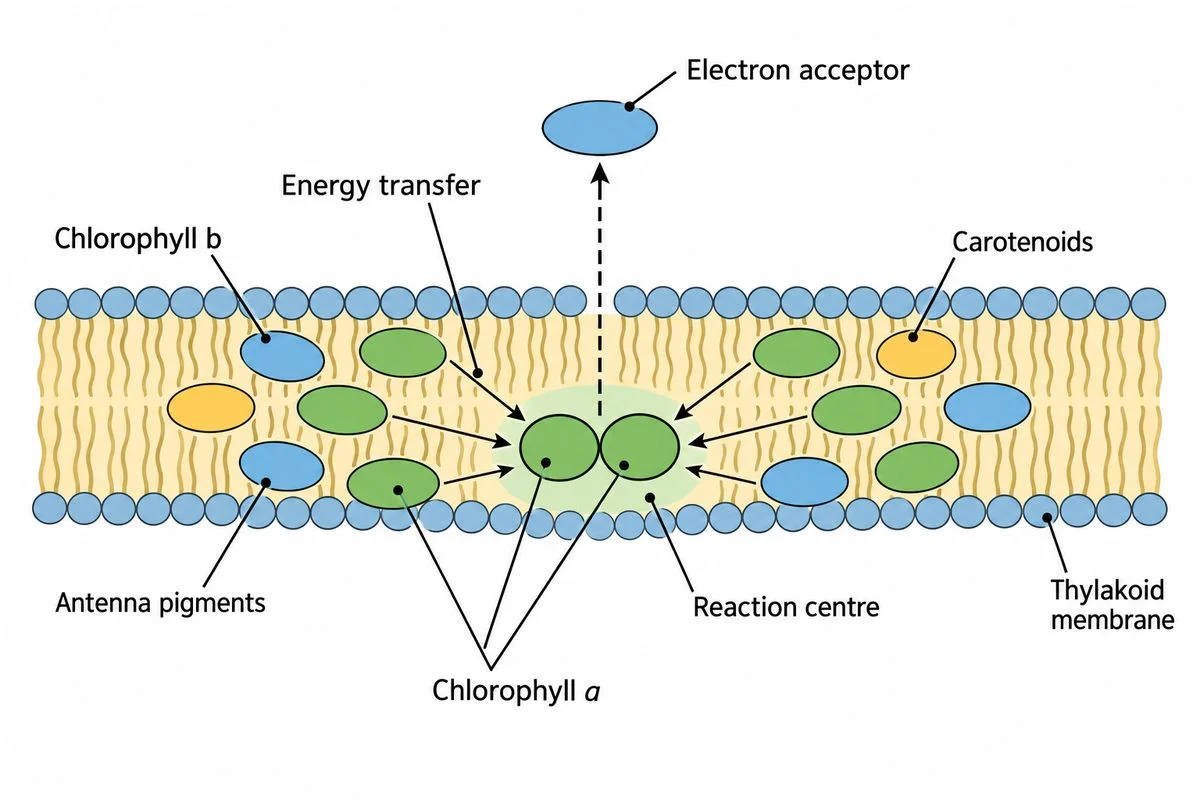
Antenna pigments pass energy inward; the reaction centre transfers an electron to an acceptor.

3. Photosynthetic Pigments and Light Harvesting Complexes

Several pigments collect light energy for chlorophyll a reaction centres.

Show
Look at the photosystem diagram. Follow energy arrows from surrounding pigments to the reaction centre. Follow the separate electron arrow to its acceptor.
Ask
With these surrounding pigments present, could light poorly absorbed by chlorophyll a still support photosynthesis?
Say
Yes, different pigments absorb different light colours and pass energy to reaction-centre chlorophyll a. This centre sends an electron to an acceptor.
Used in
Grow lights supply useful light colours, helping indoor plants make food.
If your child says…“Only chlorophyll a collects useful light.”
Ask
Where could energy go after a helper pigment absorbs it?
What’s true
Helper pigments broaden light absorption, so photosynthetic activity does not exactly follow chlorophyll a absorption.

Electron flow and ATP

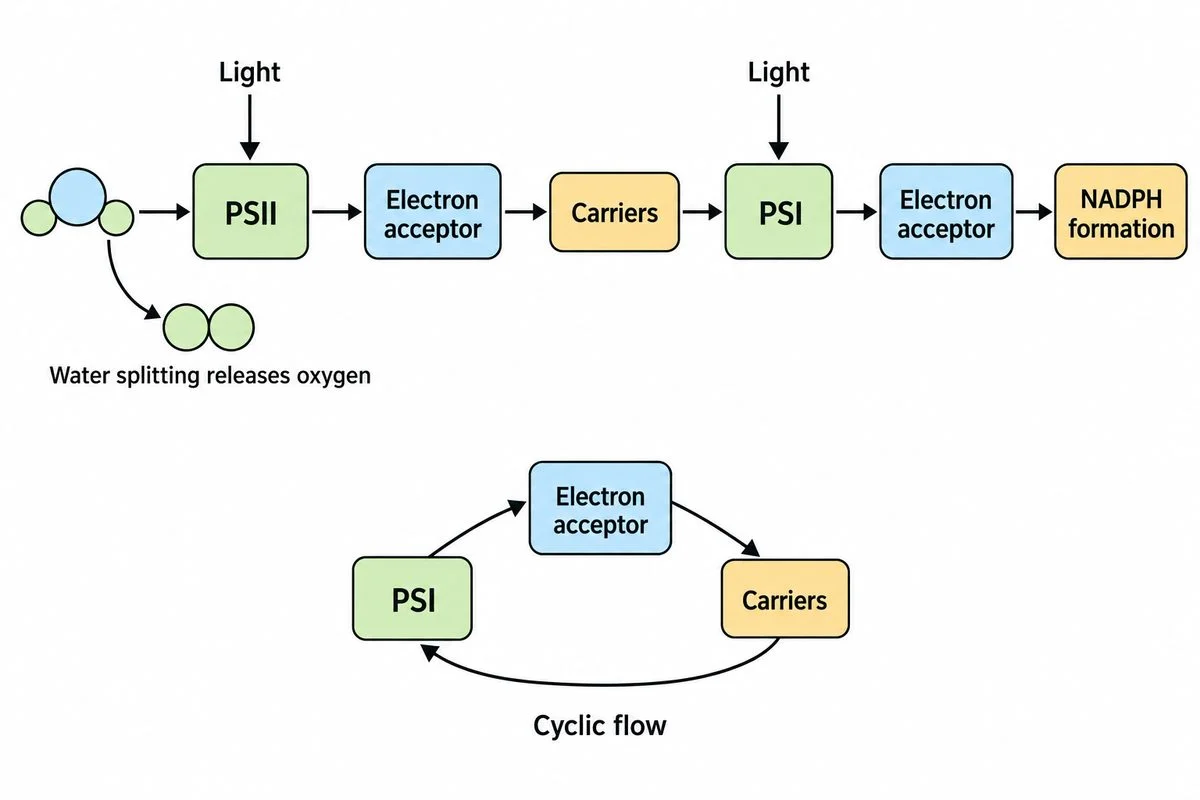
Main electron pathway runs from water to NADPH; cyclic electrons return to PSI.

4. Electron Transport and Photophosphorylation

Light drives electron flow that supports ATP and NADPH formation.

Show
Find both light inputs in the diagram. Trace electrons from water to NADPH, then around the inset.
Ask
Which products could the return loop lack?
Say
The main route makes NADPH and releases oxygen from water. Cyclic flow supports ATP formation alone.
Used in
Photosynthetic oxygen supports aerobic respiration.
If your child says…“Cyclic flow makes oxygen and NADPH too.”
Ask
Without water splitting, where would oxygen release happen in that route?
What’s true
Cyclic flow uses PSI without splitting water or producing NADPH.
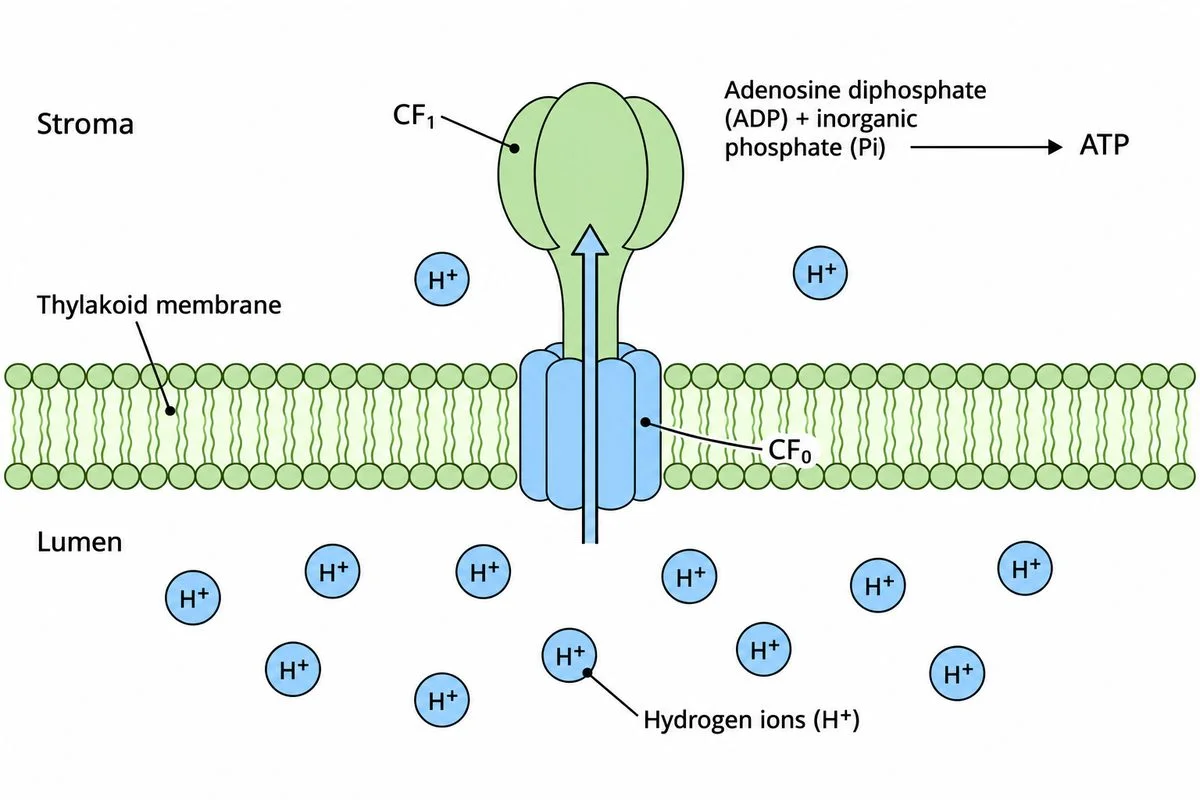
Protons flow from lumen through CF₀ towards stroma, powering ATP formation at CF₁.

5. Chemiosmotic Hypothesis

A proton difference powers ATP formation.

Show
Look at the diagram’s proton-rich lumen below the membrane. Follow the upward arrow through CF₀. Find CF₁ in the stroma.
Ask
With more protons inside this lumen, which way will they flow through ATP synthase?
Say
Protons return through the CF₀ channel, powering ATP formation at the stromal CF₁ head.
Used in
Photosynthetic ATP powers carbohydrate production for growth.
If your child says…“Protons enter the lumen through ATP synthase to make ATP.”
Ask
Which way does the arrow through CF₀ carry protons?
What’s true
ATP formation uses proton flow from the lumen towards the stroma.

Making carbohydrate and controlling its rate

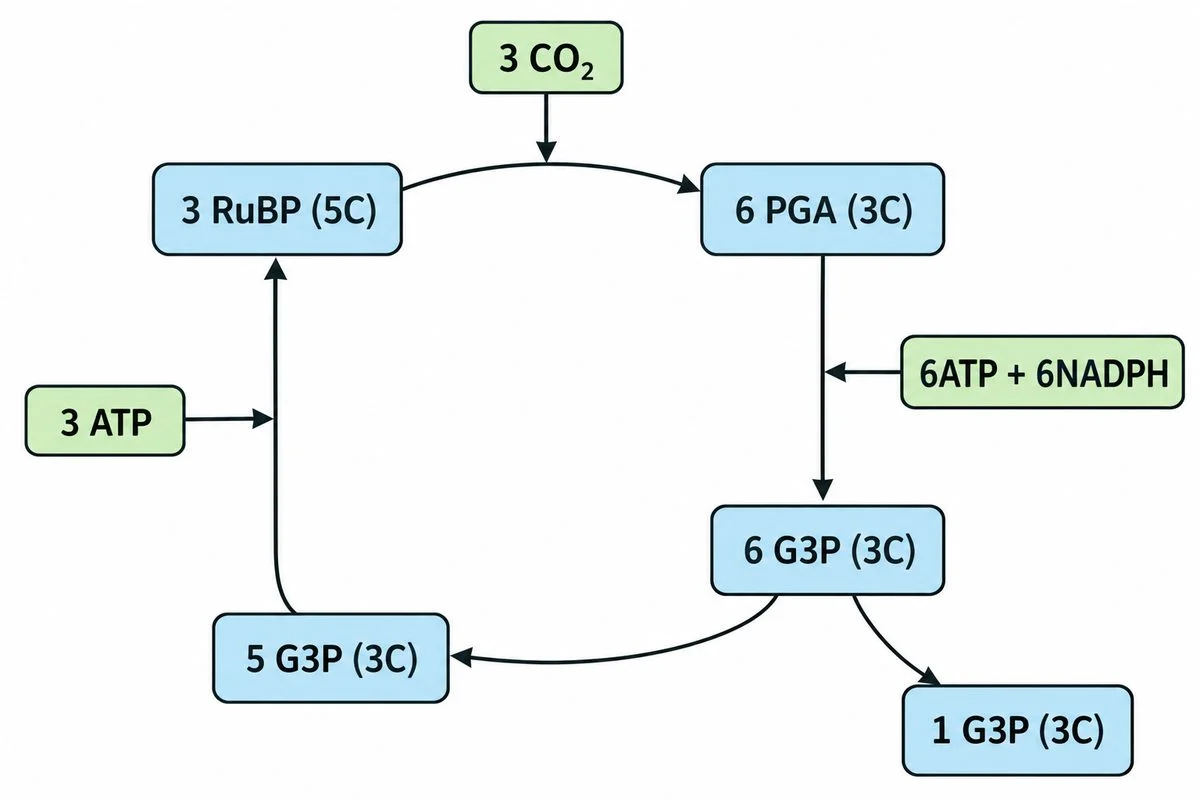
Calvin cycle shows one G3P leaving while five regenerate RuBP, with separate energy inputs.

6. The Calvin Cycle

Carbon fixation makes carbohydrate and restores RuBP.

Show
Look at the diagram. Follow carbon dioxide joining RuBP, then trace PGA to G3P and both branches. Find the energy inputs.
Ask
If all six G3P molecules left this cycle, could it keep accepting carbon dioxide?
Say
No, some carbohydrate must rebuild RuBP. Six ATP and six NADPH support G3P formation. One G3P leaves; five regenerate RuBP using three ATP.
Used in
Fixed carbon supplies plant fibres for paper.
If your child says…“RuBP gets used up and disappears.”
Ask
What would accept the next carbon dioxide if no RuBP returned?
What’s true
Most carbon stays in the cycle to rebuild RuBP for further carbon dioxide capture.
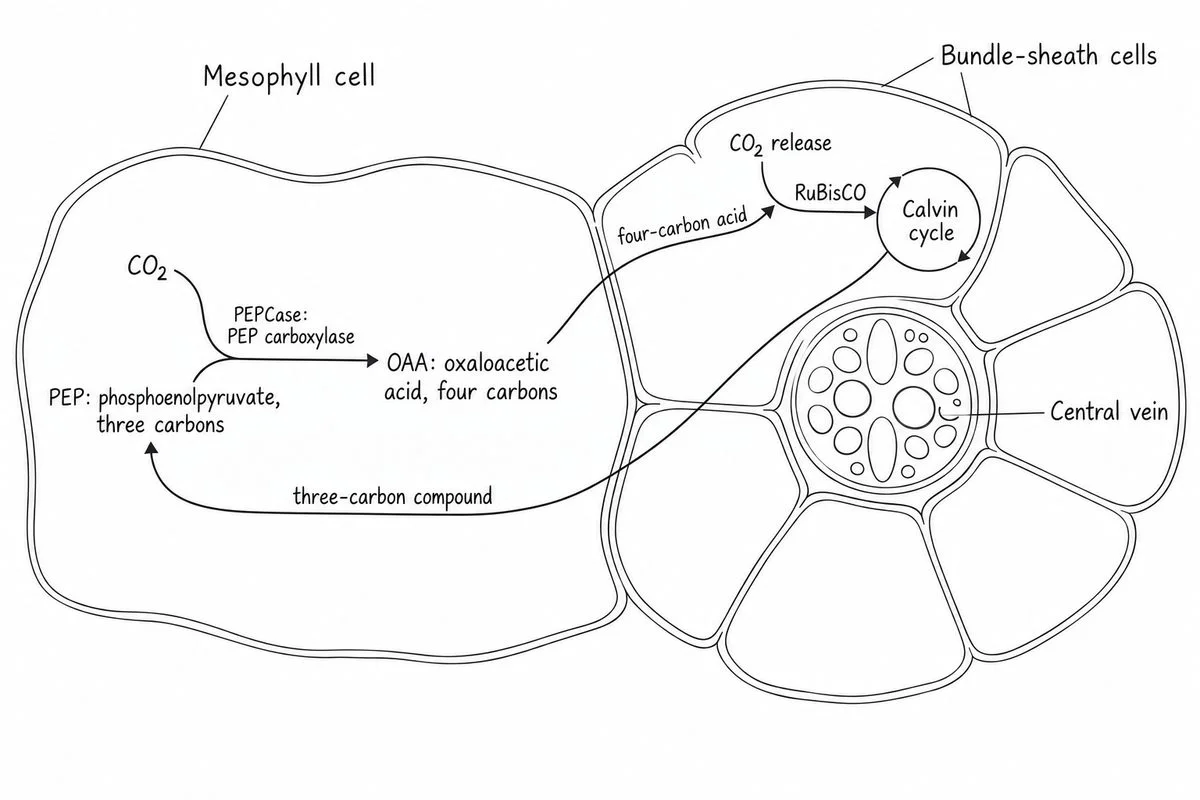
Labelled pencil sketch traces carbon delivery between mesophyll and bundle-sheath cells around a vein.

7. The C₄ Pathway and Photorespiration

Separate cells concentrate carbon dioxide around RuBisCO.

Show
Find the vein, surrounding bundle-sheath cells and outer mesophyll cell in the diagram. Trace four-carbon delivery inward and three-carbon return outward. Point to CO₂ release beside RuBisCO.
Ask
Will added CO₂ favour RuBisCO binding CO₂ or oxygen?
Say
Four-carbon acids release carbon dioxide beside RuBisCO in bundle-sheath cells. More carbon dioxide around it favours carbon fixation over photorespiration.
Used in
Reduced photorespiration helps C₄ crops retain carbon for growth.
If your child says…“The Calvin cycle runs in C₄ mesophyll cells.”
Ask
Where does the delivered carbon dioxide reach RuBisCO in this diagram?
What’s true
Mesophyll cells capture carbon first; bundle-sheath cells carry out the Calvin cycle.
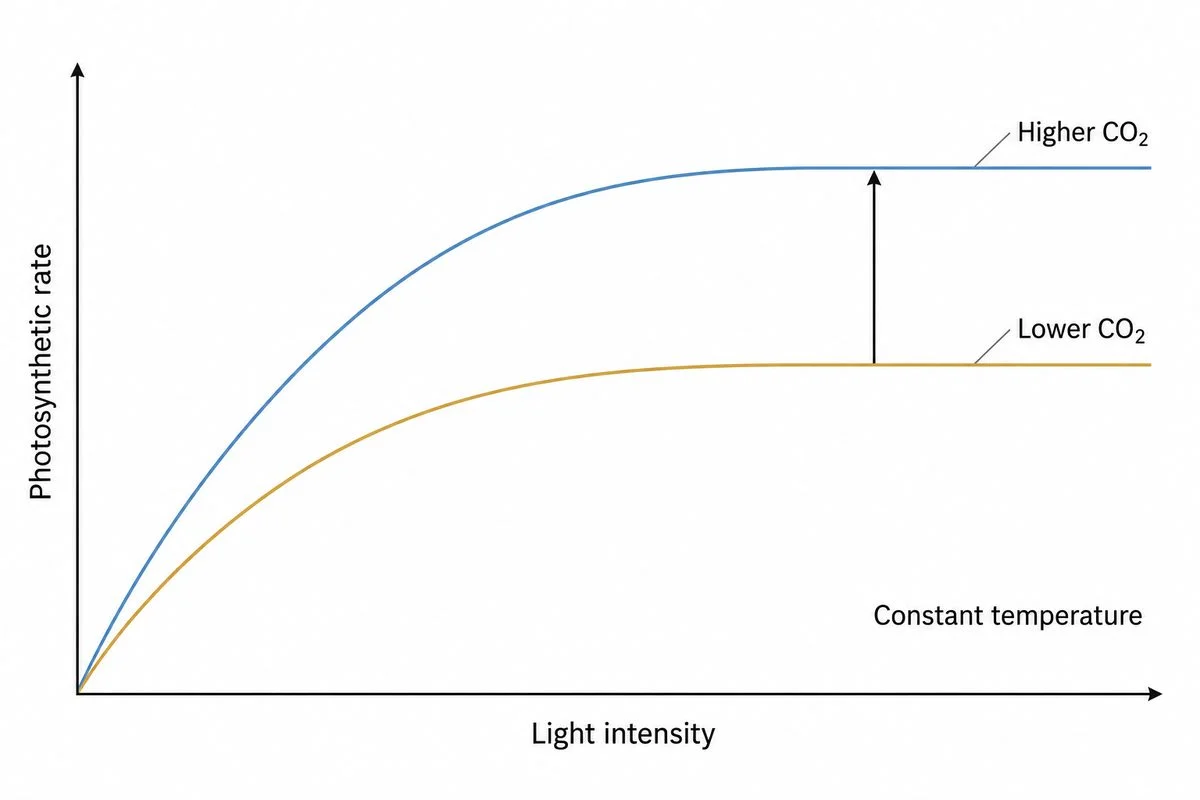
Two light-response curves show a higher plateau when carbon dioxide increases at constant temperature.

8. Factors affecting Photosynthesis

The greatest shortage relative to plant needs limits photosynthesis.

Show
Look at the diagram with the higher-CO₂ curve covered. Follow the lower-CO₂ curve to its plateau. After the prediction, uncover the other curve.
Ask
At this plateau, what could extra carbon dioxide change when extra light cannot?
Say
Extra carbon dioxide raises the rate here, while extra light does not. This controlled comparison shows that carbon dioxide was limiting. A plateau alone cannot identify the limiting factor.
Used in
Irrigation reduces water stress, helping leaves keep taking in carbon dioxide.
If your child says…“More light always means more photosynthesis.”
Ask
At the same high light intensity, which curve has the higher rate?
What’s true
At this plateau, extra light cannot overcome the carbon dioxide shortage.

A real problem

Fresh lettuce grew aboard the space station.

The growing chamber aimed to give astronauts fresh leafy vegetables.

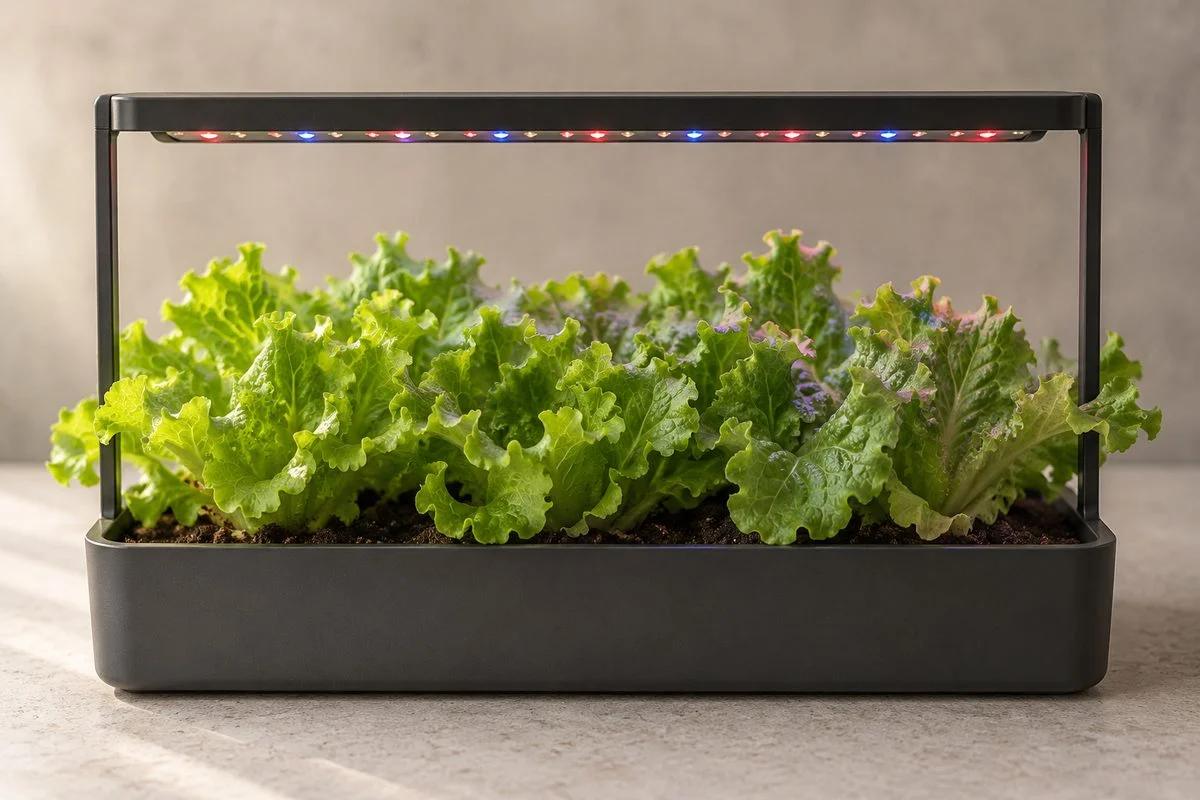
Its LED lights supplied red, blue and green light.

Red and blue illumination supported photosynthesis.

In 2015, astronauts ate lettuce grown aboard the International Space Station.

Smithsonian MagazineThe ObserverNASA

Leafy lettuce growing in a tray beneath red and blue lights.

Concept Lab · Common misconception

The tempting mistake in Plant Physiology

Open standalone misconception page →

Does doubling light always double the rate of photosynthesis?

Wrong

If light intensity doubles, the rate of photosynthesis must double at every light level.

Why it feels right. More light helps under dim conditions, so I extend that relationship.

Right

Another resource or process can limit photosynthesis when light is abundant.

Worked example

With low CO₂ the schematic rate curve rises in dim light and then plateaus. More light alone brings little change on that plateau.
  1. Imagine a leaf at constant temperature and low CO₂.
  2. Raising dim light initially increases the rate.
  3. After the rate plateaus, more light alone has little effect.
  4. Raising CO₂ can increase the rate if CO₂ was limiting.

Ask your child eight quick questions.

One per step. The answer and the reason are given.

  1. After destarching and time in light with carbon dioxide, which patches should remain starch-free?

    The white patches. They lack the green tissue needed for photosynthesis.

  2. What happens to sugar-making when its ATP and NADPH supplies run out?

    It stops. Carbon reactions depend on both supplies, even though light does not drive them directly.

  3. Why can leaves use light that chlorophyll a absorbs poorly?

    Other pigments absorb it. They pass absorbed energy to reaction-centre chlorophyll a.

  4. What does cyclic electron flow produce?

    ATP only. Electrons return to PSI without reducing NADP⁺ or splitting water.

  5. In which direction do protons flow through ATP synthase while ATP forms?

    From lumen to stroma. Their return flow releases energy from the proton difference.

  6. What must be rebuilt before the cycle can keep accepting carbon dioxide?

    RuBP. RuBP accepts incoming carbon dioxide and must be regenerated.

  7. Which cells run the Calvin cycle in a C₄ leaf?

    Bundle-sheath cells. Four-carbon compounds deliver carbon dioxide there for fixation by RuBisCO.

  8. At the same high light intensity, which increased supply explains the graph’s higher rate?

    Carbon dioxide. More light cannot remove the carbon dioxide shortage.

15 more questions with answers, 9 with pictures