Skip to content

Teach Body Fluids and Circulation in eight steps.

For each idea: show it, ask before you tell, then say one line.

Gather paper, a pencil, a timer and a chair beside a clear walking space.

Common misconceptions & worked visual for this chapter · 15 practice questions with answers

How to teach it

Blood and lymph

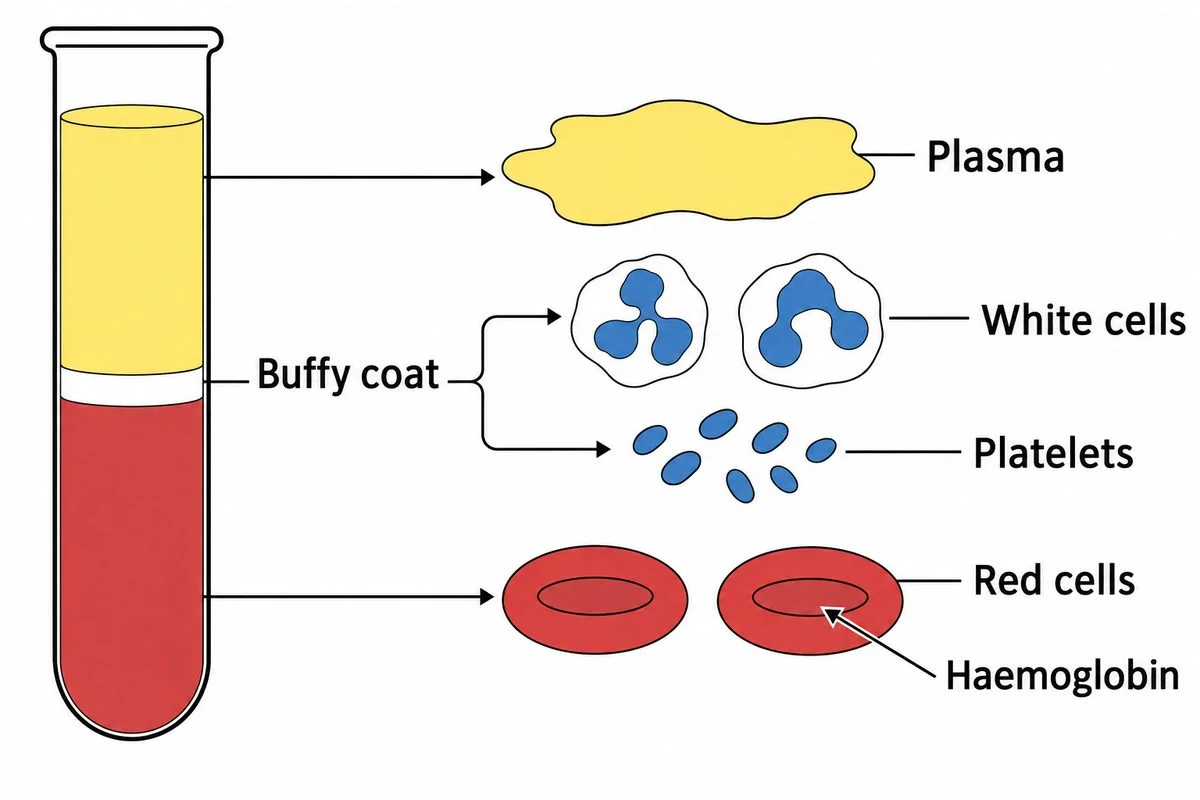
Separated blood layers connect to enlarged red cells, white cells and platelets.

1. Blood

Plasma carries dissolved substances alongside cells and clotting fragments.

Show
Look at the separated blood tube in the diagram. Follow its layers to the enlarged components. Find haemoglobin inside the red cells.
Ask
If these red cells lacked haemoglobin, what would happen to their oxygen transport?
Say
Red cells carry oxygen using haemoglobin, so without it they could not carry oxygen.
Used in
Red-cell transfusions help restore oxygen transport.
If your child says…“Platelets carry oxygen.”
Ask
Which cells in the diagram contain haemoglobin?
What’s true
Haemoglobin belongs in red cells, while platelets help blood clot.
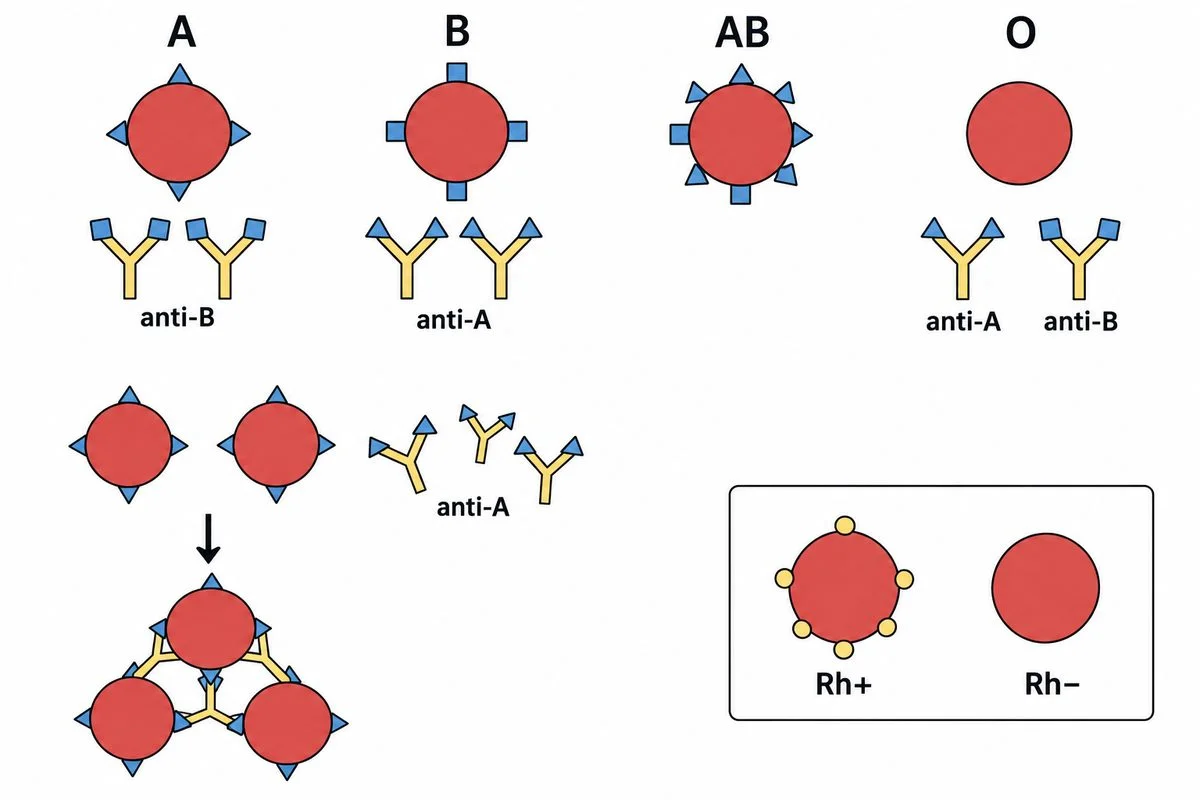
ABO antigens and antibodies, an incompatible cell cluster, and contrasting Rh cells.

2. Blood Groups

Cell antigens and plasma antibodies determine blood compatibility.

Show
Look at the diagram’s ABO columns: find cell antigens above and plasma antibodies below. Cover the lower clump, then find the separated A cells and anti-A. Compare the Rh+ and Rh− cells.
Ask
What could happen when anti-A meets these A-marked donor cells?
Say
Anti-A can link A-bearing donor cells, making them clump.
Used in
Blood typing and cross-matching reduce dangerous transfusion reactions.
If your child says…“Rh-negative blood already has anti-Rh.”
Ask
Without earlier exposure, what would have triggered anti-Rh production?
What’s true
Rh-negative people make anti-Rh only after exposure; preventive anti-Rh treatment helps prevent their own antibody production.
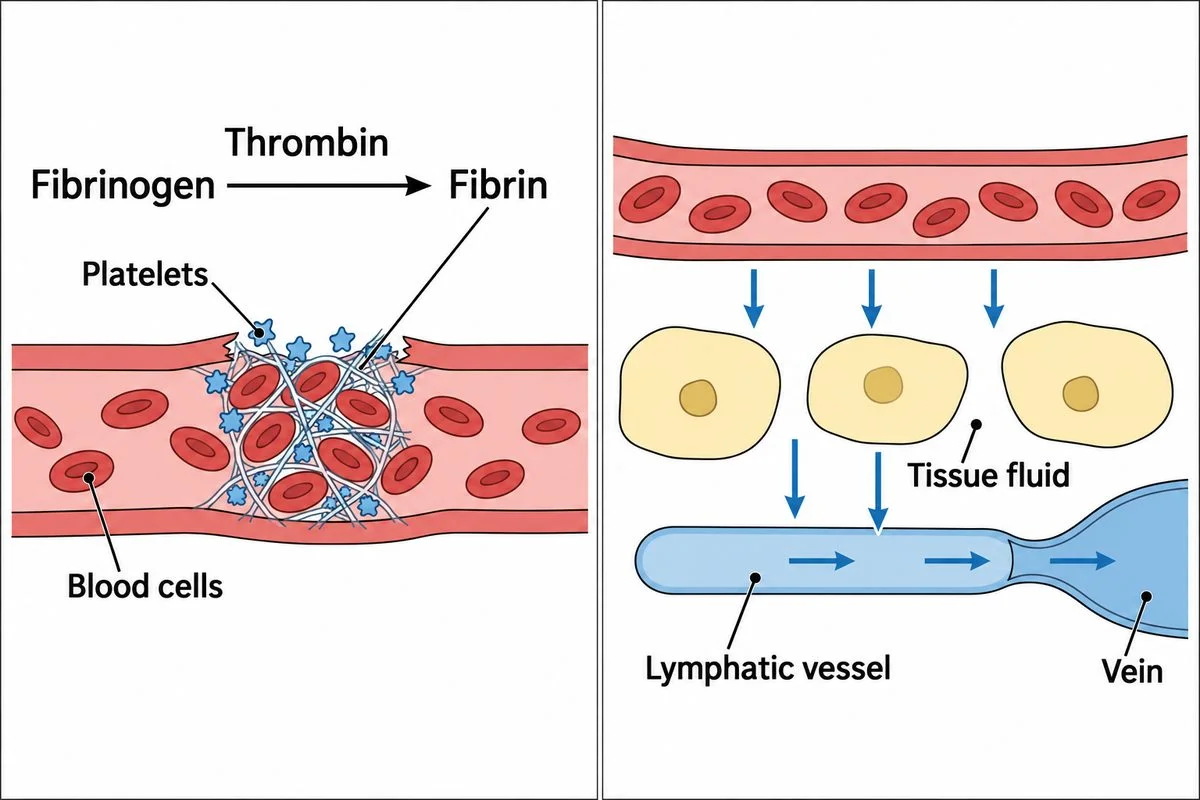
Fibrin seals a vessel break; a separate panel traces tissue fluid returning through lymph.

3. Coagulation of Blood and Lymph

Clots limit bleeding; lymph returns fluid and carries other substances.

Show
Find platelets and fibrin at the damaged vessel in the diagram. Trace the change from fibrinogen to fibrin. Follow tissue fluid into the lymphatic vessel, then towards the vein.
Ask
Without thrombin, could this fibrin mesh form to limit bleeding?
Say
No; after injury, thrombin turns fibrinogen into fibrin, whose threads trap blood cells. Lymph vessels return excess tissue fluid to blood.
Used in
Lymph returns escaped fluid and proteins to the blood.
If your child says…“Fibrinogen makes thrombin.”
Ask
Which must form before fibrinogen can become fibrin?
What’s true
Thrombokinase helps convert prothrombin into thrombin, which then converts fibrinogen into fibrin.

The heart and circulation

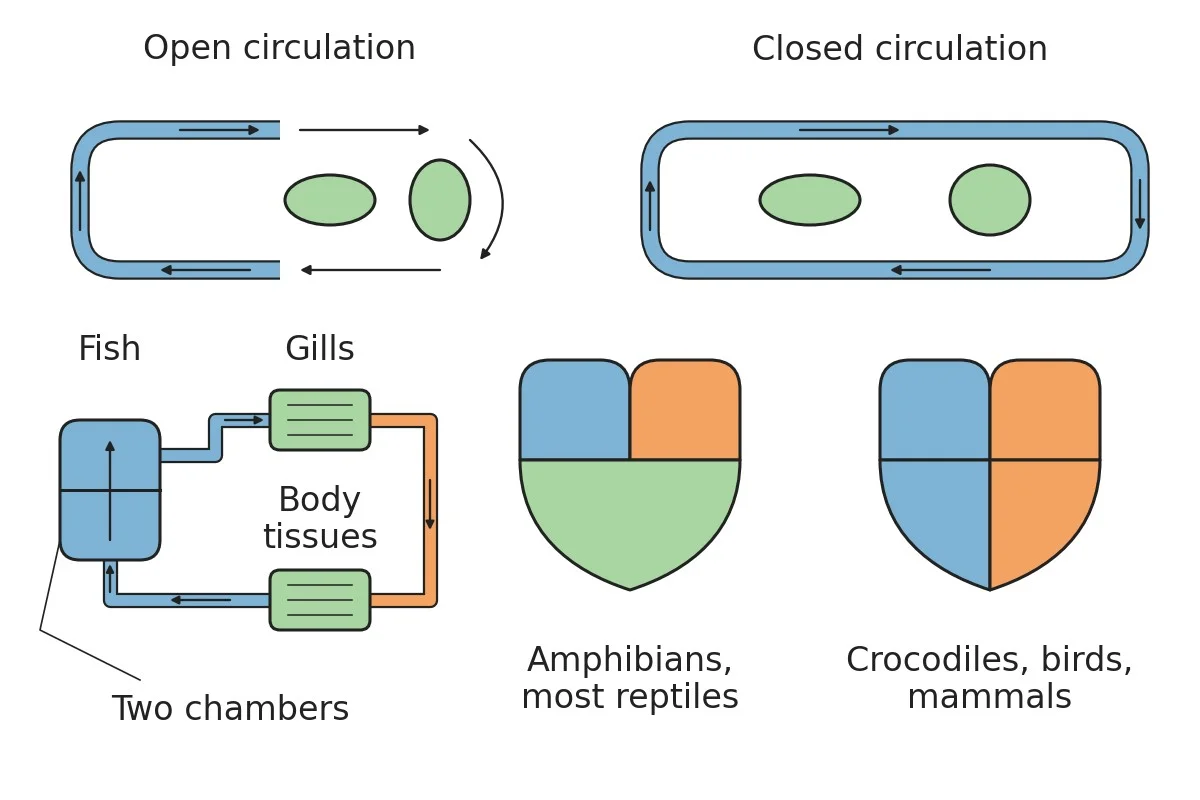
Diagram compares vessel routes and heart chambers, including the fish circuit.

4. Circulatory Pathways

Open circulation bathes organs. Circuits cross the heart once or twice.

Show
Compare the open and closed vessel routes in the diagram. Count each heart’s chambers. Trace the fish route through gills and tissues back to the heart.
Ask
Will this closed circuit pass through the heart once or twice?
Say
Closed circulation keeps blood in vessels; a fish circuit passes through its heart once. Open circulation releases blood into spaces around organs.
Used in
Closed circulation allows more precise control of blood flow.
If your child says…“Every vertebrate has four heart chambers.”
Ask
How many chambers does the fish outline contain?
What’s true
Fish have two chambers, amphibians and most reptiles three, and crocodiles, birds and mammals four.
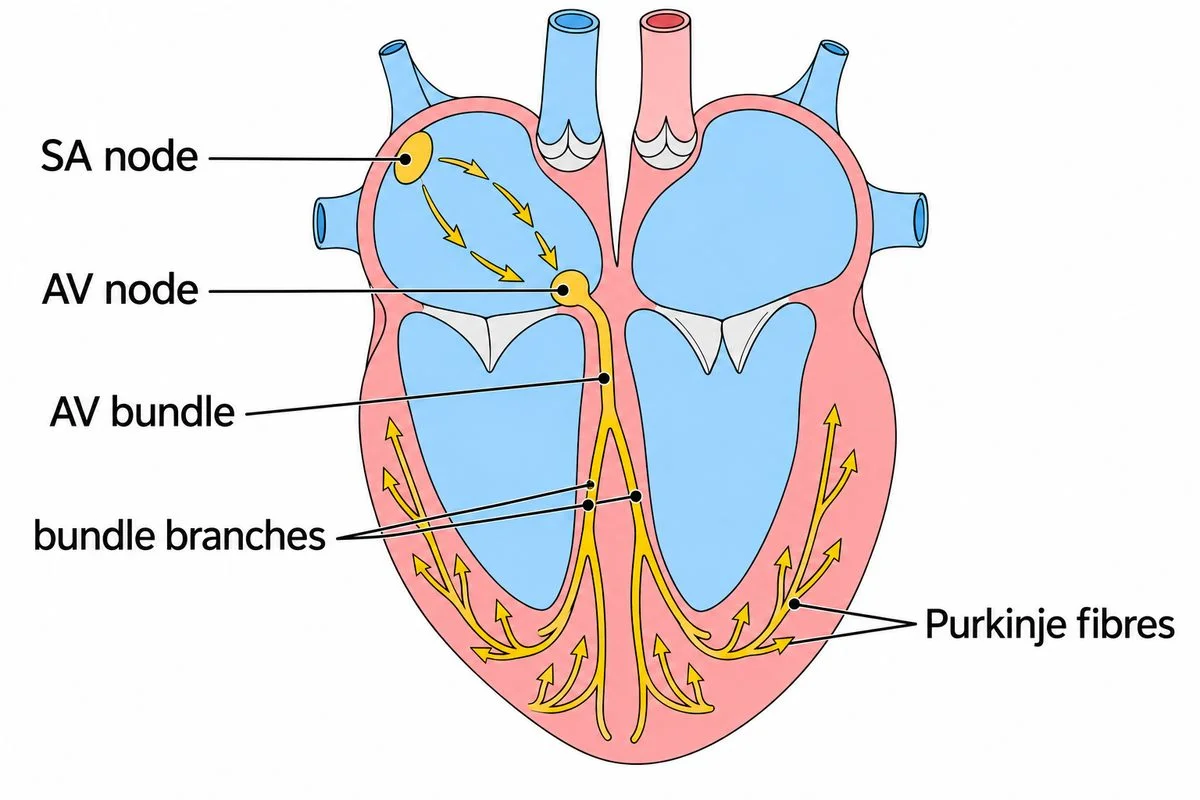
Heart diagram shows valves, thicker ventricular walls and the labelled conduction route.

5. Human Circulatory System

Heart chambers pump, valves prevent backflow, and nodal tissue coordinates beats.

Show
Find the heart’s right side on the diagram’s left. Trace SA node, AV node, AV bundle, bundle branches and Purkinje fibres.
Ask
Where will the next beat’s signal begin?
Say
The SA node starts the signal that reaches the ventricles.
Used in
Artificial pacemakers help maintain a heartbeat when its natural rhythm is too slow.
If your child says…“The AV node starts each beat.”
Ask
Which node comes first along the route you traced?
What’s true
The SA node initiates the beat, and the AV node passes its signal onwards.
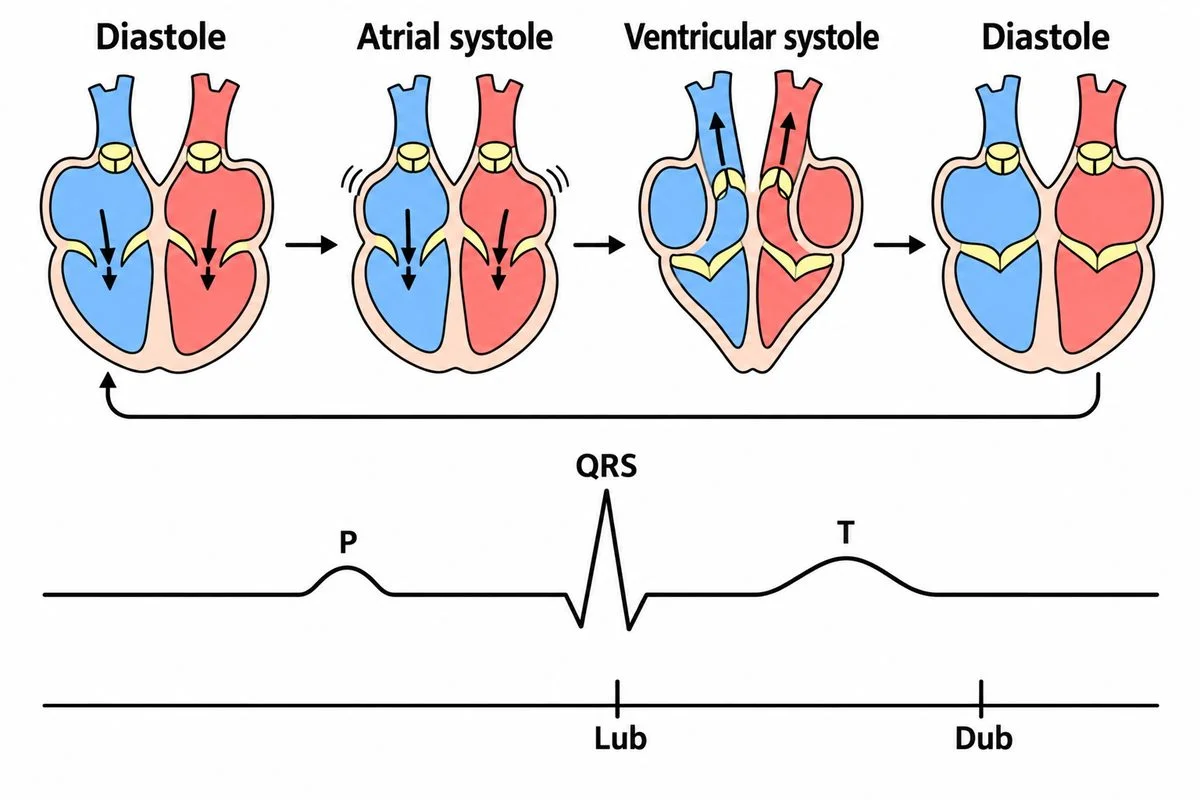
Heart phases align with electrical waves and separate markers for valve-closure sounds.

6. Cardiac Cycle and Electrocardiograph

Each beat involves filling, contraction, valve sounds and electrical changes.

Show
Read the heartbeat sequence in the diagram, then follow the ECG below. Find lub at atrioventricular closure and dub at semilunar closure.
Ask
When the valves shown close and produce lub, will the ECG record that sound?
Say
No; ECGs record electrical changes that coordinate contraction and relaxation. Atria contract before ventricles, while valve closures produce lub and dub.
Used in
ECGs help doctors assess heart rhythm.
If your child says…“An ECG records lub and dub.”
Ask
Would a recording of electrical changes be a recording of valve sounds?
What’s true
P marks atrial excitation, QRS ventricular excitation, and T ventricular recovery.
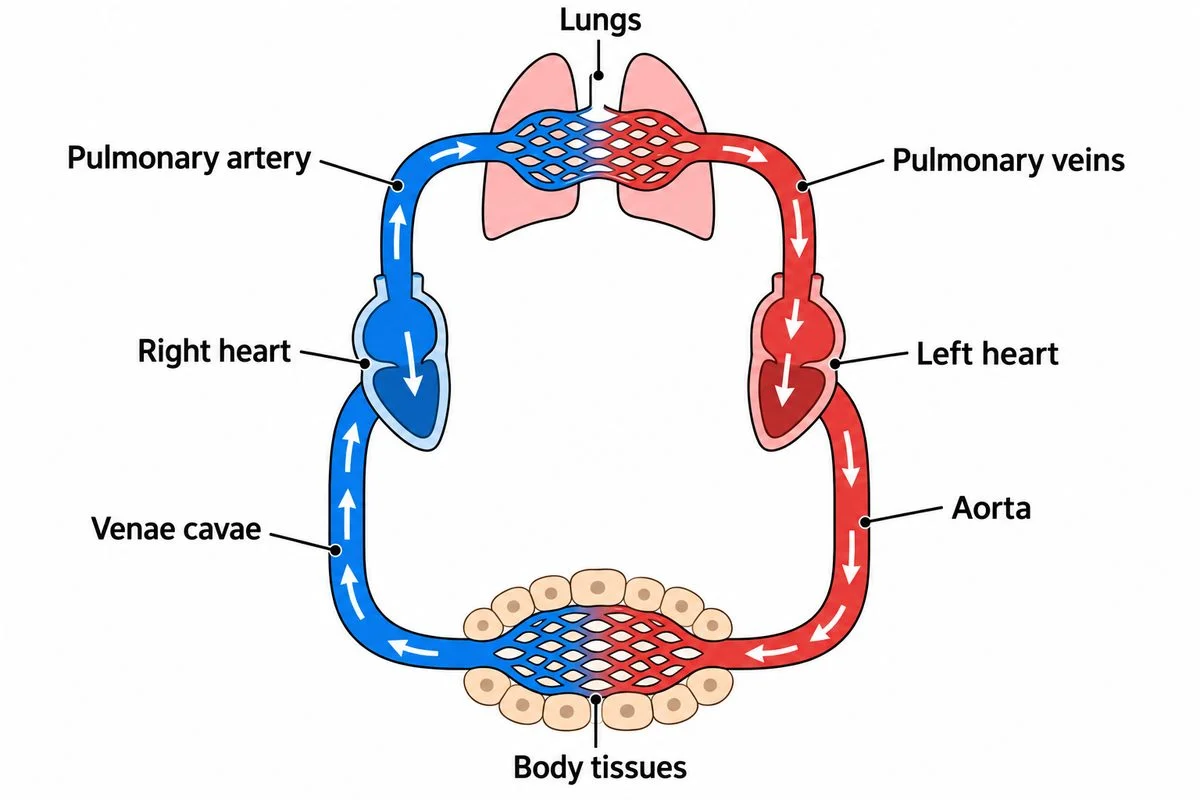
Two connected circuits carry blood between the heart, lungs and tissues.

7. Double Circulation

Blood passes through the heart twice during one complete circuit.

Show
Trace the diagram’s arrows from right heart through lungs, left heart, tissues and back.
Ask
Why must blood leaving these lungs return to the heart?
Say
The left heart pumps returning blood around the body. Blood crosses the heart twice per circuit.
Used in
Coronary vessels supply heart muscle with oxygen so it can keep pumping.
If your child says…“Every artery carries oxygen-rich blood.”
Ask
Which direction defines an artery on this route?
What’s true
The pulmonary artery carries oxygen-poor blood towards the lungs.

Heart regulation and disorders

A chair holds a timer beside a clear walking space.

8. Regulation of Cardiac Activity and Disorders of Circulatory System

Nerves adjust the heart’s rhythm; disorders affect its supply or pumping.

Show
Count wrist pulses for 15 seconds while seated. Walk comfortably for one minute. Repeat the count immediately, then after resting.
Ask
How will your pulse count change after walking?
Say
Your pulse count will usually increase after walking.
Used in
Repeated blood-pressure measurements help detect persistently high pressure.
If your child says…“Heart failure, arrest and attack all mean the heartbeat stops.”
Ask
If a heart still beats but pumps too little, which condition fits?
What’s true
Failure means inadequate pumping, arrest means stopped beating, and attacks damage heart muscle through inadequate blood supply.

A real problem

Compatibility testing helped make blood transfusions safer.

Clumping blood cells made early transfusions dangerous.

In 1907, Reuben Ottenberg performed the first transfusion using blood typing and cross-matching.

Safe transfusions depend on checking blood types and cross-matching donor and patient blood.

Rockefeller UniversityAmerican Red CrossAmerican Red Cross

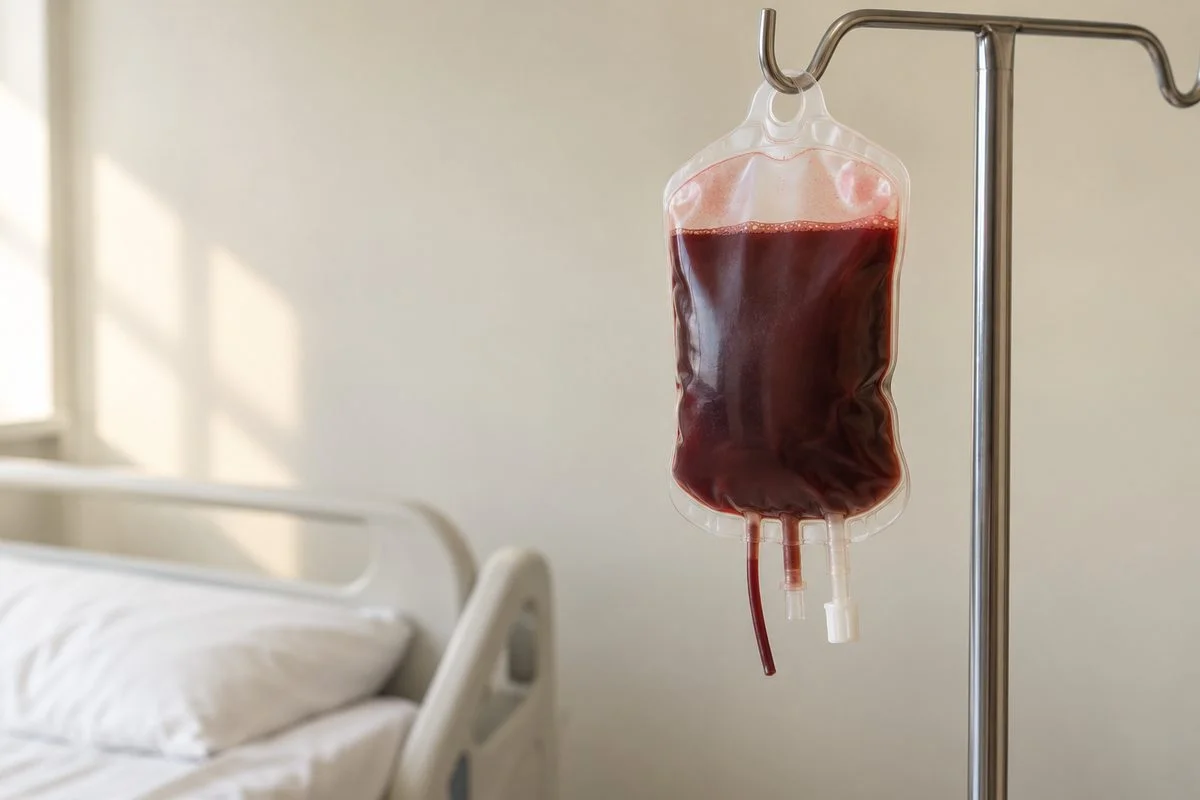
A blood bag hangs beside an empty hospital bed.

Concept Lab · Common misconception

The tempting mistake in Body Fluids and Circulation

Open standalone misconception page →

Do arteries always carry oxygenated blood?

Wrong

Every artery carries oxygen-rich blood.

Why it feels right. Most arteries in the body carry oxygen-rich blood.

Right

An artery carries blood away from the heart.

Worked example

Blood path
Right ventricle→Pulmonary artery · low O₂→Lungs
The pulmonary artery carries blood away from the heart, even though the blood is low in oxygen.
  1. Follow the pulmonary artery from the right ventricle to the lungs.
  2. It carries oxygen-poor blood away from the heart.

Ask your child eight quick questions.

One per step. The answer and the reason are given.

  1. Which blood component carries oxygen using haemoglobin?

    Red blood cells. Platelets help clotting and contain no haemoglobin.

  2. What must happen before an Rh-negative person develops anti-Rh antibodies?

    Exposure to Rh-positive blood. Anti-Rh antibodies develop after exposure, rather than being present from birth.

  3. What acts on fibrinogen to produce fibrin?

    Thrombin. Prothrombin becomes thrombin before thrombin acts on fibrinogen.

  4. How many chambers does a fish heart have?

    Two. Four chambers occur in crocodiles, birds and mammals, rather than every vertebrate.

  5. Which node normally initiates the heartbeat?

    The SA node. The AV node relays the signal rather than normally starting it.

  6. What does an ECG record?

    The heart’s electrical activity. Valve closures produce sounds, while an ECG traces electrical changes.

  7. Why is the oxygen-poor vessel leaving the right ventricle called an artery?

    It carries blood away. Direction relative to the heart defines arteries, rather than oxygen content.

  8. Which condition means the heart still beats but pumps too little blood?

    Heart failure. Failure describes inadequate pumping, while cardiac arrest means the heart stops beating.

15 more questions with answers, 9 with pictures